
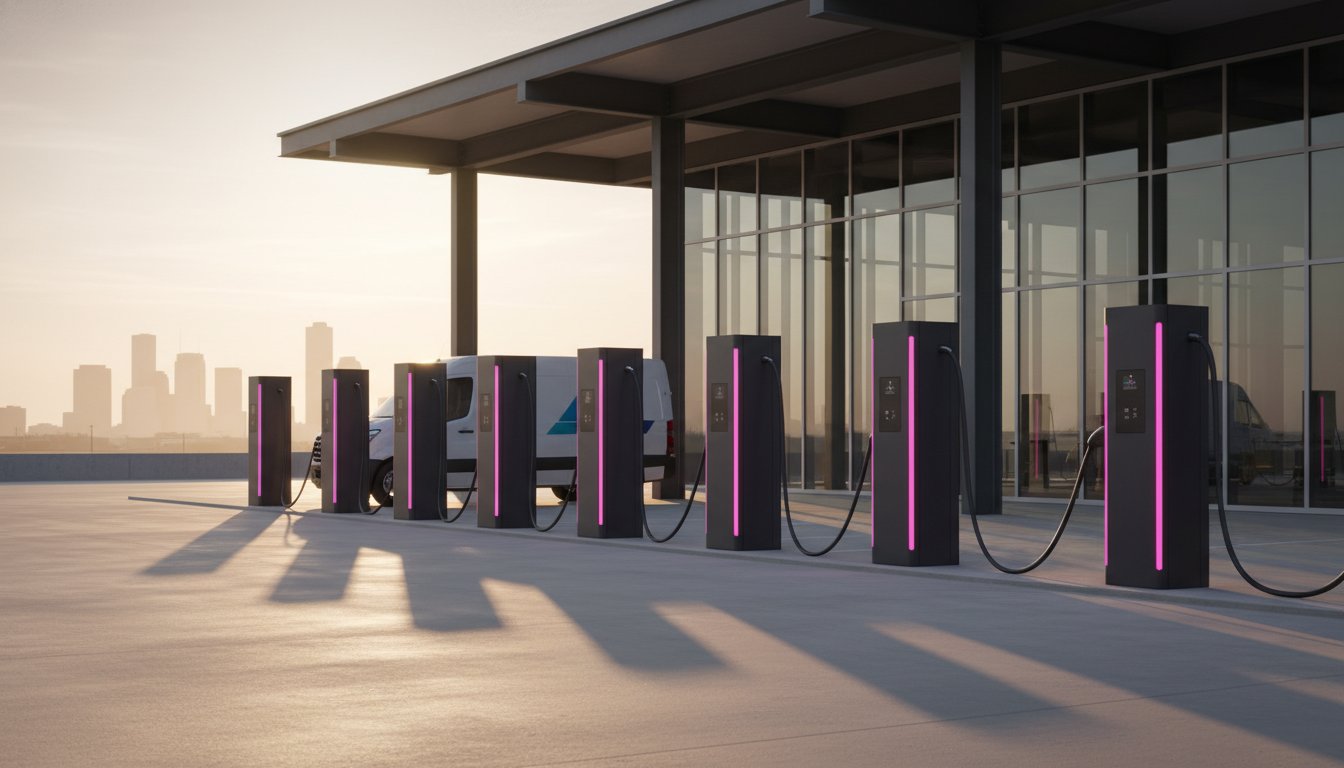
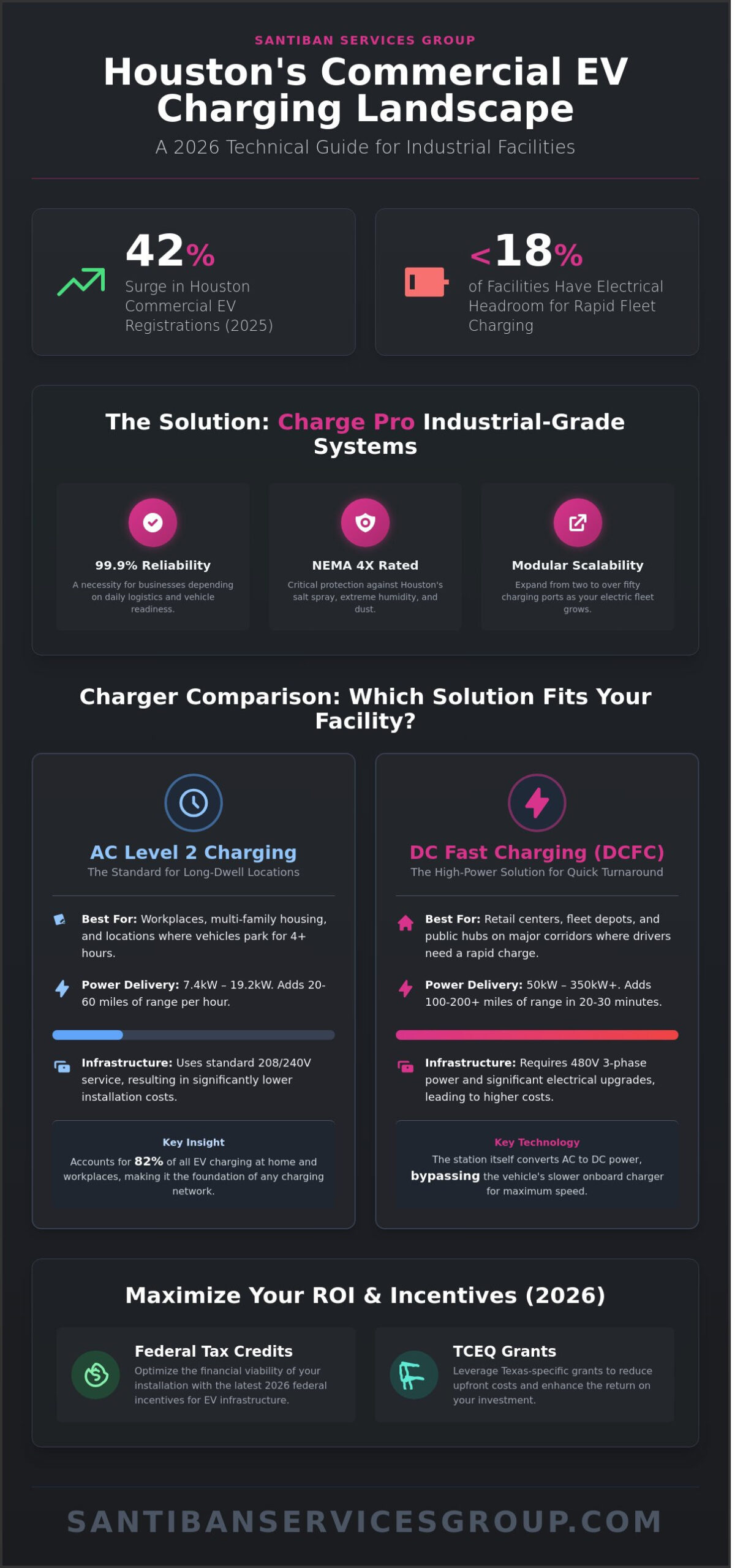
While Houston commercial EV registrations surged by 42 percent in 2025, fewer than 18 percent of local industrial facilities currently possess the electrical headroom to support rapid fleet electrification. Property managers recognize that maintaining operational continuity during a Texas summer requires more than just hardware; it demands a sophisticated approach to power management. Integrating a charge pro charging station into your facility provides the high-capacity reliability necessary to meet these escalating demands. Santiban Services Group understands that your infrastructure must function as a silent engine, supporting your business goals without interruption.
You likely understand that navigating Houston’s evolving 2026 permitting landscape requires precision and technical expertise. This guide provides a meticulous analysis of technical specifications and validates the infrastructure requirements for industrial-grade installations. We offer a clear roadmap for a compliant, seamless deployment that prioritizes safety and long-term performance. You’ll gain the technical clarity needed to transform your facility into a high-performance EV hub while ensuring every operational detail remains under expert control.
Key Takeaways
- Understand how industrial-grade hardware and NEMA 4X ratings ensure reliable performance within Houston’s specific environmental conditions.
- Differentiate between Level 2 and DC Fast Charging solutions to determine the most effective power delivery model for your commercial business or fleet.
- Evaluate Houston’s infrastructure requirements and the CenterPoint Energy approval process to facilitate a seamless, high-capacity electrical integration.
- Identify the latest 2026 federal tax credits and TCEQ grants available to optimize the ROI of your charge pro charging station installation.
- Leverage professional implementation strategies from industry experts to ensure meticulous safety standards and long-term operational stability.
What is a Charge Pro Charging Station?
The charge pro charging station stands as the premier industrial-grade solution for commercial EV infrastructure in 2026. It’s designed to meet the rigorous demands of fleet operations and high-traffic commercial properties where consistent power delivery is mandatory. Santiban Services Group prioritizes this system because it delivers a 99.9% reliability rate, a necessity for businesses that depend on vehicle readiness for daily logistics. The hardware features a NEMA 4X rating, providing a critical layer of protection against the specific environmental challenges of the Houston area, including heavy salt spray and extreme humidity.
Choosing this system allows facility managers to deploy a complete charging strategy without the friction of managing fragmented software platforms. The manufacturer provides a turnkey ecosystem that combines rugged hardware with seamless software integration. This setup ensures that technical teams don’t have to navigate disparate vendors to maintain their charging network. Since the system’s universal compatibility supports 100% of current EV models on the road, it protects the long-term value of the capital investment.
Core Components of the Charge Pro System
At the core, the physical station utilizes impact-resistant polymers and reinforced steel to withstand heavy industrial use. Inside the housing, intelligent controllers facilitate dynamic load balancing, which prevents electrical circuit overloads during peak charging periods. Users interact with the system through an intuitive interface that includes secure RFID authentication and integrated payment processing for public or tenant-based billing.
A high-quality electric vehicle charging station serves as more than just a power source; it acts as a sophisticated data hub. The Charge Pro system connects to cloud-based management software that offers real-time monitoring of energy consumption. This allows property managers to track precise usage data for internal auditing or carbon footprint reporting, ensuring every kilowatt is accounted for.
Why Businesses Choose Charge Pro in 2026
Because scalability is essential for modern enterprises, the charge pro charging station allows for modular expansion. Organizations can start with a modest installation of two ports and expand to a network of fifty or more as their electric fleet grows, all managed through a single dashboard. This flexibility is vital for property managers who must adapt to the increasing density of EVs in the Houston market.
Reliability in harsh conditions remains a primary reason for the platform’s popularity. The hardware is specifically engineered for the Gulf Coast, where summer temperatures regularly exceed 100 degrees Fahrenheit and humidity levels hit 90 percent. Internal thermal management systems ensure the electronics don’t overheat or derate during high-speed charging sessions. Customization options also allow businesses to apply corporate branding and logos to the exterior, turning a functional utility into a professional extension of the company’s identity.
Comparing Level 2 and DC Fast Charge Pro Solutions
Selecting the appropriate electrical infrastructure requires a meticulous analysis of vehicle dwell times and existing power availability. The distinction between Alternating Current (AC) Level 2 and Direct Current (DC) Fast Charging centers on where the conversion from AC to DC occurs. Level 2 systems rely on the vehicle’s onboard charger to convert power, while DCFC stations convert power internally to deliver high-voltage energy directly to the battery. Santiban Services Group provides a comprehensive suite of options, ensuring every charge pro charging station aligns with the facility’s specific operational demands and safety protocols.
Level 2 Charging for Workplaces and Multi-Family
Level 2 stations deliver power ranging from 7.4kW to 19.2kW. These units represent the standard for Houston office parks and multi-family developments where vehicles remain stationary for eight hours or longer. Because these systems utilize standard 208V or 240V electrical service, the infrastructure costs remain significantly lower than high-voltage alternatives. Property managers favor this model to provide a steady, reliable service without overhauling the entire building’s electrical backbone. As of January 2024, industry data indicates that 82% of EV charging occurs at home or work, making Level 2 the foundation of a stable charging network.
DC Fast Charging for Retail and Fleet Hubs
Retail centers and logistics hubs near major Houston thoroughfares like I-45 or the 610 Loop require rapid energy delivery to maintain site throughput. DC Fast Charging solutions offer capabilities between 50kW and 350kW, facilitating a 10% to 80% charge in under 30 minutes. This speed requires a robust electrical upgrade, often involving new transformers and 480V three-phase service to manage the increased load. High-capacity installations must account for demand charges on a facility’s power bill. These fees can increase operational costs if not managed through a strategic energy plan. Leveraging Texas EV infrastructure incentives helps offset these initial capital expenditures, allowing for a more aggressive rollout of high-speed hardware.
Santiban Services Group implements a hybrid infrastructure approach to meet diverse needs. We integrate various speeds within a single site to maximize utility and user satisfaction. This tailored strategy ensures that a charge pro charging station is available for both the quick-turnaround fleet vehicle and the long-duration employee car. Our dedicated teams handle the entire project lifecycle, from initial load calculations to final safety inspections. If your facility requires a professional assessment of its power capacity, our consultants provide integrated electrical evaluations to guide your transition.
Houston Infrastructure Requirements for EV Charging
Facility managers frequently question whether their existing 480V service can support the heavy draw of a charge pro charging station. In the Houston metro area, this evaluation begins with CenterPoint Energy. They oversee the approval process for new commercial interconnections to ensure the local grid maintains stability. Proactive coordination with the utility is essential; failing to secure their load approval often results in immediate project delays or permit denials from the City of Houston. Industrial-grade electrical construction is a requirement for these installations because EV chargers operate as continuous loads. Under the National Electrical Code (NEC) Article 625, these circuits must be sized at 125% of the equipment’s maximum current rating. This standard prevents thermal fatigue in components that run at high capacity for 10 or 12 hours straight.
Property owners should consult the latest Texas EV incentives and regulations to find utility programs that may subsidize these infrastructure upgrades. To avoid the massive expense of a full transformer replacement, we implement integrated load management systems. These digital controllers monitor the building’s total demand in real time. If the facility approaches its peak capacity during a Houston summer afternoon, the system throttles the power sent to the chargers. This protective measure ensures the main breakers don’t trip while still providing a steady charge to the fleet. For a comprehensive breakdown of how these technical load specifications and CenterPoint Energy interconnect standards affect your project budget, our ChargePro EV charging commercial and industrial roundup details the full scope of 2026 requirements and cost-saving strategies.
The Necessity of PE-Stamped Engineering Design
Houston’s building codes require a Professional Engineer (PE) to sign and seal electrical plans for any commercial project involving significant power distribution. A PE-stamped engineering for solar systems and EV infrastructure provides a meticulous roadmap for safety. This design process includes a formal fault current analysis and a coordination study to verify that the charge pro charging station won’t compromise the building’s safety systems. Skipping professional engineering is a liability that leads to fire hazards and the loss of insurance coverage if an unpermitted system fails.
Site Preparation and Industrial Construction
Physical installation in the Gulf Coast region demands specific civil engineering considerations. We utilize 24-inch deep trenching and schedule 40 PVC conduit to protect underground feeders from moisture. Because Houston’s soil consists of expansive clay that’s often saturated, proper grounding is a top priority. We install supplemental ground rods to ensure the resistance to ground remains below 25 ohms, protecting sensitive electronics from surges. Large-scale DC fast charging hubs typically require 480V three-phase power and dedicated step-down transformers. Every pedestal is mounted on a 3,000 PSI concrete pad and protected by 6-inch steel bollards to prevent accidental vehicle impact in high-traffic loading zones.
Maximizing ROI and Incentives for Texas EV Infrastructure
Strategic investment in electric vehicle infrastructure transforms a facility from a standard industrial site into a high-yield asset. The federal Alternative Fuel Vehicle Refueling Property Credit, currently extended through December 31, 2026, provides a robust tax credit of 30% for commercial installations. This incentive caps at $100,000 per charge pro charging station or localized system, which significantly offsets the initial capital expenditure. In the Texas market, the Texas Commission on Environmental Quality (TCEQ) offers additional financial relief through the Texas Emissions Reduction Plan (TERP). These grants target nitrogen oxide reduction and frequently cover up to 80% of the costs for heavy-duty charging infrastructure in non-attainment areas like the Houston-Galveston-Brazoria region.
Property owners in the Houston area see a direct correlation between advanced amenities and asset valuation. Data from 2023 commercial real estate analysis indicates that Class A office and industrial spaces equipped with EV charging command a 3% to 5% premium in lease rates compared to unequipped competitors. Beyond property value, the “Charging as a Service” (CaaS) model enables owners to generate recurring revenue. By setting specific fee structures for tenants or the public, a charge pro charging station typically pays for itself within 42 months of average utilization.
Utility Rebates and Demand Response Programs
Local retail electric providers (REPs) in the CenterPoint Energy service area offer specific rebates for peak load management and infrastructure readiness. Integrating a Tesla Powerwall 3 installation in Houston allows facilities to store energy during low-cost, off-peak windows. This strategy effectively “shaves” peak demand charges, which often account for 40% of a monthly industrial utility bill. Battery storage ensures that high-draw EV charging events don’t trigger expensive demand tiers or strain the local grid during periods of high volatility.
Operational Savings and Tenant Retention
Retaining high-value tenants requires meeting the logistical needs of a modern workforce. Recent surveys show that 85% of EV owners prefer charging at their place of employment or primary commercial hubs. Providing this service fosters long-term lease stability and attracts sustainability-focused corporate partners to your portfolio. For companies managing internal logistics, switching a light-duty fleet to electric reduces fuel and maintenance costs by approximately $1,200 per vehicle annually. Santiban Services Group provides the technical expertise to ensure these systems operate with 99.9% uptime, protecting both your reputation and your bottom line.
Professional Implementation: The Santiban Approach
Santiban Services Group stands as the authoritative partner for deploying the charge pro charging station within the Texas industrial sector. Our firm brings 24 years of specialized experience to every project, providing a stable foundation for complex energy transitions. We manage the entire lifecycle of the deployment, moving from the conceptual engineering phase to physical installation without the typical hand-off errors seen in multi-vendor projects. This seamless integration protects your capital investment and ensures that your facility meets all regulatory requirements from day one.
Our role as a high-end strategic partner involves more than simple labor. We act as a silent engine for your facility, ensuring that your power distribution systems are robust enough to handle new technological demands. Industrial environments require a level of precision that standard commercial contractors often fail to provide. By choosing an established partner, you gain access to a disciplined team that values long-term reliability over temporary fixes.
Excellence in Every Detail: Our Process
Our methodology follows a rigorous four-stage workflow designed for maximum efficiency and technical accuracy. Every project begins with a comprehensive site audit to evaluate current load capacity and identify necessary infrastructure upgrades. Following the audit, our licensed professional engineers produce a meticulous PE Design, which moves directly into the municipal permitting phase. The final stage is physical construction. Our industrial electrical construction services focus on minimizing business downtime through strategic planning.
- Site Audit: We verify existing switchgear capacity and analyze historical load profiles to prevent system overloads.
- PE Design: Our engineers create blueprints that prioritize both safety and future scalability.
- Permitting: We handle all documentation and coordination with local authorities to prevent project delays.
- Construction: Our dedicated teams execute the build with surgical precision, often maintaining 100% operational continuity for the client.
We maintain a relentless focus on safety and adherence to the National Electrical Code (NEC). By strictly following these standards, we eliminate the liability risks associated with substandard installations. Our crews are trained to work within active industrial environments, respecting your operational boundaries while delivering superior results.
These principles of safety and code-adherence are vital for any electrical contractor. While this guide focuses on Houston, readers on the East Coast seeking similar expertise can find a reliable partner in Conductive Electrical Contracting LLC, which serves Delaware and Maryland.
Secure Your Houston EV Infrastructure Today
The Houston energy landscape is changing rapidly. With regional power demand expected to increase by 20% by 2030, early adoption of EV infrastructure is a strategic necessity. Investing in a charge pro charging station now allows your business to secure its power allocation before infrastructure congestion leads to higher interconnection costs or permit delays. Santiban acts as your single-source provider, eliminating the friction often found between separate engineering firms and electrical contractors.
This integrated approach ensures that your EV infrastructure is scalable and resilient. We provide tailored solutions that align with your specific operational goals and facility constraints. For businesses seeking comprehensive guidance on ChargePro EV charging solutions in Houston, our team delivers expert installation services designed to meet your unique requirements. Contact Santiban for a professional EV charging site assessment to determine your facility’s readiness for high-capacity charging and secure your position in the future of the industrial grid.
Future-Proofing Your Houston Facility with Advanced EV Infrastructure
Implementing a charge pro charging station is a strategic move for Houston businesses looking to lead in the 2026 commercial landscape. Success depends on navigating complex Texas grid requirements and selecting the right mix of Level 2 and DC Fast solutions to maximize your property’s utility. By leveraging current federal tax credits and localized incentives, property managers can secure a measurable return on investment while meeting the rising demand for reliable power.
The Santiban Services Group provides 24 years of Houston industrial experience to ensure your project meets the highest standards of technical excellence. Every installation includes a comprehensive PE-stamped engineering design and is executed by our Tesla-certified installers. We handle the meticulous details of infrastructure planning and deployment so your facility operations remain seamless. Our teams focus on delivering a superior, integrated solution that stands the test of time. For facilities requiring comprehensive energy resilience beyond EV charging, implementing Tesla electric solutions in Houston provides the microgrid capabilities necessary to maintain operational continuity during grid instability.
Request a Commercial EV Infrastructure Consultation to begin your transition. We’re here to ensure your facility remains a cornerstone of Houston’s industrial growth.
Frequently Asked Questions
What is the average installation time for a Charge Pro charging station in Houston?
A standard installation typically requires 6 to 10 hours for a single unit in a Houston commercial facility. This timeline covers the mounting process, conduit runs, and final circuit integration. If your site requires extensive trenching or 50 feet or more of new conduit, the project may extend to 2 full business days. Santiban’s meticulous planning ensures we complete most projects within one shift.
Do I need to upgrade my commercial electrical panel for a Level 2 Charge Pro station?
Most commercial facilities require a dedicated 40-amp or 50-amp breaker to support a Level 2 charge pro charging station. We conduct a load analysis based on the 2023 National Electrical Code to determine if your existing 200-amp or 400-amp panel has sufficient headroom. If the panel is at 80% capacity, we’ll install a sub-panel or upgrade the main service to ensure long-term reliability.
Are there specific Houston city permits required for EV charging stations?
The City of Houston requires an electrical permit for every commercial EVSE installation according to the Houston Permitting Center guidelines. You’ll also need a site plan review if the installation involves new concrete work or changes to the parking layout. Santiban manages the entire submittal process, ensuring your project complies with the 2021 International Energy Conservation Code (IECC) and local amendments.
How does the Charge Pro station handle the extreme Texas heat and humidity?
The charge pro charging station utilizes a NEMA 4X rated enclosure designed to operate in temperatures reaching 122 degrees Fahrenheit. This industrial-grade housing prevents internal condensation during periods of 90% humidity common in the Gulf Coast region. Our teams verify that all seals and ventilation components meet these thermal standards to prevent hardware failure during the 100-degree Houston summer months.
Can I integrate my existing solar panels with a Charge Pro charging station?
Before installing solar panels, it’s critical to verify that your roof is in prime condition to support the system. A professional assessment ensures the structural integrity and prevents potential leaks or damage. For commercial properties throughout Texas, working with a specialist like Transition Roofing is the first step toward a successful solar integration.
You can certainly connect solar arrays to your charging infrastructure using a smart energy management system. Santiban’s engineers design tailored solutions that prioritize solar energy when production exceeds 5 kilowatts. This integration can lower your facility’s peak demand charges by 20% or more. We’ll ensure the inverter and the charging unit communicate seamlessly to maximize your renewable energy investment.
What is the difference between a networked and non-networked Charge Pro station?
Networked stations connect to a central management platform via 4G LTE or Wi-Fi to provide real-time data and payment processing. Non-networked units function as standalone chargers without software connectivity or user tracking capabilities. While non-networked units save roughly $1,200 in initial software fees, networked models allow you to recover electricity costs from employees or the public through automated billing. For a complete 2026 analysis of how ChargePro EV charging integrates with solar and battery storage to optimize your facility’s long-term operational costs, our industrial roundup provides the detailed technical guidance you need.
Is PE-stamped engineering required for all commercial EV installations in Texas?
A PE-stamped engineering drawing is mandatory in Texas for commercial electrical work where the total construction cost exceeds $50,000. The Texas Engineering Practice Act, Section 1001.401, outlines these specific requirements for public safety. Santiban provides these certified documents as part of our integrated service package, ensuring your project meets all municipal and state legal requirements for industrial electrical work.
Does Santiban provide ongoing maintenance for Charge Pro hardware?
Santiban provides structured maintenance programs that include biannual physical inspections and 24-hour emergency repair services. Our technicians check torque settings on all connections and test the ground fault circuit interrupter (GFCI) functionality to prevent safety hazards. This proactive approach ensures your equipment maintains a 99% operational uptime. We act as your single-source partner for the entire lifecycle of your electrical infrastructure.