
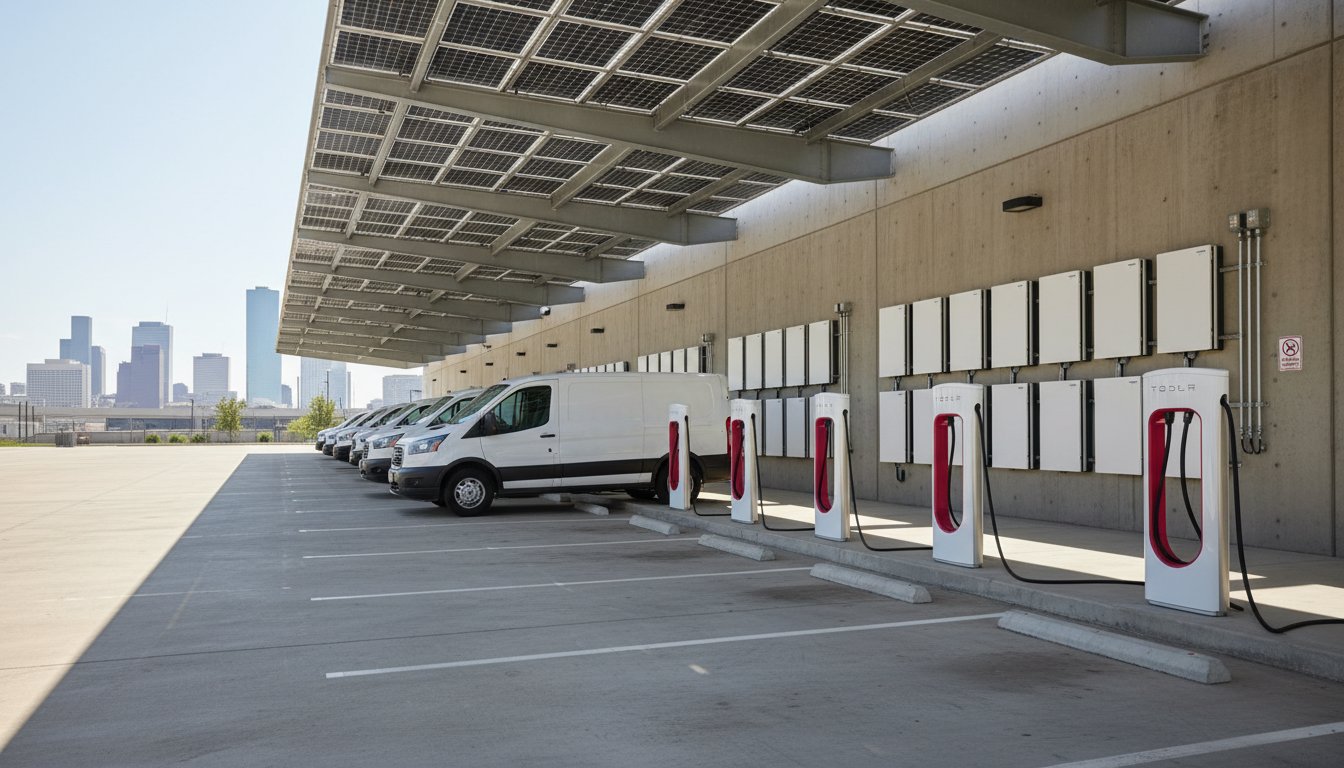
An undersized electrical panel is the primary reason 40% of Houston facility managers encounter unexpected cost overruns during fleet electrification projects. You likely believe that energy independence is a core pillar of operational stability, yet the friction of CenterPoint Energy’s interconnect standards and the City of Houston’s 2024 permitting codes often obscures the path forward. This industrial roundup ensures your investment in chargepro ev charging remains a strategic asset by detailing a turnkey approach that integrates with solar and battery storage to stabilize your long-term operational costs.
Santiban’s expert guide delivers a comprehensive analysis of the technical load specifications, the specific local engineering mandates, and the federal incentives available to maximize your 2026 ROI. We provide a clear roadmap for property managers seeking a single-source partner to manage the entire lifecycle of their industrial charging assets. From initial site assessment to final code compliance, this report outlines the superior standards required for a seamless energy transition in the Greater Houston area.
Key Takeaways
- Identify the optimal hardware configuration for your facility by analyzing the technical specifications of Level 2 and DC Fast Charging systems within the 2026 Houston landscape.
- Ensure full regulatory compliance by understanding the necessity of PE-stamped engineering for commercial electrical permits and structural infrastructure.
- Unlock superior ROI through a comprehensive analysis of federal tax credits and local CenterPoint Energy incentives available for chargepro ev charging projects.
- Secure long-term operational stability by selecting an industrial infrastructure specialist capable of providing integrated, 24/7 local support for complex installations.
Understanding the ChargePro EV Charging Ecosystem in Houston (2026)
Houston’s commercial sector has moved past the experimental phase of electrification. ChargePro ev charging provides a unified hardware and software platform that addresses the rigorous demands of 2026 fleet and tenant requirements. This ecosystem integrates high-output power delivery with cloud-based management tools to ensure maximum uptime. It’s not just a plug in the wall; it’s a sophisticated energy management tool designed for the industrial scale of the Greater Houston Area.
Harris County recorded a 40 percent increase in commercial EV infrastructure permits between 2024 and 2026. Local businesses no longer view these installations as optional amenities. They’re critical operational assets. Our turnkey approach manages the entire lifecycle. We handle preliminary engineering design, site preparation, and final commissioning to ensure seamless integration into existing facility footprints. This method reduces the logistical burden on property managers who require reliable, high-capacity solutions.
The 2026 market demands precision. ChargePro systems utilize advanced load balancing to prevent site-wide power surges. This technology allows facilities to scale their charging capacity without immediate, costly utility transformer upgrades. By choosing a comprehensive hardware and software stack, Houston enterprises secure their infrastructure against future technological shifts.
Networked vs. Non-Networked Solutions
Data connectivity is mandatory for Houston properties managing high turnover or fleet vehicles. Unlike a basic electric vehicle charging station, networked ChargePro units offer granular user access controls and real-time payment processing. These systems utilize RFID integration to secure power access and prevent unauthorized usage during off-hours. Networked charging infrastructure serves as the fundamental prerequisite for achieving measurable commercial ROI through automated billing and load management.
The Santiban Perspective on ChargePro
The Santiban Services Group applies 24+ years of industrial experience to every deployment. We recognize that ChargePro ev charging requires more than an electrical connection; it demands structural integrity and sophisticated civil work. Our teams provide a single-source solution that eliminates the friction of managing multiple contractors. For a deeper analysis of these technical specifications, consult our ChargePro: Your Ultimate Guide to EV Charging Solutions in Houston. We focus on excellence in every detail to protect your long-term capital investment and ensure operational stability.
ChargePro Hardware Roundup: Level 2 vs. DC Fast Charging
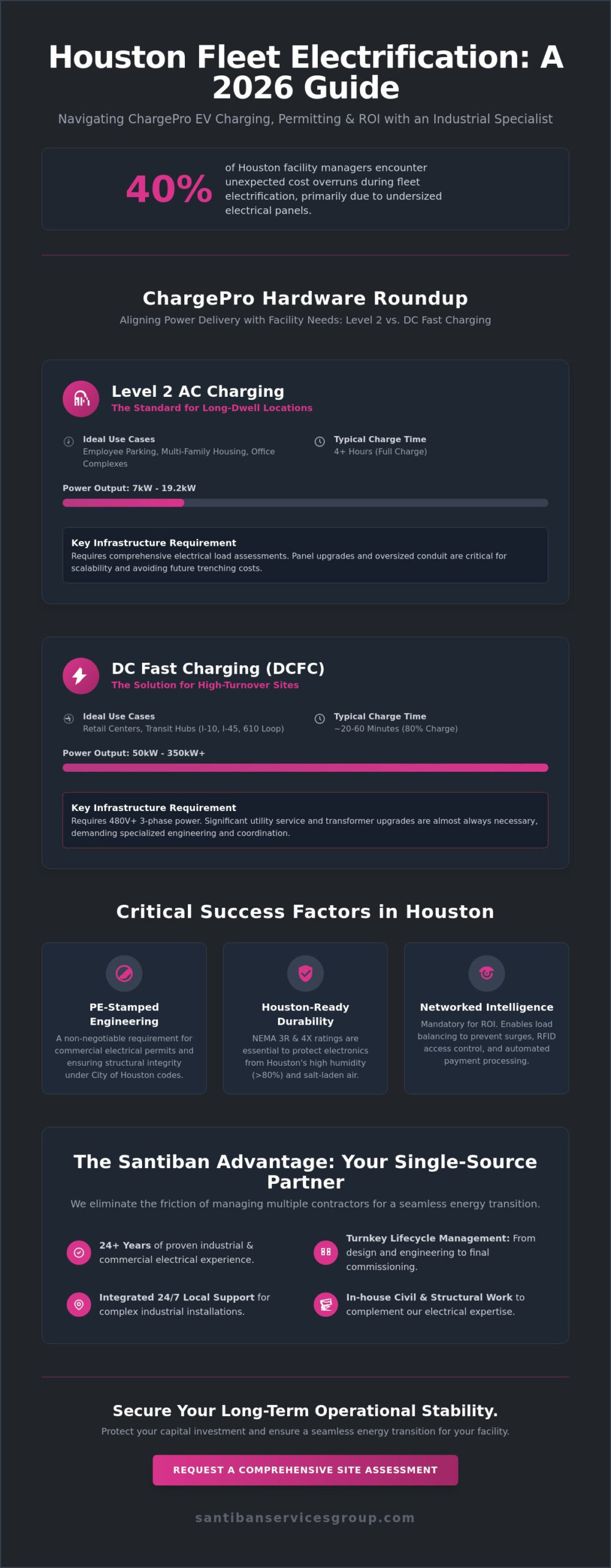
ChargePro EV charging systems provide a modular approach to infrastructure, allowing Houston facility managers to align power delivery with specific user behaviors. Hardware selection is a process that requires a meticulous evaluation of average dwell times and vehicle throughput. For the 2026 fiscal year, ChargePro hardware emphasizes durability through NEMA 3R and 4X ratings. These standards protect sensitive internal electronics from Houston’s high humidity and salt-laden air; this ensures consistent performance in environments where moisture levels frequently exceed 80 percent. Every hardware choice serves as a foundational element in a long-term strategic partnership between property owners and their service providers.
Level 2 Charging for Long-Dwell Locations
Level 2 stations are the primary solution for Houston office complexes, multi-family housing, and employee parking structures. These units typically deliver between 7kW and 19.2kW of power. It’s the standard for vehicles parked for four hours or longer. Implementing chargepro ev charging at this scale necessitates comprehensive electrical load assessments. Property managers don’t overlook the necessity of panel upgrades to accommodate the 240V requirements of multiple units. By reviewing current Texas EV charging incentives, stakeholders can secure funding to offset these necessary infrastructure improvements. Scalability is achieved by installing oversized conduit during the initial build, creating EV-ready spaces that support future growth without the need for additional trenching.
DC Fast Charging for High-Turnover Sites
Retail centers and transit hubs near major corridors like the I-10, I-45, and the 610 Loop require the rapid energy delivery of DC Fast Charging (DCFC). These stations utilize 480V three-phase power to provide outputs ranging from 50kW to 350kW. High-output hardware demands sophisticated thermal management systems. ChargePro units employ advanced liquid-cooling technology to maintain peak charging speeds even when Houston temperatures reach triple digits. Site selection for these units focuses on proximity to existing utility transformers to minimize line loss. The Santiban Services Group provides the integrated facility solutions required to manage these complex industrial installations from site prep to final commissioning. Meticulous planning ensures that these high-power stations operate with superior reliability, providing a stable service for transit fleets and commercial visitors. This single-source solution approach simplifies the transition to high-capacity chargepro ev charging for industrial clients.
The Necessity of PE-Stamped Engineering for Houston EV Projects
The City of Houston Public Works Department enforces rigorous standards for commercial electrical infrastructure. For any ChargePro EV charging installation, the municipal permit office requires technical drawings bearing the seal of a licensed Professional Engineer (PE). This mandate ensures that the proposed electrical load won’t compromise the existing municipal grid. Santiban’s engineering team provides the meticulous oversight needed to navigate these requirements. Our structural experts design trenching paths and reinforced concrete transformer pads that account for the region’s expansive clay soils. They specify precise bollard placement to protect equipment from vehicle impact. Without these stamped documents, projects often stall for 120 days or more as they fail to meet basic code compliance.
Avoiding costly delays caused by non-compliant designs remains a top priority for facility managers. Santiban’s in-house engineering team streamlines the vital coordination with CenterPoint Energy. We accelerate the service drop process by submitting 100% compliant site plans on the first attempt. This integrated approach removes the friction between design and utility approval, ensuring that your ChargePro EV charging stations become operational on schedule. Our proactive methodology transforms a complex logistical challenge into a predictable, managed process.
Compliance with Houston Electrical Codes
The 2026 National Electrical Code (NEC) introduces stricter requirements for load calculations across Texas. Commercial facilities must now demonstrate that their charging systems include dynamic load management to prevent local grid instability. This level of technical precision is detailed in our PE Stamped Engineering for Solar Systems in Houston: A 2026 Compliance Guide. Our engineers analyze existing switchgear capacity to ensure seamless integration without requiring expensive utility upgrades. We prioritize grid stability by calculating peak demand with 99.9% accuracy.
Safety and Liability Mitigation
Professional engineering serves as the foundational element of corporate risk management. For indoor parking garages, fire safety protocols must meet updated 2026 Houston Fire Department standards. This involves specific ventilation requirements and thermal monitoring systems. We also prioritize ADA accessibility. Our designs ensure charging stations meet the required 48-inch maximum reach height and clear floor space. Utilizing a technical guide for commercial EV charging helps our team mitigate long-term insurance liabilities. We provide property managers with the confidence that every installation meets federal safety benchmarks and local building ordinances. This commitment to excellence protects your assets and your visitors.
Maximizing ROI: Rebates, Solar Synergy, and Tesla Integration
Commercial property owners in 2026 can leverage a robust framework of financial incentives to offset the initial capital expenditure of chargepro ev charging stations. The federal Section 30C tax credit remains a cornerstone of this strategy, providing a 30% credit for hardware and installation costs, capped at $100,000 per unit for businesses in eligible census tracts. When combined with CenterPoint Energy’s local business incentives, these credits significantly accelerate the timeline for a full return on investment. CenterPoint also offers specialized demand-response programs; these initiatives pay participants to reduce their energy consumption during peak grid stress, effectively turning your charging station into a revenue-generating asset even when it’s not in use.
Strategic facility management requires a focus on long-term operational efficiency. Integrating solar reroofing with your EV infrastructure allows your business to capture renewable energy and store it for high-demand periods. Santiban’s dedicated teams specialize in these complex, multi-disciplinary projects, ensuring that your roof remains a durable, energy-producing asset for decades. This integrated approach reduces your reliance on the Houston grid and stabilizes your overhead costs against fluctuating utility rates.
The Powerwall 3 and ChargePro Synergy
The technical integration of chargepro ev charging with the Tesla Powerwall 3 provides a sophisticated solution for peak-shaving. Houston’s intense summer heat often triggers high demand charges, which can account for a substantial portion of a commercial electric bill. By discharging stored battery power during these peak windows, businesses avoid expensive utility spikes. This system also ensures charging continuity during grid outages through Tesla Electric integration, maintaining operational readiness when competitors are dark. For a deeper analysis of these technical advantages, consult our Tesla Electric in Houston: A Strategic Guide to Powerwall 3 & Grid ROI (2026).
Monetizing Your Charging Infrastructure
Transforming your parking lot into a profit center involves selecting the right pricing model. kWh-based billing offers the most transparent experience for users, while time-based structures encourage faster vehicle turnover in high-traffic retail environments. Beyond direct revenue, EV infrastructure is a powerful tool for tenant retention and property valuation. Recent industrial market data suggests that properties equipped with high-speed charging see a valuation increase of 3% to 5% compared to non-equipped sites. These installations also contribute essential points toward LEED certification, positioning your property as a premier destination for corporate tenants with strict ESG requirements.
Our team provides the meticulous planning required to execute these high-stakes installations. Partner with Santiban Services Group to secure your facility’s energy future today.
Execution Strategy: Choosing a Houston ChargePro Installation Firm
Selecting the right partner for your chargepro ev charging deployment involves more than verifying an electrical license. General electricians often lack the heavy machinery and civil engineering capabilities required for large-scale industrial sites. Industrial infrastructure specialists understand the specific demands of Houston’s unique soil conditions and high-density power grids. They ensure that transformer upgrades and trenching meet municipal standards without compromising existing facility foundations.
Reliability in the Houston market hinges on 24/7 local support. If a charging hub fails at a logistics center at 3:00 AM, waiting for a technician from a different time zone is not an option. A true turnkey provider must handle civil, structural, and electrical work simultaneously to maintain project momentum. This integrated approach reduces the risk of miscommunication between separate contractors and ensures a seamless transition from groundbreaking to commissioning.
When vetting a firm, prioritize those with at least 20 years of Texas energy experience. That longevity indicates a deep understanding of ERCOT regulations and local CenterPoint Energy protocols. Use the following criteria for your final selection:
- In-house civil and structural teams for seamless site preparation.
- Documented history of PE-stamped engineering designs.
- Permanent Houston-based maintenance crews for immediate response.
- Comprehensive safety records that align with industrial standards.
The Santiban Advantage in Industrial Construction
Santiban Services Group provides a single-source solution that eliminates the friction of managing multiple subcontractors. Our teams are meticulously trained to uphold our “Excellence in Every Detail” standard throughout the entire project lifecycle. We oversee everything from initial PE-stamped designs to the final municipal inspection. Our disciplined approach ensures that your infrastructure is both compliant and scalable. For a deeper look at our specific methodology, review our Commercial EV Charger Installation in Houston: The 2026 Business Guide.
Next Steps: Permitting and Site Assessment
The first action item for any Houston facility is requesting a comprehensive site load analysis. Such technical audits determine if your current electrical service can support a high-capacity chargepro ev charging network. In the current 2026 market, commercial EVSE deployment typically follows a 12 to 18-week timeline. That window accounts for utility transformer lead times and municipal permitting queues. Initiating this process early prevents operational bottlenecks during the transition to electric fleets. Securing a professional industrial partnership is a strategic necessity for long-term operational resilience.
Securing Your Houston Industrial EV Infrastructure for 2026
Transitioning to a high-capacity charging network requires more than just hardware; it demands a meticulous engineering foundation. As Houston’s 2026 commercial landscape evolves, successful projects will prioritize in-house PE-stamped designs to meet rigorous municipal safety standards and ensure long-term operational stability. Integrating chargepro ev charging solutions into your facility’s existing electrical architecture allows for a seamless transition that maximizes both energy efficiency and local tax incentives. Selection of the right hardware, whether Level 2 or DC Fast Charging, must be backed by a strategy that anticipates future growth and technological shifts.
Santiban Services Group brings over 24 years of industrial electrical experience to every deployment. As a Tesla-certified installation partner, we provide the technical precision needed to manage complex infrastructure projects from start to finish. We’ve built our reputation on being a single-source provider that handles every detail of the engineering and installation process. Request a Professional PE-Stamped EV Infrastructure Quote today to ensure your property remains a leader in the regional market. We’re ready to help you build a reliable, future-proof energy ecosystem.
Frequently Asked Questions
What is the typical cost for a commercial ChargePro EV charging installation in Houston?
Commercial installation costs depend on your existing site infrastructure and total power requirements. Data from the 2023 Department of Energy Alternative Fuels Data Center shows that Level 2 commercial units typically cost between $4,000 and $10,000 per port. These figures include hardware and basic electrical upgrades but don’t include extensive trenching. Large-scale industrial projects requiring significant site work will see higher capital expenditures based on the complexity of the electrical layout.
Do I need a new transformer from CenterPoint Energy for DC Fast Charging?
Most DC Fast Charging installations exceeding 50kW require a dedicated transformer upgrade from CenterPoint Energy to handle the increased load. Existing commercial electrical services rarely have the 480V three-phase capacity necessary to support high-speed charging without impacting building operations. Santiban Services Group manages the entire coordination process with CenterPoint to ensure the utility infrastructure matches the 2026 load requirements for your chargepro ev charging deployment.
How does the Houston climate affect ChargePro charging station longevity?
Houston’s 90 percent relative humidity and triple-digit summer temperatures necessitate NEMA 4X rated enclosures for all outdoor equipment. High heat often triggers thermal derating, which reduces charging speeds to protect internal components from damage. Our team implements specific cooling protocols and protective coatings to prevent corrosion from the salt air prevalent in the Gulf Coast region. These meticulous standards ensure your chargepro ev charging stations maintain a 10 year operational lifespan.
Can I integrate my existing solar panels with a ChargePro station?
Integration with existing photovoltaic systems is possible through the installation of a smart energy management system. This configuration allows your station to prioritize solar generation during peak sunlight hours, which reduces your reliance on the ERCOT grid. We design tailored solutions that balance solar output with battery storage to maintain consistent charging speeds even during heavy cloud cover. This approach maximizes the return on investment for your pre-existing renewable assets.
What is the difference between a Level 2 and a DC Fast Charger for my business?
Level 2 chargers provide 7 to 19 kilowatts of power and are ideal for employees or tenants who park for at least 8 hours. DC Fast Chargers deliver between 50 and 350 kilowatts, which can charge a vehicle to 80 percent in less than 30 minutes. Businesses with high vehicle turnover, like retail centers or fleet hubs, benefit most from the rapid throughput of DCFC technology. We help you select the precise equipment mix based on your facility’s specific dwell times.
Is PE-stamped engineering required for every commercial EV charger in Texas?
Texas law requires a Professional Engineer (PE) to stamp electrical plans for any commercial project that exceeds specific voltage or occupancy thresholds. Most commercial EV installations fall under this mandate because they involve high-voltage modifications and complex load calculations. Santiban Services Group provides comprehensive engineering services to ensure every project meets the 2026 Texas electrical code requirements. This professional oversight guarantees safety and facilitates a smoother inspection process with local authorities.
How long does the permitting process take for EV charging in the City of Houston?
The permitting process through the City of Houston Permitting Center typically spans 4 to 8 weeks for standard commercial electrical permits. Complex industrial sites requiring structural reviews or utility easements can extend this timeline to 12 weeks. Our dedicated teams handle all documentation and plan submissions to minimize administrative delays. We track every milestone to ensure your project stays on the projected 2026 schedule without unexpected setbacks.