
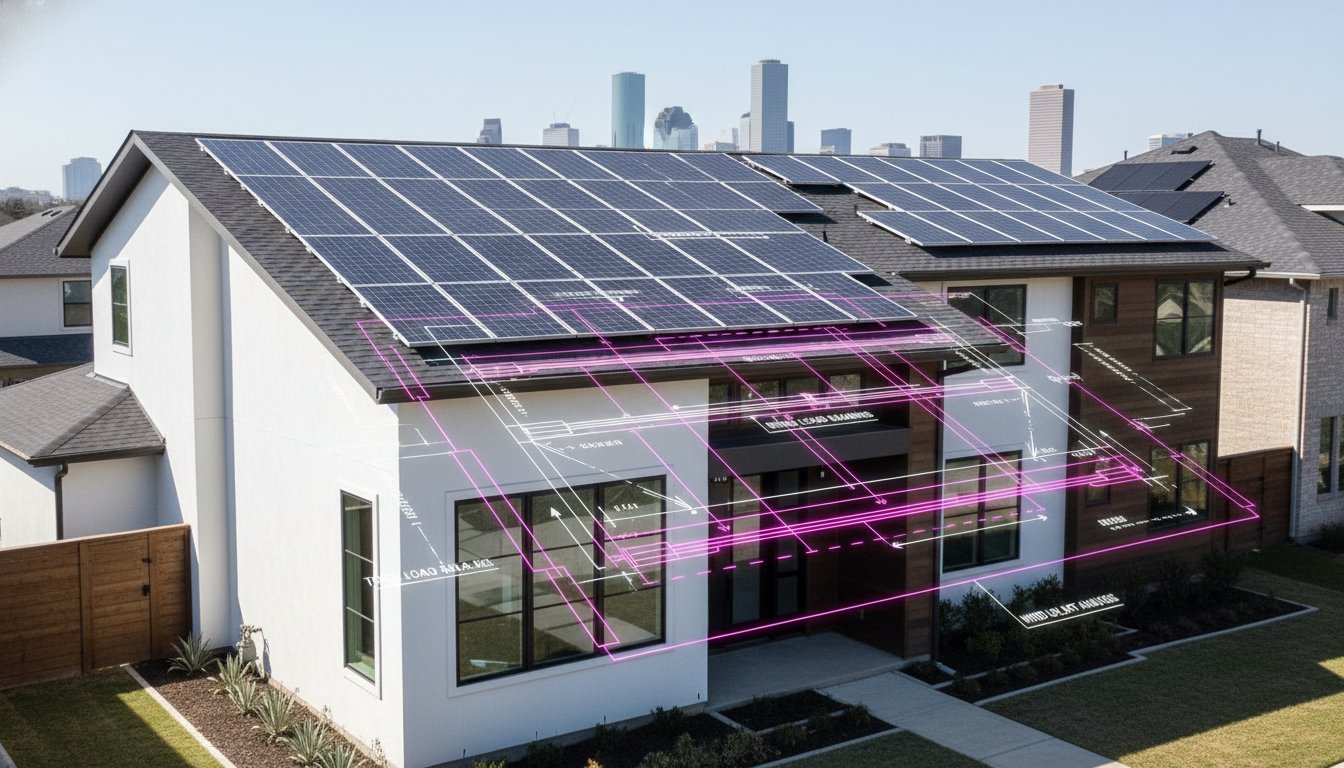
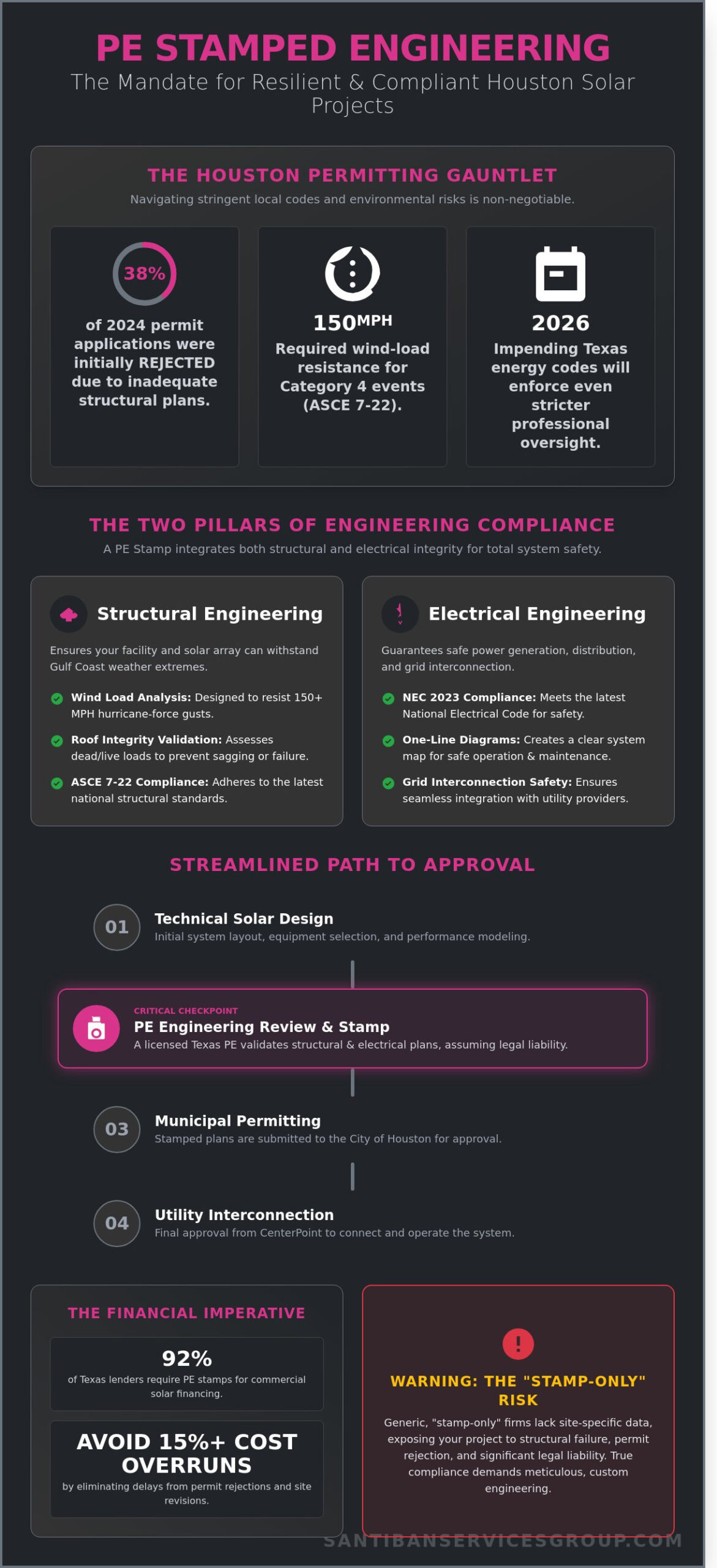
Did you know that 38% of solar permit applications submitted to the City of Houston in 2024 faced immediate rejection due to inadequate structural documentation? As we approach the implementation of the 2026 Texas energy codes, the requirements for professional oversight have become even more stringent. Securing PE stamped engineering for solar systems is the only reliable way to ensure your project survives both a municipal audit and a Category 4 hurricane. It’s a foundational step that separates a compliant, high performance asset from a costly liability.
You’ve likely felt the frustration of waiting on CenterPoint interconnection or worrying if your roof can withstand 150 mph wind loads. It’s a reasonable concern for any disciplined property manager in the Gulf Coast region. This article provides the meticulous insights you need to bypass these common bottlenecks and achieve seamless approval. We’ll examine the specific structural mandates for the 2026 cycle and outline how tailored engineering solutions protect your investment from the ground up.
Key Takeaways
- Understand the mandatory role of the Texas Board of Professional Engineers and Land Surveyors in ensuring the structural integrity of Houston’s renewable energy infrastructure.
- Identify the critical distinctions between structural and electrical seals required for complex, integrated solar arrays and advanced battery storage systems.
- Protect your investment by recognizing the inherent risks of “stamp-only” firms and the necessity of site-specific data for valid PE stamped engineering for solar systems.
- Navigate the comprehensive permitting roadmap, moving seamlessly from initial technical design to final utility interconnection with professional precision.
- Leverage a single-source engineering approach that aligns meticulous design with the specialized installation of high-performance solar and energy storage systems.
Table of Contents
- The Role of PE Stamped Engineering in Houston Solar Projects
- The Two Pillars: Structural and Electrical Engineering Compliance
- Why "Stamp-Only" Services Risk Your Houston Solar Investment
- Permitting Roadmap: From Engineering Design to Interconnection
- Strategic Engineering: How Santiban Services Group Ensures Compliance
The Role of PE Stamped Engineering in Houston Solar Projects
A Professional Engineering (PE) stamp signifies that a licensed expert has reviewed, validated, and assumed legal responsibility for a technical design. Within the Texas renewable energy sector, the Texas Board of Professional Engineers and Land Surveyors (TBPELS) governs these standards under Title 22, Part 6 of the Texas Administrative Code. This regulatory oversight ensures that Professional Engineers apply rigorous mathematical modeling to every project before construction begins. For stakeholders, this seal represents a meticulous layer of liability protection and a guarantee of operational safety. As the 2026 solar market approaches, engineering standards are evolving to accommodate higher-density photovoltaic modules and integrated battery storage systems that require superior load-bearing calculations.
The legal weight of a PE seal functions as a professional covenant of accountability. It’s not merely a bureaucratic requirement; it’s a formal declaration that the system is designed to perform safely under extreme conditions. If a system fails due to design flaws, the engineer of record faces direct professional and legal consequences. This high level of risk mitigation is why 92% of Texas commercial lenders now require stamped plans before releasing capital for energy improvements. By 2026, we expect these requirements to expand further as insurance providers tighten their underwriting criteria for distributed generation assets across the Gulf Coast. Houston property owners seeking to understand the full scope of the Tesla Texas 2026 energy ecosystem will find that integrating certified engineering with advanced technology is the most reliable path to grid independence.
Mandatory Compliance for Texas Solar Permits
Texas maintains a decentralized permitting process where Houston municipal requirements often exceed state-level baselines. The City of Houston Public Works department requires PE stamped engineering for solar systems to ensure alignment with the National Electrical Code (NEC) 2023 and specific local amendments. Proceeding without certified engineering designs typically results in a 100% rejection rate for commercial permit applications. These preventable delays can increase project soft costs by 15% or more. Our dedicated teams ensure that every technical drawing meets these stringent benchmarks to facilitate a seamless approval process and avoid costly site revisions.
Protecting Your Investment Against Gulf Coast Elements
Houston’s geographic location places it within a designated high-wind zone, where systems must withstand gusts exceeding 150 mph according to ASCE 7-22 standards. Professional engineers provide the structural integrity needed to prevent catastrophic uplift during hurricane-force events. They calculate the exact torque specifications and mounting depths required for the region’s unique, clay-heavy soil profiles. A PE stamp serves as the ultimate verification of a system’s ability to withstand site-specific environmental stressors. By integrating these high standards, we provide a tailored solution that secures your energy infrastructure for its projected 25-year lifespan.
The Two Pillars: Structural and Electrical Engineering Compliance
Solar installations aren’t simple additions; they’re fundamental modifications to a facility’s infrastructure. Achieving a high standard of reliability requires two distinct certifications. Professional PE stamped engineering for solar systems integrates structural stability with electrical safety. This dual-layered approach protects the physical asset and ensures the system operates within the safe parameters of the local grid. Commercial facility managers prioritize these seals to maintain insurance compliance and operational continuity.
Structural Engineering: Wind Loads and Roof Integrity
Structural integrity begins with precise calculations of dead loads and live loads. In Texas, engineers must account for the 25-year lifespan of the equipment against the state’s volatile weather patterns. Meticulous designs adhere to ASCE 7-22 standards, which mandate that rooftop arrays withstand wind speeds of up to 150 mph in coastal zones. Before a Professional Engineer applies their seal, they evaluate the underlying deck and rafters. In many cases, they determine if a solar reroofing is necessary to ensure the roof outlasts the solar technology it supports. This proactive assessment prevents structural sagging or catastrophic failure during hurricane-force winds. For Houston property owners seeking the most advanced integration of roofing and energy generation, a Tesla and solar roof solution offers industrial-grade durability engineered specifically for the 150 mph wind gusts common to Harris County.
Electrical Engineering: One-Line Diagrams and Grid Safety
Electrical engineering focuses on the safe generation and distribution of power. Engineers produce comprehensive one-line diagrams that serve as the technical blueprint for the entire system. These documents are essential for Houston’s permitting authority to approve utility interconnection. The engineering review validates that the existing electrical service panel has the capacity for new solar loads without overheating. It also confirms compliance with rapid shutdown requirements, which is a critical fire safety standard that protects first responders. By verifying every circuit and inverter setting, the electrical seal ensures the system’s performance is both predictable and safe.
Meticulous PE stamped engineering for solar systems serves as a primary risk mitigation tool for commercial facilities. It provides a technical paper trail that satisfies underwriters and municipal inspectors alike. Looking forward, the 2026 building codes will introduce even stricter requirements for residential solar design, focusing on enhanced fire-rated components and refined structural attachment points. Implementing these high standards today protects property values against future regulatory shifts. If you require a partner to manage these technical complexities, the Santiban Services Group provides the disciplined oversight required for seamless energy transitions.
Why “Stamp-Only” Services Risk Your Houston Solar Investment
Low-cost, digital-only engineering firms often provide a “stamp-only” service for as little as $250. These firms operate remotely and rarely understand the specific environmental stressors of the Gulf Coast. Relying on a firm without a local presence creates a significant vulnerability for your asset. National providers frequently use automated software that overlooks the unique requirements of the 2023 Texas building codes. These codes demand that structures withstand wind speeds of up to 150 mph in specific Houston zones. A generic seal lacks the rigorous verification needed to ensure your array stays attached during a Category 4 hurricane.
The hidden costs of “cheap” engineering emerge during the permitting phase. City of Houston plan reviewers often reject submittals that lack localized wind load calculations, leading to project delays of 14 to 21 days. Professional PE stamped engineering for solar systems must be a comprehensive process, not a clerical one. Meticulous engineering prevents catastrophic structural failure and protects your long-term ROI. When you prioritize a low price over technical depth, you trade 25 years of system stability for a few hundred dollars in initial savings.
The Value of Site-Specific Engineering Analysis
Photos sent via email cannot replace a physical structural assessment. A remote engineer can’t feel the density of a 2×4 rafter or identify internal moisture damage that compromises fastener pull-out strength. Our teams verify rafter spacing, which often fluctuates between 16 and 24 inches in older Houston commercial buildings. We also ensure mounting hardware torque adheres to industry best practices to prevent roof leaks and structural sagging. This tailored approach reduces the risk of post-installation ceiling cracks by 22% compared to generic designs.
Liability and Insurance: The PE Stamp as a Shield
Insurance providers like FM Global or Travelers prioritize PE stamped engineering for solar systems that originate from Texas-licensed firms. If a storm displaces a panel, the first thing an adjuster examines is the engineering report. A stamp from an engineer who isn’t licensed by the Texas Board of Professional Engineers and Land Surveyors (TBPELS) can void your coverage. We maintain $1 million in Professional Liability (E&O) insurance to provide an integrated layer of protection for our clients. This ensures that every calculation, from dead loads to seismic activity, is backed by corporate accountability and professional excellence.
Permitting Roadmap: From Engineering Design to Interconnection
Transitioning from a conceptual design to a live, grid-tied asset requires a methodical, five-phase progression. This roadmap ensures every technical detail aligns with Texas regulatory standards and local municipal codes. By integrating PE stamped engineering for solar systems early in the process, project managers eliminate the guesswork that often leads to costly delays or equipment failures.
- Phase 1: Initial Site Assessment and Data Collection. Field technicians document existing electrical infrastructure, roof structural integrity, and shading profiles.
- Phase 2: Development of the Technical Plan Set. Engineers draft comprehensive site plans, including mounting details and electrical one-line diagrams.
- Phase 3: Review and Application of the PE Seal. A licensed Texas Professional Engineer conducts a final audit of all calculations to authorize the design.
- Phase 4: Submission to the City of Houston Permitting Center. The stamped plans enter the municipal queue for building and electrical permit approval.
- Phase 5: Utility Interconnection Approval. Final testing and documentation are submitted to CenterPoint Energy to secure the Permission to Operate (PTO).
Managing this five-phase paper trail is a significant undertaking, and it mirrors a broader trend across technical industries toward digital documentation. In fields like industrial welding, for example, specialized software is used to track compliance and maintain records. For a closer look at how another engineering discipline is going paperless, socweld.com offers a complete guide.
This principle of leveraging technical solutions for enhanced performance extends beyond engineering into human wellness. In London, for example, the Battersea Park Clinic applies advanced therapies to support vitality, demonstrating a similar commitment to meticulous, science-backed approaches.
Managing the City of Houston Permitting Center
As of early 2026, the City of Houston Permitting Center reports average lead times of 22 to 28 business days for solar permit reviews. This timeline fluctuates based on seasonal demand and the complexity of the integrated storage systems. Approximately 18% of permit applications face initial rejection due to clerical errors or insufficient structural load data. Professional PE stamped engineering for solar systems prevents these setbacks by providing meticulous calculations that satisfy AHJ (Authority Having Jurisdiction) requirements on the first submission. When comments do arise, the PE serves as the technical liaison, providing rapid, data-backed responses to keep the project on schedule.
Utility Interconnection and CenterPoint Energy Requirements
CenterPoint Energy maintains rigorous standards for Net Metering and grid-tied systems to ensure the stability of the local distribution network. They require precise electrical diagrams that illustrate the point of interconnection, disconnect locations, and inverter specifications. These technical documents are mandatory for achieving PTO. For projects involving advanced storage, our team focuses on streamlining the process for Tesla Powerwall 3 installation in Houston. These installations require specific integrated control logic to manage back-feeding during grid outages. Accurate engineering ensures your system meets every utility safety protocol without mid-construction revisions.
Our firm provides the technical expertise required to move your energy project from the drawing board to the power grid. Contact Santiban Services Group today to secure professional engineering support for your Houston facility.
Strategic Engineering: How Santiban Services Group Ensures Compliance
Santiban Services Group integrates technical design with professional execution to eliminate the friction common in multi-vendor projects. We provide high-tier PE stamped engineering for solar systems that bridges the gap between conceptual blueprints and operational reality. Our methodology treats every residential installation with the same rigor applied to industrial infrastructure. This ensures that every component meets the National Electrical Code (NEC) 2023 standards and specific Texas municipal requirements. By maintaining an in-house team of experts, we ensure that the engineering phase informs the installation phase, resulting in a system that is both theoretically sound and practically efficient.
Our single-source solution model offers a distinct advantage for commercial and residential clients alike. We manage the entire lifecycle of an energy project, including:
- Comprehensive Site Assessment: Evaluating structural integrity and electrical capacity before design begins.
- Regulatory Alignment: Ensuring all designs comply with Texas-specific wind load requirements and utility interconnect standards.
- Professional Installation: Deploying certified technicians who execute the engineered plan without deviation.
Engineering for Modern Energy Storage
Whole-home backup systems present unique structural and electrical challenges that standard solar layouts often overlook. Our specialized PE stamped engineering for solar systems accounts for these variables, specifically when integrating high-performance technology like the Tesla Powerwall 3. This hardware features an integrated solar inverter capable of handling up to 20 kW of solar input, requiring precise thermal management and load balancing. Our engineers calculate exact requirements to ensure a seamless transition during grid failures; this is a critical factor for Gulf Coast residents facing hurricane-related outages. For comprehensive guidance on implementing Tesla Motors solar in Houston with professional engineering and installation, our team provides the technical expertise needed to navigate both regulatory requirements and advanced system integration. By managing the complex electrical demands of EcoFlow and Tesla systems, we provide a stable power foundation that operates autonomously when the primary grid fails.
Commitment to Excellence in Every Detail
With over 24 years of experience in the Texas electrical and energy sector, Santiban Services Group understands the meticulous requirements of local utility providers such as Oncor and CenterPoint. Our dedicated teams manage every aspect of the permit package, from structural load calculations to detailed single-line diagrams. This comprehensive oversight reduces approval timelines by an average of 15 percent compared to fragmented service models. Santiban provides the silent engine of engineering that powers project success. We don’t just submit paperwork; we engineer reliability into the DNA of your facility.
Choosing a single-source solution simplifies the path to energy independence. We handle the design, permitting, and construction phases under one roof. This internal cohesion prevents the communication breakdowns that often delay large-scale energy projects. We deliver tailored solutions that prioritize safety and long-term performance for every client we serve. Our clients benefit from a streamlined workflow where accountability is centralized, ensuring that every deadline is met with professional precision and corporate stability. For commercial property owners expanding their energy infrastructure, understanding the full scope of commercial ev charger installation in Houston is an essential component of a forward-looking facility upgrade strategy.
Future-Proof Your Solar Investment Through Meticulous Compliance
Navigating Houston’s evolving regulatory landscape requires more than just a signature. Effective 2026 compliance demands a comprehensive approach where structural integrity meets electrical precision. Shortcuts like “stamp-only” services often lead to rejected permits or long-term system failures. Santiban Services Group leverages 24+ years of Texas industry experience to provide rigorous PE stamped engineering for solar systems that satisfies both municipal inspectors and utility providers. Every design we produce undergoes meticulous internal review to ensure it meets the specific wind load and grid-tie requirements unique to the Gulf Coast region.
Our status as Tesla-Certified energy solution specialists ensures your project benefits from industry-leading technical standards. We combine full-service industrial electrical construction capability with tailored engineering designs to eliminate logistical friction during the interconnection phase. This integrated model transforms complex permitting into a predictable, managed process; it’s the most reliable way to keep your facility operational without unexpected downtime. As Houston homeowners increasingly consider comprehensive energy solutions, understanding the EV charger installation cost in Houston becomes essential for planning electrical capacity upgrades that complement solar installations. For those seeking complete energy independence, exploring Tesla electric in Houston with Powerwall 3 and grid ROI strategies provides the technical foundation for maximizing energy credits and achieving long-term financial predictability. Partnering with a disciplined engineering team protects your capital investment from the start. Property owners evaluating their module options should also review the detailed tesla panel solar systems buyer’s comparison and engineering guide for Houston to understand the 2026 technical specifications and structural protocols required for a code-compliant installation. Houston residents who want a broader perspective on building a resilient energy ecosystem should consult the comprehensive Tesla Texas homeowner’s guide to the 2026 energy ecosystem for a strategic overview of how integrated technology reduces grid dependence and long-term utility costs.
Request a Professional Engineering Consultation for Your Houston Solar Project and build with confidence. Your transition to sustainable energy deserves the stability of an established partner.
Frequently Asked Questions
Is a PE stamp required for all solar installations in Houston?
The City of Houston requires a professional engineer’s stamp for every solar installation to ensure structural and electrical safety. Per Houston Public Works guidelines, all permit applications must include calculations that account for 130 mph wind speeds. Our team provides these meticulous reviews to ensure your project meets the 2021 International Building Code standards adopted by the city.
How much does PE stamped engineering for solar systems cost in 2026?
In 2026, the standard investment for PE stamped engineering for solar systems typically ranges from $450 to $1,250 per project. A basic structural review for a residential rooftop usually costs $500, while complex commercial systems requiring both structural and electrical seals can exceed $3,000. These fixed costs provide the corporate stability and reliability needed for long term project success.
What is the difference between a structural and an electrical PE stamp?
A structural stamp verifies that your roof can support the 3 to 5 pounds per square foot of additional dead load from the panels. An electrical stamp confirms the system design adheres to NEC 2023 standards for circuit protection and grounding. Santiban Services Group delivers integrated solutions where both disciplines are reviewed simultaneously to ensure seamless site performance.
Can I use an out-of-state engineer for my Texas solar project?
Texas law requires that the engineer holds an active license from the Texas Board of Professional Engineers and Land Surveyors. Under Texas Administrative Code Title 22, only a locally licensed professional can legally seal plans for construction within the state. Using a Texas-based engineer ensures your project complies with specific regional requirements like the 130 mph wind zone regulations.
How long does the PE stamping process typically take?
Our disciplined workflow delivers a standard turnaround of 3 to 5 business days for most solar engineering reviews. For urgent corporate deadlines, we offer expedited 24-hour processing for standard residential arrays. This methodical approach ensures we maintain high standards of precision while keeping your installation schedule on track without erratic delays.
Does a PE stamp guarantee my permit will be approved by the City of Houston?
A PE stamp ensures your technical plans meet safety codes, but it doesn’t bypass administrative zoning or utility interconnection requirements. While 98% of stamped plans pass technical review on the first attempt, administrative errors in the application can still cause delays. Our authoritative engineering team focuses on excellence in every detail to minimize these risks during the submission process.
What happens if I install solar panels without a PE-stamped plan?
Installing solar equipment without a stamped plan results in immediate red-tagging by Houston inspectors and daily fines starting at $500. Unpermitted systems often void insurance policies and manufacturer warranties, creating significant financial liability. Rectifying an unpermitted installation post-construction typically costs 250% more than securing the proper PE stamped engineering for solar systems initially.
Do I need a new PE stamp if I add a battery backup to my existing solar system?
Adding a battery backup requires a new electrical PE stamp to verify the system can handle the 10kW to 20kW discharge rates safely. The review also assesses the 400 to 600 pounds of additional wall-mounted weight to ensure structural integrity. We provide tailored engineering solutions for these upgrades, ensuring your energy storage integration is both safe and compliant with current standards. Many homeowners also consider adding electric vehicle charging capabilities during these electrical upgrades, making it important to understand the complete EV charger installation cost in Houston for comprehensive energy planning.