
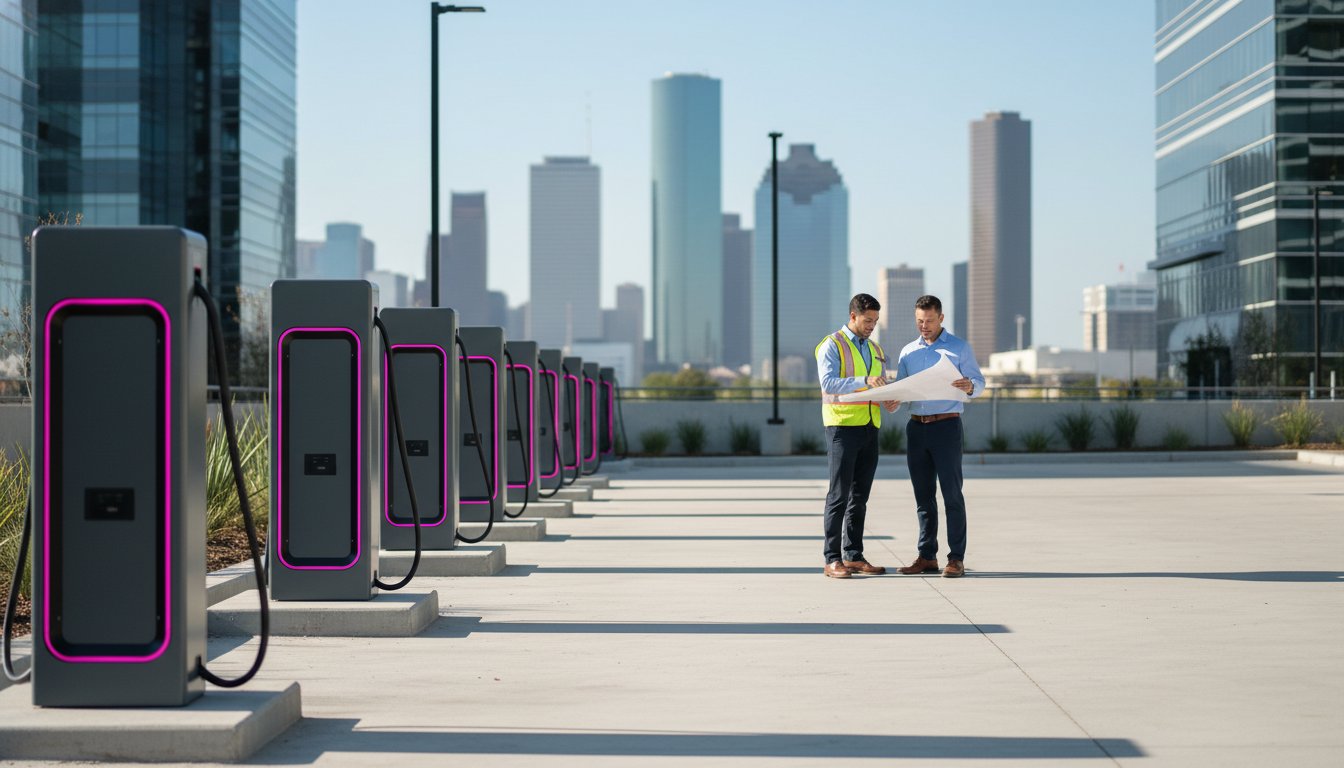
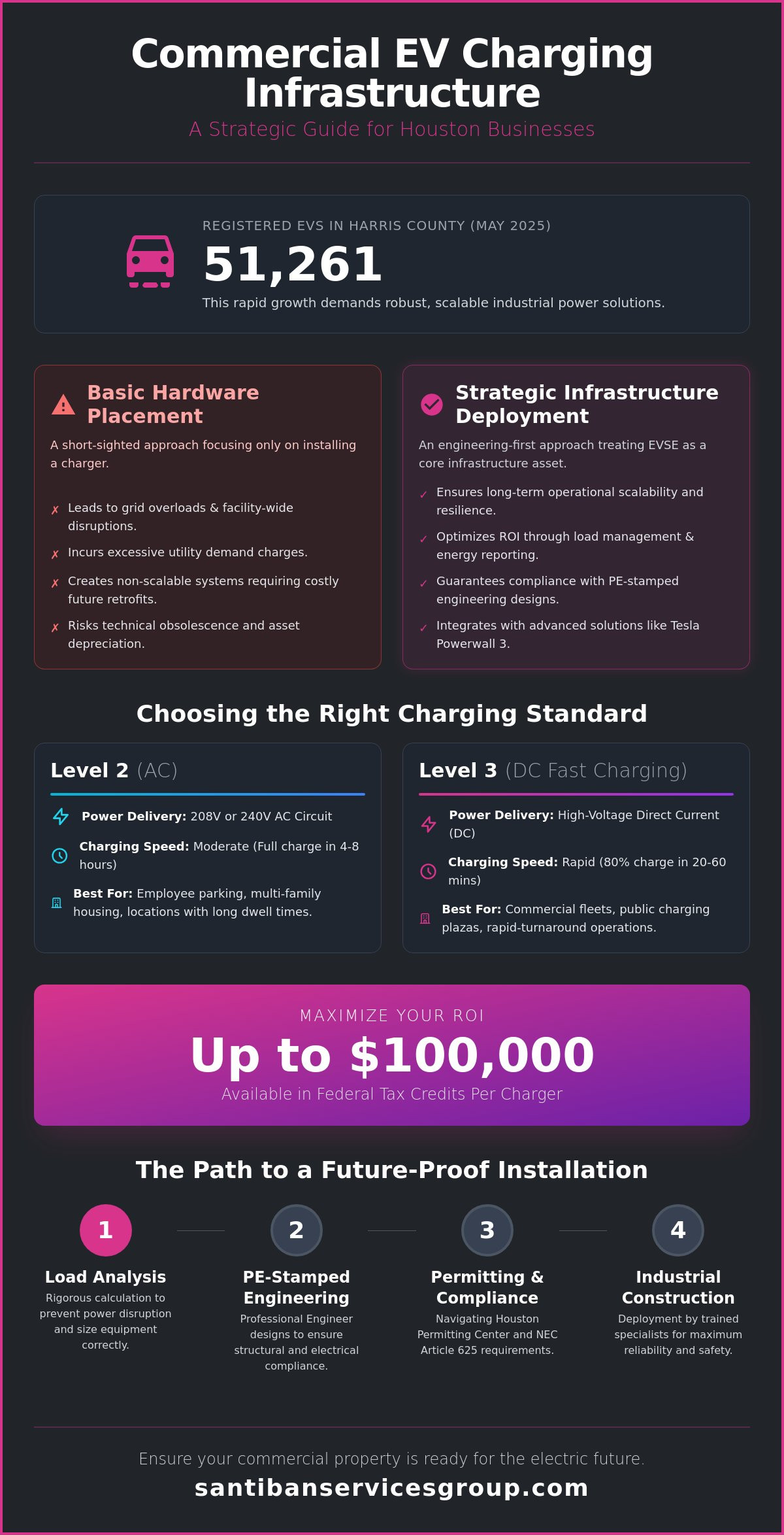
As of May 2025, Harris County recorded 51,261 registered battery electric and plug-in hybrid vehicles, a figure that underscores the immediate need for robust industrial power solutions. Partnering with the commercial EV charging station installers Houston relies on for complex projects requires moving beyond basic electrical work toward comprehensive infrastructure engineering. You understand that the primary challenge for expansion in 2026 is grid capacity, where improper planning leads to non-scalable systems and excessive utility demand charges. This guide details the technical, regulatory, and engineering requirements necessary for a successful large-scale deployment.
We provide a clear roadmap for navigating the Houston Permitting Center and ensuring compliance with National Electrical Code Article 625. Our analysis covers how PE-stamped engineering design and industrial electrical construction protect your investment from technical obsolescence. You’ll gain insights into maximizing ROI through federal tax credits of up to $100,000 per charger and strategic load management techniques. This professional overview ensures your organization transitions to fleet or public charging with the precision and reliability that corporate stability demands.
Key Takeaways
- Differentiate between basic hardware placement and strategic infrastructure deployment to ensure long-term operational scalability.
- Partner with professional commercial EV charging station installers Houston to conduct rigorous load analyses that prevent facility-wide power disruptions.
- Optimize organizational ROI by implementing sophisticated energy reporting and access control systems tailored to fleet and public-facing requirements.
- Navigate complex municipal regulations with PE-stamped engineering designs that mandate structural and electrical compliance for high-capacity systems.
- Evaluate potential industrial partners based on specialized personnel training and their ability to integrate advanced solutions like Tesla Powerwall 3.
The Strategic Landscape of Commercial EV Infrastructure in Houston
The transition toward large-scale electrification in Houston has moved past the experimental phase into a standard requirement for industrial and corporate operations. By 2026, the demand for high-capacity charging is no longer driven solely by early adopters but by comprehensive fleet mandates and institutional sustainability requirements. Engaging with qualified commercial EV charging station installers Houston ensures that your facility moves beyond the simple placement of hardware toward a fully integrated power ecosystem. This distinction is critical; while a basic installation focuses on a single point of delivery, a comprehensive deployment considers grid capacity, future expansion, and long-term facility resilience.
Primary stakeholders, including facility managers, developers, and fleet operators, now view Electric Vehicle Supply Equipment (EVSE) as a strategic infrastructure asset rather than a simple utility expense. This equipment requires precise industrial electrical construction to handle the significant load requirements of modern EV charging technology. Proper deployment involves rigorous engineering to prevent operational disruptions and ensure the system remains scalable as vehicle counts increase. When infrastructure is treated as a strategic asset, it becomes a silent engine for corporate growth and operational stability.
Houston’s Electrification Mandate
Local corporate sustainability goals are directly influencing commercial property valuations across the Greater Houston area. In districts like the Energy Corridor, high-value tenants and top-tier employees prioritize sites that offer reliable charging infrastructure. Building owners who fail to integrate these systems risk asset depreciation as the market shifts toward electric mobility. We focus on creating future-proof industrial facilities that accommodate the high-voltage requirements of 2026 and beyond. This proactive approach eliminates the need for costly retrofits and positions properties as leaders in the regional energy transition.
Infrastructure as a Competitive Advantage
Strategic EV infrastructure provides a tangible return on investment through several channels. It serves as a powerful tool for employee retention and can generate public-facing revenue for multi-use developments. The synergy between charging stations and other energy assets, such as Tesla Powerwall 3 systems, allows for sophisticated load management and peak shaving. By incorporating these technologies into a unified electrical framework, businesses achieve a level of energy independence and cost control that traditional utility connections cannot match. This integrated strategy transforms a necessary compliance measure into a core competitive advantage for any industrial or commercial operation.
Engineering for Scale: Technical Requirements and Grid Capacity
Executing a large-scale electrification project requires a departure from residential-style thinking toward rigorous industrial standards. As experienced commercial EV charging station installers Houston firms must prioritize precise load calculations to prevent facility-wide power outages during peak usage. When multiple high-capacity chargers activate simultaneously, the sudden draw can overwhelm existing switchgear and trip primary breakers. Our approach treats charging infrastructure as a core component of your facility’s energy ecosystem, ensuring that every kilowatt is accounted for through disciplined engineering and site-specific load analysis.
The technical foundation of any deployment begins with a clear understanding of power delivery methods. According to the Alternative Fuels Data Center, selecting the appropriate charging level is a balance between operational speed and infrastructure cost. While Level 2 AC charging is often sufficient for employee parking where vehicles remain stationary for several hours, it lacks the throughput required for rapid-turnaround fleet operations. Level 3 DC Fast Charging delivers high-voltage direct current directly to the vehicle battery, enabling rapid energy transfer for high-volume commercial needs.
Level 2 vs. Level 3: Choosing the Right Standard
Level 2 systems operate on 208V or 240V circuits and are the standard for workplace environments and multi-family developments. They offer a cost-effective way to provide consistent energy over extended periods. In contrast, Level 3 DC Fast Chargers require 480V three-phase power and specialized industrial electrical construction. These units are essential for transit hubs and heavy-duty fleets that cannot afford long downtime. Choosing the wrong standard leads to underpowered infrastructure or unnecessary capital expenditure, making professional guidance vital during the design phase.
Coordinating with CenterPoint Energy
Large-scale deployments frequently exceed the existing capacity of the local grid, necessitating early coordination with CenterPoint Energy. Verifying grid capacity involves a detailed review of the “Service Point” where the utility delivers power to the property. If the total load exceeds the current transformer’s rating, a utility-side upgrade is mandatory. These upgrades in the Houston industrial sector can involve significant lead times, often stretching several months. Identifying these requirements during the initial PE-stamped engineering design phase prevents project delays and ensures a seamless transition to high-capacity charging.
Beyond hardware, smart load management is the primary tool for controlling operational costs. By utilizing software to distribute power dynamically, businesses can avoid the steep peak demand charges that CenterPoint Energy applies to high-usage commercial accounts. This strategic approach allows for more charging ports without requiring a massive increase in total service capacity. Our focus remains on creating a stable, predictable energy profile that supports your growth while maintaining the integrity of your facility’s electrical backbone.
Fleet vs. Public Charging: Designing for Operational ROI
The design of an EV infrastructure project depends entirely on its intended utility. While technical specifications remain consistent across high-capacity projects, the operational logic for a private fleet depot differs fundamentally from a public-facing retail hub. Professional commercial EV charging station installers Houston must evaluate these distinct philosophies to ensure the resulting network delivers maximum ROI. For fleet operations, ROI is measured through reduced downtime and lower energy costs. For public networks, it’s often driven by direct revenue or increased customer dwell time. Our approach ensures that every design choice aligns with the long-term financial objectives of the facility owner.
Modern charging networks rely on robust back-end software to manage complex user interactions. This includes real-time monitoring of energy consumption, automated billing for public users, and tiered access control for employees or VIP tenants. These systems provide the data necessary for facility managers to make informed decisions about future expansions. Without integrated reporting, it’s impossible to accurately measure the performance of the infrastructure against corporate sustainability targets. For a comprehensive analysis of how these strategic decisions impact your bottom line, review our guide on commercial ev charger installation for business ROI.
Optimizing Fleet Operations
In a fleet environment, the layout of the depot is a critical factor for driver efficiency. We design layouts that maximize throughput, ensuring vehicles can move through the charging cycle without congestion. Integrating charging schedules with fleet management software allows for automated load balancing, which minimizes energy costs while ensuring every vehicle is ready for its shift. Redundancy is another pillar of industrial electrical infrastructure. If a single charging port fails, the system must maintain enough capacity to prevent operational delays. Emerging bidirectional charging technology further enhances value by allowing fleet batteries to discharge power back into the facility during peak demand periods, effectively turning a vehicle fleet into a grid-stabilizing asset.
Public-Facing Revenue Models
Public-facing charging stations serve as a primary tool for customer acquisition and retention. Retailers and developers utilize these assets to attract high-value demographics who prefer to shop or dine where they can charge. Success in this sector requires sophisticated software integration for billing and access control. Users expect seamless authentication via RFID cards or mobile applications, and site owners require transparent energy reporting to track profitability. When planning these installations, it’s vital to consult the Houston Permitting Center to ensure that public-access layouts comply with all local safety and accessibility standards. Planning for scalability is essential as EV adoption grows across Texas, allowing for the addition of more ports as demand increases without a complete overhaul of the primary electrical service.
Navigating Houston Permitting and PE-Stamped Engineering
The transition from a technical design to a physical asset requires navigating a complex regulatory environment. In the City of Houston and Harris County, commercial EV charging station installers Houston must secure specific electrical and building permits before breaking ground. This process isn’t merely administrative; it’s a safety and liability firewall. Authorities Having Jurisdiction (AHJ) require comprehensive documentation that proves the proposed system won’t compromise the existing facility or the local grid. Professional engineering is the cornerstone of this approval process, providing the AHJ with a certified guarantee that all components meet rigorous safety standards.
This level of validation is as critical for EV charging infrastructure as it is for other high-voltage installations. For instance, you can see why PE stamped engineering for solar systems is vital for all energy projects, as it ensures long-term structural and electrical compliance. By delivering precise, stamped plans, we eliminate the ambiguity that often leads to permit rejections or project delays.
The PE-Stamping Process for EVSE
Structural integrity is a frequent oversight in commercial charging projects. Pedestal mounts and overhead charging supports must withstand Houston’s significant wind load requirements and unique soil conditions. Our engineering team verifies that foundations are appropriately sized and that electrical designs adhere to the most recent National Electrical Code (NEC) standards. A PE stamp effectively transfers technical liability from the property owner to the licensed engineer, providing a layer of corporate protection that basic electrical contractors cannot offer.
Streamlining the Approval Timeline
The Houston permitting process often stalls due to incomplete load studies or a lack of detailed one-line diagrams. We mitigate these delays by providing “As-Built” drawings and precise documentation from the outset. This proactive approach accelerates AHJ approval and ensures that final inspections proceed without costly corrections. Managing the transition from design to physical industrial electrical construction requires a disciplined flow of information between engineers and field personnel. Precision in the planning phase is the only way to avoid the pitfalls of unpermitted or non-compliant infrastructure.
To ensure your facility meets all 2026 regulatory standards, consult our industrial engineering team for a comprehensive site evaluation and compliance review.
The Santiban Industrial Standard: Choosing a Houston Partner
Selecting a strategic partner for large-scale electrification requires a rigorous evaluation of technical capacity and industrial heritage. While many firms offer basic hardware placement, partnering with the commercial EV charging station installers Houston relies on for high-capacity projects ensures your infrastructure is built to industrial standards. Corporate procurement departments must prioritize partners with a proven background in industrial electrical construction. A qualified entity should demonstrate multi-sector expertise, managing the complex interplay between charging ports, facility switchgear, and advanced energy storage. Certifications for high-capacity technology, such as Tesla Powerwall 3 integration, serve as a critical benchmark for technical proficiency in the 2026 market.
Assessing a provider’s ability to deliver in-house PE-stamped engineering design is equally vital for risk mitigation. This capability ensures that the transition from a conceptual layout to physical infrastructure remains seamless and code-compliant without relying on third-party delays. Safety protocols should be non-negotiable and deeply documented. Our teams utilize specialized, high-voltage personnel trained to operate within active industrial environments without disrupting existing workflows. This disciplined focus on operational continuity and professional jargon reflects a commitment to the precision that modern corporate managers demand.
24+ Years of Electrical Precision
Santiban Services Group brings a legacy of over 24 years in complex industrial electrical construction to every electrification project. We operate as a single-source provider, managing every phase from the initial engineering stamp to final commissioning and long-term maintenance. This unified approach eliminates the communication gaps that often occur when multiple contractors are involved in a single deployment. For organizations currently in the planning phase, it’s beneficial to review our ev charger installation cost guide to establish a realistic baseline for industrial-grade budgeting and asset management.
Next Steps for Facility Execution
Initiating a professional site feasibility and load capacity audit is the primary step toward preparing your facility for 2026 electrification standards. This audit identifies potential grid bottlenecks and determines if existing transformers require utility-side upgrades. By addressing these technical requirements early, you protect your infrastructure from underperformance and ensure long-term scalability. We provide the disciplined, hardworking personnel necessary to keep your operations running smoothly in the background while building the energy systems of the future. Contact Santiban Services Group for a professional EV infrastructure assessment to begin your transition with corporate confidence.
Securing Your Industrial Energy Future
Deploying large-scale EV infrastructure is a sophisticated engineering endeavor that demands more than simple electrical connectivity. As the 2026 market shifts toward total electrification, the role of professional commercial EV charging station installers Houston becomes central to maintaining facility operational integrity. Successful deployment relies on rigorous load calculations, seamless municipal permitting, and the strategic integration of high-capacity hardware. By prioritizing industrial-grade standards today, you ensure your facility remains a competitive, future-proof asset within the Texas energy landscape.
Our team brings over 24 years of complex industrial electrical experience and Tesla-certified energy solutions to every project. We provide in-house PE-stamped engineering design to guarantee that every operational detail remains under expert control. This disciplined approach minimizes risk and maximizes long-term ROI for your organization. Partner with Houston’s Industrial EV Infrastructure Experts to initiate a comprehensive site audit and secure your energy independence. We’re ready to help you build a resilient, scalable network that powers your corporate growth.
Frequently Asked Questions
How much does it cost to install a commercial EV charging station in Houston?
Total project costs depend on site-specific variables such as trenching requirements, hardware selection, and current grid capacity. Factors like the distance from the primary electrical panel and the need for transformer upgrades significantly influence the final budget. Businesses should leverage the federal 30C tax credit, which covers up to 30% of infrastructure costs, alongside available Entergy rebates to optimize their initial investment.
Do I need to upgrade my commercial electrical panel for an EV charger?
Most industrial facilities require a dedicated sub-panel or a significant upgrade to existing switchgear to support high-capacity charging. Level 3 systems demand 480V three-phase power, which often exceeds the capacity of standard commercial services. A professional load analysis determines if your current infrastructure can handle the additional demand without risking facility-wide outages or equipment damage.
What is the difference between Level 2 and Level 3 charging for businesses?
Level 2 charging utilizes 208V or 240V AC power and is ideal for environments where vehicles remain parked for several hours, such as workplace or multi-family settings. Level 3, or DC Fast Charging, delivers high-voltage direct current directly to the battery for rapid energy transfer. This standard is essential for fleet operations and transit hubs that require high vehicle throughput and minimal downtime.
Does the City of Houston require a permit for EV charger installation?
Yes, the Houston Permitting Center requires an electrical permit for any new commercial EVSE installation. For projects involving multiple stations, the city mandates detailed electrical plans and load analyses to ensure compliance with National Electrical Code Article 625. Qualified commercial EV charging station installers Houston firms manage these submissions to prevent project delays and ensure all safety standards are met.
Why is PE-stamped engineering required for my commercial EV project?
Professional engineering is mandatory for verifying the structural and electrical integrity of commercial charging hubs. A PE-stamped design confirms that pedestal mounts and foundations can withstand local wind load requirements and that the electrical system is safely integrated. This certification reduces corporate liability and provides the Authority Having Jurisdiction with the technical assurance needed for rapid permit approval.
Are there Texas state incentives for commercial EV charging stations in 2026?
While state-level programs vary, businesses currently benefit from the federal 30C tax credit, which provides up to $100,000 per charger for eligible installations. Local utility providers like Entergy also offer rebates for Level 2 and DC Fast Charging units to encourage commercial electrification. It is vital to consult with a strategic partner to identify all applicable incentives before breaking ground on a new project.
Can I integrate solar panels and battery storage with my EV charging hub?
Integrating solar panels and battery storage systems, such as Tesla Powerwall 3, allows businesses to mitigate expensive peak demand charges. These energy assets enable peak shaving by discharging stored power during periods of high grid stress. This unified approach to energy management increases facility resilience and provides a more predictable cost structure for long-term fleet or public charging operations.
How long does the installation process take for a commercial facility?
The timeline for a commercial deployment is largely dictated by utility coordination and the permitting process. While physical installation may take only a few weeks, securing utility-side upgrades from CenterPoint Energy can extend the project duration to several months. Early engagement with engineering and utility stakeholders is the only way to ensure an efficient transition from design to operational status.