
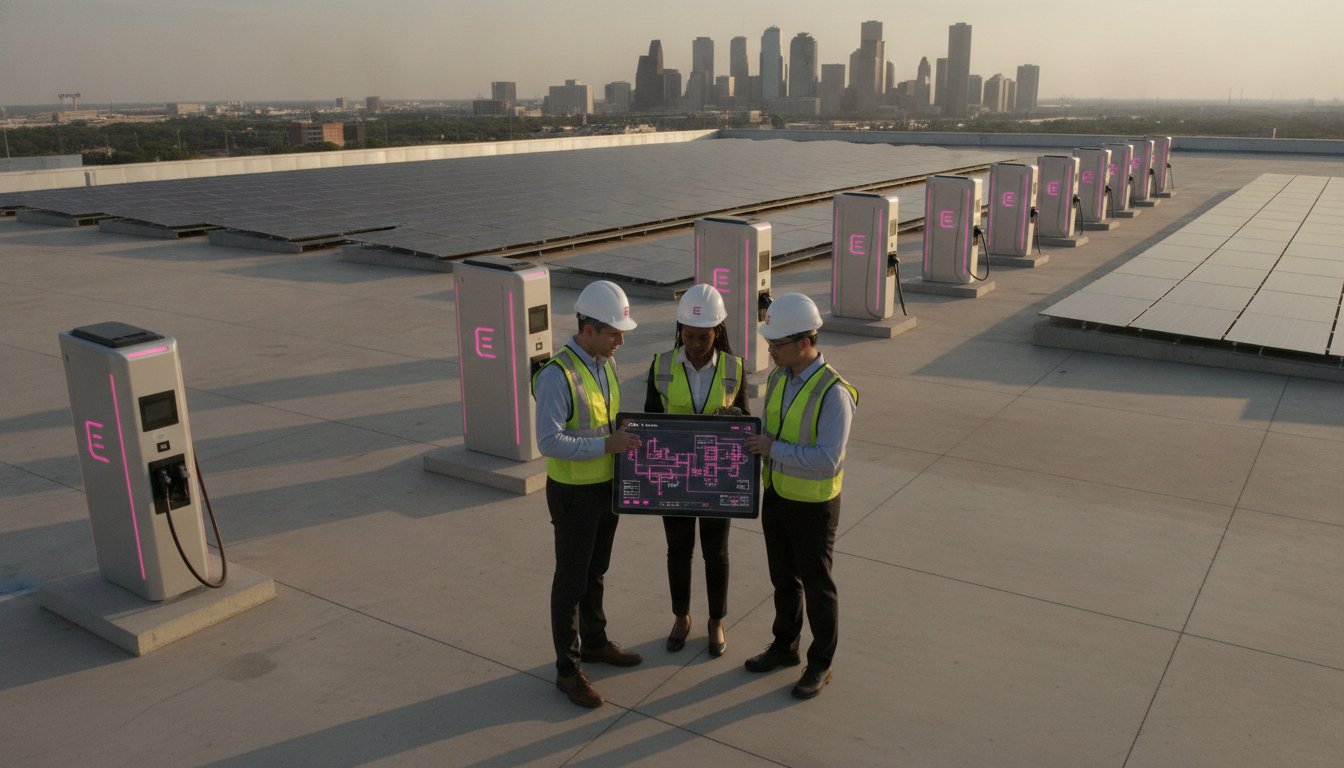
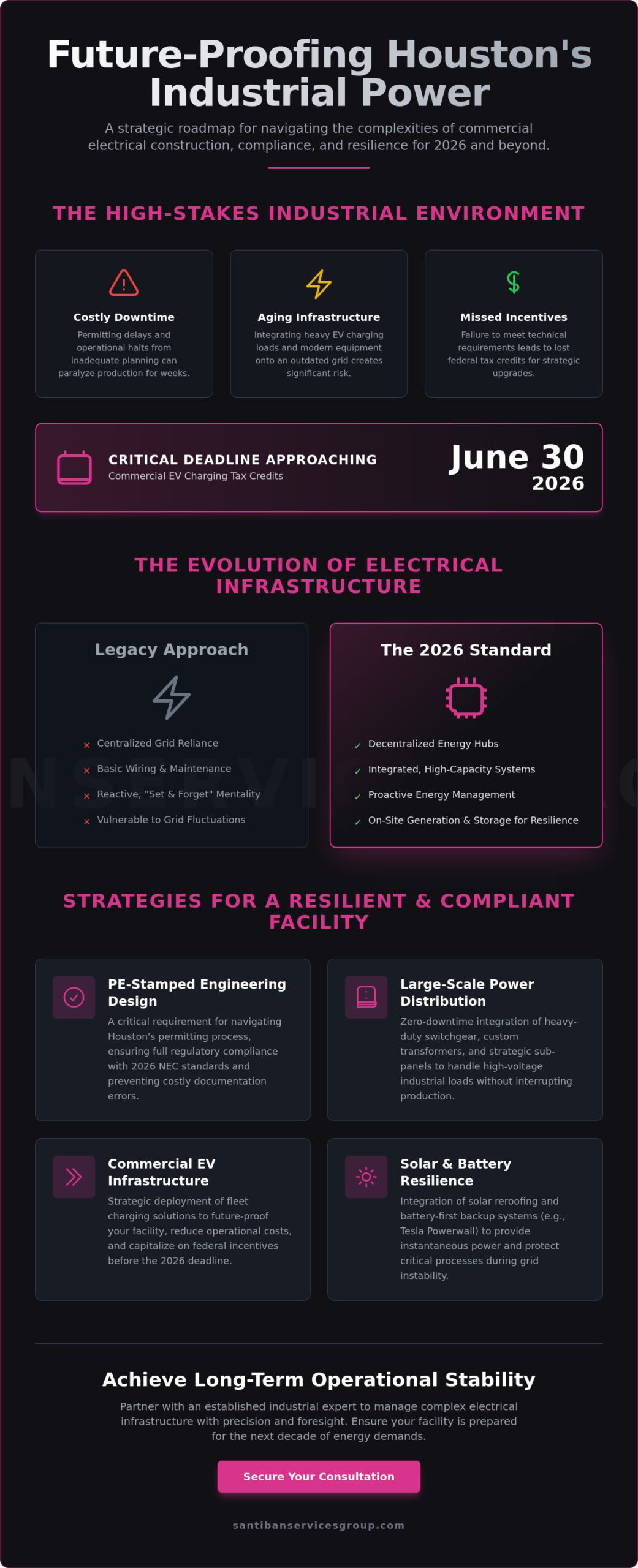
Could a single documentation error in your engineering plans delay your facility’s operational timeline by weeks? In the high-stakes environment of commercial electrical construction Houston TX, technical precision isn’t just a preference; it’s a requirement for survival. Most industrial operators understand the frustration of permitting delays caused by inadequate documentation or the anxiety of integrating heavy EV charging loads onto an aging grid. These challenges often lead to costly downtime and missed federal incentives, such as the June 30, 2026, deadline for commercial EV charging tax credits.
It’s clear that maintaining a resilient, future-proofed facility requires more than just basic wiring. You need a strategic partner who manages the complexities of PE-stamped engineering and the shifting 2026 National Electrical Code standards with absolute authority. This guide provides the roadmap to achieving a seamless design-build process that reduces operational downtime and prepares your infrastructure for the next decade of energy demands. We’ll examine the latest regulatory updates, efficient EV fleet deployment strategies, and the tactical integration of solar resilience to ensure your operations remain uninterrupted and fully optimized.
Key Takeaways
- Understand how the landscape of commercial electrical construction Houston TX is evolving toward decentralized energy systems to ensure long-term industrial resilience.
- Identify the technical strategies for executing large-scale power distribution upgrades that prioritize zero-downtime integration for continuous operation.
- Learn why PE-stamped engineering design is a critical requirement for navigating the Houston permitting process and ensuring full regulatory compliance.
- Explore the strategic integration of commercial EV charging infrastructure and solar reroofing to future-proof your facility against rising energy costs.
- Discover how partnering with an established industrial expert provides the stability and precision necessary to manage complex electrical infrastructure projects.
The Evolution of Commercial Electrical Construction in Houston (2026)
Commercial electrical construction Houston TX has transitioned from a supporting utility into a primary driver of industrial operational stability. In 2026, the definition of success involves more than just passing basic inspections. It requires the integration of high-capacity infrastructure capable of supporting rapid industrial expansion and complex energy needs. Understanding the History of Houston’s Electrical Grid reveals a legacy of centralized power that is now being challenged by the necessity for localized resilience. Today’s facilities must function as sophisticated energy hubs, balancing grid reliance with on-site generation and storage to maintain a competitive edge.
Local expertise in Houston’s specific climate and regulatory zones remains a non-negotiable requirement for any large-scale project. An industrial electrical contractor now operates as a strategic partner rather than a mere service provider. This shift ensures that every operational detail is under expert control, projecting the persona of a silent engine that keeps the client’s background operations running without interruption. Precision in execution is the new standard for corporate stability.
Houston’s Industrial Power Demands in 2026
The current industrial landscape is defined by the massive power requirements of hyperscale data centers and highly automated manufacturing plants. These facilities demand a level of electrical precision that traditional contractors often struggle to meet. The adoption of the 2026 National Electrical Code (NEC) on September 1, 2026, has raised the bar for compliance and safety across Texas. Extreme weather events continue to threaten grid stability, making resilient design a core requirement for any new build. To bridge this reliability gap, certified Tesla Powerwall installers are now essential for providing the battery backup necessary to protect critical industrial processes during grid fluctuations.
Beyond Basic Wiring: The Integrated Facility
Modern energy management requires a unified approach to monitoring and load balancing. In 2026, treating electrical systems as a static asset is a significant liability. Active systems now monitor peak demand periods to optimize consumption and reduce operational costs. This transition from simple maintenance to comprehensive energy management ensures that facilities are capable of supporting future expansions without requiring a total system overhaul. A “set it and forget it” mentality leads to inefficiencies and potential downtime. Professional contractors prioritize thoroughness, utilizing parallel structures in their design to create a rhythmic sense of order and comprehensive capability within the facility’s power distribution network.
Comprehensive Industrial Electrical Services: Powering Houston’s Infrastructure
Industrial operations require a unified electrical strategy that transcends simple component replacement. High-performance commercial electrical construction Houston TX demands a meticulous focus on zero-downtime integration, ensuring that facility upgrades don’t paralyze production. This approach involves the deployment of advanced power distribution systems, including heavy-duty switchgear, custom-configured transformers, and strategic sub-panels designed to handle high-voltage industrial loads. Every installation is executed with a commitment to corporate stability, positioning the electrical system as the silent engine of the facility.
Industrial-grade lighting solutions serve as a critical component for both safety and productivity. Modern LED systems reduce energy overhead while improving visibility in hazardous manufacturing zones. Beyond illumination, the shift toward emergency backup resilience has moved from traditional diesel generators toward battery-first solutions. These systems provide instantaneous power delivery, bridging the gap during grid instability without the mechanical latency of legacy equipment. This transition reflects a broader trend toward decentralized energy management that prioritizes immediate response and long-term sustainability.
Large-Scale Electrical Construction & Deployment
The design-build methodology streamlines the execution of complex projects by unifying engineering and construction under a single point of responsibility. This model reduces project timelines and eliminates the communication gaps that often lead to costly revisions. Managing industrial retrofits in active operational environments requires extreme organization and a serious commitment to safety. We prioritize precision when installing high-voltage components, particularly in the humid and corrosive atmosphere of the Texas Gulf Coast. Every project phase aligns with the standards set by the Houston Permitting Center to ensure that all documentation and physical installations meet local code requirements without delay.
Maintenance and Operational Continuity
Predictive maintenance remains the most effective strategy for protecting long-term ROI. Utilizing thermal imaging and routine load testing allows technicians to identify potential points of failure before they result in catastrophic downtime. Professional-grade component selection ensures that the infrastructure remains durable under the stresses of continuous industrial use. Maintaining this level of operational continuity requires a partner who understands that electrical work isn’t a one-time event but a recurring commitment to excellence. For organizations seeking a reliable partner to manage these complexities, exploring our specialized industrial electrical construction services ensures your facility remains a high-functioning asset.
The Compliance Edge: PE-Stamped Engineering Design & Permitting
Technical precision in commercial electrical construction Houston TX begins long before the first conduit is installed. In an era of increasing regulatory scrutiny, a Professional Engineer (PE) stamp represents the ultimate hallmark of professional accountability. For industrial operators, this isn’t merely a bureaucratic formality; it’s a critical mechanism for mitigating systemic risk. High-quality engineering documentation ensures that every component of the electrical infrastructure aligns with both structural requirements and the latest safety protocols. This meticulous approach to design directly influences facility insurance premiums, as underwriters increasingly reward projects that demonstrate comprehensive compliance and professional-grade oversight.
Ensuring structural and electrical harmony prevents the costly field modifications that often derail industrial timelines. By validating load calculations and circuit designs upfront, engineers provide a blueprint that guarantees operational stability from day one. This level of thoroughness protects the client’s capital investment and establishes a reliable foundation for future facility expansions. When every operational detail is under expert control, the electrical system functions as a stable asset rather than a potential point of failure.
Why Your Project Needs a PE Stamp in Texas
Texas law mandates specific engineering oversight for complex commercial and industrial electrical modifications. This requirement is especially stringent for projects involving decentralized energy assets. Utilizing PE stamped engineering for solar systems and battery storage is essential for ensuring that these additions don’t compromise the existing building’s structural integrity or electrical balance. A PE stamp provides a legal and professional guarantee that the design meets the 2026 National Electrical Code (NEC) standards. It serves as a definitive statement of quality that reassures stakeholders, inspectors, and corporate procurement departments alike.
Streamlining the Permitting Lifecycle
Navigating the specific building codes of the Houston area requires a disciplined and organized approach. Precise upfront engineering documentation is the most effective tool for avoiding the repetitive cycles of “comment and resubmit” that plague many industrial projects. When engineering is integrated with execution, the permitting process becomes a predictable phase of the project rather than a bottleneck. This unified workflow allows for a more sophisticated analysis of Texas Grid Integration Challenges, ensuring that your facility’s connection to the utility is both compliant and optimized for long-term resilience. By addressing potential utility requirements during the design phase, we eliminate the surprises that lead to budget overruns and operational delays. Our methodology prioritizes functional clarity, ensuring that every permit application is supported by data-driven engineering that inspectors can approve with confidence.
Future-Proofing: EV Infrastructure & Renewable Integration
The industrial landscape in 2026 requires a proactive approach to energy autonomy. For many organizations, commercial electrical construction Houston TX now centers on the strategic deployment of high-capacity charging assets and renewable generation. Fleet electrification is no longer a peripheral consideration; it’s a core business requirement that impacts logistics, tenant satisfaction, and corporate sustainability metrics. Integrating these heavy loads requires a disciplined engineering approach to ensure the existing facility capacity isn’t compromised by the sudden demand of high-voltage charging or solar fluctuations.
Achieving maximum energy independence involves more than just adding hardware. It requires a unified system where solar generation, battery storage, and EV loads operate in a rhythmic sense of order. By leveraging the federal Investment Tax Credit, which remains at 30% in 2026, and taking advantage of Texas property tax exemptions for solar, businesses can significantly offset the capital expenditure of these upgrades. This financial strategy, combined with technical precision, transforms the electrical system into a resilient corporate asset.
Commercial EV Charger Installation in Houston
Selecting the appropriate hardware is the first step in a successful rollout. Level 2 chargers are ideal for employee parking or long-duration tenant stays, while DC Fast Chargers provide the high-turnover capacity required for commercial fleets. It’s vital to act before the June 30, 2026, federal tax credit deadline for commercial EV charging stations to maximize your net ROI. Understanding the nuances of commercial ev charger installation involves analyzing site-wide load management to prevent peak demand charges. We implement sophisticated load-sharing technologies that allow multiple vehicles to charge without triggering expensive utility penalties or requiring immediate transformer upgrades.
Renewable Energy Synergies
Solar reroofing offers a unique opportunity to maximize the lifespan of your facility’s roof while simultaneously generating clean, on-site power. This integrated approach ensures that the structural and electrical components are installed with a unified focus on durability. To manage the intermittency of solar power, we utilize the Tesla Powerwall 3 for commercial applications. These units provide essential peak shaving capabilities, discharging stored energy during high-tariff periods to lower operational costs. Exploring the benefits of Tesla electric in Houston allows businesses to participate in grid-tied ROI programs, turning battery storage into a hedge against Texas grid volatility. To begin future-proofing your facility with high-end strategic partners, explore our commercial EV and solar integration services today.
Partnering for Long-Term Reliability: The Santiban Advantage
Selecting a partner for commercial electrical construction Houston TX is a decision that impacts a facility’s operational viability for decades. Reliability isn’t just a marketing claim; it’s a byproduct of over 24 years of industrial experience in the Texas Gulf Coast. Santiban Services Group operates under a “Silent Engine” philosophy, functioning as a competent and invisible force that maintains background operations without disruption. This approach prioritizes traditional professional values and a relentless focus on the precision of execution, ensuring that every operational detail is under expert control.
A unified engineering and construction team eliminates the common friction points that lead to project delays. By housing both technical design and physical deployment under one roof, we close the gap between an industrial vision and its operational reality. This organizational structure allows for a proactive approach to challenges, utilizing parallel workflows to maintain a rhythmic sense of order throughout the project lifecycle. Corporate stability is reinforced when your electrical partner values consistent performance and long-term relationships above all else.
A Disciplined Approach to Industrial Safety
Industrial safety is the foundation of our corporate persona. We don’t just meet minimum requirements; we exceed NEC and OSHA standards in high-risk commercial environments. Our specialized personnel undergo rigorous professional training to ensure they’re prepared for the complexities of modern industrial sites. This disciplined approach to safety protects your workforce and your capital assets, humanizing our corporate structure through a serious commitment to the well-being of every individual on-site. Safety isn’t a separate silo; it’s an integrated component of our high-end strategic partnership that aims to reassure clients that every detail is managed with absolute care.
Requesting a Strategic Consultation
Moving from an initial concept to a PE-stamped design requires a steady, methodical, and predictable flow of information. We provide customized results tailored to Houston’s unique industrial sectors, including energy, logistics, and the life sciences. Our process is factual and measured, eschewing marketing hype for a sober presentation of our capacities and service lines. By aligning your facility’s infrastructure with the strategic insights provided in this guide, you ensure a future-proofed operation capable of supporting the next generation of industrial demand. Secure your facility’s future—Contact Santiban Services Group for a professional assessment.
Securing Your Industrial Infrastructure for the Next Decade
Establishing a resilient facility requires a unified approach to energy management and technical compliance. The transition toward decentralized power and high-capacity EV charging demands a level of precision that only an established partner can provide. Successful commercial electrical construction Houston TX in 2026 depends on integrating these complex systems without disrupting your primary operations. By prioritizing PE-stamped engineering and proactive load management, you protect your capital investment and ensure long-term operational continuity.
Santiban Services Group bridges the gap between sophisticated design and seamless execution. With over 24 years of industrial experience and in-house PE-stamped engineering design capabilities, we ensure every project meets the highest standards of corporate stability. As a Tesla-certified energy solution installer, we’re uniquely positioned to deploy the resilient infrastructure your organization requires to maintain a competitive advantage in an evolving energy landscape.
Partner with Santiban for Expert Commercial Electrical Construction
We look forward to providing the disciplined oversight and technical precision necessary to keep your facility running at peak performance.
Frequently Asked Questions
What is the difference between commercial and industrial electrical construction?
Commercial construction focuses on retail, office, and mixed-use spaces with standard power requirements. Industrial electrical construction involves high-voltage systems, heavy machinery, and complex power distribution for manufacturing or logistics facilities. These industrial environments require specialized training to manage corrosive atmospheres and massive electrical loads that exceed standard commercial specifications.
Why is PE-stamped engineering required for Houston commercial projects?
Texas law requires a Professional Engineer (PE) to seal plans for most commercial modifications to ensure public safety and code compliance. The Houston Permitting Center mandates these stamped documents to verify that the proposed design handles the intended load safely. This documentation provides a legal guarantee that your commercial electrical construction Houston TX project aligns with the 2026 National Electrical Code standards.
How long does a commercial EV charger installation typically take?
A standard Level 2 installation for a single port can be completed in a few days, but site-wide commercial deployments often take several weeks. The timeline depends on the existing electrical capacity and the complexity of the trenching or conduit runs required. Upfront engineering and permitting usually account for the largest portion of the project duration before physical installation begins.
Can my facility support a large EV fleet without a major utility upgrade?
Many facilities utilize intelligent load-sharing technology and on-site battery storage to manage high-demand charging without immediate utility transformer upgrades. These systems monitor real-time power consumption and distribute available electricity across the fleet to avoid peak demand penalties. Strategic engineering allows you to maximize current capacity while planning for future infrastructure growth in a methodical manner.
What are the benefits of integrating Tesla Powerwall 3 into a commercial building?
The Tesla Powerwall 3 provides instantaneous backup power and sophisticated peak shaving capabilities for commercial buildings. It allows facilities to store energy during low-cost periods and discharge it when utility rates are highest. This system enhances grid resilience and ensures that critical operations continue uninterrupted during local outages or periods of Texas grid instability.
How does solar reroofing differ from standard solar panel installation?
Solar reroofing involves an integrated approach where the roofing material and the solar assets are installed as a unified system. Unlike standard installations that penetrate an existing roof, this method ensures the structural integrity and warranty of the roof remain intact. It’s a comprehensive solution that maximizes both the lifespan of the building exterior and the efficiency of the energy generation.
What should I look for in a Houston commercial electrical contractor?
Prioritize contractors with extensive industrial experience, in-house engineering capabilities, and a proven safety record. A reliable partner should demonstrate a thorough understanding of local Houston codes and the 2026 NEC updates. Look for a disciplined organization that offers customized results rather than generic labor services to ensure your complex project remains on schedule.
How do PE-stamped designs help with commercial insurance and liability?
PE-stamped designs serve as documented proof that the electrical system was engineered to meet rigorous safety and structural standards. Insurance underwriters often view these projects as lower risk, which can lead to more favorable premium rates for the facility owner. This professional validation mitigates corporate liability by ensuring that all installations are legally compliant and technically sound from the outset.