
Would you willingly commit to an investment that includes a $5,000 penalty hidden in the fine print? As of May 2026, Houston property owners face this exact risk when they install high-efficiency solar arrays on aging infrastructure. With the 30% federal tax credit having expired on December 31, 2025, protecting your $28,281 average system cost requires meticulous foresight. Identifying the specific signs you need a solar reroof before the first mounting bracket is secured is the only way to avoid the redundant labor costs of a future removal and reinstallation project.
You likely recognize that a solar transition is a 25-year commitment to energy independence and property value enhancement. This article provides a comprehensive framework to evaluate your roof health against the rigorous demands of modern solar technology. You’ll gain a clear checklist to identify structural vulnerabilities, understand the nuances of Houston’s $500 permitting fees, and learn how to leverage the state’s 100% property tax exemption. We will examine seven critical indicators that determine whether your current roof can support a seamless, integrated energy solution or if a strategic reroof is required to safeguard your long-term ROI.
Key Takeaways
- Align your roof’s remaining lifespan with the 25-year durability of Tier-1 solar panels to ensure consistent performance and avoid redundant labor costs.
- Conduct a thorough inspection for the specific signs you need a solar reroof, focusing on surface degradation like granule loss and structural issues like ridge sagging.
- Verify that your property’s dead load capacity meets engineering standards for the additional weight of a modern solar array.
- Implement Houston-specific wind uplift fastening patterns to protect your infrastructure from the unique demands of the Gulf Coast climate.
- Leverage a single-source solution for both roofing and solar installation to streamline permitting and guarantee a seamless, high-performance energy system.
The 25-Year Alignment: Why Your Roof Lifespan Must Match Your Solar Investment
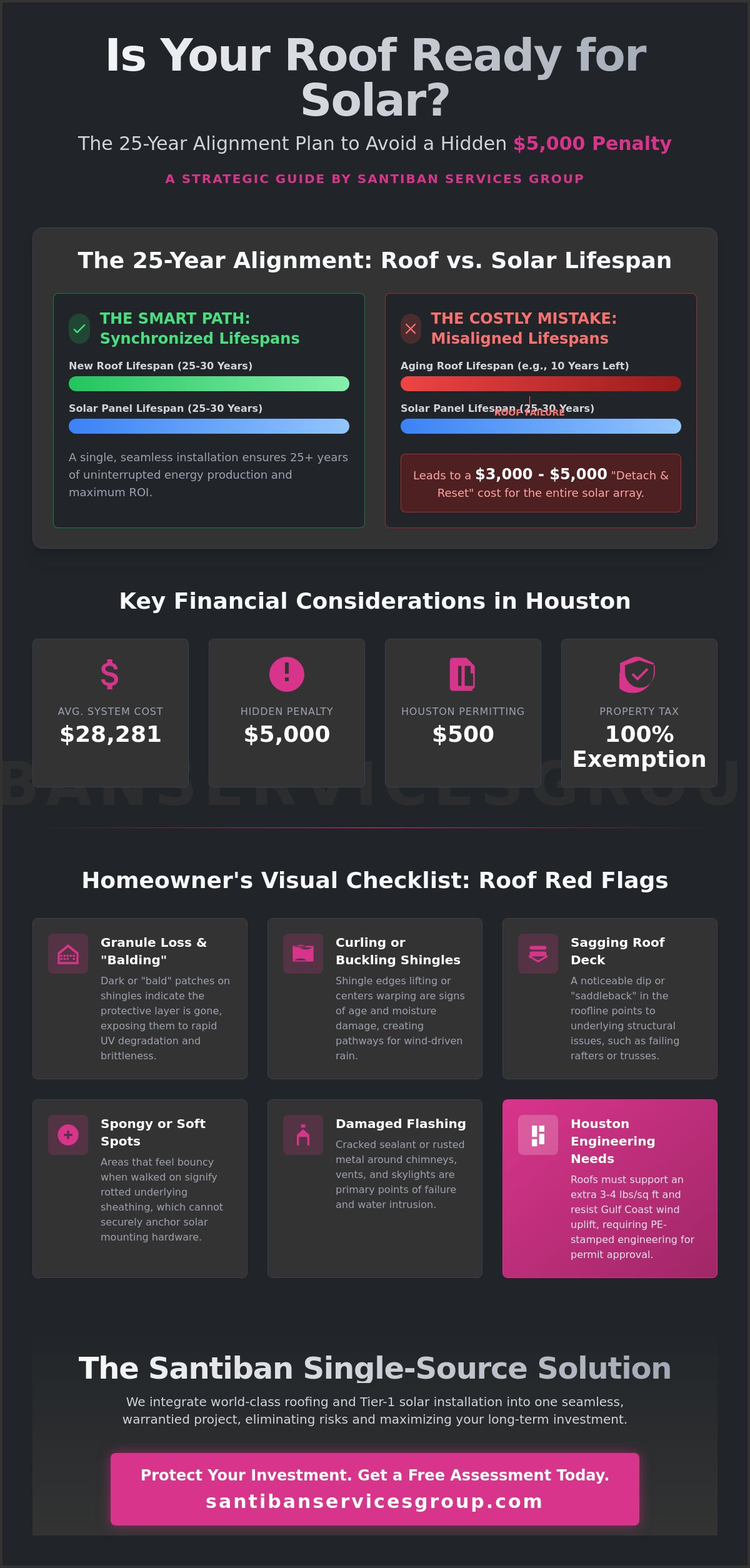
A solar reroof represents a strategic infrastructure upgrade designed to synchronize the longevity of your property’s exterior with the 25-year operational lifecycle of modern Tier-1 photovoltaic technology. It’s not merely a maintenance task; it’s a foundational requirement for any high-performance rooftop solar power system. When a property owner ignores the signs you need a solar reroof, they effectively gamble on the integrity of their investment. Most Tier-1 panels are engineered to produce power for 25 to 30 years. If these are installed on a roof with only 10 years of remaining utility, the financial repercussions are significant.
The primary risk lies in the “detach and reset” process. Should your roof require replacement mid-way through the solar system’s life, you’ll face labor costs ranging from $3,000 to $5,000 just to move the panels. Santiban Services Group advocates for a “Zero-Waste Installation” philosophy. This methodology ensures that your roofing materials and solar components age in parallel, maximizing your return on investment and eliminating redundant labor expenditures. Identifying the signs you need a solar reroof today prevents a logistical and financial crisis a decade from now.
The Mathematical Argument for Reroofing First
The financial landscape for Houston solar changed significantly after the 30% federal tax credit for homeowners expired on December 31, 2025. Without this upfront offset, the focus shifts entirely to long-term operational savings. A combined solar reroof project in 2026 typically ranges from $15,000 to over $50,000. While this is a substantial capital commitment, it’s far more efficient than paying for separate mobilizations. By integrating these services, you eliminate the 20% labor premium often associated with fragmented contracting. Protecting your ROI means ensuring your roof doesn’t become a liability in year twelve of a twenty-five-year energy plan.
Houston Permitting and Compliance Standards
The City of Houston maintains rigorous building codes that require documented proof of structural integrity before a solar permit is issued. These regulations ensure that the “dead load” of the panels, which adds approximately 3 to 4 pounds per square foot, doesn’t compromise the building’s safety. Santiban Services Group manages this complexity through PE-stamped engineering for solar systems, which is a critical component of the local permitting process. Our dedicated teams provide a single-source solution, managing everything from the initial structural assessment to the final electrical interconnection. This integrated approach ensures meticulous compliance with Texas regulations and provides the corporate stability property managers expect.
Visible Indicators: A Homeowner’s Checklist for Surface Degradation
A comprehensive roof assessment begins with a meticulous visual inspection of the primary protective layer. Identifying the physical signs you need a solar reroof requires more than a casual glance from the ground. Property owners should look for substantial granule loss, which often manifests as “balding” on asphalt shingles. These granules are not merely aesthetic; they protect the underlying bitumen from UV radiation. In the intense Houston sun, exposed bitumen becomes brittle within months, leading to widespread failure once the weight of a solar array is applied.
Recognizing these signs you need a solar reroof is the first step in a disciplined facility management strategy. Curling, buckling, or “cupping” of shingle edges indicates that the material has reached its end-of-life stage. These deformations create gaps that allow wind-driven rain to penetrate the underlayment. Property managers should also note any “soft spots” or bouncy sections while walking the surface. These areas typically signify advanced rot in the plywood decking, which can’t securely hold the lag bolts used in solar mounting systems. The integrity of flashing around chimneys and vents must also be verified, as these common failure points become nearly impossible to repair once panels are installed.
Asphalt Shingle Health and Solar Racking
Solar racking systems require multiple penetrations into the roof rafters to secure the mounting rails. If shingles are brittle, the pressure of the installation process causes immediate cracking and subsequent leaks. Beyond the installation phase, a phenomenon known as “thermal lag” occurs. Panels trap heat against the roof surface, often maintaining temperatures significantly higher than exposed shingles. This accelerated heat stress rapidly degrades already compromised materials. For those considering an upgrade, consulting with a qualified solar infrastructure partner ensures these variables are evaluated before construction begins.
Attic-Side Inspections for Hidden Moisture
A thorough evaluation must include the interior of the attic space to identify hidden vulnerabilities. Property owners should look for daylight peeking through the roof deck, which indicates a direct breach in the building envelope. Dark streaks or water staining on rafters and plywood are definitive indicators of active or historical moisture intrusion. Mold or mildew odors suggest poor ventilation, a condition that will only worsen once panels restrict airflow across the roof surface. It’s essential to identify these red flags early to ensure the structural foundation is capable of supporting a 25-year energy investment.
Structural and Engineering Red Flags: Beyond the Shingles
Structural integrity forms the invisible foundation of a 25-year energy asset. While surface aesthetics are important, the underlying framework must support the “dead load” of a modern photovoltaic system. Solar modules and their associated racking hardware add approximately 3 to 4 pounds per square foot of constant pressure to your rafters. If your building’s skeleton is already showing signs of fatigue, adding this weight is a liability. Identifying the structural signs you need a solar reroof often requires a professional evaluation of the ridge line and rafters. A sagging ridge line is a definitive red flag, suggesting that the existing rafters can no longer manage the current load, let alone the added stress of an industrial-grade solar array.
Another non-negotiable indicator is the presence of multiple shingle layers. In many older Houston neighborhoods, contractors historically installed new shingles directly over old ones to save on labor. You cannot safely install solar racking over two or more layers of roofing material. The mounting brackets require a direct, secure connection to the roof deck and rafters to resist wind uplift. If your property has an “overlay” roof, it’s one of the most critical signs you need a solar reroof. Additionally, we must assess the thickness of the roof sheathing. If the plywood or OSB deck is less than 7/16 of an inch thick, it likely lacks the fastener pull-out strength required for long-term solar stability.
The Necessity of PE-Stamped Engineering Design
Santiban Services Group maintains a superior safety standard by utilizing PE-stamped engineering for every solar project. This process involves a licensed Professional Engineer verifying that your specific roof structure can withstand both the dead load of the panels and the “live loads” from wind and weather. In Houston, where wind speeds can exceed 130 mph during tropical events, this engineering stamp is a vital safeguard. It ensures that your infrastructure investment remains secure and compliant with the latest municipal building codes, providing the corporate stability our clients demand.
Load-Bearing Capacity for Battery Integration
Modern energy independence often requires the integration of heavy storage equipment. As a certified Tesla Powerwall installer, we meticulously plan for the weight distribution of battery units and high-efficiency modules. A Tesla Powerwall 3, for instance, is a substantial piece of hardware that requires precise mounting. A strategic solar reroof allows our dedicated teams to reinforce the roof deck or wall structures before the installation begins. This proactive approach ensures that your entire energy ecosystem is supported by a foundation engineered for excellence in every detail.
Houston-Specific Climate Considerations for Solar Reroofing
Houston’s environmental conditions are uniquely aggressive, characterized by extreme humidity, hurricane-force winds, and intense thermal cycles. These factors accelerate the degradation of roofing materials far faster than in more temperate regions. When evaluating the signs you need a solar reroof, property owners must consider the presence of Gloeocapsa Magma. This hardy algae species thrives in the Gulf Coast’s high humidity, appearing as dark streaks that gradually consume the limestone filler in asphalt shingles. This biological degradation compromises the shingle’s structural integrity, making it an unsuitable foundation for a 25-year solar array.
Thermal expansion also plays a critical role in the longevity of your energy system. During Houston’s frequent 100°F+ days, the temperature on a roof surface can exceed 160°F. This heat causes solar mounting points and racking components to expand and contract. In an aging roof, this constant mechanical stress leads to micro-tears in the underlayment and around fastener penetrations. Identifying these climate-driven signs you need a solar reroof early ensures that your system doesn’t develop catastrophic leaks during our intense tropical rain events. For a reliable transition, request a professional infrastructure assessment from our dedicated team.
Wind Speed Ratings and Solar Racking
In accordance with Texas building standards, roofs in the Houston region must withstand wind speeds of 130 mph or higher. Solar panels effectively act as a “sail,” significantly increasing the wind uplift forces acting on the roof deck. A strategic reroof provides the opportunity to implement superior fastening patterns, often referred to as “Nail Zones,” which secure shingles against these extreme pressures. Upgrading to impact-resistant shingles during this phase is a meticulous way to protect your investment from the hail and debris common in Gulf Coast storms.
Ventilation and Moisture Management
Effective ventilation is a non-negotiable requirement for Texas properties. Ridge vents play a critical role in preventing attic heat buildup, which can otherwise damage both the roof deck and the efficiency of your solar inverters. While solar panels provide beneficial shading, they can also create a “micro-climate” that traps moisture against the shingles if airflow is restricted. Our teams utilize meticulous sealing techniques and integrated ventilation designs to manage this moisture. This proactive approach prevents the mold and rot that often go unnoticed beneath active solar arrays.
The Strategic Advantage of a Solar Reroof with Santiban Services Group
The Santiban Services Group provides a single-source solution that eliminates the inherent risks of fragmented contracting. Traditional installations often involve separate roofing and solar entities; this frequently leads to accountability gaps when structural issues or leaks arise. By integrating these services, we ensure a seamless transition from the initial tear-off to the final electrical interconnection. This unified approach provides property owners with a comprehensive warranty that covers both the building envelope and the energy generation system. Our project management teams oversee every operational detail, ensuring that the signs you need a solar reroof are addressed before a single panel is mounted. We prioritize corporate stability and long-term reliability, acting as a disciplined partner for your property’s infrastructure.
Meticulous project management is the hallmark of our service delivery. We eliminate the “contractor gap” by utilizing dedicated teams trained in both high-end roofing and industrial electrical construction. This ensures that every penetration is sealed to superior standards and every mounting bracket is secured to a reinforced deck. You won’t find the typical finger-pointing between contractors here. Instead, you’ll experience a steady, methodical workflow that respects your time and your property’s integrity. It’s an integrated strategy designed to protect your ROI for the full 25-year lifespan of the system.
Premium Integrated Solar Roof Solutions
For property owners seeking the pinnacle of energy resilience, we offer advanced integrated solar roof solutions as a premium, aesthetically pleasing alternative to traditional panels. These systems replace standard shingles with sleek, durable solar tiles, creating a modern, high-performance aesthetic that is remarkably robust. Our teams also optimize these installations for future optimized grid energy programs, allowing you to maximize your financial returns through automated energy trading. We apply an “excellence in every detail” mantra to these projects, ensuring that your home’s foundation is as technologically advanced as the energy it generates.
Next Steps for Houston Homeowners
Securing your home’s energy future requires a professional foundation and a clear understanding of the signs you need a solar reroof. In May 2026, the timeline for a typical integrated project remains steady at four to six weeks from the initial engineering design to final municipal inspection. We invite you to request a comprehensive site assessment from our technical experts. Our team will provide a factual, transparent evaluation of your roof’s health and a tailored proposal for your solar transition. Don’t wait for a leak to compromise your investment. Establish a partnership with a reliable provider that values consistency and professional performance above all else.
Secure Your Infrastructure for a 25-Year Energy Cycle
Identifying the signs you need a solar reroof is the most critical step in protecting your property’s long-term ROI. A solar transition isn’t just an electrical upgrade; it’s a structural commitment that must withstand Houston’s 130 mph wind speeds and intense humidity. By ensuring your roof and panels share a synchronized 25-year lifecycle, you eliminate the risk of a $5,000 panel removal fee later. This proactive alignment safeguards your investment and guarantees that your building envelope remains secure under the weight of modern photovoltaic technology.
Santiban Services Group provides the corporate stability and technical precision required for these complex infrastructure projects. Our Tesla-certified installation team leverages over 24 years of industrial electrical experience to deliver seamless results. We include PE-stamped engineering for all complex projects to verify that every detail meets rigorous safety and compliance standards. Consult with our Houston solar reroof experts today to establish a foundation built for excellence. We look forward to securing your energy future with a reliable, single-source solution.
Frequently Asked Questions
How old is too old for a roof when installing solar panels?
Any roof with more than 10 to 12 years of service is generally considered too old for a new solar installation. Because Tier-1 panels are engineered for a 25-year lifecycle, an aging roof will likely fail long before the energy system. This creates a financial liability, as property owners must pay between $3,000 and $5,000 to detach and reset the panels during a future roof replacement. Evaluating the signs you need a solar reroof today prevents this redundant expenditure.
Does a solar reroof qualify for the 30% Federal Solar Tax Credit?
No, the 30% Residential Clean Energy Credit for homeowners expired on December 31, 2025. For systems installed in 2026, homeowners must rely on other financial drivers such as the 100% Texas property tax exemption on solar value and long-term electricity savings. While some commercial entities may still capture tax benefits, residential property owners should focus on the strategic ROI of a combined installation to minimize upfront labor premiums.
Can I just repair the leaky parts of my roof instead of a full reroof?
Isolated repairs are rarely sufficient for a property transitioning to solar energy. Solar racking systems add 3 to 4 pounds of dead load per square foot across the entire roof surface, requiring uniform structural integrity. Patching specific leaks doesn’t address underlying issues like brittle bitumen or widespread granule loss. Identifying the comprehensive signs you need a solar reroof ensures that your infrastructure can support the mechanical stress of an array for several decades.
How long does the solar reroofing process take with Santiban Services Group?
A typical integrated project requires four to six weeks from the initial PE-stamped engineering design to final municipal interconnection. This timeline accounts for the 2 to 4 weeks usually required for City of Houston permit processing. Our dedicated teams manage the transition meticulously, ensuring the roof replacement and solar installation occur in a logical, efficient sequence that minimizes disruption to your daily operations.
Will installing solar panels void my existing roof warranty?
Installing panels through a separate contractor frequently voids existing manufacturer warranties due to the numerous penetrations required for racking. Santiban Services Group eliminates this risk by providing a single-source solution. We handle both the roof replacement and the Tesla-certified solar installation, which allows us to provide a unified warranty. This comprehensive coverage protects the building envelope and the energy system under one professional entity.
What happens if my roof leaks after the solar panels are installed?
Our integrated service model ensures that any post-installation issues are resolved without the “contractor gap” or finger-pointing common in fragmented projects. Because we manage both the infrastructure and the energy components, our internal teams are responsible for the entire system’s integrity. We utilize meticulous sealing techniques designed for Houston’s intense rain events, but should a leak occur, we provide a single point of contact for rapid resolution.
Is it cheaper to do the roof and solar at the same time?
Consolidating these projects typically reduces total labor costs by 20% compared to hiring separate contractors at different times. You eliminate the cost of multiple mobilizations and avoid the $3,000 to $5,000 penalty of removing panels for a future reroof. A combined project is a strategic hedge against rising labor rates and ensures that your energy investment is built on a foundation of excellence from day one.
What is the best roofing material for solar panels in Houston?
Architectural asphalt shingles with a 130 mph wind rating or integrated Tesla solar tiles are the superior choices for the Houston climate. These materials are specifically engineered to withstand the Gulf Coast’s high humidity and extreme thermal expansion. We ensure that every installation utilizes meticulous fastening patterns to resist wind uplift, providing a stable and reliable platform for your 25-year solar investment.