
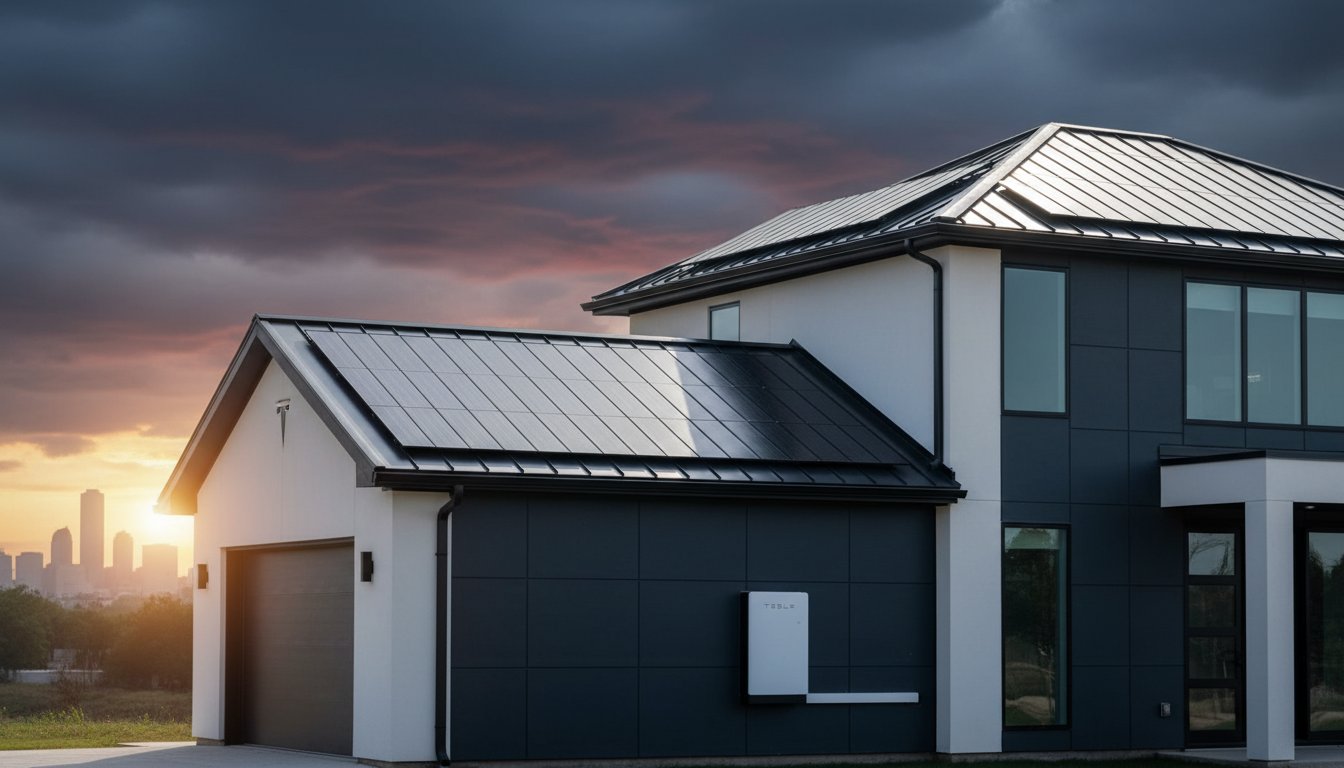
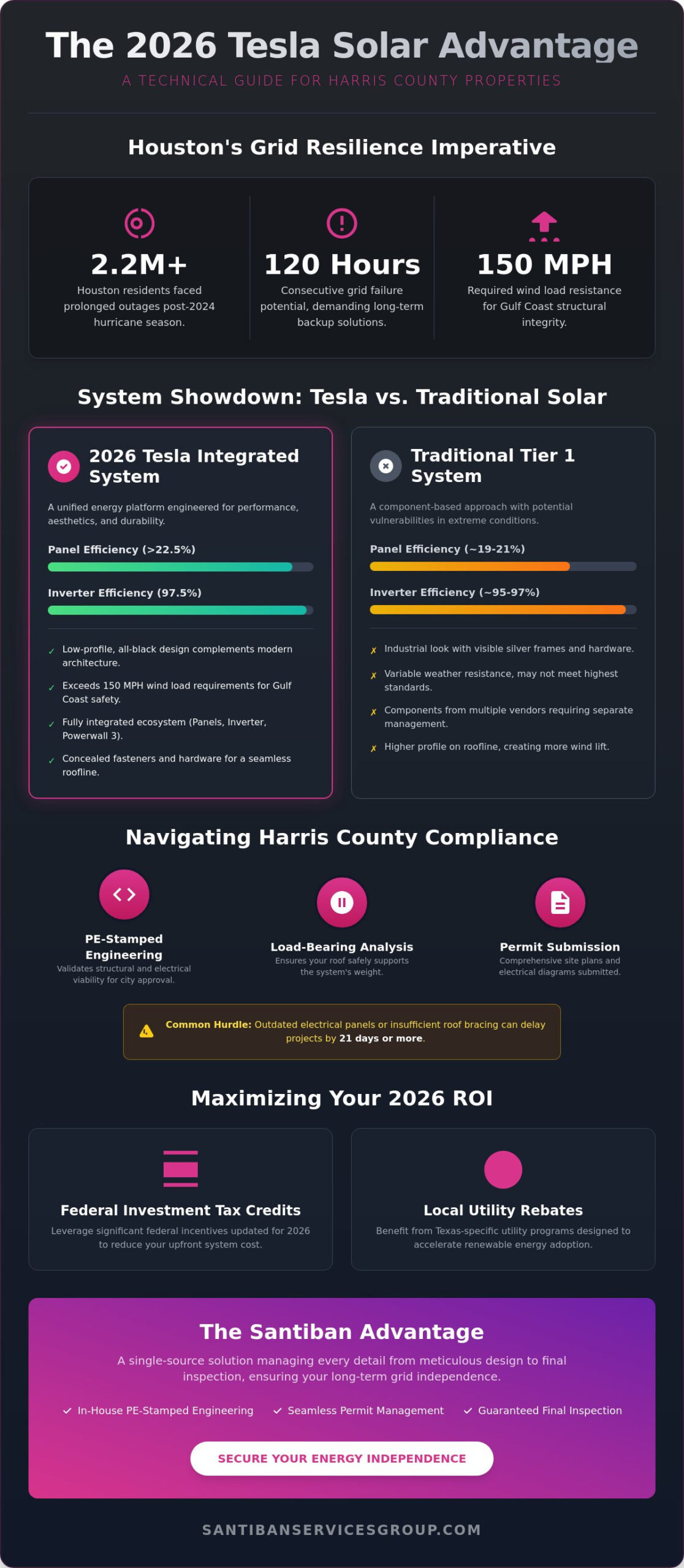
Could your property maintain operational continuity if the Harris County grid failed for 120 consecutive hours? Following the 2024 hurricane season, where more than 2.2 million Houston residents experienced prolonged outages, the necessity for a resilient energy strategy is undeniable. We recognize that you require a power solution capable of withstanding 150 mph wind loads while delivering consistent, high-end performance. Integrating a tesla panel solar system provides the sophisticated technical foundation required for this level of autonomy. You’ve likely concluded that traditional backup systems often fail to meet the rigorous demands of Houston’s extreme weather cycles.
This guide delivers a comprehensive analysis of the 2026 technical specifications and local structural protocols essential for a superior installation. We’ll show you how to navigate the complex Harris County permitting processes to ensure your system is fully code-compliant and meticulously engineered for durability. You’ll gain a clear understanding of the professional requirements for seamless integration with the Powerwall 3 and how our tailored solutions secure your long-term grid independence. We’ve organized this comparison to provide the factual clarity needed for a disciplined investment in your property’s infrastructure.
Key Takeaways
- Understand the technical specifications of the 2026 Tesla ecosystem and how its low-profile design optimizes energy efficiency for modern Houston properties.
- Navigate the rigorous Houston Permitting Center requirements by utilizing PE-stamped engineering and comprehensive structural load-bearing analysis for your project.
- Compare the performance and durability of a tesla panel solar system against traditional Tier 1 alternatives in high-humidity and high-heat environments.
- Identify the latest 2026 federal investment tax credits and local utility rebates to maximize the financial return on your renewable energy transition.
- Ensure a seamless installation process by leveraging a single-source solution that manages every detail from meticulous design to final inspection.
What defines a Tesla Panel Solar System in 2026?
In 2026, a tesla panel solar installation represents more than a collection of photovoltaic modules; it is a unified energy platform engineered for the specific demands of the Houston metropolitan area. Tesla hardware utilizes high-efficiency monocrystalline silicon cells that achieve conversion rates exceeding 22.5%. These systems prioritize a low-profile architecture, sitting closer to the roofline than traditional rack-mounted alternatives. This design choice reduces wind lift and improves the structural resilience of the array during severe weather events.
2026 marks a critical juncture for Texas homeowners. Following the 2024 and 2025 updates to the Texas utility grid regulations, residential solar adoption in Harris County has increased by 18% annually. Houston residents now view solar as a necessity for operational continuity. While traditional panels often feature silver frames and visible mounting hardware, Tesla’s design utilizes all-black components and concealed fasteners. This meticulous finishing ensures the array complements the architectural integrity of modern Houston homes while providing a superior power-to-weight ratio. Understanding the full scope of the tesla texas energy ecosystem is essential for homeowners evaluating long-term grid independence strategies.
The Integrated Ecosystem: Panels, Inverters, and Powerwall 3
The Tesla Solar Inverter manages energy conversion with 97.5% efficiency, ensuring minimal power loss during peak Houston summers. This hardware works in tandem with tesla motors solar technology to create a closed-loop energy environment. According to this Tesla Energy Overview, the brand’s shift toward integrated storage solutions has redefined how residential power is managed through a single software interface. The Tesla ecosystem functions as a self-sustaining microgrid that prioritizes home loads before exporting excess energy to the ERCOT grid.
Aesthetics and Durability for the Houston Modern Home
Houston’s deed-restricted communities often impose strict guidelines on external modifications. Tesla’s sleek profile satisfies these aesthetic requirements by eliminating the industrial look of standard solar arrays. Engineering standards for the Gulf Coast require hardware to withstand wind speeds exceeding 150 mph. Tesla’s proprietary mounting systems are tested to meet these rigorous safety protocols, ensuring the tesla panel solar system remains secure during tropical storms. Professional installation teams focus on excellence in every detail, utilizing meticulous finishing techniques that conceal all visible wiring and hardware within the attic space or behind the panels themselves. This approach provides a seamless appearance that preserves property values in high-end neighborhoods like River Oaks and The Woodlands.
The Necessity of PE-Stamped Engineering for Houston Solar Projects
The Houston Permitting Center enforces rigorous standards for renewable energy installations. For a tesla panel solar system, the city requires Professional Engineering (PE) stamps to validate structural and electrical viability. This mandate ensures the existing roof structure can support the additional dead load of the panels and hardware. Santiban Services Group provides these essential engineering services in-house to maintain project momentum and technical accuracy.
Structural load-bearing analysis remains a critical requirement. Engineers calculate the weight distribution to prevent sagging or long-term structural fatigue on residential frames. Simultaneously, electrical engineering ensures the tesla panel solar array integrates safely with the CenterPoint Energy grid. This meticulous planning prevents voltage surges or equipment failure during peak production hours. Our proactive approach to design minimizes the risk of system rejection by municipal inspectors.
Navigating Houston Permitting and Compliance
Securing a Harris County solar permit involves a detailed application process. You must submit a site plan, a three-line electrical diagram, and detailed structural calculations. Common hurdles include outdated electrical panels or insufficient roof bracing, which can delay projects by 21 days or more. Utilizing PE stamped engineering for solar systems reduces these delays by providing code-compliant documentation during the initial submission. Homeowners should consult Federal Solar Incentives and Guides to understand the broader regulatory and financial landscape before beginning. Santiban Services Group manages these logistics as a single-source partner, ensuring a predictable project timeline.
Structural Integrity and Solar Reroofing
Installing solar on a roof nearing the end of its lifecycle is a tactical error. We evaluate roof age and health before any installation. If a roof is over 12 years old, we often recommend a solar reroof. This proactive approach prevents leaks and ensures the mounting system meets 2026 Houston building codes for wind resistance. These updated codes require systems to withstand gusts up to 150 mph in specific coastal zones. An integrated reroofing strategy provides a seamless transition between the protective layer and the energy-generating hardware. Our dedicated teams focus on excellence in every detail to protect your long-term investment. If you’re planning an upgrade, you can contact our engineering team for a preliminary site assessment.
Tesla Panel Solar vs. Traditional Solar: A Houston Comparison
Houston’s climate demands specialized engineering that prioritizes durability alongside power generation. The tesla panel solar system distinguishes itself through a low-profile design and superior thermal management. While traditional Tier 1 monocrystalline panels often prioritize peak efficiency in laboratory settings, the Tesla ecosystem focuses on consistent output under real-world Texas conditions. This performance gap becomes evident when comparing long-term degradation and hardware resilience in high-moisture environments.
Heat Tolerance and Efficiency in the Texas Summer
Houston experiences an average of 40 days per year with temperatures exceeding 90 degrees. Solar cells naturally lose efficiency as they heat up. Tesla panels utilize a specialized backing and frame design that facilitates airflow, mitigating the heat island effect on residential rooftops. Tesla’s hardware achieves a temperature coefficient of -0.34% per degree Celsius, which outperforms the industry average of -0.39% observed in many standard monocrystalline modules. This technical advantage ensures that tesla panel solar installations continue to produce high yields even when roof temperatures climb above 140 degrees.
High humidity levels in the Gulf Coast region also introduce specific oxidative risks to electrical components. Tesla’s integrated wiring and sealed junction boxes prevent the moisture ingress that leads to premature corrosion in cheaper alternatives. This engineering precision is supported by Solar Panel Efficiency Data, which tracks how high-quality silicon cells maintain better long-term reliability when exposed to environmental stressors. By minimizing thermal and moisture-related losses, Houston homeowners see a more predictable return on their energy investment.
Hurricane Resilience and Wind Load Ratings
Resilience is a non-negotiable requirement for Houston infrastructure. Tesla panels are engineered to withstand wind loads of up to 2,400 pascals, meeting the strict building codes required for hurricane-prone areas. The proprietary mounting hardware creates a seamless bond with the roof deck. This reduces the lift forces that can detach traditional railed systems during tropical storms or high-wind events. The system’s durability is tested against 1.75-inch hail at speeds of 76 mph, providing a level of protection that exceeds standard industry benchmarks.
Beyond the panels themselves, the integration of energy storage is critical for operational continuity during grid outages. Selecting a certified tesla powerwall installer ensures that the entire electrical architecture is hardened against the unique challenges of the Texas coastal plain. This integrated approach provides several benefits:
- Structural Integrity: Interlocking components reduce vibration and mechanical stress.
- Meticulous Sealing: Waterproofing techniques that protect the roof’s substrate.
- Redundant Safety: Rapid shutdown capabilities that exceed NEC 2020 requirements.
Tesla guarantees a degradation rate of no more than 0.5% per year over a 25-year period. This ensures the system still produces approximately 86% of its original capacity after two decades of service. For Houston homeowners, the cost-to-value ratio is driven by this longevity and the reduction in maintenance overhead. Traditional systems may offer lower upfront costs, but they often lack the integrated monitoring and aesthetic cohesion that preserve property value over time. Santiban Services Group provides the professional oversight required to deploy these sophisticated assets with absolute precision.
Calculating ROI: 2026 Incentives and Energy Savings in Texas
Achieving a favorable return on investment for a tesla panel solar installation in Houston requires a meticulous analysis of the 2026 fiscal environment. Financial performance is no longer dictated solely by energy offset. It is driven by a sophisticated combination of federal tax credits, state-level property tax exemptions, and strategic grid participation. Property owners in the CenterPoint Energy service area benefit from a regulatory framework that encourages renewable integration, provided the system is engineered for maximum efficiency.
Texas Tax Code Section 11.27 provides a significant advantage for Houston residents. This statute allows a 100% property tax exemption on the appraised value added to a property by a solar energy system. While your home value increases due to the premium tesla panel solar hardware, your tax liability remains unchanged. This exemption ensures that the long-term appreciation of your asset doesn’t erode your annual energy savings.
Maximizing the Federal Investment Tax Credit
The Federal Investment Tax Credit (ITC) remains the most powerful catalyst for solar ROI in 2026. Under current legislation, taxpayers can claim a 30% credit on the total cost of the system. This includes the solar panels, Powerwall storage units, and all associated engineering and installation fees. To secure this credit, the system must be placed in service during the tax year. We recommend maintaining a comprehensive file of all manufacturer certifications and final inspection reports. IRS Form 5695 is the primary document required to claim this credit. Strategic timing is essential. Completing your installation before the end of the fiscal year allows you to realize these tax benefits in the immediate filing cycle, effectively reducing your net capital outlay by nearly one-third.
Utility-Specific Rebates and Net Metering
Houston’s deregulated market offers diverse opportunities for solar buyback plans through various Retail Electric Providers (REPs). While CenterPoint Energy manages the transmission infrastructure, the ROI depends on selecting a provider that offers competitive rates for exported energy. The ecosystem becomes significantly more profitable when you integrate tesla electric into your strategy. This platform allows for automated energy trading within the ERCOT market.
Effective ROI management involves:
- Exporting excess energy during peak demand periods when prices are highest.
- Utilizing stored Powerwall energy during “Critical Load” events to avoid high market rates.
- Selecting REPs that offer “Real-Time” pricing rather than fixed-rate buyback caps.
Our teams ensure that every system is configured to handle these complex export scenarios with precision. This proactive approach transforms your solar installation from a passive utility into an active financial asset.
To ensure your facility meets the highest standards of energy efficiency and structural integrity, contact Santiban Services Group for a professional consultation today.
The Santiban Advantage: Professional Tesla Solar Installation
A Disciplined Approach to Energy Infrastructure
Our authoritative engineering background ensures a superior installation process. Industrial-grade residential solar demands meticulous craftsmanship that standard contractors often overlook. We apply rigorous technical standards to every tesla panel solar project. This disciplined methodology mitigates risks associated with Houston’s extreme weather, including the high-wind loads common in the Gulf Coast region. Our commitment to safety and compliance remains absolute. We ensure every component meets or exceeds the 2026 National Electrical Code requirements. By maintaining total control over the design and labor, we eliminate the variables that lead to system failure.
- PE-stamped structural and electrical blueprints for every residential project.
- In-house master electricians oversee all wiring and grid interconnection tasks.
- Rigorous 50-point safety inspections conducted before system activation.
- Deployment of industrial-grade mounting hardware for maximum roof integrity.
Getting Started with Your Houston Solar Project
A professional site assessment is the first step toward a high-performing tesla panel solar system. We don’t rely on satellite imagery alone. Our technicians perform detailed on-site evaluations to analyze roof health and existing electrical capacity. We handle the complex logistics of solar reroofing and Powerwall battery integration with surgical precision. This integrated approach ensures your roof and solar array function as a single, cohesive unit. Our teams manage all permitting and utility interconnection paperwork to provide a seamless experience for the property owner.
Request a tailored proposal for your Houston property today. We provide clear, factual data regarding your expected energy production and system longevity. Our proposals reflect 24 years of technical expertise and a steadfast commitment to corporate stability. We remain a dependable partner long after the installation is complete, ensuring your investment delivers consistent value for decades.
Securing Houston’s Energy Future with Meticulous Engineering
Investing in a tesla panel solar system in 2026 requires more than high-end hardware. It demands a sophisticated engineering approach tailored to Houston’s rigorous coastal building codes and the 30% Residential Clean Energy Credit currently available through federal programs. Success in the Texas energy landscape depends on meticulous planning and PE-stamped designs that ensure structural integrity against Gulf Coast weather patterns. These technical requirements aren’t optional; they’re the foundation of a reliable long-term asset. By prioritizing professional engineering over basic installation, you protect your property’s value and operational continuity. A comprehensive review of the tesla texas 2026 energy ecosystem guide provides additional context for homeowners navigating these infrastructure decisions.
Santiban Services Group brings 24+ years of industry experience to every project. As a Tesla Certified Installation Partner, we provide an integrated solution that combines superior technology with in-house PE-stamped engineering design. We manage every operational detail to ensure a seamless transition for your property. Our dedicated teams focus on excellence in every detail, providing the corporate stability you need for a permanent energy partnership. We’re ready to transform your facility’s energy profile with the precision and professionalism your investment deserves.
Consult with our Tesla-certified engineers for your Houston solar project to begin your transition to a reliable, high-performance energy future. Your path to energy independence is secure with a partner that values consistent performance above all else.
Frequently Asked Questions
How much do Tesla solar panels cost in Houston for 2026?
Tesla solar panels in Houston typically cost between $2.50 and $3.30 per watt before the application of federal tax incentives. This pricing aligns with the Solar Energy Industries Association data for the Texas market, where a standard 12 kW system requires a gross investment of approximately $30,000 to $39,600. The 30% Investment Tax Credit remains available through 2032, which significantly reduces the net capital expenditure for local homeowners. Our firm provides meticulous cost analyses to ensure every project meets these established market benchmarks.
Are Tesla solar panels worth it compared to a Tesla Solar Roof?
Traditional panels offer a faster return on investment because they provide a 20% higher energy yield per dollar spent compared to the integrated roof product. While the Solar Roof serves as a complete structural replacement, a tesla panel solar installation integrates with your existing roof to provide superior efficiency at a lower price point. We specialize in tailored solutions that prioritize long-term asset performance and functional clarity for our clients. Most Houston properties benefit more from the higher power density of traditional modules.
Can Tesla panels withstand a Category 4 hurricane in Houston?
Tesla solar panels are engineered to withstand wind speeds of up to 150 miles per hour, which encompasses the requirements for a Category 4 hurricane. These systems comply with the Texas Department of Insurance windstorm building codes specifically mandated for the Houston-Galveston coastal region. Our dedicated teams utilize specialized mounting hardware to ensure every installation maintains its structural integrity during extreme weather. This proactive approach to safety ensures your energy infrastructure remains secure even in the most challenging conditions.
What is the warranty period for a Tesla panel solar system?
The comprehensive warranty for a tesla panel solar system includes a 25 year performance guarantee and a 10 year workmanship warranty. This performance guarantee ensures the modules retain 80% of their original generating capacity after two and a half decades of operation. We manage the technical oversight of these systems to ensure they meet these rigorous standards for reliability. Our commitment to excellence ensures your facility remains operational and efficient throughout the entire equipment lifecycle without unexpected maintenance costs.
Do I need a new roof before installing Tesla solar panels?
You should replace your roof prior to installation if the current structure has less than 10 years of functional life remaining. Because solar panels have a 25 year lifespan, installing them on an aging roof leads to a costly removal and reinstallation process when the shingles eventually fail. Our technicians conduct a meticulous assessment of your roof’s condition during the initial engineering phase. We provide integrated solutions that coordinate roofing repairs with solar deployment to ensure a seamless and stable transition.
How long does the Tesla solar installation process take in Harris County?
The installation process in Harris County generally requires 60 to 90 days from the initial contract signing to the final permission to operate. This timeline includes 3 to 4 weeks for engineering design and 2 to 5 weeks for municipal permitting through the City of Houston or Harris County offices. The physical installation on your property usually concludes within 2 business days. Our project managers handle every logistical detail to ensure the flow of information is logical, steady, and predictable.
Is PE-stamped engineering required for all Houston solar projects?
The City of Houston and Harris County require a Professional Engineer stamp for all solar structural and electrical plan sets. This certification confirms that your roof can support the additional 3 pounds per square foot of dead load and meet local wind uplift requirements. Our firm provides comprehensive, PE-stamped engineering packages for every residential and commercial project we oversee. We prioritize technical precision to ensure your system meets all safety and regulatory mandates without exception.
Does Tesla solar work during a Houston power outage?
Tesla solar panels only provide power during a grid failure if the system includes a Powerwall battery backup. Without a battery, the inverter automatically shuts down during an outage to prevent backfeeding electricity into the grid, which is a safety requirement for utility workers. An integrated Powerwall system detects a power loss in less than 20 milliseconds and transitions your home to stored energy seamlessly. This setup provides essential reliability and corporate-level stability during Houston’s frequent grid instabilities.