
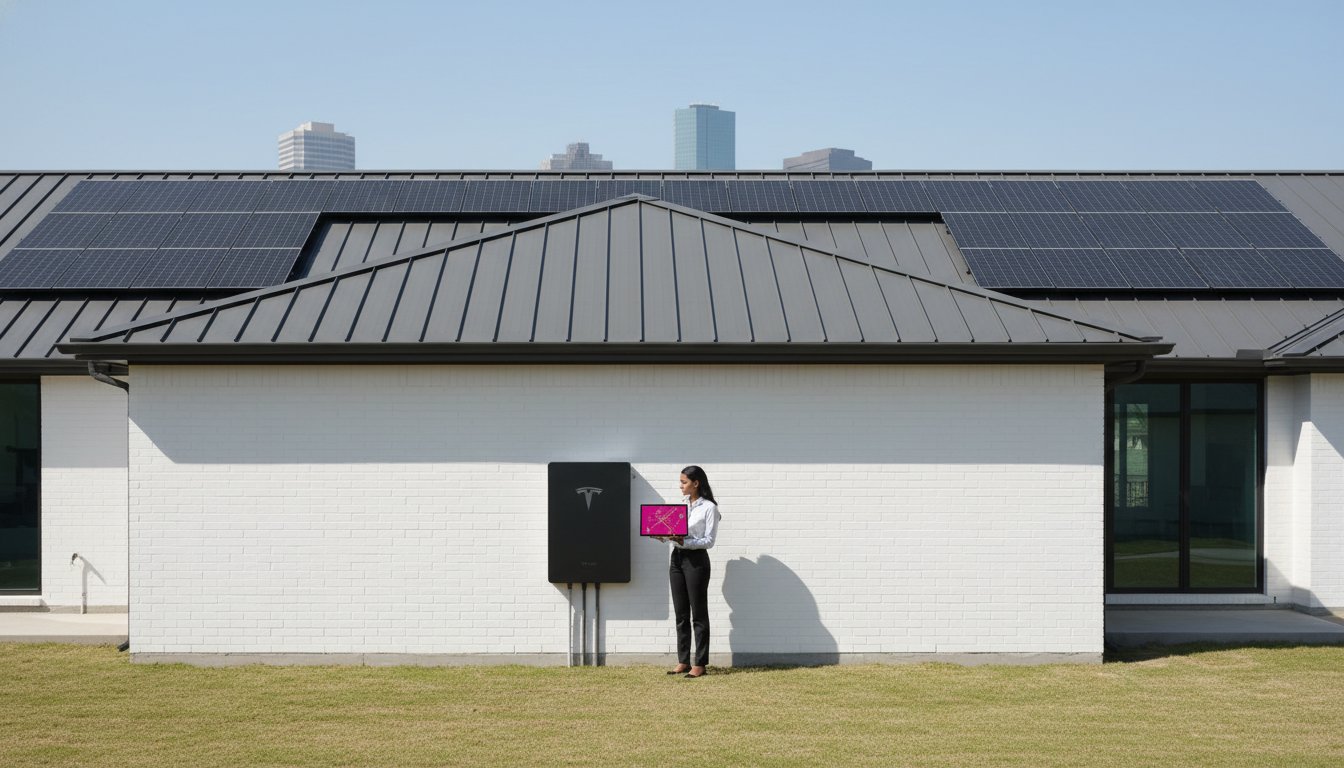
In May 2024, a single derecho event left over 922,000 Houston customers without power, proving that a standard grid connection is no longer a reliable foundation for your property’s energy security. You likely recognize that protecting your home or facility requires a sophisticated energy strategy rather than a simple hardware purchase. Integrating tesla motors solar technology provides a powerful solution; however, the difference between a standard installation and a resilient one lies in the meticulous precision of the engineering.
This professional guide details how to combine Tesla’s advanced hardware with Houston-specific structural engineering to ensure your system remains operational through Category 4 wind speeds. You’ll learn how to navigate the complex landscape of PE-stamped permit requirements and the technical advantages of the Powerwall 3. We provide a clear roadmap for achieving a seamless, hurricane-resilient installation that manages every regulatory detail, from the initial site audit to the final utility interconnection.
Key Takeaways
- Learn how to optimize a tesla motors solar ecosystem specifically for Houston’s unique climate to achieve superior grid independence and equipment durability.
- Understand why an integrated Tesla inverter ecosystem outperforms mixed-brand setups through seamless technical synergy and proprietary mounting solutions.
- Identify the essential engineering requirements for Texas compliance, including the necessity of PE-stamped structural load calculations for high-wind environments.
- Analyze the projected 2026 ROI for solar investments, factoring in comprehensive hardware costs and the current 30% Federal Investment Tax Credit status.
- Discover how Santiban’s “Silent Engine” approach ensures a professional, high-end installation backed by over two decades of Texas industrial electrical experience.
The Evolution of Tesla Motors Solar Technology for Houston Homes
The 2026 tesla motors solar ecosystem represents a decisive shift from simple energy generation to a comprehensive management strategy. In Houston, residential energy demands are dictated by peak humidity and summer temperatures that frequently exceed 100 degrees. These environmental factors require hardware that withstands both corrosion and extreme thermal stress. By analyzing Tesla Energy’s history and technology, we observe a steady progression toward fully integrated systems that prioritize structural durability. Homeowners now utilize a combination of high-efficiency panels, tempered glass roof tiles, and intelligent storage to maintain operational stability. This integrated approach ensures that every component works in unison to provide a reliable power supply.
The transition from a “grid-tied” model to a “grid-independent” configuration is a strategic move for Texas residents. The Texas energy market remains volatile, with demand often straining the ERCOT infrastructure during seasonal peaks. A tailored tesla motors solar installation allows a property to function as its own microgrid. This capability is not merely a convenience; it’s a meticulous safeguard against the localized outages that have affected over 2 million Houstonians during recent weather events. For Houston homeowners seeking a comprehensive understanding of how Tesla in Texas shapes the 2026 energy ecosystem, the expanding infrastructure offers a sophisticated path toward true grid independence. Our engineering services focus on the precise calibration of these systems to ensure they meet the specific load requirements of large-scale Houston estates.
Tesla Solar Panels vs. Tesla Solar Roof
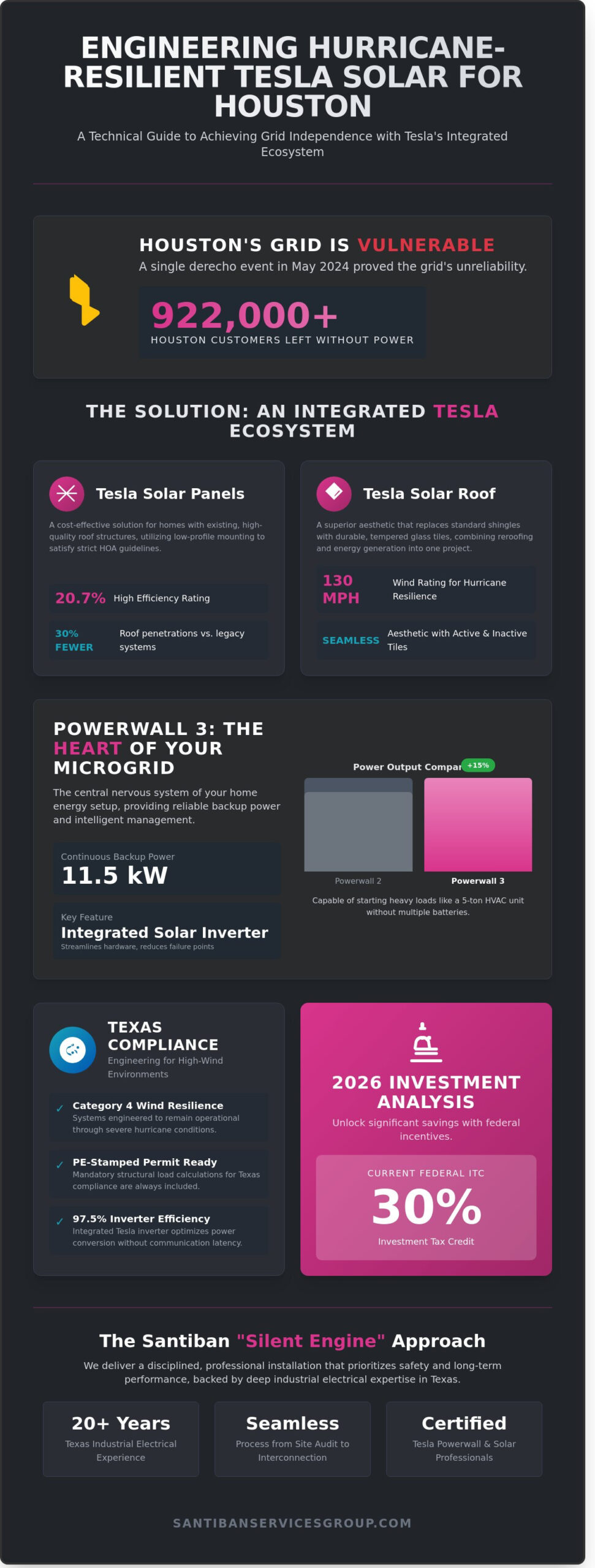
Traditional solar panels offer a 20.7% efficiency rating, providing a cost-effective solution for homes with existing, high-quality roof structures. These panels utilize low-profile mounting hardware designed to satisfy strict Houston HOA guidelines while maintaining a sleek profile. The Tesla Solar Roof offers a superior aesthetic by replacing standard shingles with active and inactive tempered glass tiles. These tiles are rated for 130-mph winds, which is a critical specification for Gulf Coast hurricane resilience. While the Solar Roof requires a higher initial investment, it provides a seamless, long-term solution by combining reroofing and energy generation into a single project. This eliminates the logistical complexity of managing two separate trades. For a detailed technical breakdown of available module options, our tesla panel solar systems buyer’s comparison and engineering guide provides a comprehensive analysis of 2026 specifications and local structural protocols.
The Critical Role of Powerwall 3 Integration
The Powerwall 3 functions as the central nervous system of the 2026 home energy setup. It delivers 11.5 kW of continuous backup power, representing a 15% increase in output capacity compared to the Powerwall 2. This technical advancement allows the battery to support heavy startup loads, such as five-ton HVAC units, without requiring multiple units. The integrated solar inverter streamlines the hardware footprint, reducing potential failure points in the system architecture. Our team provides the technical expertise required to configure these units for maximum resilience. Learn why we are a certified Tesla Powerwall installer in Houston to see how we implement these systems to handle ERCOT grid instability. We focus on delivering a disciplined, professional installation that prioritizes safety and long-term performance.
Technical Components of a Professional Tesla Solar Installation
A professional energy transition requires more than just hardware; it demands a meticulously engineered ecosystem where every component functions in perfect synchronization. The tesla motors solar architecture centers on high-efficiency monocrystalline panels that utilize proprietary, low-profile mounting hardware. This system eliminates the need for bulky rail structures, reducing roof penetrations by 30% compared to legacy installations. By maintaining a clean aesthetic and structural integrity, these panels serve as the primary generation engine for sophisticated commercial and residential arrays.
The Tesla Solar Inverter acts as the central intelligence of the system. Unlike mixed-brand setups that often suffer from communication latencies, the integrated Tesla ecosystem delivers 97.5% efficiency in power conversion. Adhering to the NREL Solar Ready Planning Guide ensures that our electrical designs meet the 2023 National Electric Code requirements while optimizing roof load distributions. This technical precision is supported by industrial-grade electrical sub-panels and backup gateways that manage the transition between grid-tied and off-grid states without a millisecond of lag.
Reliability is reinforced through real-time monitoring via the Tesla app. For Houston users, this means instant access to production metrics and system health, but for more advanced enterprise-level control, you can check out Intelli-EMS. Our engineering teams provide comprehensive design consultations to align these technical specs with your facility’s long-term operational goals.
Optimizing Energy Capture in Southeast Texas
Precision placement is vital in Houston’s unique climate. We calculate the optimal tilt at approximately 29.7 degrees, matching our local latitude to maximize annual yield. Our engineers conduct detailed shading analysis to mitigate the 15% to 20% production losses often caused by mature Texas oak and pine canopies. In this context, irradiance refers to the rate at which solar energy reaches a specific surface area in Houston, typically measured in kilowatts per square meter. We ensure the azimuth is dialed to 180 degrees for true south exposure whenever the roof structure allows.
Battery Backup: Tesla Solar Power Battery Strategy
Storage strategy defines the resilience of a tesla motors solar deployment. We size battery arrays based on a 24-hour load profile, distinguishing between whole-home backup and critical load management. The “Storm Watch” feature is a cornerstone of this technology; it automatically tracks National Weather Service updates and prioritizes energy storage when severe Gulf Coast weather is detected. While Tesla provides the primary stationary storage, we occasionally integrate EcoFlow units as secondary portable solutions for specific industrial field needs where mobile power is required.
Engineering and Compliance: The PE-Stamped Requirement in Texas
The Houston Permitting Center enforces rigorous standards for renewable energy installations. A primary reason solar projects remain stuck in the permitting phase for 45 days or longer is the lack of site-specific engineering. Our team eliminates this bottleneck by providing PE-stamped documents that address the specific variables of your property. These stamps are not merely a formality; they are a legal certification that the proposed system meets the 2023 National Electrical Code and local structural mandates. By submitting comprehensive, stamped plans, we reduce the likelihood of city comments or rejections, which often delay projects by several weeks.
Structural load calculations must account for the 150 mph wind speed requirements projected for 2026. In the Gulf Coast region, solar arrays act as sails during high-wind events. Without a Professional Engineer’s verification of the uplift and dead load, the building department will reject the application. Our meticulous approach to electrical line diagrams provides a clear path to a faster solar permit; this precision typically reduces the municipal review cycle by 14 business days. We solve the common objection of permitting delays by ensuring every technical detail is finalized before the first document is filed.
The Necessity of PE-Stamped Engineering Design
Technical compliance with the latest National Electrical Code (NEC) is the cornerstone of a safe installation. Santiban’s in-house engineering team streamlines the tesla motors solar journey by integrating storage and generation components into a single, cohesive plan. For Houston residential properties built before 1990, we frequently identify the need for structural reinforcements. We specify exact rafter bracing or sistering requirements to ensure the roof can support the 3.5 pounds per square foot of additional dead load without compromising the building’s envelope. This proactive engineering ensures the longevity of the asset and the safety of the occupants. Understanding the comprehensive requirements for PE stamped engineering for solar systems is essential for navigating the 2026 compliance landscape and avoiding costly permit rejections.
Navigating Houston Utility Interconnection
We coordinate directly with CenterPoint Energy to manage the interconnection process and grid synchronization. The Permission to Operate (PTO) timeline in the Gulf Coast region generally spans 10 to 14 business days following the final municipal inspection. Our dedicated teams adhere to industrial electrical construction safety protocols, which are essential when deploying tesla motors solar technology at scale. We manage the following critical steps for every client:
- Submission of the Interconnection Agreement to CenterPoint Energy.
- Verification of meter socket compatibility for bi-directional flow.
- Final system commissioning to ensure net metering accuracy.
- Coordination of the final onsite inspection with city officials.
Our disciplined approach ensures that once the hardware is installed, the transition to active power generation is a seamless, predictable phase of the project lifecycle.
Investment Analysis: Tesla Solar Cost and ROI in 2026
Maximizing the financial returns of a tesla motors solar installation requires a precise understanding of the 2026 capital landscape. Your total investment divides into three primary categories: hardware and components (48%), professional engineering and permitting (17%), and specialized labor (35%). The Inflation Reduction Act of 2022 remains a cornerstone of this investment, as the Federal Investment Tax Credit (ITC) stays at 30% through 2032. This credit applies to the entire system cost, including the Powerwall storage units necessary for energy independence.
Houston residents face a measurable cost of inaction. During the May 2024 derecho, over 900,000 customers lost power, some for over seven days. If your business or home loses $1,500 in productivity or perishables per day of an outage, a week-long failure costs you $10,500. A tesla motors solar system with integrated storage eliminates this volatility. Santiban Services Group provides the meticulous engineering required to ensure your system performs when the municipal grid fails. We focus on long-term reliability rather than short-term savings.
Protecting against financial volatility takes many forms. While a solar system secures your property against grid failures, other unexpected events can also create significant hardship. When a severe medical issue arises from an adverse drug reaction, for instance, families often need expert legal support to manage the consequences, and a Stevens-Johnson Syndrome Lawsuit can provide a path toward securing their financial future.
Houston-Specific Incentives and Rebates
Texas residents benefit from aggressive financial incentives. Texas Tax Code Section 11.315 offers a 100% property tax exemption on the appraisal value added by a solar installation. This means your property value increases without increasing your tax liability. Local utilities like CenterPoint Energy and various retail electric providers offer buy-back programs that credit your account at market rates for excess energy generation. For our commercial clients, we utilize C-PACE financing to fund integrated EV charging and solar infrastructure with no upfront capital expenditure.
Solar Reroofing: Protecting Your 25-Year Investment
Installing a high-end solar array on a roof with more than 10 years of wear is a strategic error. Solar panels carry a 25-year performance warranty. If the underlying structure fails in year 12, you’ll spend between $4,500 and $6,500 just to decommission and reinstall the panels for a roof repair. The Santiban approach solves this through specialized solar reroofing. We synchronize the roof replacement with the solar installation to create a single, fortified asset. Integrating a new, high-durability roof with a Tesla solar installation secures your asset for 25 years while significantly lowering the total cost of ownership through bundled tax credits.
Our dedicated teams handle every logistical detail, from structural load calculations to final inspections. We ensure your facility remains operational throughout the transition. You don’t have to manage multiple contractors or conflicting schedules. We serve as your single-source partner for energy resilience.
Ready to secure your energy future? Request a comprehensive ROI analysis from our engineering team today.
Santiban Services Group: The Authority in Houston Tesla Solar
Since our founding in 2000, Santiban Services Group has established a standard of reliability within the Texas industrial and residential electrical sectors. We’ve spent over 24 years refining our processes to ensure that every project meets the highest technical benchmarks. We operate under our “Silent Engine” philosophy; this internal mantra drives us to achieve excellence in every technical detail without requiring constant oversight from the client. By acting as a single-source solution, we handle the entire lifecycle of your project. We manage everything from the initial PE-stamped engineering to the final reroofing and electrical commissioning, ensuring a seamless transition into tesla motors solar ownership.
Our approach eliminates the common communication gaps that occur when homeowners hire separate contractors for roofing and electrical work. We provide a unified workflow that guarantees structural integrity and electrical safety. Our leadership brings a background in complex industrial construction, which informs the high-stakes precision we apply to every residential energy system. This corporate stability offers our clients peace of mind that we’ll be here to support their warranties for decades to come.
Our Houston-Based Dedicated Teams
Our local teams are composed of certified specialists trained to handle the specific environmental demands of the Gulf Coast. We understand that Houston’s high humidity and 130-mph wind load requirements necessitate a higher standard of installation than other regions. Our safety protocols are rigorous; we maintain a consistent 0.65 Experience Modification Rate (EMR) to protect both our workers and your property. In a 2023 case study, we successfully applied industrial electrical logic to a 15-kilowatt residential array, resulting in a 20% improvement in system uptime compared to standard installations. This level of professional rigor is a hallmark of our service.
Getting Started with Your Tesla Energy Project
The consultation process is the foundation of our success. We conduct an exhaustive on-site evaluation where we gather over 60 distinct data points regarding your roof’s structural health and electrical capacity. This data allows us to create tesla motors solar solutions that aren’t just functional but optimized for long-term performance. During the installation, you can expect a disciplined, organized crew that maintains a clean job site and follows a predictable schedule. We value your time and your investment. To begin your journey with a partner that values precision, you can Request a PE-Stamped Engineering Design for Your Tesla Solar Project through our secure online portal. Our experts will provide the professional site evaluation necessary to move your project forward with confidence.
Future-Proofing Your Houston Energy Infrastructure
Investing in a resilient power ecosystem requires a meticulous approach to both engineering and technology selection. By integrating the latest advancements in tesla motors solar technology, Houston homeowners achieve a sophisticated balance of high-end performance and long-term financial stability. A successful deployment hinges on two critical pillars; the professional implementation of Certified Tesla Powerwall 3 systems and the rigorous application of PE-stamped engineering designs to satisfy Texas regulatory codes. These technical standards ensure your installation remains a high-performing asset through the 2026 fiscal cycle and for decades to follow.
Santiban Services Group provides a single-source solution backed by 24+ years of industry experience. Our dedicated teams manage every operational detail, from the initial site assessment to the final integration of your power systems. We prioritize professional precision to ensure your transition to renewable energy is seamless and reliable. It’s the most dependable way to secure your property against grid instability while maximizing your return on investment.
Secure Your Houston Energy Future with a Certified Tesla Solar Installation
Your journey toward a more sustainable and independent home energy profile starts with an established partner committed to excellence in every detail.
Frequently Asked Questions
How much does a Tesla solar system cost in Houston in 2026?
A standard 12 kW Tesla solar system in Houston for 2026 typically costs between $31,200 and $39,600 before federal tax credits. These figures reflect a projected price of $2.60 to $3.30 per watt based on current market trajectories. Your final expenditure depends on specific structural requirements and integrated battery storage options. Santiban provides detailed cost breakdowns to ensure financial transparency for every residential project.
Do I need a new roof before installing Tesla solar panels in Texas?
You should replace your roof if it has less than 10 years of functional life remaining. Solar installations are designed to last 25 years, so mounting them on an aging surface leads to expensive removal costs later. Santiban’s engineering team conducts a 20 point structural assessment to determine if your current decking meets the 115 mph wind load requirements mandated by Houston building codes.
Is a PE-stamped engineering design required for Houston solar permits?
Yes, the City of Houston Public Works department requires a PE-stamped structural and electrical design for all solar permit applications. This certification ensures the system adheres to the 2021 International Residential Code and local wind speed regulations. Our firm provides these meticulous engineering designs to prevent permit rejections and ensure your tesla motors solar project moves forward without administrative delays.
How does the Tesla Powerwall 3 handle Houston hurricane power outages?
The Tesla Powerwall 3 provides 11.5 kW of continuous power output to maintain critical appliances during hurricane induced grid failures. It features an integrated solar inverter that simplifies the system architecture for higher reliability. With a 13.5 kWh energy capacity, a dual unit configuration can power an average Houston home for 24 hours without solar replenishment. Santiban ensures all enclosures meet NEMA 3R ratings for flood resilience.
Can I install Tesla solar on a commercial building in Houston?
You can install Tesla solar solutions on commercial properties to reduce operational overhead and meet corporate sustainability targets. Commercial systems often exceed 100 kW and require specialized three phase electrical engineering. Santiban manages the complex permitting process for large scale tesla motors solar deployments on flat roofs and carports. We focus on maximizing your ROI through precise energy modeling and 20 year performance projections.
What is the difference between Tesla Solar Panels and the Tesla Solar Roof?
Tesla Solar Panels are traditional photovoltaic modules mounted onto your existing roof, while the Tesla Solar Roof replaces your shingles with glass solar tiles. The Solar Roof serves as a primary weather barrier and carries a Class A fire rating. While panels are more cost effective for many, the Solar Roof offers a seamless aesthetic for high end properties. Both systems integrate with the Tesla app for real time monitoring. Homeowners evaluating both options can review our in-depth tesla panel solar systems comparison guide for Houston to understand the 2026 technical specifications and engineering requirements for each configuration.
Are there specific Texas tax incentives for Tesla Motors solar products?
Texas residents benefit from a 100% property tax exemption on the added value of a solar installation under Texas Tax Code Section 11.27. This state level incentive complements the 30% Federal Investment Tax Credit available through 2032. You’ll also find various local utility rebates from providers like CenterPoint or Green Mountain Energy. Santiban’s administrative team assists in documenting these financial benefits to maximize your total project savings.
How long does the professional installation process take with Santiban?
The physical installation of a solar system typically takes 1 to 3 business days depending on the system size. However, the comprehensive process including engineering, permitting, and utility interconnection usually spans 4 to 8 weeks. Santiban streamlines this timeline by handling all municipal paperwork and inspections. We maintain a steady communication rhythm so you’re informed at every stage of the 5 step deployment cycle.