
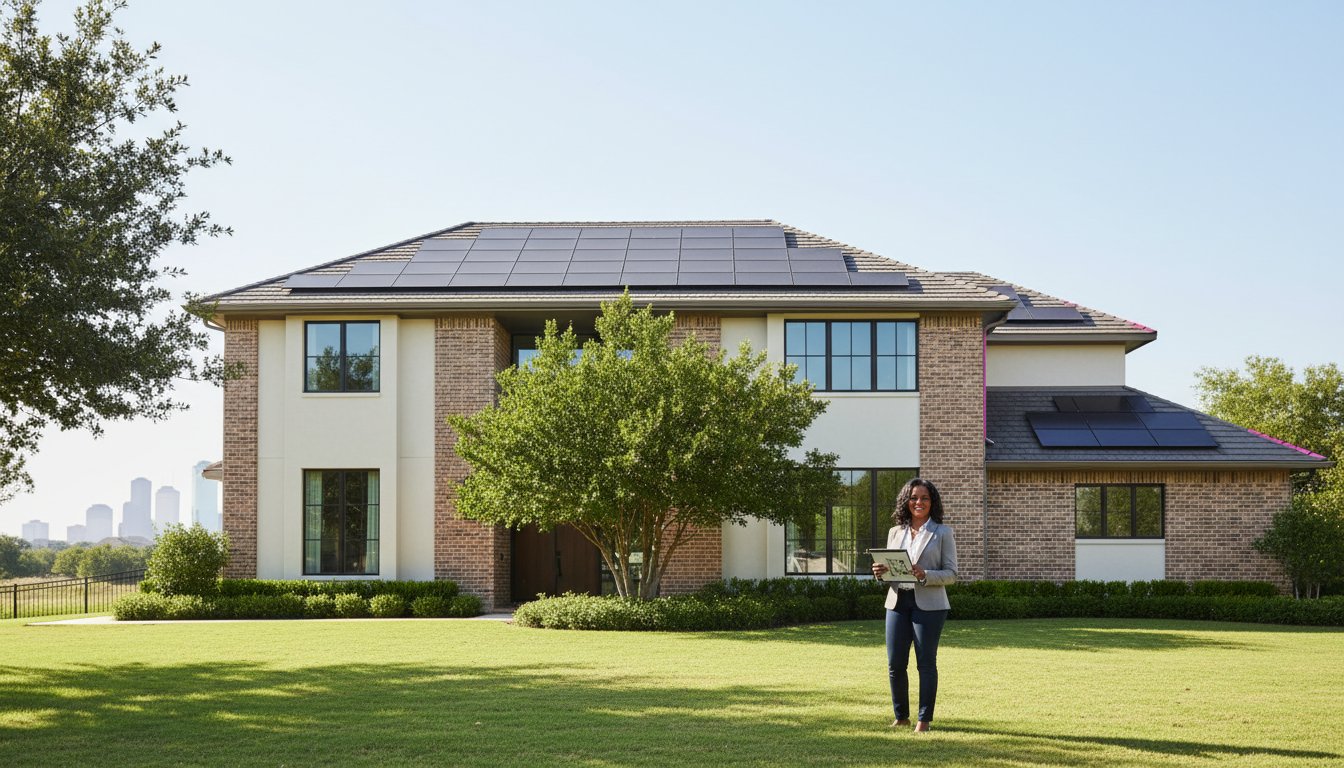
What if the most effective tool for bypassing a restrictive board isn’t a plea for sustainability, but a professional engineering report? Many homeowners view the process of getting HOA approval for solar panels in Houston as a subjective battle over aesthetics; however, the reality is a technical negotiation governed by strict state statutes. You likely feel anxious about potential legal disputes or concerned that your board will reject your application based on outdated bylaws. It’s a valid concern. Nobody wants to risk a $12,960 investment on a system that might be deemed a violation.
This guide empowers you to manage the approval process with the same meticulous standards used in professional facility management. You’ll learn how to leverage Texas Property Code Section 202.010 and the May 2025 HB 431 update to ensure your solar roof tiles or panels are legally protected. We’ll outline the “10% rule” that limits HOA interference and show you how to utilize the $135 per kilowatt CenterPoint rebate to maximize your ROI. From securing PE-stamped documentation to understanding the post-ITC financial landscape of 2026, this guide provides the integrated strategy you need to secure a clear approval letter and start saving.
Key Takeaways
- Leverage Texas Property Code Section 202.010 and the May 2025 HB 431 update to ensure your right to install solar energy devices is legally protected against broad HOA prohibitions.
- Navigate the process of getting HOA approval for solar panels in Houston by applying the “10% Rule,” which prevents boards from mandating placement changes that compromise system efficiency.
- Evaluate the aesthetic and legal advantages of solar roof tiles, which now receive explicit protection under 2026 Texas regulations for seamless architectural integration.
- Streamline your application with PE-stamped engineering documentation that provides the technical precision necessary to satisfy rigorous architectural review guidelines.
- Deploy an integrated strategy that combines professional production reports with established engineering standards to eliminate delays and maximize your long-term ROI.
Understanding Your Solar Rights: Texas Property Code Section 202.010
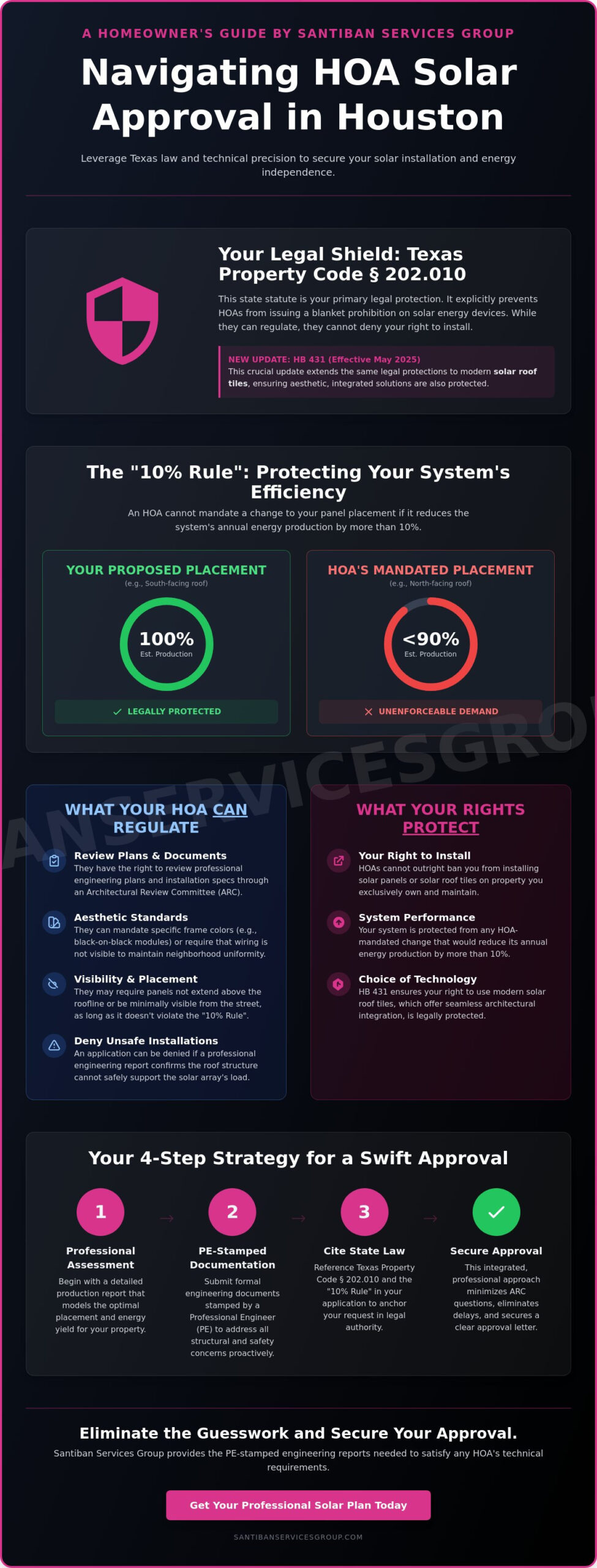
Texas law provides a robust framework for renewable energy adoption, yet many residents find the intersection of state law and local bylaws confusing. Texas Property Code Section 202.010 serves as the primary legal shield for residents seeking energy independence. This statute explicitly prevents homeowners associations from prohibiting the installation of solar energy devices. However, a common misconception exists that this legal right bypasses the need for formal association consent. Even with state protections, getting HOA approval for solar panels in Houston remains a mandatory administrative step. The law distinguishes between an association’s inability to “prohibit” solar and its authority to “regulate” the installation process. This regulatory power allows boards to mandate specific placement or aesthetic standards, provided these requirements don’t compromise the system’s financial viability or performance.
The 2026 legal landscape is defined by recent legislative updates that strengthen homeowner positions. The May 29, 2025, effective date of HB 431 was a pivotal moment for the industry, as it formally extended solar protections to include solar roof tiles. This ensures that modern, integrated roofing solutions receive the same legal standing as traditional crystalline modules. Understanding Your Solar Rights requires a firm grasp of how these statutes interact with local deed restrictions to ensure a seamless project launch. When getting HOA approval for solar panels in Houston, homeowners must present a plan that respects these aesthetic boundaries while citing the specific protections afforded by the Texas Solar Rights Act.
The Legal Protections for Houston Homeowners
Texas law prioritizes system efficiency over arbitrary aesthetic preferences. An HOA cannot force you to install panels on a north-facing roof slope if doing so significantly reduces the energy yield. The Architectural Review Committee (ARC) maintains the right to review your plans, but they must operate within the boundaries of state law. If a proposed placement change results in a production drop of more than 10%, the association’s request is typically unenforceable. This protection ensures that your investment continues to meet the performance benchmarks required for a strong return on investment.
Common Legal Exceptions HOAs Can Use
While protections are broad, they aren’t absolute. HOAs maintain the authority to deny applications based on specific safety and structural concerns. For example, if a professional engineering assessment determines that a roof structure cannot safely support the load of an industrial-grade solar array, the board can legally block the installation until structural reinforcements are made. Other valid exceptions include:
- Common Areas: Installations are restricted to property owned exclusively by the homeowner. You can’t place arrays on shared community assets, parking structures, or neighborhood parks.
- Aesthetic Standards: Boards often mandate specific frame colors, such as black or bronze, to maintain neighborhood uniformity. Black-on-black modules are frequently the preferred standard for conservative Houston committees.
- Visibility: HOAs may require that panels don’t extend above the roofline or are positioned to minimize visibility from the street, provided this doesn’t violate the production loss limits mentioned earlier.
Success in this phase depends on meticulous documentation. By providing the board with a comprehensive plan that addresses these specific exceptions upfront, you position yourself as a proactive partner rather than an adversary. This disciplined approach is the most effective way to secure a timely approval letter.
The financial viability of a residential solar system depends entirely on precise orientation and sun exposure. While boards often prioritize neighborhood uniformity, Texas Property Code Section 202.010 provides a critical safeguard: the “10% Rule.” This statute dictates that an association cannot mandate an alternative panel location if that move reduces the system’s estimated annual energy production by more than 10% compared to the homeowner’s proposed placement. For many, getting HOA approval for solar panels in Houston involves defending the use of street-side roof slopes when they offer the only viable solar access. Boards cannot legally enforce “curb appeal” restrictions that strip 15% or 20% of your production capacity.
Successfully challenging an HOA’s request for relocation requires more than a simple assertion of rights. It demands meticulous documentation and industrial-grade software analysis. Relying on basic estimates is insufficient when facing an Architectural Review Committee. Instead, homeowners should present a professional shading and production report that quantifies yield across every roof facet. This data-driven approach transforms an emotional debate about aesthetics into a factual discussion about engineering and asset performance.
Proving Production Loss to Your HOA Board
Modern approval packets should utilize LiDAR data and 3D modeling to illustrate the impact of nearby obstructions and roof pitch. These reports demonstrate exactly how much energy is lost when moving panels from a south-facing front roof to a shaded rear slope. Professional yield forecasts provide the empirical evidence needed to shut down unreasonable objections. When you provide a comprehensive report that shows a 12% production drop, the board’s request for relocation becomes legally void under Texas law. You can ensure your technical documentation meets these high standards by partnering with a dedicated engineering team that understands local statutes.
Houston Wind-Load and Safety Standards
Houston’s proximity to the Gulf Coast introduces unique variables into the approval process. HOAs often cite “public safety” or “structural integrity” as reasons to delay projects. Because the region is subject to high-velocity hurricane zones, your application must address local wind-load requirements. A structural integrity report, often requiring a PE stamp, confirms that the roof can withstand the added weight and uplift forces of an industrial-grade mounting system. Providing this documentation proactively demonstrates a commitment to safety and excellence in every detail. It eliminates the board’s ability to use safety as a vague pretext for denial, ensuring your installation proceeds without unnecessary logistical hurdles.
Solar Roof Tiles vs. Traditional Panels: 2026 Approval Trends
The evolution of solar technology has fundamentally altered the negotiation process with Houston Architectural Review Committees. While traditional crystalline modules remain the most common choice, the rise of integrated solar tiles represents a significant shift in 2026 Approval Trends. The enactment of HB 431 on May 29, 2025, removed the legal ambiguity surrounding these systems by granting solar tiles the same explicit protections as traditional panels. For homeowners in deed-restricted communities, this technology provides a critical advantage. Getting HOA approval for solar panels in Houston is often less complex when the “panels” are virtually indistinguishable from standard roofing materials like slate or shingles.
Traditional racking systems require mounting hardware that elevates panels above the roofline, creating a profile that some conservative boards find disruptive. In contrast, integrated solutions replace the existing roof deck entirely. This transitions the project from a utility upgrade to a high-end home improvement. Positioning the project as a premium reroofing effort rather than a mechanical installation often neutralizes aesthetic objections before they are formally raised. Boards are far more likely to approve a system that enhances the property’s architectural integrity while providing 100% of the required energy production.
Tesla Solar Roof and Houston HOA Standards
The Tesla Solar Roof has emerged as the premier solution for Houston’s high-end neighborhoods. Its meticulous design utilizes tempered glass tiles that offer superior durability and a seamless aesthetic. By eliminating visual clutter like silver frames and exposed wiring, it satisfies the most rigorous architectural guidelines. Successfully integrating Tesla and solar roof systems requires a partner capable of managing both structural roofing and electrical engineering under a single-source solution. This integrated approach ensures that every detail, from the ridge caps to the valley flashing, meets both Tesla’s standards and your HOA’s bylaws.
Battery Storage and HOA Visibility
HOA regulations frequently extend beyond the roof to include the visibility of external equipment. Boards often require that battery units, such as the Tesla Powerwall 3, are mounted in inconspicuous locations to maintain community standards. Best practices for Houston homes involve installing these units inside garages or behind approved landscape screening. Utilizing a certified Tesla powerwall installer ensures the conduit runs are hidden and the final appearance remains compliant with community standards. This attention to detail prevents post-installation violation notices and reinforces the project’s professional execution. A clean, compliant look is just as important as the system’s electrical performance.
Step-by-Step: Getting Your Solar Application Approved in Houston
Securing a formal approval letter requires a methodical approach that mirrors corporate facility management. It isn’t merely an administrative task; it’s a technical presentation. Your first step involves obtaining the most recent Architectural Review Guidelines and solar-specific bylaws from your association. Many Houston communities updated these documents following the May 29, 2025, legislative changes, so ensuring you have the current version is paramount. Once you understand the local constraints, you can build a submittal packet that addresses every potential board concern before it’s even raised.
A comprehensive application packet acts as your primary leverage during negotiations. This file should include detailed site maps, manufacturer specification sheets for all hardware, and the professional production reports discussed in previous sections. You should submit this documentation via certified mail or a timestamped HOA portal. This action is critical because it initiates the legal “shot clock,” providing a verifiable record of when the board’s review period began. When getting HOA approval for solar panels in Houston, having a paper trail is your best defense against administrative delays or lost paperwork.
The Importance of PE-Stamped Engineering
Houston’s classification as a high-wind zone makes PE stamped engineering for solar systems a functional necessity rather than an optional add-on. A professional engineer’s stamp on your structural and electrical designs serves as an indisputable verification of safety and compliance. Boards frequently attempt to reject applications by citing vague “structural integrity” concerns. A PE stamp effectively shuts down these objections by providing a licensed professional’s guarantee that the system meets all local building codes. Santiban’s approach prioritizes this level of meticulous engineering, ensuring that every design is ready for both the HOA board and the municipal inspector.
Managing the HOA ‘Shot Clock’
Most deed-restricted communities in Houston operate under a 30-day review mandate. If your board fails to issue a formal decision within this legally mandated timeframe, the application may be considered approved by default depending on your specific bylaws. However, you shouldn’t assume approval without written confirmation. While the Houston Permitting Center typically processes solar permits within 2 to 4 weeks, the HOA review must run in parallel to avoid project stagnation. If the board provides feedback or requests modifications, respond immediately with factual, engineering-backed rebuttals to keep the process moving. You can ensure your project stays on schedule by utilizing Santiban’s integrated project management services for every phase of the installation.
Why Santiban’s Technical Precision Wins HOA Approval
Success in getting HOA approval for solar panels in Houston requires more than a basic understanding of state law; it demands a partner with industrial-grade expertise. Santiban Services Group brings over 24 years of electrical and energy experience to every residential project. We operate as a silent engine behind your transition to renewable energy, ensuring every technical detail aligns with both state statutes and local deed restrictions. Our teams possess a deep understanding of the specific bylaws governing diverse Houston neighborhoods, from the historic requirements of River Oaks to the modern standards of The Woodlands. This localized knowledge allows us to anticipate board objections and address them proactively through meticulous documentation.
The Santiban Advantage centers on our integrated approach to project management. While many installers outsource their technical drawings, we provide comprehensive, PE-stamped engineering as a core component of our service. This professional verification serves as a high-end strategic asset when getting HOA approval for solar panels in Houston. It transforms your application from a simple request into a formal engineering proposal that boards find difficult to challenge. By combining industrial scale with a focus on dedicated teams, we ensure your system is designed for superior performance and seamless architectural integration.
Meticulous Design and Superior Execution
Our commitment to excellence in every detail defines our installation process. As a Tesla-certified partner, we specialize in the meticulous deployment of Powerwall 3 systems and integrated solar reroofing solutions. These technologies represent the gold standard for grid independence and long-term resilience. Our design process eliminates visual clutter and prioritizes structural safety, satisfying the most rigorous Architectural Review Committees. We handle the complex logistical challenges and technical hurdles so you don’t have to. This disciplined approach ensures your home is positioned as a leader in the Houston energy landscape while maintaining the high standards of your community.
Contact Santiban for a Seamless Solar Transition
Transitioning to solar energy should be a predictable and stable process. Santiban Services Group manages every stage of your project, from the initial engineering design to the final utility interconnection. We provide the tailored solutions necessary to navigate Houston’s unique regulatory environment with quiet confidence. If you’re ready to secure your energy future and bypass the frustrations of HOA bureaucracy, our team is prepared to assist. We invite you to request a professional solar consultation from Santiban Services Group to begin your comprehensive site evaluation and engineering assessment today.
Securing Your Energy Independence with Technical Authority
The path to sustainable power in 2026 is defined by a rigorous adherence to state statutes and professional engineering standards. You now understand that Texas Property Code Section 202.010 and the “10% rule” provide the legal foundation for your project. Success in getting HOA approval for solar panels in Houston depends on your ability to present factual, data-driven reports that satisfy aesthetic and safety requirements. By prioritizing professional documentation over subjective debate, you ensure your application moves through the Architectural Review Committee without unnecessary friction.
Santiban Services Group stands as your high-end strategic partner in this transition. We leverage 24+ years of industrial electrical experience and our status as Tesla-Certified Installers to deliver systems that exceed community standards. Our integrated approach includes a comprehensive PE-stamped engineering design for every project; this provides the structural verification necessary to shut down safety-related objections. It’s a level of precision that transforms your home into a resilient asset. Secure Your Professional Solar Engineering Design with Santiban and experience the reliability of a partner committed to excellence in every detail. Your journey toward energy independence is supported by a team that values long-term stability and technical mastery.
Frequently Asked Questions
Can my Houston HOA legally deny my solar panel request?
An HOA cannot legally prohibit solar energy devices on your property due to Texas Property Code Section 202.010. However, they maintain the right to regulate placement for aesthetic reasons if it doesn’t compromise production. Exceptions include safety hazards, installations on common areas, or systems that violate property lines. Getting HOA approval for solar panels in Houston requires following these specific legal boundaries while ensuring your application meets all structural standards.
What is the 10% production loss rule in Texas solar law?
The 10% rule prevents an HOA from mandating a panel location that reduces annual energy production by more than 10% compared to your proposed design. This calculation must be based on a professional yield forecast. Additionally, boards cannot enforce restrictions that increase the total system cost by more than $2,000. These financial and performance safeguards protect your investment from unreasonable architectural demands.
Do I need a PE-stamped engineering drawing for HOA approval in Houston?
A PE-stamped engineering drawing is the industry standard for ensuring structural and electrical compliance in high-wind regions. While some HOAs might only request a site map, providing a stamped design from a licensed professional engineer eliminates safety-related objections. This documentation is also a prerequisite for the Houston Permitting Center. Utilizing professional-grade engineering ensures your project meets the 2026 safety benchmarks for the Gulf Coast.
Does Texas law protect solar roof tiles in 2026?
Yes, Texas law explicitly protects solar roof tiles following the enactment of HB 431 on May 29, 2025. This legislation updated the definition of solar energy devices to include integrated roofing materials. This change allows homeowners to choose seamless, aesthetically superior options like the Tesla Solar Roof without fear of HOA prohibition. These systems now enjoy the same statutory safeguards as traditional racking-based solar arrays.
Can an HOA force me to hide my Tesla Powerwall 3?
An HOA can enforce reasonable aesthetic guidelines for the placement of external battery units like the Tesla Powerwall 3. They may request that equipment be installed inside a garage or behind approved landscape screening to maintain community standards. As long as these requirements don’t make the installation impossible or cost-prohibitive, they’re generally enforceable. Meticulous planning ensures your storage system remains both functional and compliant with neighborhood bylaws.
How long does a Houston HOA have to approve or deny my solar application?
Most Houston HOAs operate under a 30-day review period specified within their governing documents. This “shot clock” begins once you submit a complete application packet via certified mail or the association’s digital portal. If the board fails to respond within this timeframe, the application is often deemed approved by default. Always verify your specific community’s bylaws to ensure you’re tracking the correct administrative deadline.
What should I do if my HOA rejects my solar panel placement?
If your board rejects a placement, you should provide a professional shading and production report to verify the impact on energy yield. If the requested change violates the 10% production loss rule, the HOA’s rejection is legally unenforceable under state law. Getting HOA approval for solar panels in Houston often requires this technical rebuttal to resolve disputes. Presenting empirical data is the most effective way to overturn an unreasonable placement request.
Are there specific color requirements for solar panels in Houston HOAs?
Many Houston associations mandate specific aesthetic standards, such as black frames or low-profile mounting systems. They often require that panels be installed parallel to the roofline and do not extend above the ridge. These regulations are legal as long as they don’t significantly reduce production or increase costs beyond the $2,000 threshold. Selecting all-black modules or integrated solar tiles is a proactive way to meet these conservative architectural guidelines.