

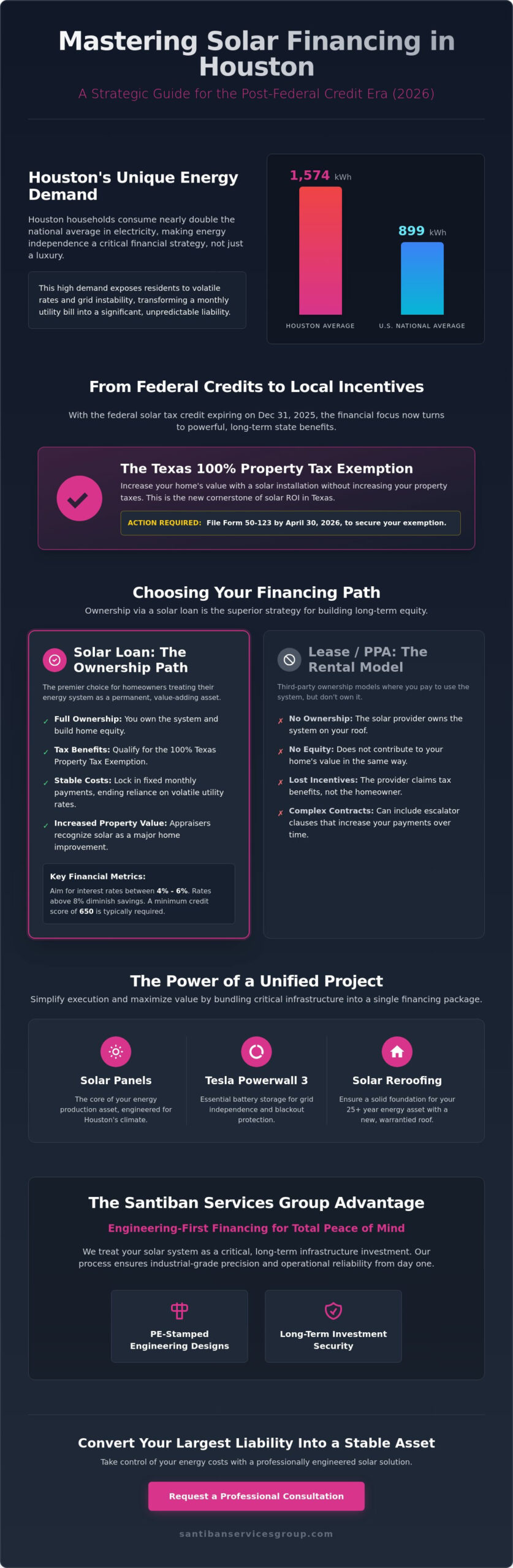
With the expiration of the federal solar tax credit on December 31, 2025, the financial strategy for residential energy has fundamentally shifted from a tax-driven incentive model to a performance-based engineering investment. Houston households now consume an average of 1,574 kilowatt-hours per month, which is nearly double the national average. This high demand, coupled with rising local electricity rates, makes financing solar panels in Houston a critical decision that requires technical precision. You likely recognize that the era of federal credits is over, leaving you to navigate a complex landscape of private loans and local property tax exemptions.
This guide provides the professional clarity needed to master modern solar financing, including the strategic bundling of Tesla Powerwall 3 installations and solar reroofing into a single, cohesive investment. You’ll learn how to leverage the Texas 100% property tax exemption and select the right Retail Electric Provider in our deregulated market to maximize your return. We will examine the transition toward engineering-first assets, providing a methodical breakdown of loan structures and the technical integration of battery storage to ensure your system operates as a reliable, long-term asset under expert control.
Key Takeaways
- Analyze how solar ownership converts volatile monthly utility liabilities into a stable, engineered asset designed for Houston’s high-consumption climate.
- Compare the structural advantages of various loan and lease models to identify the optimal strategy for financing solar panels in Houston in the current market.
- Maximize long-term ROI by leveraging the 100% Texas property tax exemption and identifying the most favorable solar buyback plans from local Retail Electric Providers.
- Simplify project execution by bundling critical infrastructure, such as solar reroofing and Tesla Powerwall 3 integration, into a single, unified financing package.
- Ensure investment security through PE-stamped engineering designs that prioritize industrial-grade precision and long-term operational reliability.
The Economics of Solar Energy in Houston for 2026
Houston’s energy market operates within a deregulated framework that exposes residents to significant price fluctuations. As of May 2026, the average household in this region consumes 1,574 kilowatt-hours monthly. This demand is nearly double the national average of 899 kilowatt-hours. High consumption levels make homeowners particularly vulnerable to the rate volatility seen in recent years. Financing solar panels in Houston allows you to transition from a passive consumer of expensive grid power to an active manager of a private energy asset. This transition is no longer just a luxury; it’s a strategic necessity for managing long-term household operational costs.
The “Avoided Cost” principle defines the modern ROI of solar. Every dollar spent on a solar loan replaces a dollar that would have been paid to a Retail Electric Provider. Unlike utility payments, which continue indefinitely and often increase, a solar loan has a fixed duration and a defined end date. Once you retire the debt, the cost of energy production drops to near zero. This strategic shift in cash flow reclassifies energy from an ongoing operational expense into a tangible capital investment. By securing financing today, you lock in your energy costs and protect your budget from future utility price hikes.
Rising Utility Costs and Grid Instability
Houston’s unique weather patterns, ranging from extreme summer heatwaves to severe tropical events, place immense pressure on the local distribution infrastructure managed by CenterPoint Energy. These events frequently cause price spikes in the wholesale market. Retail Electric Providers eventually pass these costs on to consumers through higher rates. While the federal tax credit expired at the end of 2025 under the One Big Beautiful Bill Act, the underlying economics remain strong. The cost of doing nothing is a permanent, increasing liability. Residential solar systems equipped with home battery backup help mitigate grid stress and ensure operational continuity during localized outages.
Solar as a Property Value Multiplier
High-end solar installations serve as significant equity drivers in the Houston real estate market. Lenders and appraisers increasingly recognize these systems as low-risk home improvements because they reduce the future carrying costs of the property. Texas law supports this valuation through a 100% property tax exemption on the value added by solar and battery systems. To secure this benefit for the 2026 tax year, homeowners must file Form 50-123 with their county appraisal district by the April 30, 2026, deadline. Integrating premium components like the Tesla Powerwall 3 further enhances this value. These systems are viewed as essential infrastructure rather than optional upgrades. Understanding the broader context of solar energy financial incentives helps in evaluating how these local benefits replace the previous federal landscape.
Comparing Houston Solar Financing Options: Loans, Leases, and PPAs
Selecting a structure for financing solar panels in Houston requires a careful evaluation of long-term equity versus immediate liquidity. Direct ownership through a solar loan remains the preferred path for homeowners who view their energy system as a permanent property asset. Although the residential federal tax credit expired at the end of 2025, owners continue to capture value through the 100% Texas property tax exemption. In contrast, third-party ownership models like leases or Power Purchase Agreements (PPAs) shift the legal ownership and the associated commercial tax benefits to the provider. This choice fundamentally alters the financial trajectory of the installation.
Specialized solar loans in the Texas market currently feature interest rates typically ranging between 4% and 6%. Financial data indicates that rates exceeding 8% may negatively impact the total savings over the life of the system. Most reputable lenders require a minimum credit score of 650 to qualify for these competitive terms. Homeowners often weigh these specialized loans against a Home Equity Line of Credit (HELOC). While a HELOC might offer a lower interest rate, it uses the residence as collateral. Specialized solar loans are frequently unsecured, though they often include dealer fees that are rolled into the total loan balance.
For residents considering comprehensive energy upgrades, PACE financing in Texas offers an alternative by allowing energy improvements to be funded through property assessments. This structure can be particularly effective for large-scale projects. Ensuring your system is backed by PE-stamped engineering design provides the technical validation that many lenders require for high-value asset approval.
Solar Loans and $0-Down Financing
$0-down financing remains a popular entry point for Houstonians. These loans allow you to replace a fluctuating utility bill with a fixed monthly payment without an upfront capital requirement. It’s essential to scrutinize the “Dealer Fee” associated with these products. This fee is an upfront cost added to the loan principal to secure a lower interest rate. While it reduces the monthly payment, it increases the total debt. Fixed-rate financing is generally recommended to ensure long-term budget stability against market volatility.
Leasing vs. PPA: Understanding the Fine Print
Leases and PPAs have seen increased adoption in 2026. Because the “One Big Beautiful Bill Act” allows commercial entities to claim credits that residents cannot, these providers can offer lower monthly rates. However, a lease may limit your long-term ROI since you don’t own the equipment. A PPA differs by charging you only for the kilowatt-hours the system produces, rather than a flat monthly equipment fee. Both options can complicate home transfers, as buyers must agree to assume the contract terms during the sale.
Maximizing Incentives: Federal ITC and Texas Local Benefits
The financial framework for financing solar panels in Houston underwent a fundamental transformation on January 1, 2026. With the expiration of the residential federal tax credit under the “One Big Beautiful Bill Act,” homeowners must now shift their focus toward state-level exemptions and manufacturer-specific incentives to secure the best possible ROI. While the previous 30% credit is no longer available for direct residential purchases, the underlying economics of solar remain robust due to Texas-specific protections that stabilize long-term ownership costs.
Texas provides a 100% property tax exemption on the value a solar or battery system adds to your primary residence. This ensures that while your home equity increases, your annual tax liability does not. To secure this benefit for the 2026 tax cycle, you must file Form 50-123 with your specific county appraisal district. The deadline for this filing is April 30, 2026. This exemption represents a significant recurring saving that offsets the initial cost of the installation over the life of the system.
CenterPoint Energy does not currently offer a direct-to-consumer residential solar rebate. Instead, their “Standard Offer Program” provides incentives to contractors for energy efficiency upgrades. Residents in the deregulated Houston market must instead optimize their returns by selecting a Retail Electric Provider (REP) with favorable solar buyback terms. For instance, as of April 2026, Green Mountain Energy offers plans with fixed export credits of 6.3¢/kWh. Monitoring the latest developments in Texas solar incentives and financing is essential for identifying which REPs provide the highest value for your surplus energy production.
Navigating the Federal ITC
The expiration of the residential credit means that direct owners can’t use a federal tax offset to reduce their loan principal in 2026. This change has made third-party ownership models, such as leases and PPAs, more prevalent. In these arrangements, the commercial entity claims the tax benefits and passes a portion of those savings to the homeowner through lower monthly payments. If you’re considering a battery-only installation, such as a Tesla Powerwall 3, you should consult a tax professional. They can help you determine if any commercial or specialized credits apply to your specific financial situation before you finalize your financing agreement.
Texas State Incentives and Local Rebates
Local incentives often come in the form of manufacturer-driven programs rather than utility rebates. Tesla is currently offering a $500 manufacturer rebate per Powerwall 3 unit, a program set to expire on September 30, 2026. When combined with the property tax exemption, these localized benefits significantly shorten the typical solar payback period in Houston, which currently ranges between 7 and 12 years. By applying these savings directly to your financed principal, you reduce the total interest paid and accelerate your path to full energy independence.
Financing Complex Projects: Solar Reroofing and Tesla Powerwalls
Financing solar panels in Houston often involves more than just selecting a photovoltaic array. Comprehensive energy projects in 2026 frequently require structural upgrades or advanced storage integration to achieve peak performance. Specialized lenders recognize that a solar installation is only as durable as the structure beneath it. Consequently, many modern loan products allow for the bundling of critical infrastructure improvements into a single, unified debt instrument. This approach simplifies the capital structure of the project while ensuring that every component of the energy system is engineered for longevity.
Lenders view “Solar-Plus-Storage” projects as high-value assets because they provide predictable energy costs and enhanced property resilience. When a project includes both generation and storage, it transitions from a simple utility offset to a comprehensive backup solution. This technical maturity reduces the perceived risk for financial institutions, often leading to more streamlined approval processes for homeowners who prioritize industrial-grade equipment and professional installation standards.
The Strategic Advantage of Solar Reroofing
Installing a high-efficiency solar system on a roof nearing the end of its operational life is a significant financial oversight. If the roof fails before the panels, the homeowner faces the substantial expense of removing and reinstalling the entire array. Bundling tesla and solar roof solutions into the primary financing package addresses this liability from day one. Many specialized energy loans allow for the inclusion of roofing costs, provided the work is performed as part of a solar installation. This strategy ensures the structural integrity of the home matches the 25-year lifespan of the solar hardware.
Investing in Resilience with Tesla Powerwall 3
The Tesla Powerwall 3 has become a standard requirement for Houstonians seeking to mitigate the impact of local grid instability. Financing this technology as part of the initial solar project allows you to leverage its energy arbitrage capabilities immediately. By storing power when rates are low and discharging it during peak demand, the system actively contributes to the loan’s ROI. Working with a certified tesla powerwall installer ensures that the storage system is correctly integrated into the home’s electrical panel for seamless backup during storm seasons. Current manufacturer programs, such as the $500 rebate per Powerwall 3 unit available through September 30, 2026, further incentivize the inclusion of storage in your financing plan. To ensure your complex project meets all technical requirements for asset-backed financing, you should consult with an established industrial electrical partner during the design phase.
Engineering-First Financing: The Santiban Services Group Advantage
Financing solar panels in Houston is fundamentally an exercise in risk management. Lenders look for technical validation before releasing funds for high-value energy assets. Santiban Services Group utilizes over 24 years of experience in industrial electrical construction to provide this necessary assurance. By treating a residential solar installation with the same rigor as a commercial infrastructure project, we eliminate the technical uncertainties that often stall loan approvals or complicate insurance coverage. This professional approach ensures that every operational detail is under expert control from the initial design to final interconnection.
The back-office execution of a solar project is just as critical as the physical installation. A methodical and predictable permitting process is essential for the timely funding of solar loans. Many financial products release capital only upon the reaching of specific milestones, such as the issuance of municipal permits or the receipt of Permission to Operate (PTO) from CenterPoint Energy. Our established relationships with local jurisdictions and deep understanding of the deregulated Texas market allow us to streamline these administrative requirements. This efficiency minimizes delays, allowing homeowners to transition from grid reliance to self-generation without unnecessary financial friction.
The Role of PE-Stamped Engineering in Financing
Professional engineering stamps are more than a regulatory hurdle; they serve as a primary financial safeguard. Lenders and insurance providers prioritize projects that carry PE stamped engineering for solar systems because these documents provide verified proof of structural and electrical integrity. In Houston’s demanding climate, this verification confirms that the array can withstand specific wind loads and that the electrical integration meets the highest safety standards. This level of compliance reduces the long-term risk of system failure and protects the underlying value of the financed asset.
Choosing a Certified Partner for Your Investment
The distinction between a sales-focused solar entity and an industrial electrical contractor is vital for protecting your long-term ROI. A disciplined, hardworking team ensures that the installation uses industrial-grade components and follows precise construction protocols. These high standards are what differentiate a strategic energy asset from a simple home appliance. The status of Santiban Services Group as a certified Tesla Powerwall installer further secures your investment by ensuring that all hardware is installed according to manufacturer specifications, which preserves your equipment warranties.
Your energy transition requires a partner that values precision and corporate stability. Requesting a customized engineering design and a comprehensive financing quote is the final step in securing your household’s operational future. By prioritizing technical excellence and industrial-scale expertise, you ensure that your solar system remains a reliable, high-performing asset for decades to come.
Securing Your Energy Future with Engineered Precision
The transition toward sustainable energy in 2026 relies on precise financial modeling and industrial-grade hardware integration. You’ve seen how the strategic shift from federal tax credits to local exemptions and engineering-led design stabilizes long-term energy costs. Effectively financing solar panels in Houston requires moving beyond surface-level quotes to embrace a comprehensive view of your home as a private utility asset. By prioritizing structural integrity and battery resilience, you secure a predictable financial future regardless of grid volatility.
Operational excellence is the hallmark of a successful energy investment. Santiban Services Group provides the reliability of over 24 years of electrical experience and the technical assurance of PE-stamped engineering design for every project. As a Tesla-certified installation partner, we focus on the precision of execution that corporate procurement standards demand. Take the next step toward energy independence by requesting a custom solar financing quote from Santiban Services Group. Our team is ready to deliver a customized solution that protects your investment and ensures consistent performance for decades.
Frequently Asked Questions
Can I finance solar panels in Houston with $0 down?
Yes, $0-down solar loans are widely available for financing solar panels in Houston. These financial products allow you to initiate an installation without an initial capital outlay, replacing your monthly utility liability with a fixed loan payment. Qualification for these terms typically depends on your credit profile and debt-to-income ratio. Most reputable lenders structure these loans so that the monthly payment is comparable to or lower than your current average electricity bill.
Does the 30% Federal Tax Credit apply to financed solar systems in 2026?
No, the 30% residential federal tax credit (Section 25D) is no longer available for new solar installations as of January 1, 2026. This credit expired following the passage of the “One Big Beautiful Bill Act” on July 4, 2025. Homeowners now rely on the 100% Texas property tax exemption and manufacturer-specific rebates to optimize their return on investment. Third-party ownership models like leases may still capture commercial credits that are passed down as lower monthly rates.
Can I include the cost of a new roof in my solar loan?
Yes, many specialized energy lenders allow you to bundle the cost of a new roof into your primary solar financing package. This process, referred to as solar reroofing, is often a technical necessity if your current roof lacks the structural integrity to support an array for its 25-year lifespan. Bundled financing ensures that both the roof and the solar system are covered under a single, unified debt instrument with a fixed interest rate.
What credit score is needed for solar financing in Texas?
Most competitive solar lenders in the Texas market require a minimum credit score of 650. To secure the most favorable interest rates, which currently range between 4% and 6%, a score of 720 or higher is typically necessary. While some lenders offer products for scores as low as 600, these often come with higher interest rates or increased dealer fees that can impact the long-term ROI of the project.
How does financing a Tesla Powerwall 3 differ from financing panels?
Financing the Tesla Powerwall 3 is generally integrated into a comprehensive “Solar-Plus-Storage” loan rather than handled as a separate transaction. While solar panels provide the generation, the Powerwall 3 adds essential backup and energy arbitrage capabilities. Lenders often view these integrated systems as lower-risk assets because they provide greater energy independence and higher property valuation in the Houston real estate market.
Are solar loan interest rates tax-deductible in Houston?
Interest on specialized, unsecured solar loans is generally not tax-deductible. However, if you utilize a Home Equity Line of Credit (HELOC) for financing solar panels in Houston, the interest may be deductible if the funds are used specifically to improve your primary residence. Tax laws are subject to change, so you should consult with a certified tax professional to determine how these rules apply to your specific financial structure.
What happens to my solar financing if I sell my Houston home?
You typically resolve the solar loan balance during the closing process of your home sale. Because a solar installation is an engineered asset that adds documented value to the property, the increased sale price often covers the remaining debt. If you have utilized a third-party ownership model like a lease or PPA, the new homeowner must meet the lender’s credit requirements to assume the contract obligations.
How long are the typical terms for a Houston solar loan?
Typical solar loan terms in Houston range from 10 to 25 years. A 10-year term is often chosen by homeowners who wish to minimize total interest costs and achieve full ownership more quickly. Conversely, a 25-year term is designed to provide the lowest possible monthly payment, often ensuring that the cost of the loan remains below the avoided cost of grid electricity from the first month of operation.