

The expiration of the residential federal tax credit on December 31, 2025, has fundamentally altered the financial landscape for renewable energy in Southeast Texas. While the average solar panel payback period Houston homeowners experience now ranges between 8 and 12 years, securing the most efficient return requires a sophisticated approach to system design. It’s no longer enough to simply install panels; you must account for rising CenterPoint transmission fees and the nuances of deregulated buyback plans.
You’ve likely noticed your monthly statements increasing despite efforts to conserve energy, especially as grid instability during hurricane season becomes more frequent. This analysis provides a precise roadmap to help you regain control over your utility expenses through strategic engineering and incentive capture. We’ll examine how the $135 per kilowatt CenterPoint rebate and the 100% Texas property tax exemption reduce your net investment. Additionally, we will demonstrate how a Tesla Powerwall 3 installation optimizes your ROI by managing energy discharge during peak rate periods and providing critical backup when the local grid fails.
Key Takeaways
- Calculate the specific financial variables that define the solar panel payback period Houston homeowners encounter in the current 2026 energy market.
- Assess how structural factors, including roof orientation and local shading profiles, dictate the speed of your return on investment.
- Utilize local CenterPoint rebates and federal tax incentives to significantly reduce net installation costs and accelerate your break-even point.
- Quantify the resilience value of a Tesla Powerwall 3 by analyzing its role in avoiding outage costs and optimizing energy arbitrage.
- Recognize the importance of PE-stamped engineering and precise design in protecting your asset from long-term maintenance liabilities.
Understanding the Solar Panel Payback Period in Houston (2026)
The solar panel payback period Houston homeowners must analyze represents the precise duration required for cumulative utility savings to equalize the net cost of the system. In the 2026 fiscal landscape, most residential installations reach this break-even point within 8 to 12 years. This timeframe serves as a critical metric for evaluating the viability of renewable energy as a long-term capital improvement. It’s the point where your initial investment is fully recouped through avoided electricity costs.
Houston’s geographic position provides a distinct advantage in this calculation. Despite electricity rates that often sit below national averages, the region’s high solar irradiance ensures that a Photovoltaic system operates at peak capacity for a greater number of hours annually compared to northern markets. This high production volume accelerates the recovery of the initial outlay. Although the 30% federal tax credit for homeowner-owned property expired on December 31, 2025, the combination of local rebates and rising grid costs maintains a compelling financial trajectory for those who prioritize engineered efficiency.
The Formula for Calculating Houston Solar ROI
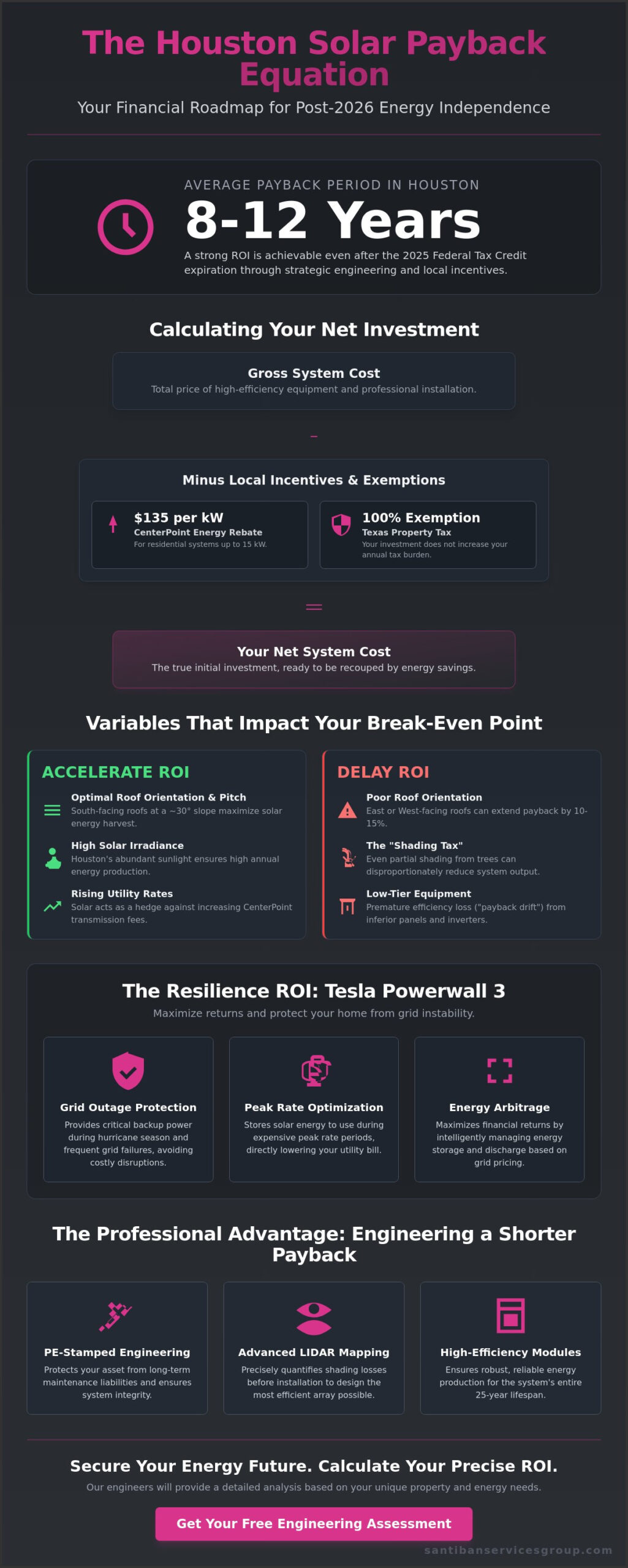
Determining your exact solar panel payback period Houston metrics requires a rigorous breakdown of the Gross System Cost minus all applicable local incentives. The CenterPoint Energy rebate currently offers $135 per kilowatt for residential systems up to 15 kW. Additionally, Texas law provides a 100% property tax exemption for the value solar adds to a residence; this ensures your investment does not increase your annual tax burden.
- Gross System Cost: The total price of equipment and professional installation.
- Net Cost: Gross cost minus the CenterPoint rebate and other available credits.
- Annual Savings: Total kilowatt-hours produced multiplied by your current utility rate.
Our engineering team factors in the historical electricity inflation rates within the ERCOT market to project future savings accurately. By utilizing high-efficiency modules with minimal degradation, we ensure that energy production remains robust over the system’s 25-year lifespan. This technical precision prevents the “payback drift” often seen with lower-tier equipment that loses efficiency prematurely.
Initial Investment vs. Long-Term Capital Gains
Solar infrastructure should be viewed with the same scrutiny as a traditional brokerage account or real estate portfolio. While the S&P 500 is subject to market volatility, the savings generated by a solar array are consistent and effectively tax-free. Local real estate data from sources like Zillow consistently shows that solar-equipped homes in Harris County command a premium, providing an immediate boost to home equity upon installation. This transition transforms a monthly utility expense into a tangible asset with a predictable internal rate of return. The payback period functions as a strategic hedge against the unpredictable nature of future utility rate structures.
Variables That Accelerate or Delay Your Break-Even Point
The physical characteristics of your property dictate the efficiency of your energy harvest. In Harris County, roof orientation serves as the primary driver of production volume. South-facing roofs are the gold standard for maximizing solar intake, as they capture the most consistent sunlight throughout the day. While East or West orientations remain viable, they typically extend the solar panel payback period Houston residents expect by 10% to 15%. Pitch also matters; a 30-degree slope is ideal for shedding debris while maintaining an optimal angle for the Texas sun. Deviating from these parameters requires more panels to achieve the same offset, which increases your initial capital requirement.
Environmental obstructions present a significant financial variable. Houston is known for its lush oak tree canopies, but these provide more than just shade. Even partial shading on a single string of panels can disproportionately reduce the output of the entire array. This “shading tax” directly delays your break-even point. We utilize advanced LIDAR mapping to quantify these losses before installation begins. If your site has significant obstructions, high-performance power optimizers or microinverters become mandatory to mitigate production drops, ensuring your ROI remains on track despite the local foliage.
Equipment selection involves a trade-off between upfront cost and long-term yield. Tier 1 panels offer lower degradation rates, which preserves your savings in years 10 through 25. While budget alternatives seem attractive, their faster efficiency loss can add years to your payback timeline. For those managing aging infrastructure, solar reroofing provides a strategic advantage. By coordinating a roof replacement with your solar project, you ensure the structural integrity of the asset for its entire lifespan. This unified approach often simplifies financing and prevents the costly future expense of removing and reinstalling panels for roof repairs. Although the Residential Clean Energy Credit is no longer available for new 2026 installations, those who placed systems in service during 2025 may still be finalizing these claims on their 2026 tax returns.
The Impact of Houston Weather Patterns
Houston’s extreme humidity and heat create a challenging operating environment for electrical components. High ambient temperatures can cause voltage drops in standard inverters, reducing overall system efficiency. Our designs prioritize thermal management and utilize industrial-grade hardware to resist heat-related degradation. Additionally, the Gulf Coast rainy season and hurricane threats necessitate PE-stamped engineering design. This ensures your mounting systems are rated for high-wind resilience, protecting your investment from catastrophic weather events that could otherwise reset your payback clock to zero.
System Sizing: Finding the “Sweet Spot”
Oversizing a system in a market without 1-to-1 net metering leads to diminishing returns. Because many Houston Retail Electricity Providers (REPs) offer lower rates for exported energy than what they charge for consumption, the most profitable systems are sized to cover exactly 100% of your 12-month historical usage. We analyze your CenterPoint usage data to identify this “sweet spot.” You can learn more about matching capacity to your specific needs in our guide on Tesla and solar roof solutions in Houston. Precision in sizing ensures you don’t overpay for capacity that the grid won’t fairly compensate you for.
Maximizing Incentives: CenterPoint Rebates and Buyback Plans
The financial viability of a renewable energy project in Houston depends heavily on the successful capture of local utility incentives. For the 2026 fiscal year, CenterPoint Energy maintains its Residential Solar Program, offering a rebate of $135 per kilowatt for systems capped at 15 kW. This incentive is processed as a credit on the customer’s invoice, providing an immediate reduction in the net capital required for installation. Our engineering team manages this documentation process to ensure the rebate is secured without administrative delays, which is a critical step in maintaining the projected solar panel payback period Houston residents expect.
While the residential federal tax credit for homeowner-owned systems expired for property placed in service after December 31, 2025, many homeowners are currently documenting their 30% credit on 2026 tax returns for systems completed in late 2025. It’s essential to maintain accurate records of final inspections to satisfy IRS requirements. When calculating your ROI, comparing your project against the average cost of solar in Texas provides a benchmark for your investment. For those starting projects in 2026, third-party ownership models or commercial tax structures may still offer avenues to leverage federal tax advantages, effectively lowering the barrier to entry for high-capacity systems.
Texas’s deregulated market introduces a variable that can shift your break-even point by more than two years. Unlike states with mandatory net metering, Houston homeowners must navigate a diverse array of solar buyback plans offered by Retail Electricity Providers (REPs). These plans vary between fixed-rate credits and real-time market pricing. Selecting an REP that aligns with your production profile is as important as the physical installation itself, as the wrong plan can lead to significant lost energy value during peak production hours.
Choosing the Right Retail Energy Provider (REP)
Auditing a potential REP requires a thorough review of the Electricity Facts Label (EFL). You should look specifically for clauses regarding excess generation and whether the provider offers 1-to-1 credit or a lower avoided cost rate. Utilizing resources like the Texas Power Guide allows for a data-driven comparison of current offers. Often, the plan with the lowest base rate for consumption includes unfavorable terms for solar exports, making it a poor choice for owners who generate a surplus during daylight hours.
Commercial and Industrial Incentives
Business owners in Houston have access to more aggressive financial instruments, including Section 179 depreciation and the Modified Accelerated Cost Recovery System (MACRS). These allow for the rapid recovery of capital costs through accelerated depreciation schedules. Beyond these tax advantages, commercial EV charger installation creates a synergistic ROI. By utilizing solar infrastructure to power fleet or employee charging stations, businesses reduce their demand charges and improve the overall efficiency of their industrial electrical construction. This integrated approach transforms a simple energy project into a comprehensive facility upgrade with multiple revenue and savings streams.
The Resilience ROI: Tesla Powerwall 3 and Avoided Outage Costs
Quantifying the financial return of a solar installation requires a shift from simple utility savings to a broader “Resilience ROI.” In the Houston market, the Value of Lost Load (VOLL) is a critical metric. VOLL represents the economic cost of power interruptions, including lost remote work productivity, spoiled inventory, and the expense of alternative lodging during extended grid failures. While a standard solar array without storage must shut down during an outage for safety reasons, the integration of a Tesla Powerwall 3 allows your system to operate independently. This capability transforms the battery from a backup luxury into a high-yield financial asset that protects your household from the unpredictable costs of grid instability.
The Tesla Powerwall 3 utilizes advanced software to execute “Time-of-Use” (TOU) arbitrage. By storing solar energy when production is high and discharging it during peak evening rate periods, the system actively lowers your effective electricity rate. This strategic energy management directly accelerates the solar panel payback period Houston homeowners experience by maximizing the value of every kilowatt-generated. When compared to the 10-year total cost of ownership (TCO) of a traditional standby generator, the Powerwall 3 offers a superior financial trajectory. Generators require ongoing fuel costs, noisy operation, and recurring mechanical maintenance, whereas battery storage provides a silent, zero-emission solution with significantly lower operational overhead.
Tesla Electric and Grid Participation
Participation in the Tesla Electric Virtual Power Plant (VPP) introduces a new revenue stream for Houston residents. By allowing the ERCOT grid to draw from your Powerwall 3 during periods of extreme demand, you earn credits that further offset your monthly statements. This collaborative grid participation moves beyond passive savings and turns your home into a micro-utility. To understand the technical requirements and financial benefits of these programs, you can reference our detailed guide on Tesla Electric in Houston. These grid-interactive features are essential for shortening the total system payback period in a deregulated environment.
Financial Comparison: Battery vs. No Battery
While the initial capital requirement for a Powerwall 3 is higher than a standalone solar installation, the long-term savings profile is more robust. Without a battery, you’re forced to export excess solar energy at “avoided cost” rates, which are often significantly lower than the retail price you pay for consumption. A battery allows you to keep that energy for your own use, effectively “buying” it from yourself at the full retail rate. For homeowners who rely on medical equipment or maintain a professional home office, the “insurance value” of 24/7 power provides an intangible yet vital return. If you’re ready to secure your energy independence, you can schedule your Tesla Powerwall 3 installation with our specialized electrical team today.
Battery storage is now a documented financial asset that increases home equity while providing a definitive hedge against the rising transmission fees seen across Harris County.
Engineering a Shorter Payback: The Santiban Professional Advantage
The technical precision of your installation is the final, most influential variable in the solar panel payback period Houston homeowners must calculate. While many providers focus on volume, our approach is rooted in industrial electrical construction standards. Substandard installations often lead to systemic failures, such as roof leaks or electrical faults, which introduce significant unbudgeted costs. These “hidden” expenses can effectively reset your break-even timeline. By prioritizing structural integrity and electrical accuracy, we ensure your system remains a high-performing asset for its entire 25-year lifecycle.
Our commitment to excellence includes maintaining Tesla-certified status for Powerwall 3 and solar panel installation. This certification is not merely a badge; it’s a requirement for ensuring your manufacturer warranties remain valid and enforceable. When an array is designed with commercial precision, it avoids the common pitfalls of residential solar, such as poor cable management or insufficient thermal spacing. This disciplined approach to execution protects your internal rate of return from the erosion caused by avoidable maintenance events.
The Value of PE-Stamped Engineering
Professional engineering is a cornerstone of a reliable energy project. We provide PE-stamped engineering design for every installation to satisfy rigorous municipal permitting and CenterPoint interconnection requirements. This level of documentation streamlines the approval process and ensures that your roof can support the static and dynamic loads of the array, particularly during Gulf Coast wind events. You can review the specific regulatory advantages in our PE Stamped Engineering for Solar Systems guide. Superior design reduces long-term Operations & Maintenance (O&M) costs, keeping your payback trajectory on schedule.
Long-Term System Monitoring and Support
Proactive monitoring is essential for protecting your ROI over the decades. A single month of undetected system downtime can cost hundreds of dollars in lost savings and exported energy credits. We utilize advanced telemetry to track production in real-time, allowing for rapid intervention if performance deviates from engineered expectations. This focus on consistency is why local, Texas-based support is vital. Unlike national entities that may struggle with regional logistics, our team is positioned to handle warranty claims and technical adjustments with the speed that a stable energy infrastructure requires.
Securing a precise financial outcome requires more than a generic estimate. It demands a technical analysis of your property’s unique variables. We invite you to contact our engineering department to request a customized financial feasibility study. This report will provide the year-by-year data necessary to approve your investment with confidence, ensuring your transition to solar is backed by professional-grade execution and corporate stability.
Securing Your Energy Future in Houston
The variables governing the solar panel payback period Houston homeowners navigate in 2026 are complex but manageable through technical precision. Achieving a rapid return on investment requires a combination of high-efficiency hardware, strategic REP selection, and the integration of battery storage to capture resilience value. By leveraging CenterPoint rebates and the Texas property tax exemption, you transform an escalating utility expense into a stable, long-term asset.
Our approach is anchored in 24+ years of industrial electrical experience. We provide PE-stamped engineering design and utilize Tesla-certified installers to ensure every system meets the highest standards of safety and performance. This disciplined methodology protects your property and your financial interests against the volatility of the ERCOT grid. If you’re ready to move beyond general estimates and secure a data-driven projection for your specific site, take the next step in your energy transition.
Request a Professional Solar ROI Analysis for Your Houston Property
Investing in professional-grade solar infrastructure is a decisive move toward long-term fiscal stability and energy independence.
Frequently Asked Questions
What is the average solar payback period in Houston for 2026?
The average solar panel payback period Houston residents experience currently ranges between 8 and 12 years. This timeframe reflects the 2026 fiscal environment where local utility rebates and property tax exemptions offset the expiration of previous federal incentives. Precise break-even points depend on your specific roof orientation, total system capacity, and the efficiency of your selected hardware.
Does CenterPoint Energy offer a solar rebate for residential customers?
CenterPoint Energy maintains a residential solar rebate program that provides $135 per kilowatt for qualifying installations. This incentive applies to systems with a capacity of up to 15 kW and is typically reflected as a credit on the final installation invoice. Our engineering team manages the necessary documentation to ensure your project meets all technical requirements for this utility credit.
How does the 30% Federal Tax Credit work for Houston solar installations?
The 30% federal tax credit for homeowner-owned systems is not available for property placed in service after December 31, 2025. Homeowners who completed their installations during the 2025 calendar year may still claim the credit on their 2026 tax returns. For new 2026 projects, you should consult with a tax professional regarding third-party ownership models or commercial incentives that may still apply.
Are solar buyback plans still available in the Texas deregulated market?
Solar buyback plans remain available through various Retail Electricity Providers (REPs) within the ERCOT grid. These plans are not standardized; some offer 1-to-1 credits while others utilize real-time market pricing for exported energy. It’s vital to audit the Electricity Facts Label of any potential plan to ensure the export rates support your projected solar panel payback period Houston goals.
Will adding a Tesla Powerwall 3 increase my solar payback period?
Integrating a Tesla Powerwall 3 increases the initial capital outlay but provides a distinct “Resilience ROI” through avoided outage costs. While the battery adds to the upfront cost, it enables “Time-of-Use” arbitrage by discharging stored energy when grid rates are highest. This strategic energy management can help mitigate the impact of rising transmission and distribution fees from CenterPoint.
Is solar worth it in Houston if my electricity rate is low?
Solar remains a strategic capital improvement in Houston even when current electricity rates appear low. Utility rates in the deregulated market are subject to volatility and historical increases in transmission charges. A professional-grade solar installation functions as a long-term hedge, locking in a predictable cost for energy and protecting your household from future market fluctuations and grid instability.
How does a PE-stamped engineering design affect my solar ROI?
PE-stamped engineering design protects your return on investment by ensuring structural integrity and compliance with local wind-load requirements. This level of professional oversight prevents costly roof leaks, system downtime, and permitting delays that often plague “budget” installations. Accurate engineering ensures the system operates at peak efficiency for its full 25-year lifecycle, preventing “payback drift” caused by mechanical failures.
Can I take my solar panels with me if I move before the payback period ends?
Removing a solar array is technically possible but generally impractical due to the labor costs and potential for roof damage. Most homeowners find it more financially advantageous to treat the system as a permanent fixture that increases home equity. Local real estate data suggests that solar-equipped homes in the Houston area command a higher resale price, allowing you to recoup your investment at the time of sale.