
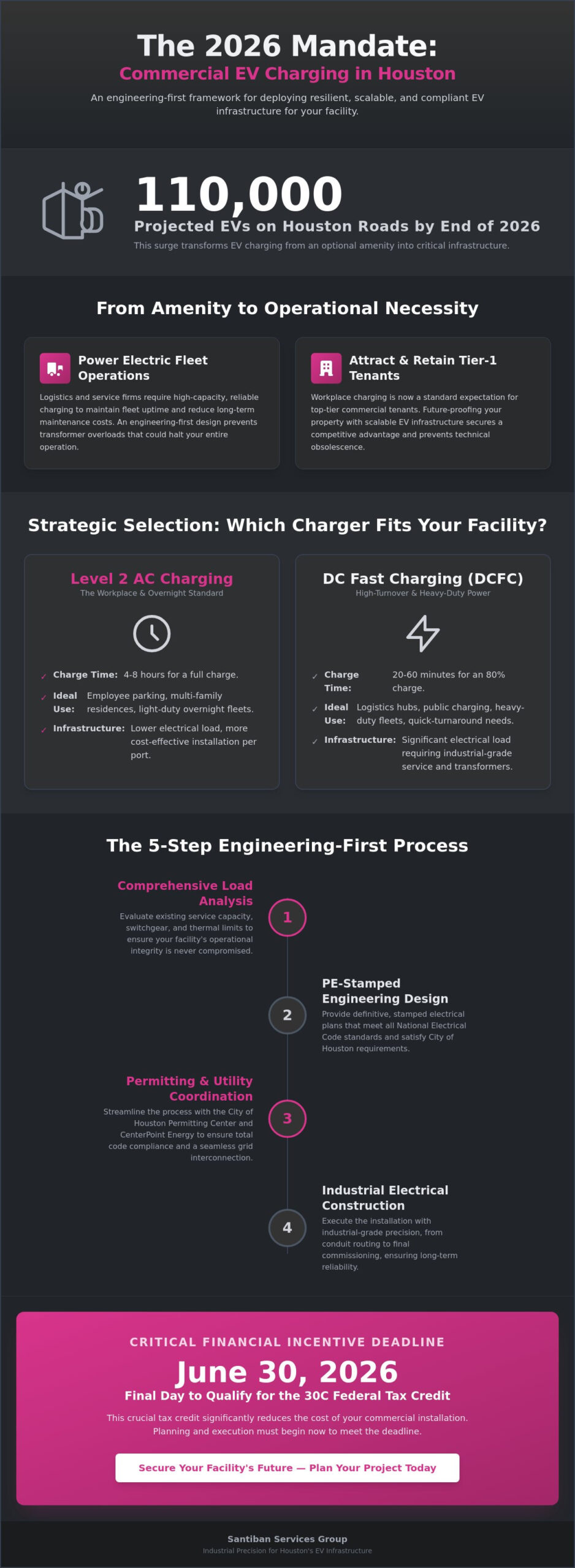
By the conclusion of 2026, projections from EVolve Houston estimate that 110,000 electric vehicles will be active on local roads. For facility managers and industrial operators, this surge represents a shift from elective amenity to critical infrastructure. You’ve likely realized that a standard plug-and-play approach is insufficient when grid capacity in industrial zones is limited and the City of Houston Permitting Center requires rigorous documentation. Executing a successful commercial EV charging station installation Houston project requires more than just hardware; it demands a systematic, engineering-first strategy to protect your facility’s operational integrity.
This guide provides a comprehensive technical framework for deploying resilient charging networks that scale alongside your business. You’ll learn how to manage complex permitting processes and leverage PE-stamped engineering design to ensure total code compliance. We also detail the critical June 30, 2026, deadline for the 30C federal tax credit and provide a roadmap for coordinating with CenterPoint Energy to future-proof your electrical capacity without compromising current operations. From load analysis to industrial electrical construction, this overview ensures your infrastructure remains a stable asset for years to come.
Key Takeaways
- Understand why EV infrastructure has transitioned from an optional amenity to a core requirement for 2026 Houston commercial properties.
- Learn how PE-stamped engineering design prevents catastrophic load failures and ensures your facility’s long-term electrical stability.
- Evaluate the specific infrastructure demands of Level 2 versus DC Fast Charging based on your facility’s unique vehicle dwell times.
- Streamline your commercial EV charging station installation Houston by following verified steps for City of Houston permitting and CenterPoint Energy interconnection.
- Discover how industrial electrical construction expertise provides the precision needed for complex, high-capacity charging deployments.
Why Houston Businesses are Scaling EV Infrastructure in 2026
Houston’s commercial landscape is undergoing a fundamental transformation. As of early 2025, electric vehicles accounted for nearly 7% of new light-duty vehicle sales in Texas. By mid-2026, the volume of EVs on local roads has reached a critical mass that necessitates a shift in perspective. Facility managers no longer view charging as a luxury perk for executives. Instead, it’s a core component of industrial electrical construction. A professional commercial EV charging station installation Houston project is now a requirement for operational continuity and corporate stability.
Institutional capital and corporate ESG mandates are driving this acceleration. Large-scale tenants increasingly prioritize properties that align with their sustainability benchmarks. Properties lacking robust electric vehicle supply equipment (EVSE) face the risk of technical obsolescence. We view these installations through the “silent engine” philosophy. These systems must function reliably in the background, ensuring that every operational detail is under expert control without requiring constant intervention from management. Reliability is the primary driver of return on investment.
The Rise of Electric Fleet Operations
Logistics and service firms across the Greater Houston area are converting to electric fleets to reduce long-term maintenance costs. High-capacity charging is vital for maintaining uptime in these high-pressure environments. While Level 2 systems suffice for overnight charging of light-duty vans, heavy-duty applications often require the rapid turnover provided by DC Fast Charging. Precision in the design phase prevents transformer overloads that could otherwise halt entire logistics chains. Our approach prioritizes industrial-grade resilience to keep your fleet moving without interruption.
Attracting and Retaining Tier-1 Tenants
Tier-1 tenants in Houston’s commercial hubs now expect workplace charging as a standard lease inclusion. The professional workforce increasingly demands accessible charging during business hours. Forward-thinking owners recognize that designing for 2030 requirements during a 2026 installation is significantly more cost-effective than attempting a piecemeal retrofit later. Scalability is achieved through thorough site assessments and PE-stamped engineering that anticipates future demand. By future-proofing your infrastructure today, you secure a competitive advantage in a market that values high-end strategic partnerships and consistent performance.
Engineering-First Installation: The Role of PE-Stamped Design
Many providers view EV chargers as simple plug-in appliances. This perspective is fundamentally flawed in an industrial context. A successful commercial EV charging station installation Houston requires a unified engineering approach that treats every charger as an integrated component of your facility’s broader electrical ecosystem. Without a rigorous engineering-first strategy, adding high-capacity charging ports can lead to catastrophic load failures or localized grid instability. Precision is the baseline for ensuring that your infrastructure remains a stable asset rather than an operational liability.
Professional engineering design involves more than just circuit mapping. It requires a comprehensive structural and electrical analysis before any ground is broken. We evaluate the existing service capacity, conduit routing, and thermal limitations of your current switchgear. This thoroughness ensures that the installation doesn’t compromise the “silent engine” of your daily operations. By prioritizing technical excellence during the design phase, you protect your facility from the hidden costs of poor planning and equipment overloads.
Why Your Project Requires a PE Stamp
A Professional Engineer (PE) stamp serves as the definitive baseline for technical excellence and safety. In Houston, the permitting process for commercial electric vehicle supply equipment is rigorous and requires detailed electrical plans. Stamped designs provide the City of Houston Permitting Center with the necessary documentation to verify that your system meets National Electrical Code standards. This level of PE stamped engineering for solar systems and EV infrastructure significantly reduces corporate liability. It creates a verified record of safety that protects your capital assets and personnel from preventable electrical hazards.
Load Management and Grid Synchronization
Industrial facilities often operate near their peak electrical capacity. Adding multiple high-output chargers can push a system into a state that triggers expensive utility demand penalties or equipment damage. Our engineering process involves a detailed load analysis to calculate current demand versus available headroom. We utilize software-driven load balancing to protect the facility’s main electrical service, allowing for the dynamic distribution of power based on real-time usage. This approach allows for the seamless integration of EV infrastructure with existing industrial systems, often avoiding the immediate need for costly utility transformer upgrades. Our team at Santiban Services Group focuses on these precise details to ensure your infrastructure remains dependable under maximum load conditions.
Strategic Selection: Level 2 vs. DC Fast Charging for Houston Facilities
Selecting the appropriate technology for a commercial EV charging station installation Houston project depends entirely on the vehicle duty cycle. Facility managers must analyze dwell times, the duration a vehicle remains parked, to determine the optimal power delivery. While speed is often equated with quality, over-engineering a site with unnecessary fast chargers leads to inflated capital expenditures and higher utility demand charges. Conversely, under-powering a high-turnover location results in operational bottlenecks. A precise match between hardware capability and user behavior is the only way to ensure a stable return on your infrastructure investment.
Hardware durability is a critical consideration in the Greater Houston area. The local climate, characterized by high humidity and salt-laden air near the coast, necessitates NEMA 4X-rated enclosures to prevent corrosion and internal component failure. We also prioritize hardware that utilizes the Open Charge Point Protocol (OCPP). This open-standard ensures long-term vendor flexibility. It allows you to switch network providers or management software without the need to replace physical assets. This strategy protects your facility from being locked into a single proprietary ecosystem that may not meet future requirements.
Level 2 Charging for Long-Dwell Properties
Properties such as office complexes, multi-family developments, and hospitality venues are ideal for Level 2 AC charging. Since vehicles typically remain stationary for four to eight hours, these systems provide a steady, cost-effective replenishment of range. Scaling these networks efficiently often involves utilizing dual-port stations. This configuration maximizes parking space utility and reduces trenching costs per port. Level 2 remains the industrial standard for overnight fleet charging, offering a balanced load that minimizes stress on the facility’s main electrical service while vehicles are idle.
DC Fast Charging for Rapid Turnover
Retail centers and transit corridors require a different technical approach. Level 3 DC Fast Charging (DCFC) delivers high-velocity power for vehicles that only stop for 20 to 40 minutes. The infrastructure requirements for these systems are significant. They typically demand a 480V 3-phase power supply and specialized cooling systems to manage the heat generated during rapid energy transfer. These installations are essential for high-utilization commercial vehicles and public-facing hubs where throughput is the primary metric of success. Proper planning ensures these high-draw systems don’t disrupt the facility’s existing industrial electrical construction or trigger excessive peak-demand penalties.
Navigating Houston Permitting and CenterPoint Energy Requirements
Securing regulatory approval is the most significant hurdle in any commercial EV charging station installation Houston project. The technical specifications of the hardware are irrelevant if the installation fails to meet the City of Houston’s stringent electrical codes or exceeds the capacity of the local grid. Managing these administrative requirements demands a disciplined approach to documentation and utility coordination. Our role is to act as the silent engine, managing the complex permitting and interconnection processes so your operations remain uninterrupted.
Texas building codes have increasingly shifted toward “EV-ready” standards, requiring that many new commercial constructions include the foundational conduit and panel capacity for future charging stations. For existing structures, the challenge involves retrofitting these systems while maintaining strict compliance with Article 625 of the National Electrical Code. Our team manages the entire administrative burden, from the initial load analysis to final city inspections, ensuring every operational detail is under expert control.
The Permitting Roadmap in Harris County
The Houston Permitting Center requires a licensed electrician to obtain all necessary electrical permits for Level 2 and DC fast charging systems. A common pitfall for many businesses is submitting incomplete one-line diagrams or failing to provide a comprehensive load analysis. These omissions lead to costly delays and project stagnation. We prioritize the development of PE-stamped site plans that clearly outline circuit configurations and safety protocols. By managing these inspections with technical precision, we ensure a zero-delay completion schedule that adheres to all local safety mandates.
Utility Coordination and Transformer Upgrades
Interconnecting with CenterPoint Energy is a multi-step process that begins with a thorough assessment of your facility’s existing service capacity. If the projected load from your charging network exceeds current headroom, utility-side transformer upgrades may be required. In some cases, installing a dedicated EV meter is the most strategic path to manage energy costs and avoid impacting your primary building service. Leveraging our commercial ev charger installation expertise allows you to minimize utility fees through optimized design and strategic load management. If you are prepared to secure your facility’s power requirements, partner with Santiban Services Group for an engineering-led deployment.
Santiban Services Group: Industrial Precision for Houston EV Infrastructure
Reliability in infrastructure isn’t accidental. It’s the result of disciplined execution and decades of technical expertise. Santiban Services Group positions itself as the authoritative partner for complex industrial electrical projects across the Texas region. With over 24 years of experience in Texas electrical construction, we understand the unique demands of the Houston power grid. Our integrated approach combines PE-stamped engineering design with industrial electrical construction to deliver a seamless commercial EV charging station installation Houston experience. We operate as a silent engine, managing every technical and administrative detail so your organization can focus on its core business operations.
Our commitment to corporate stability means we value long-term relationships over short-term gains. This philosophy is reflected in the consistent performance of the systems we deploy. By providing a unified solution that spans from initial design to final interconnection, we eliminate the friction often associated with multi-vendor projects. You receive a customized result that aligns with your facility’s specific operational requirements and safety standards.
The Santiban Difference: Industrial Scale, Human Precision
Large-scale electrical construction requires a level of precision that basic labor services cannot provide. Our background in industrial environments ensures that your EV project is built to withstand high-utilization duty cycles and harsh environmental conditions. We maintain a relentless focus on safety and PE-stamped accuracy, ensuring that every circuit and transformer is optimized for long-term performance. By prioritizing efficient design during the initial planning phase, we help facility managers solve the complex ev charger installation cost puzzle. High standards in engineering naturally lead to reduced operational overhead and fewer technical failures over the life of the system.
Start Your Infrastructure Assessment
The path to a resilient charging network begins with a comprehensive site audit and load analysis. Our onboarding process is methodical, moving from initial assessment to a final PE-stamped design that guarantees code compliance. For properties seeking total energy independence, we specialize in integrating EV charging infrastructure with Tesla and solar roof systems. This unified energy strategy maximizes your return on investment by pairing renewable generation with high-capacity storage and charging. Secure a consultation with Houston’s industrial energy specialists today to ensure your facility remains a leader in the 2026 energy landscape.
Securing Houston’s Energy Future Through Engineering Excellence
Deploying a resilient charging network requires a shift from basic equipment procurement to sophisticated industrial engineering. Successful commercial EV charging station installation Houston projects hinge on the precision of PE-stamped designs and the seamless coordination with municipal permitting bodies. By prioritizing load management and infrastructure durability, facility managers protect their capital assets from technical obsolescence and unforeseen utility fees. These engineering-first decisions ensure that your facility remains a stable asset in an evolving market.
Santiban Services Group leverages over 24 years of industrial electrical construction experience to manage the complexity of your deployment. Our team provides in-house PE-stamped engineering design services and operates as certified Tesla and industrial infrastructure partners. We handle the administrative and technical burdens of utility interconnection so your facility can function without interruption. Maintaining a stable and scalable power ecosystem is a strategic imperative for the modern commercial landscape. We invite you to leverage our disciplined approach to secure your facility’s operational integrity.
Request a Professional Engineering Assessment for Your Houston Commercial EV Project to begin your transition. Establishing a future-ready infrastructure today ensures that your organization remains a silent engine of reliability for years to come.
Frequently Asked Questions
What is the typical timeline for commercial EV charging station installation in Houston?
Project timelines typically span several months, primarily driven by the City of Houston permitting process and utility interconnection schedules. While the physical construction of a commercial EV charging station installation Houston project may only take a few weeks, the preliminary engineering, site assessment, and administrative approvals require significant lead time. Coordinating with CenterPoint Energy for service upgrades often represents the longest phase of the deployment. We manage these schedules with disciplined precision to ensure your project remains on track for its projected completion date.
Does my Houston business need a new transformer for Level 3 DC Fast Charging?
Most commercial facilities require a dedicated transformer or a significant service upgrade to support Level 3 DC Fast Charging. These systems demand high-voltage 480V 3-phase power, which often exceeds the capacity of standard building services. Our engineering team conducts a thorough load analysis to determine if your existing infrastructure has the necessary headroom. If the current transformer cannot support the additional demand, we coordinate directly with the utility to facilitate the required upgrades without disrupting your primary operations.
Are there Texas state incentives or federal tax credits for commercial EVSE in 2026?
The federal 30C tax credit remains a primary incentive, providing a credit of 30% for the cost of hardware and installation up to $100,000 per charger until it expires on June 30, 2026. At the state level, the Texas Light-Duty Motor Vehicle Purchase or Lease Incentive Program is no longer accepting applications for the 2026 fiscal year. While CenterPoint Energy offers energy efficiency programs for large facilities, they don’t currently promote a specific commercial EV charging rebate. We recommend finalizing your installation before the June federal deadline to maximize your capital recovery.
What is the difference between a networked and non-networked commercial charger?
Networked chargers utilize cellular or Wi-Fi connectivity to provide remote monitoring, automated billing, and real-time data analytics. Non-networked units are standalone devices that provide power without the ability to track usage or restrict access via software. For most commercial environments, networked hardware is the standard choice because it allows facility managers to manage energy loads and generate usage reports. This connectivity is essential for any commercial EV charging station installation Houston project intended for multi-tenant or fleet applications where accountability is required.
How do I manage billing and access for employees vs. the public?
Access control is managed through cloud-based software platforms that utilize RFID cards, mobile applications, or vehicle identification. These systems allow you to set tiered pricing structures, offering subsidized rates for employees while charging market rates for public users. You can also restrict charging hours or reserve specific ports for fleet vehicles only. This level of customized control ensures that your infrastructure serves your corporate objectives while providing a secondary service to the public if desired.
Why is PE-stamped engineering required for my commercial EV project?
The City of Houston Permitting Center requires PE-stamped electrical plans to verify that the proposed installation complies with the National Electrical Code and local safety standards. A Professional Engineer’s stamp provides a third-party verification that the load analysis, circuit design, and structural mounting are technically sound. This requirement protects your facility from catastrophic electrical failures and reduces corporate liability. Our in-house engineering team provides these stamped designs as a baseline for every industrial-scale deployment we execute.
Can Santiban integrate EV charging with our existing solar and battery backup systems?
Santiban specializes in creating unified energy ecosystems by integrating EV infrastructure with Tesla Powerwall systems and solar arrays. This approach allows your facility to offset high demand charges by utilizing stored energy during peak periods. We design these systems to work in synchronization, ensuring that your EV charging load doesn’t compromise the stability of your battery backup during a grid outage. Combining these technologies provides a comprehensive solution for long-term energy resilience and operational stability.
What are the maintenance requirements for commercial charging stations in Houston’s climate?
Houston’s high humidity and salt-laden air require a proactive maintenance schedule to prevent corrosion and hardware failure. We recommend semi-annual inspections of charging cables, connectors, and internal cooling fans to ensure consistent performance. While NEMA 4X-rated enclosures provide superior protection against environmental elements, periodic testing of the ground-fault circuit interrupter (GFCI) systems and software updates is necessary. Maintaining these high standards of care extends the lifespan of your equipment and prevents unplanned downtime.