
Sizing a solar array based on national averages is a recipe for disappointment when the Houston humidity hits 95 percent. While the average local system size is 12.75 kW, simply matching that number won’t guarantee your home stays cool during a grid failure or a record-breaking heatwave. You are likely tired of seeing $400 monthly electric bills and feeling uncertain about the reliability of the Texas power infrastructure. Determining exactly what size solar system do I need in Houston requires a transition from basic estimates to professional engineering.
We recognize that an investment of this scale demands a focus on operational precision and structural integrity. This guide provides the engineering insights necessary to offset heavy HVAC loads and ensure your system remains resilient against coastal weather patterns. You will discover the exact calculations for your energy profile, the necessity of PE-stamped designs for systems exceeding 10kW, and how to optimize your ROI using the Tesla Powerwall 3 now that the federal residential tax credit has expired. We provide the technical roadmap to move your property toward true energy independence with confidence.
Key Takeaways
- Understand how Houston’s heat dome and humidity levels impact photovoltaic efficiency, requiring specialized sizing to maintain consistent performance.
- Determine what size solar system do I need in Houston by analyzing a tiered sizing framework that accounts for both energy consumption and roof footprint.
- Discover how the Tesla Powerwall 3 integration enables a transition from basic grid-tied systems to comprehensive, grid-independent energy strategies.
- Learn why Houston’s 140+ mph wind zone requirements necessitate PE-stamped engineering for structural compliance and professional permitting.
- Identify the technical limitations of generic online solar calculators compared to a professional engineering assessment rooted in decades of industrial experience.
Determining Your Solar Capacity: Why Houston’s Climate Dictates System Size
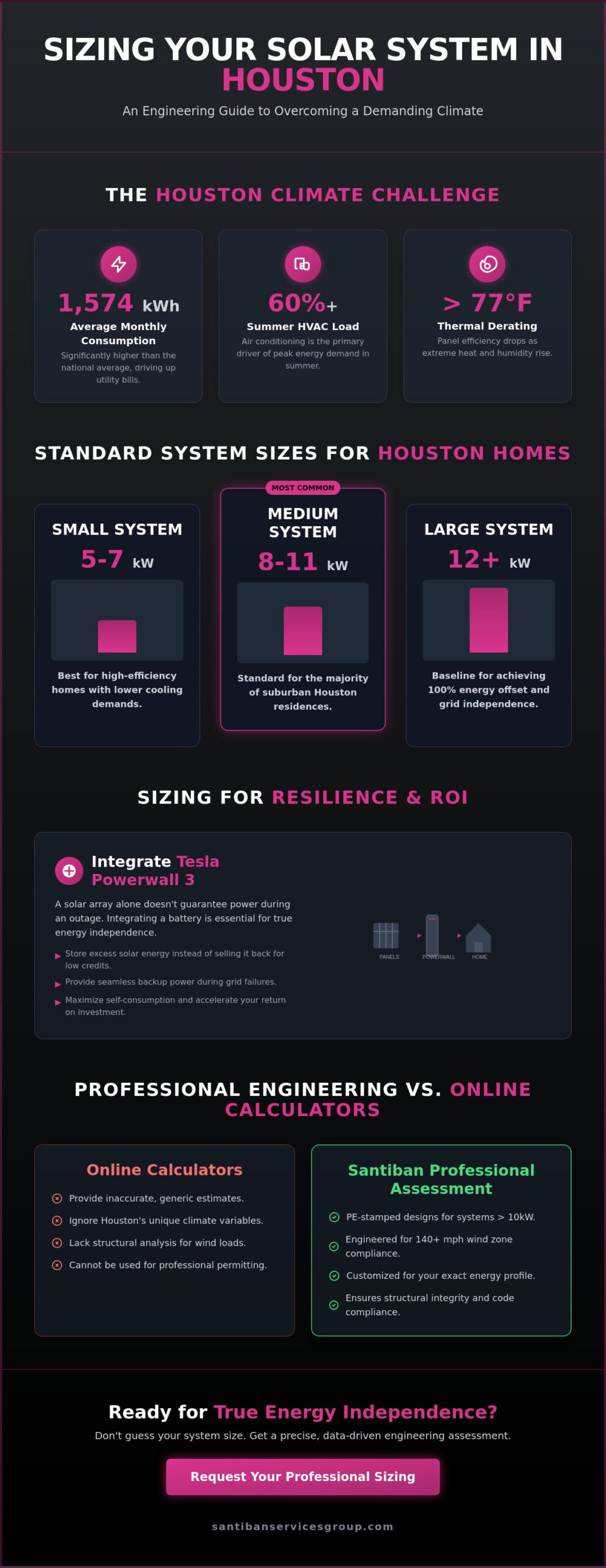
Solar system sizing is a precise calibration between a property’s annual kilowatt-hour (kWh) consumption and its available roof area. In the Texas Gulf Coast region, this equation is complicated by extreme ambient temperatures. High humidity and the recurring “Heat Dome” phenomenon don’t just increase energy demand; they physically reduce the efficiency of your solar panels. As temperatures rise above 77°F, standard photovoltaic system components begin to experience voltage drop, a process known as thermal derating. While some regions can rely on smaller arrays, Houston homeowners must account for this efficiency loss to achieve meaningful financial returns.
The average Houston household consumes approximately 1,574 kWh per month. This figure is significantly higher than the national average, largely due to the prolonged cooling season. Aiming for a 100 percent offset is the standard objective for homeowners who want to eliminate their reliance on the volatile Texas grid. This strategy ensures that the energy produced during daylight hours covers the high costs of cooling a home in August, providing a predictable path to financial recovery. Professional sizing accounts for these local variables to ensure your system doesn’t underperform when you need it most.
The HVAC Factor: Powering Houston Summers
In Southeast Texas, air conditioning units often account for 60 percent or more of a home’s total energy profile during the summer months. To determine what size solar system do I need in Houston, you must look beyond annual averages and focus on the July through September peaks. During these months, consumption can double. System designs must be sized to maximize the 4.5 to 5.2 peak sun hours available in 770xx zip codes. This ensures the array generates sufficient power to run high-tonnage HVAC systems while simultaneously charging battery reserves for nighttime use.
Utility Interconnection and Net Metering in 2026
CenterPoint Energy maintains strict technical standards for residential solar interconnection to ensure grid stability. Because Houston operates within a deregulated market, your sizing strategy depends heavily on your chosen Retail Electric Provider (REP). Most REPs offer solar buyback programs, but the credit rates often differ from the retail import rate. If your REP provides a 1-to-1 credit, sizing for exactly 100 percent offset is ideal. For systems exceeding 10kW, CenterPoint requires PE-stamped engineering to approve the interconnection, ensuring the local infrastructure can handle the back-fed power safely. If buyback rates are lower, integrating a Tesla Powerwall 3 becomes essential to store excess energy for self-consumption.
Calculating the Kilowatts: Standard System Sizes for Houston Homes
Determining what size solar system do I need in Houston requires a tiered evaluation of your property’s energy profile. Residential systems generally fall into three categories based on their output capacity. Small systems (5-7 kW) are suitable for high-efficiency homes with lower cooling demands. Medium systems (8-11 kW) serve as the standard for the majority of suburban residences. Large systems (12+ kW) are frequently the baseline for properties seeking a 100 percent energy offset. As you plan and install your home solar system, the 2026 regulatory environment demands precision. Because the federal residential solar tax credit expired on December 31, 2025, systems must be engineered for optimal ROI without the buffer of federal subsidies.
Panel wattage significantly influences the physical footprint of the array on your roof. Selecting 450W panels instead of 400W modules allows for a higher kilowatt capacity using fewer units. This is a critical consideration for Houston homes with limited roof real estate or complex architectural features. If your roof area is insufficient for a full offset, our engineering team prioritizes high-yield placement and the integration of Tesla Powerwall 3 installation to maximize the utility of every kilowatt produced. This technical approach ensures that even smaller footprints deliver reliable performance during peak demand periods.
System Size vs. Square Footage: A General Benchmark
Residences between 1,500 and 2,000 square feet typically require 6kW to 8kW of solar capacity to meet standard operational needs. For larger homes ranging from 2,500 to 3,500 square feet, a 10kW system is often the necessary starting point. These benchmarks fluctuate based on specific high-load variables. Swimming pool pumps, dedicated home offices, and the presence of electric vehicle chargers will increase the required kilowattage. Accuracy in these initial calculations prevents the need for costly system expansions in the future.
Equipment Quality and Its Impact on System Footprint
High-efficiency equipment is essential for navigating the shading challenges posed by mature Texas Oaks. We define energy density as the ratio of power produced per square foot of installed solar hardware. Maximizing this ratio is vital for achieving energy independence on constrained roof surfaces. Utilizing microinverters further optimizes the system by ensuring that partial shading on one module doesn’t degrade the output of the entire array. This level of technical detail differentiates a standard installation from a high-performance energy solution designed for long-term stability.
Sizing for Resilience: Integrating Tesla Powerwall 3 into Your Design
Engineering a solar solution for resilience requires a different technical approach than sizing for simple bill reduction. While grid-tied systems focus on annual kilowatt-hour offsets, grid-independent strategies prioritize daily operational survival. When determining what size solar system do I need in Houston, the inclusion of energy storage is the most significant variable. A Tesla Powerwall 3 serves as the central hub of this design. Its integrated inverter handles up to 11.5 kW of continuous power, which simplifies the balance between solar production and battery storage capacity. This hardware allows for a more efficient transfer of energy, ensuring that your property remains a self-sustaining entity when the local grid fails.
Successful resilience sizing depends on the recharge ratio. This calculation ensures the solar array produces enough surplus energy during the five peak sun hours to fully recharge the batteries while simultaneously powering the home’s active loads. If the array is too small, the battery storage will not reach 100 percent capacity before sunset, leaving the home vulnerable during the night. For property owners who require modularity or supplemental backup for specific zones, EcoFlow battery backup solutions offer a versatile alternative. These systems can be integrated to provide targeted redundancy alongside a primary solar installation.
Whole-Home Backup vs. Critical Loads
Defining your backup scope is a critical step in the engineering process. Sizing for critical loads involves maintaining power for essential infrastructure like refrigeration, security systems, and medical devices. The whole-home challenge in Southeast Texas is more complex. It requires the system to manage the high inrush current needed to jump-start a 5-ton air conditioning unit during a blackout. We utilize advanced load management and specific solar-to-battery ratios to prevent system trips. Strategic Tesla Electric integration further enhances this design by allowing larger systems to generate revenue through grid support when the local infrastructure is stable.
Hurricane Season Preparedness: Multi-Day Autonomy
Multi-day autonomy is the standard for Houston hurricane preparedness. During extended outages, the solar array must be large enough to sustain the home even during periods of heavy cloud cover. Our approach to resilience sizing accounts for these unpredictable Gulf Coast weather patterns. The Tesla Powerwall 3 integrated inverter maximizes efficiency by reducing the energy lost during DC-to-AC conversion. This ensures that every watt harvested by your panels is utilized or stored with precision. We design these systems to function as a disciplined, invisible force that maintains your domestic operations regardless of external conditions.
Beyond the Panels: Structural Integrity and PE-Stamped Engineering
Determining what size solar system do I need in Houston is only half of the engineering challenge. The physical weight and wind resistance of the array must align with the structural capabilities of your residence. Houston is situated in a high-velocity wind zone, where building codes often require resilience against 140+ mph winds. This environmental reality demands more than a simple panel count. It requires a rigorous technical assessment of the roof’s load-bearing capacity. A PE-stamped engineering design is not a luxury in Harris County; it’s a regulatory necessity for systems exceeding 10kW.
Many homeowners express concern regarding whether their roof will collapse under the weight of 30 or more panels. A standard residential roof is designed to handle significant dead loads, but the age and condition of the decking are critical. This is why we prioritize solar reroofing as a foundational step for older properties. Integrating a new roof with your solar installation ensures that the structural substrate is as durable as the technology it supports. This proactive approach prevents the need for costly system removals if the roof fails mid-way through the solar lifespan.
Structural Analysis for Houston Homes
Our team conducts an exhaustive review of rafter strength and spacing for every project. We apply industrial-grade engineering standards to residential applications to ensure long-term stability. This process identifies any necessary structural reinforcements before the installation begins. The impact of Solar Reroofing on long-term system stability cannot be overstated. By focusing on the structural health of the building, we mitigate risks associated with the added weight of high-efficiency modules.
Permitting and Compliance in Harris County
Navigating the City of Houston (COH) and Harris County permitting centers requires meticulous documentation. Professional design documents prevent costly installation delays by meeting all local building codes on the first submission. A PE stamp is a legal guarantee of structural safety. It confirms that a licensed professional engineer has verified the system’s compliance with wind load and weight distribution standards. To ensure your project meets these rigorous requirements, consult with our specialized personnel for a comprehensive structural review.
Professional Sizing vs. Online Calculators: The Santiban Approach
Instant solar calculators often provide a superficial estimate that fails to account for the technical complexities of a Houston property. These tools rely on generic satellite data which frequently misses critical details like roof pitch nuances, vent pipe placements, and micro-shading from neighboring structures. Relying on an automated quote can lead to a system that is either undersized for the August heat or oversized for your actual roof capacity. Our approach replaces these generalizations with 24 years of industrial electrical and solar experience. We treat every residential project with the same technical rigor required for large-scale industrial electrical construction, a standard also upheld by professional consultants like MarGav Solar in the renewable energy sector.
A professional assessment is the only way to ensure your system is engineered for long-term stability. We don’t just look at your current electric bill; we analyze the efficiency of your existing electrical infrastructure. This includes evaluating whether your home is prepared for future high-load additions. If you plan to add a home workshop or an accessory dwelling unit, your system size must reflect those projected demands. Our specialized personnel utilize precision tools to measure actual solar access, ensuring that every panel is placed for maximum yield and operational reliability.
The Site Assessment Checklist
Our technical audit covers several critical variables that online tools ignore. We evaluate your main electrical panel capacity to determine if it can support a residential Level 2 upgrade or even Commercial EV Charger infrastructure for property owners with business needs. Shade analysis is performed on-site to account for the growth patterns of local foliage over the next decade. We also provide customized ROI modeling. This modeling reflects the specific terms of your Retail Electric Provider (REP) and your unique energy usage history, providing a factual basis for your investment.
Your Next Steps: Moving from Estimate to Engineering
Determining what size solar system do I need in Houston is a transition from a preliminary estimate to a finalized engineering plan. A professional consultation provides the only definitive answer to your sizing requirements by merging historical data with structural reality. We bridge the gap between standard residential solar and industrial-grade reliability. This ensures your system remains a disciplined, invisible force powering your home for decades. We invite you to contact us to request a professional engineering assessment for your Houston home and secure your energy independence with precision.
Secure Your Energy Future with Engineering Precision
Achieving energy independence in Southeast Texas requires a transition from simple panel counts to disciplined structural engineering. You now understand that determining what size solar system do I need in Houston involves balancing extreme cooling loads with rigorous wind zone compliance. A successful design integrates high-efficiency modules with advanced storage solutions to ensure your operations remain uninterrupted during grid failures. We prioritize precise calculations that account for thermal derating and roof-specific load-bearing capacities.
Our team leverages 24+ years of Texas energy experience to deliver customized, industrial-grade results for every residence. As a Tesla Certified Installer, we provide the technical expertise necessary to optimize your property for the 2026 energy market. We invite you to Request a Professional PE-Stamped Solar Assessment to verify your structural requirements and finalize your engineering design. You can move forward with the confidence that your energy infrastructure is built for long-term stability and reliable performance. Your property is ready to become a self-sustaining asset.
Frequently Asked Questions
How many solar panels do I need to run a 2,000 sq ft house in Houston?
A 2,000 square foot residence in Houston typically requires an 8kW to 12kW system, which translates to approximately 20 to 30 high-efficiency panels. This range accounts for the significant energy consumption required to cool a home during the humid Gulf Coast summers. Your specific panel count depends on your annual kilowatt-hour usage and the available unobstructed roof area. A professional engineering review is necessary to finalize the exact quantity for your property.
Can I run my central AC on solar power during a Houston blackout?
You can operate a central air conditioning unit during a grid failure only if your system includes a high-capacity battery like the Tesla Powerwall 3. Standard solar arrays without storage automatically shut down during blackouts to protect utility workers. The Powerwall 3 provides the high inrush current necessary to start large HVAC compressors. This ensures your home remains habitable during extended outages caused by local infrastructure failures or severe weather.
What is the average cost of a 10kW solar system in Houston for 2026?
Market data for 2026 shows that solar installation prices in Houston remain competitive and generally fall below national averages. While the federal residential tax credit expired at the end of 2025, the 100 percent property tax exemption in Texas continues to provide significant long-term value. Total project costs are influenced by the choice of high-efficiency hardware and the complexity of the structural engineering required. Property owners should consult a technical expert for a detailed project estimate.
Do I need a new roof before installing solar panels in Texas?
A roof replacement is required if your existing shingles or decking have less than 10 to 15 years of operational life remaining. Installing an array on a compromised surface leads to unnecessary expenses if the system must be removed for roof repairs later. We provide solar reroofing to ensure the structural substrate matches the 25-year lifespan of the solar technology. This proactive step secures the integrity of your investment and prevents future logistical complications.
Is a 5kW solar system enough for a typical Houston family?
A 5kW system is generally insufficient for a typical family when determining what size solar system do I need in Houston. Most local households consume between 1,300 and 1,574 kWh per month, which far exceeds the output of a 5kW array. This size is usually reserved for smaller, high-efficiency properties or those seeking only a partial offset of their energy costs. Most suburban homes require a baseline of 10kW to achieve meaningful energy independence.
What happens to my solar system during a hurricane or high wind event?
Professionally engineered solar systems are designed to withstand wind loads exceeding 140 mph in accordance with Houston building codes. The mounting hardware and structural attachments are verified through PE-stamped engineering to ensure the array remains secure during extreme weather. Systems equipped with battery storage will continue to provide power to your home even if the utility grid is damaged by the storm. This resilience is a primary benefit of industrial-grade residential design.
How many Tesla Powerwalls do I need for a whole-home backup?
Most Houston residences require two to three Tesla Powerwall 3 units to support true whole-home backup, particularly when running 4-ton or 5-ton air conditioning units. A single unit is typically sufficient for managing critical loads like refrigeration, lighting, and medical devices. The exact number of batteries depends on your peak power demand and the duration of autonomy you require during an outage. We calculate these requirements during our technical site assessment.
Does the City of Houston require a permit for solar panel installation?
The City of Houston requires a formal permit from the Houston Permitting Center for all residential solar installations. This regulatory process ensures that the system complies with electrical safety standards and structural load requirements. An interconnection agreement with CenterPoint Energy is also mandatory to safely manage the flow of electricity to and from the grid. Professional design documents are essential for navigating these compliance steps without experiencing project delays.