
In the peak of a Houston summer, your air conditioning system is more than a convenience; it is a critical piece of safety infrastructure. You likely share the common concern that the ERCOT grid may falter exactly when the heat index reaches its most dangerous levels. Determining exactly how many Powerwalls to power a house in Houston requires a professional evaluation of your home’s high-surge loads and the specific demands of the Gulf Coast climate. While the federal solar tax credit expired at the end of 2025, strategic investments in storage technology remain essential for maintaining operational continuity during hurricane season.
This article provides the technical clarity needed to size a Tesla Powerwall 3 system for your specific property. You will discover how the 11.5 kW continuous power output of the newest model handles large AC units during a total grid failure. We also detail the current CenterPoint Energy rebates available in 2026 and the necessity of PE-stamped engineering for local permitting. This guide offers a clear roadmap for achieving a resilient, customized backup solution that functions as a silent engine for your home, ensuring your household remains operational regardless of external conditions.
Key Takeaways
- Learn why the 11.5 kW continuous output of the Powerwall 3 is critical for managing the high-surge loads of Houston air conditioning units during grid failures.
- Understand the technical distinction between energy capacity and power output to accurately determine how many Powerwalls to power a house in Houston based on your load profile.
- Discover how the integrated hybrid inverter in the 2026 model provides robust support for heavy appliances while simplifying the overall installation architecture.
- Identify why local regulations in the City of Houston require professional PE-stamped engineering to ensure the structural and electrical integrity of your system.
- Review the three primary backup tiers, categorized as Essential, Standard, and Whole-Home, to align your equipment count with your specific requirements for long-term resilience.
Sizing Your Energy Independence: How Many Powerwalls for Houston?
Determining the precise configuration for residential energy storage in Southeast Texas requires a departure from national averages. The primary question of how many Powerwalls to power a house in Houston depends on two distinct technical metrics: energy capacity and continuous power output. In 2026, the Powerwall 3 has become the industrial standard for these installations, offering a specialized hybrid inverter that streamlines the transition between solar generation and battery discharge. While older models often required multiple units to handle the initial surge of a central air conditioner, the newer architecture prioritizes high-output performance to meet the demands of the Houston climate.
Capacity vs. Power: The Critical Distinction
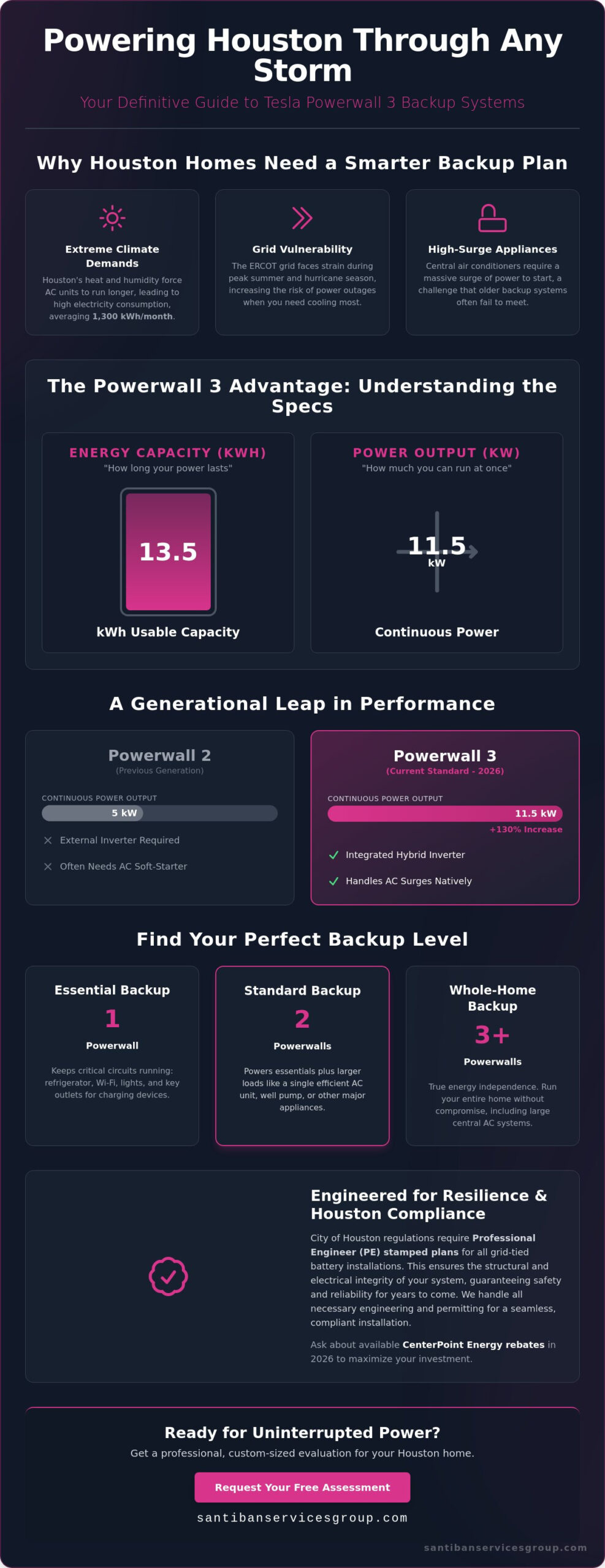
Energy capacity, measured in kilowatt-hours (kWh), represents the total volume of electricity stored within the system. Think of this as the size of your fuel tank. Power output, measured in kilowatts (kW), represents the rate at which that energy can be delivered to your home’s electrical panel. The Tesla Powerwall 3 provides 13.5 kWh of usable capacity and an impressive 11.5 kW of continuous power output. This high power rating is a strategic advantage for Houstonians because it allows a single unit to support the heavy electrical loads of modern appliances. However, capacity still dictates how long those appliances can run. If the ERCOT grid fails during a prolonged heatwave, your system must have enough stored energy to maintain cooling cycles until the sun rises to recharge the batteries.
The Houston Consumption Profile
Average residential electricity consumption in Houston is approximately 1,300 kWh per month, according to industry data from May 2026. This figure is significantly higher than the national average due to the extreme humidity and heat characteristic of Harris County. Humidity forces HVAC systems to operate for extended cycles to remove moisture from the air, which increases the total energy drain on a battery system. A 2,500 sq. ft. home in Houston will typically consume more energy than an identical structure in a cooler or drier climate. When calculating your backup needs, our engineering team analyzes these specific environmental factors to ensure your system provides customized results rather than a generic estimate. Relying on a single battery might cover essential lights and refrigeration, but sustaining a comfortable indoor environment during hurricane season usually necessitates a multi-unit configuration designed for high-duration resilience.
The Powerwall 3 Advantage: Why the Math Changed in 2026
The introduction of the Tesla Powerwall 3 has fundamentally altered the engineering landscape for residential backup systems. When calculating how many Powerwalls to power a house in Houston, the metric that matters most in 2026 is no longer just total energy storage, but the unit’s ability to manage high-surge startup currents. Because Houston homes maintain electricity consumption levels higher than the national average, the previous requirement for multiple batteries was often driven by power limitations rather than capacity needs. The Powerwall 3 addresses this with an 11.5 kW continuous output, which represents a 130% increase over its predecessor’s performance.
This technical evolution is particularly relevant for managing heavy industrial-grade home appliances. Older battery models frequently struggled with the initial inrush of current required to start a central air conditioning compressor. The Powerwall 3 utilizes a robust integrated inverter that handles these surges with precision. By providing a higher peak power rating, the system often eliminates the need for third-party soft-starters on HVAC units. This reduction in hardware complexity improves long-term reliability and ensures that your cooling system remains operational when the grid fails during extreme heat events.
Powerwall 3 vs. Powerwall 2: A 2026 Comparison
The transition to the Powerwall 3 provides a more efficient installation footprint and superior electrical performance for Houston residents. The following data highlights why the newer model is the preferred choice for modern energy independence:
| Specification | Powerwall 2 | Powerwall 3 |
|---|---|---|
| Continuous Power Output | 5 kW | 11.5 kW |
| Usable Energy Capacity | 13.5 kWh | 13.5 kWh |
| Solar Inverter | External Required | Integrated Hybrid |
| Efficiency Type | AC-Coupled | DC-Coupled |
Integrated Inverter Benefits for Solar Reroofing
The integrated hybrid inverter is a critical component for homeowners considering Tesla and solar roof solutions. By consolidating the solar and battery inverters into a single chassis, the system achieves higher efficiency through DC-coupling. This design minimizes energy conversion losses and reduces potential points of failure within the system. From an operational standpoint, this streamlined architecture simplifies the permitting process. Our team can secure Houston permits more efficiently because the unified design meets local technical standards with fewer components. To ensure your system adheres to all municipal safety codes, we provide professional PE-stamped engineering design services for every installation.
The AC Factor: Sizing for Houston’s Cooling Demands
In the context of Southeast Texas, air conditioning is a fundamental safety requirement rather than a secondary comfort. When determining how many Powerwalls to power a house in Houston, the primary constraint is the startup demand of your HVAC system. Unlike lighting or refrigeration, central air conditioners require a massive instantaneous draw of electricity to engage the compressor. If your battery system cannot provide this peak current, the AC will fail to start, regardless of how much total energy remains in the batteries. Professional load calculations are the only way to verify exactly how many Powerwalls to power a house in Houston when dealing with high-tonnage cooling systems.
Locked Rotor Amps (LRA) Explained
The most critical metric for your energy system design is the Locked Rotor Amps (LRA) rating. This value represents the maximum current an electric motor draws when starting from a standstill. You can typically locate this figure on the manufacturer’s data plate attached to your outdoor condenser unit. While a standard 3-ton AC unit might draw only 3 kW while running, its LRA could require a surge equivalent to 15 kW or more. Our certified Tesla Powerwall installer team performs a detailed load analysis for every project to ensure the battery configuration matches these surge requirements. Because the Powerwall 3 delivers 11.5 kW of continuous power, it can often manage the startup of a 3-ton unit that previously required two Powerwall 2 units.
Sizing for Duration: Surviving a 3-Day Outage
Energy security in Houston must account for the reality of electric reliability in Texas during peak summer months and hurricane season. A single Powerwall 3 provides 13.5 kWh of capacity. If a 3-ton AC runs at a 50% duty cycle, it will consume approximately 1.5 kWh every hour. At this rate, a single battery would be depleted in less than nine hours without solar recharge. To sustain a household through a multi-day grid failure, most 2,000 to 3,000 sq. ft. Houston homes find their ‘sweet spot’ with a two or three-battery configuration. This setup allows for specific operational advantages:
- Consistent Cooling: Maintaining safe indoor temperatures and humidity levels during the hottest parts of the day.
- Load Shedding: Using the Tesla app to prioritize the AC while temporarily disabling non-essential loads like pool pumps or electric dryers.
- Solar Buffer: Providing enough storage to capture excess solar generation during the day to power the home through the night.
This strategic approach ensures that your home remains a resilient sanctuary until grid services are restored. By balancing the high power output of the Powerwall 3 with sufficient total capacity, you can achieve a whole-home backup solution that performs reliably under the most demanding conditions.
Engineering Resilience: PE Stamps and Houston Regulations
Determining how many Powerwalls to power a house in Houston involves more than just electrical calculations; it requires strict adherence to municipal safety codes and structural standards. Because the Gulf Coast is prone to high wind loads and extreme weather events, the City of Houston and Harris County mandate rigorous technical compliance for all battery storage systems. A critical component of this process is obtaining PE stamped engineering for solar systems and battery backups. This certification ensures that the installation does not compromise the structural integrity of your property and that the electrical integration meets the highest safety benchmarks.
Homeowners often express concern regarding Homeowners Association (HOA) approvals and municipal inspections. Texas law provides significant protections for solar and battery installations, including a 100% property tax exemption for the added home value these systems provide. However, passing a city inspection requires precise documentation. Our team manages every operational detail, from initial load calculations to the final inspection, ensuring your multi-unit Powerwall setup integrates seamlessly with your existing electrical panel. If your current panel cannot support the increased amperage of multiple Powerwall 3 units, we coordinate the necessary industrial electrical construction to upgrade your infrastructure to modern standards.
The Role of the Professional Engineer (PE)
A Professional Engineer (PE) provides an authoritative verification of your system’s design. This process is not merely a bureaucratic hurdle but a vital safety measure for high-voltage energy storage. In Houston, PE-stamped designs are essential for securing permits and ensuring that the equipment can withstand local environmental pressures. By utilizing an in-house engineering approach, we eliminate the delays typically associated with third-party design firms. This proactive strategy allows for faster interconnection with the grid and provides homeowners with the quiet confidence that their system is engineered for long-term reliability.
Tesla Electric and Grid ROI in Texas
Beyond providing emergency backup, your battery configuration serves as a strategic financial asset. Participating in Tesla Electric in Houston allows you to monetize your stored energy by selling it back to the grid during periods of high demand. This Virtual Power Plant (VPP) participation can significantly improve the return on investment for an additional Powerwall unit. In 2026, CenterPoint Energy continues to offer residential solar program rebates of $135 per kilowatt for systems up to 15 kW, further offsetting the initial capital requirement. By leveraging intelligent software management, you can maximize your Tesla Solar investment while contributing to the overall stability of the Texas grid.
To begin your transition to a resilient energy future, contact our team to schedule a professional PE-stamped engineering design consultation for your Houston property.
Conclusion: Designing Your Houston Backup Strategy
Establishing a resilient energy profile for a Southeast Texas property requires a methodical approach to system sizing. Determining how many Powerwalls to power a house in Houston is a function of your specific load profile and the duration of backup required during a grid failure. In 2026, the Powerwall 3 serves as the primary building block for these systems, offering the high power output necessary to sustain cooling cycles in extreme humidity. While a single unit provides essential backup for lighting and refrigeration, most homeowners opt for a multi-unit configuration to achieve standard or whole-home operational continuity.
Your choice of battery count typically falls into three distinct tiers of protection. An essential setup utilizing one Powerwall 3 focuses on low-amperage circuits like medical devices and internet connectivity. A standard configuration of two batteries provides the surge capacity to run a modern 3-ton air conditioner, which is a critical safety requirement during Houston summers. For those seeking complete energy independence, a whole-home strategy involving three or more units ensures that your household remains fully operational throughout the duration of hurricane recovery efforts. Integrating these units with a solar reroofing project in 2026 allows you to maximize self-consumption of energy now that federal tax credits have expired, shifting the financial focus toward grid rebates and long-term reliability.
Your 3-Step Sizing Roadmap
To ensure your energy storage system performs with precision, follow this structured evaluation process:
- Step 1: Audit your 12-month kWh usage history from your Houston utility provider to identify seasonal peaks and average daily consumption.
- Step 2: Identify your ‘must-run’ appliances, such as HVAC systems, well pumps, and refrigeration, to calculate the total Locked Rotor Amps (LRA) your system must support.
- Step 3: Consult with a certified installer to develop a PE-stamped system design that meets all municipal permitting and structural requirements.
Why Choose Santiban Services Group?
Our organization brings over 24 years of industrial-grade electrical experience to every residential project in Texas. We function as a unified provider, managing every detail from solar installation and reroofing to complex battery backup configurations. This comprehensive approach ensures that your system is not just a collection of hardware, but a professionally engineered solution designed for Gulf Coast resilience. By handling all PE-stamped engineering design and permitting in-house, we provide a seamless path to energy independence. Schedule your Houston Powerwall 3 consultation today to receive a customized load analysis and secure your home’s operational future.
Secure Your Houston Energy Independence
Achieving total grid resilience requires a precise alignment of technology and professional engineering. The Powerwall 3 provides the robust 11.5 kW output necessary to manage the intense cooling demands of the Gulf Coast climate. Finalizing the decision on how many Powerwalls to power a house in Houston involves more than just selecting a battery count; it requires a detailed analysis of your home’s unique electrical load and structural requirements. Our team ensures every installation meets the rigorous standards of Harris County through inclusive PE-stamped engineering and industrial-grade construction practices.
With 24+ years of Texas electrical expertise, Santiban Services Group operates as a silent engine behind your home’s most critical systems. Our Tesla-certified installers provide the technical precision needed to transition your property into a self-sustaining sanctuary. Don’t leave your family’s safety to the uncertainties of the ERCOT grid. Request a Professional Powerwall 3 Sizing Estimate for Your Houston Home and take the final step toward reliable, long-term energy security. We look forward to engineering a customized solution that maintains your household’s operational continuity for years to come.
Frequently Asked Questions
Can one Tesla Powerwall 3 run a 5-ton AC unit in Houston?
A single Tesla Powerwall 3 typically cannot support the startup surge of a 5-ton AC unit without additional hardware. While the Powerwall 3 offers a high continuous output of 11.5 kW, a 5-ton compressor often requires a much higher instantaneous draw, known as Locked Rotor Amps. Determining how many Powerwalls to power a house in Houston with a large AC unit requires a professional load analysis to ensure the system can handle these specific surges.
How long will 2 Powerwalls last during a total grid failure in Texas?
Two Powerwall 3 units provide 27 kWh of usable capacity, which can sustain a Houston home for several days if managed correctly. When determining how many Powerwalls to power a house in Houston for hurricane resilience, we factor in daily solar recharge rates. Without solar, two units may power a central AC for 12 to 18 hours; however, prioritizing essential loads like refrigeration and medical equipment can extend this duration significantly.
Do I need a special permit to install multiple Powerwalls in Harris County?
Yes, all battery storage installations within Harris County and the City of Houston require a formal permit from the Houston Permitting Center. These regulations ensure that the system adheres to strict electrical and structural safety codes. Every project we manage includes a PE-stamped engineering design to satisfy these municipal requirements, which prevents delays during the final inspection and ensures your system is fully compliant with local law.
Is it better to get more solar panels or more Powerwalls for hurricane backup?
Optimal hurricane resilience requires a strategic balance between generation and storage. Solar panels provide the energy needed to recharge your system, but additional Powerwalls are necessary to sustain heavy loads through the night and during cloud cover. If your goal is to maintain air conditioning during a multi-day outage, increasing your battery count is often more effective than simply adding more panels to an undersized storage array.
What is the difference between Powerwall 3 and Powerwall+ for Houston homes?
The Powerwall 3 is the current 2026 standard, featuring an integrated hybrid inverter and a significantly higher power output than previous models. While the Powerwall+ also included an integrated inverter, the Powerwall 3 utilizes a DC-coupled architecture that improves overall efficiency and simplifies the installation footprint. This newer model is specifically engineered to handle the high-surge requirements of modern, all-electric Houston homes more effectively than its predecessors.
Does the Tesla Powerwall 3 work with existing solar panels from other brands?
The Tesla Powerwall 3 is designed to integrate with a wide variety of existing solar panel brands through AC-coupling. While it performs most efficiently as a DC-coupled system in new installations, it remains a versatile solution for homeowners looking to add storage to an established solar array. Our technicians verify the compatibility of your current inverter and electrical panel to ensure a seamless integration that maintains the performance of your entire system.
How does the Tesla Electric program in Texas affect how many batteries I should buy?
Participation in the Tesla Electric program may encourage you to install more batteries than your basic backup needs require. By having excess storage, you can sell power back to the grid during peak demand periods when rates are highest, which improves your long-term return on investment. This program transforms your batteries into a strategic financial asset, allowing you to maximize the utility of your energy storage system throughout the year.
Can I add more Powerwalls to my system later if my energy needs increase?
You can expand your energy storage capacity by adding more units at a later date if your consumption increases. The Powerwall 3 system supports the installation of up to four units for a total capacity of 54 kWh. However, it’s often more cost-effective to install the necessary number of batteries during the initial project to minimize labor costs and ensure your electrical infrastructure is sized correctly from the start.