
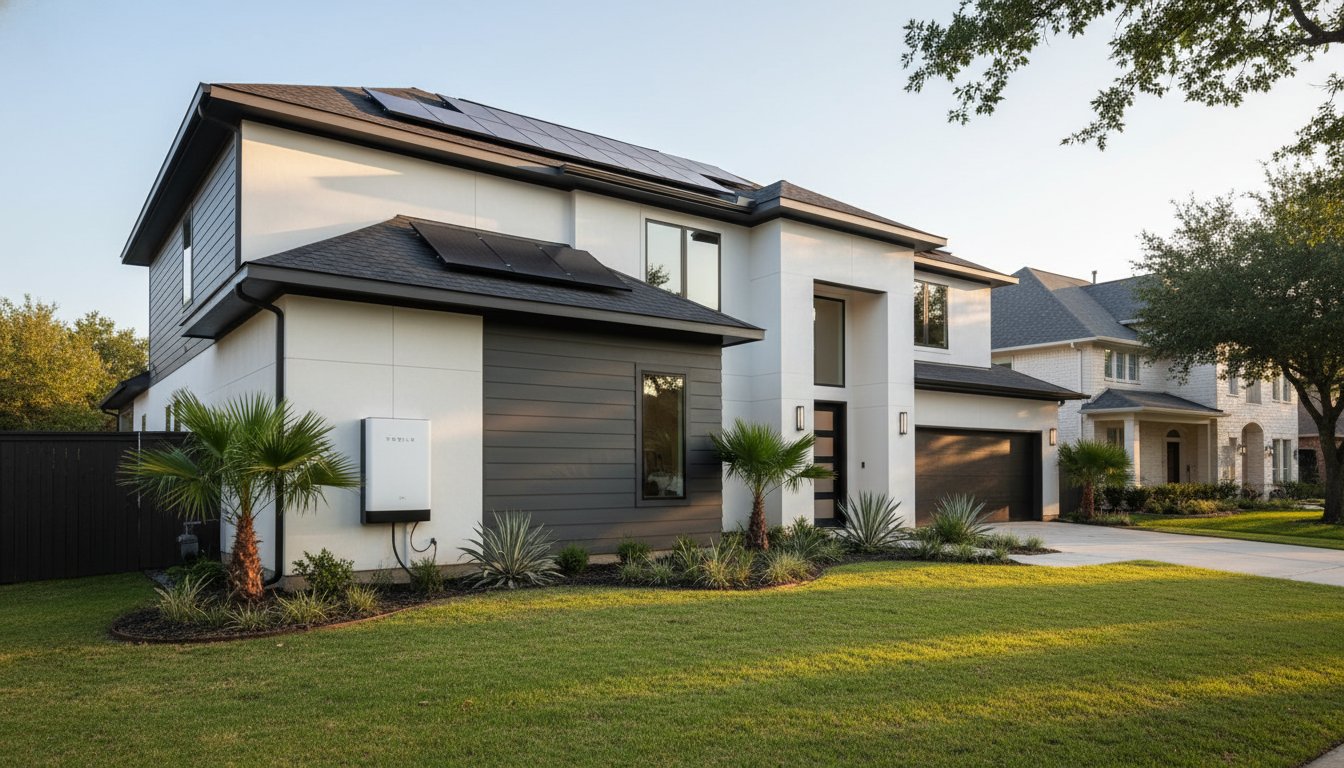
In the evolving Houston real estate market, a standard solar array is no longer a simple utility upgrade; it is a sophisticated energy resilience asset. Many homeowners express concern regarding the persistent instability of the Texas grid and question if their capital expenditure will yield a verifiable return. Learning how to increase home value with solar requires a focus on the precision of the installation and the integration of advanced storage technology. You understand that a property capable of autonomous operation during a grid failure commands a premium that traditional homes cannot match.
This 2026 guide delivers a factual breakdown of the ROI associated with solar reroofing and battery storage systems. We outline how specific technologies, such as the Tesla Powerwall 3, transform a residence into a market differentiator for discerning buyers. You will learn the exact steps to document system performance for appraisers and how to communicate the long term financial benefits of energy independence. This analysis ensures you possess the data required to validate your home’s value in any market condition.
Key Takeaways
- Analyze the shift in property valuation where owned solar systems are treated as high-performing capital improvements rather than liabilities.
- Evaluate the “resilience premium” that Houston homebuyers associate with grid independence and protection from energy price volatility.
- Learn how to increase home value with solar by integrating industrial-grade battery backups and professional engineering to secure a property premium.
- Identify the role of PE-stamped engineering and specialized solar reroofing in establishing a verifiable asset for future buyers.
- Determine the financial advantages of solar ROI compared to traditional cosmetic upgrades to optimize your home’s equity profile.
The Valuation Shift: Measuring Solar Impact on Property Value in 2026
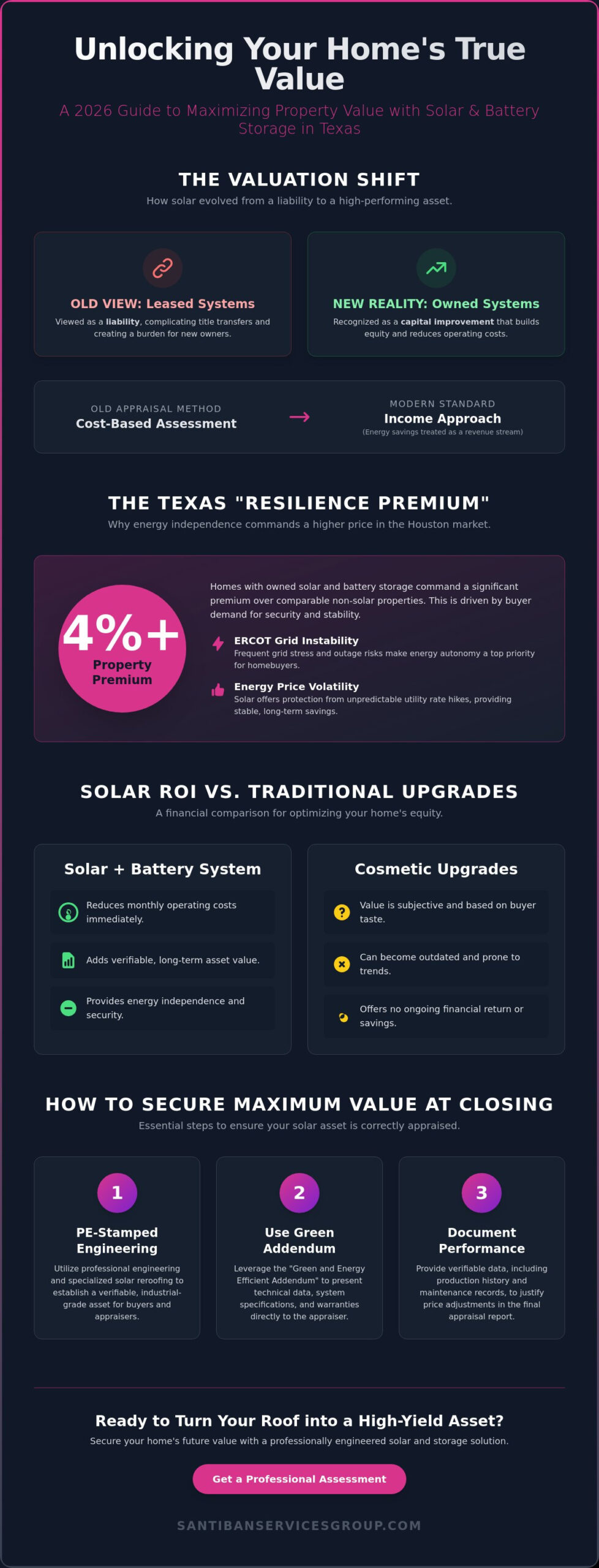
The real estate market in 2026 recognizes solar installations as significant capital improvements rather than temporary additions. Homeowners often ask how to increase home value with solar, and the answer lies in the transition from viewing panels as gadgets to viewing them as essential infrastructure. An owned system functions as a high-performing asset that reduces monthly operating costs. This reduction is a primary driver for buyer demand, especially as energy prices remain a significant portion of household expenditures. Unlike leased systems, which can complicate a title transfer and act as a liability, owned solar assets are clear equity builders that streamline the sale process.
Appraisers are increasingly moving away from simple cost-based assessments. They now favor the “Income Approach,” which treats energy savings as a recurring revenue stream for the property owner. By calculating the total energy offset over the anticipated life of the system, professionals can assign a specific dollar value to the installation. This shift is supported by the maturity of the technology behind solar panels, which has proven its long-term reliability and performance metrics to financial institutions. When a home produces its own power, it effectively lowers its “cost of ownership,” making it more attractive to qualified buyers who prioritize long-term fiscal stability.
National Trends vs. the Texas Market
Texas has emerged as a top-tier state for solar premiums because of the unique pressures on the ERCOT grid. While national averages vary, the Texas market places a higher value on energy autonomy due to frequent price volatility and demand spikes. Local utility rates continue to influence buyer behavior, as residents seek protection from unpredictable monthly bills. In 2026, homes in major Texas metropolitan areas with owned solar assets typically command a property premium of approximately 4% over comparable non-solar residences. This resilience factor makes solar a more stable investment than many traditional cosmetic interior renovations.
Appraisal Standards for Solar Assets
To secure this value at closing, homeowners must align with Fannie Mae and Freddie Mac appraisal standards. These organizations recognize owned solar as a permanent fixture that contributes to the property’s appraised value. Utilizing the “Green and Energy Efficient Addendum” is critical during the sale process. This document allows you to present technical data, production history, and warranty information directly to the appraiser. Professional documentation serves as the bridge between a functional system and a higher closing price. Without these records, the system might be undervalued, as appraisers require verifiable data to justify price adjustments in their final reports.
Why Texas Homebuyers Prioritize Solar and Energy Storage
In the Houston real estate market, the conversation around how to increase home value with solar has shifted from environmental ethics to operational necessity. Texas homebuyers are increasingly focused on the “Resilience Premium.” This concept reflects the additional value assigned to properties that can maintain power during ERCOT grid instabilities. Recent weather events have fundamentally altered buyer psychology. Consequently, solar installations and home battery backups are no longer viewed as optional green features. They are now categorized as essential infrastructure, similar to a modern HVAC system or a structural foundation.
Data from the real estate sector supports this valuation shift. A recent study found that homes equipped with solar panels consistently earn a sales premium compared to non-solar properties. In Texas, this premium is often amplified when the system includes energy storage. Buyers recognize that a home capable of autonomous operation provides a level of security that traditional homes lack. Strategic investments like solar reroofing ensure that the system remains structurally sound for decades, protecting the property’s envelope while generating power.
Grid Reliability as a Selling Point
Positioning a home as a “self-contained power plant” creates a powerful marketing narrative. For Houston residents, the memory of extended outages remains a significant motivator. A property featuring a Tesla Powerwall 3 installation offers immediate proof of reliability. This specific technology allows for seamless transitions to backup power, ensuring that critical loads remain active during grid failures. This capability is a primary differentiator in competitive listings. It transforms a standard residence into a secure asset that operates independently of the local utility’s performance.
Reduced Operating Costs for Future Owners
Energy prices in 2026 continue to present a challenge for traditional homeowners. By comparing the monthly carrying costs, it becomes clear that solar-equipped homes offer a lower “Total Cost of Ownership.” Future owners benefit from immediate utility savings, which effectively increases their purchasing power. This financial advantage is particularly attractive to corporate managers and professionals who analyze long-term asset performance. Solar acts as a definitive hedge against the price volatility inherent in the Texas energy market, making the home a more predictable financial commitment.
Solar ROI vs. Traditional Home Improvements: A Financial Comparison
Evaluating capital improvements requires a disciplined analysis of asset depreciation and functional utility. When homeowners investigate how to increase home value with solar, they often find that traditional renovations like kitchen remodels or bathroom upgrades suffer from rapid aesthetic depreciation. A modern kitchen may be the centerpiece of a home today, but its value diminishes as design trends evolve and appliances reach the end of their service lives. In contrast, a solar installation functions as an industrial-grade energy asset. It provides a predictable financial return through utility offset, maintaining its value through long-term performance guarantees rather than subjective visual appeal.
The financial profile of solar is further enhanced by the federal Investment Tax Credit (ITC). This incentive allows homeowners to deduct 30 percent of the system cost from their federal taxes, significantly lowering the net investment. Because this credit applies to the total project cost, including necessary structural preparations, it effectively subsidizes the transition to a high-performance home. When you combine this with the immediate reduction in monthly operational expenses, the solar asset begins to pay for itself long before the property is listed for sale. This creates a dual benefit of immediate cash flow and increased equity.
Cost Recovery Rates in 2026
In the 2026 Texas real estate market, solar installations frequently achieve a cost recovery rate of 100 percent or higher. This is particularly true when the system is owned outright and integrated with modern storage solutions. While a mid-range kitchen remodel typically recovers 60 to 75 percent of its cost at resale, a strategic solar installation in Houston often delivers a full return on the net investment. This performance is driven by the fact that buyers view energy independence as a hedge against inflation. They’re willing to pay a premium for a home that has already mitigated its most volatile monthly expense.
Maintenance and Longevity Considerations
Longevity is a critical factor for corporate-minded buyers who prioritize low-maintenance assets. High-quality solar panels come with 25-year performance warranties, ensuring the system remains a viable asset for the next generation of owners. Utilizing professional solar and solar roof solutions further secures this value. By performing solar reroofing, you ensure the underlying structure is as durable as the panels themselves. This eliminates the common buyer anxiety regarding the cost of removing panels for future roof repairs, positioning the entire roof assembly as a unified, worry-free system.
Strategies to Maximize Resale Value: Beyond the Panels
Maximizing property premiums requires a focus on technical specifications and verifiable documentation. While many homeowners understand the basic premise of solar, understanding how to increase home value with solar involves moving beyond the panels themselves. You must ensure the system is perceived as a permanent, high-quality structural component. This is achieved through industrial-grade installation standards and the integration of advanced storage technology. Technical excellence is the primary differentiator in a competitive real estate market.
Securing the full financial benefit of your investment also depends on transferable warranties and accurate production data. Choosing an established partner ensures that the system performance guarantees remain valid for the next owner. You should maintain a digital archive of annual production reports to demonstrate the system historical financial performance. This data allows you to present a factual case for the property reduced operating costs during negotiations. For a comprehensive evaluation of your property solar potential, contact Santiban Services Group to review our engineering and installation standards.
The Importance of Engineering and Compliance
Professional engineering serves as a foundational element of property value. Utilizing PE stamped engineering for solar systems provides a level of quality assurance that standard residential installations often lack. These certified designs ensure the roof structural integrity is maintained and streamline the permitting process with local jurisdictions. When a home inspector reviews the property, an engineering stamp acts as definitive proof of compliance. It reassures prospective buyers that the system was built to industrial standards, preventing future structural complications or insurance disputes.
Future-Proofing with Battery Storage
In the 2026 Houston market, energy storage has become the new benchmark for luxury real estate. Engaging a certified tesla powerwall installer ensures the home remains functional during localized grid failures. This capability is often the deciding factor for high-end buyers who prioritize continuity of lifestyle. A Powerwall 3 installation provides whole-home backup, distinguishing the property from homes with only partial-load systems. This level of energy security is now viewed with the same importance as premium interior finishes were in previous years.
The Santiban Advantage: Securing Your Solar Investment in Houston
Santiban Services Group operates as the disciplined, silent engine behind Houston’s most resilient residential properties. While previous sections detailed the market shift toward energy autonomy, the technical execution of these systems determines their ultimate financial performance. We prioritize industrial-grade electrical construction and meticulous solar reroofing to ensure every installation functions as a permanent, high-performance structural asset. By adhering to these rigorous standards, we provide homeowners with the technical foundation necessary to realize a significant property premium. Understanding how to increase home value with solar requires a partner who treats residential projects with the same precision and organizational discipline as a complex industrial facility. Our focus on recurring quality ensures that every operational detail remains under expert control.
Expertise in Texas Energy Infrastructure
Our team leverages over 24 years of specialized industry experience to navigate the complexities of the Texas energy infrastructure. We don’t settle for standard residential shortcuts. Instead, we implement PE-stamped engineering for every complex installation to ensure long-term structural and electrical integrity. As a tesla electric certified partner, we bridge the gap between advanced technology and professional execution. This certification offers the brand recognition and reliability that savvy buyers prioritize during the resale process. We provide the comprehensive engineering documentation and production data required by appraisers to validate the system’s tangible contribution to the home’s final valuation. Our specialized personnel are trained to maintain the highest standards of safety and technical accuracy.
Ready to Increase Your Home Value?
Securing a measurable return on investment begins with a data-driven strategy and a commitment to customized results. We offer a comprehensive ROI analysis for Houston property owners seeking to optimize their energy profile and property value. Whether you’re upgrading to a Tesla Powerwall 3 or an EcoFlow battery backup system, our team manages every detail of the integration with methodical precision. This proactive approach ensures your home is prepared for the energy demands and grid instabilities of 2026. Our status as an established partner allows us to build long-term relationships based on consistent performance and reliability. Contact Santiban Services Group today to schedule a professional consultation and define the technical requirements for your energy resilience project.
Securing the Future of Your Houston Real Estate Asset
The 2026 real estate landscape in Houston prioritizes energy resilience and structural integrity above temporary aesthetic trends. You have seen that owned solar assets, when paired with high-performance storage, provide a verifiable property premium that traditional renovations cannot match. Understanding how to increase home value with solar is no longer a theoretical exercise; it is a matter of technical precision and rigorous documentation. By treating your energy system as a long-term capital improvement, you ensure your property remains a competitive asset in any market cycle.
Santiban Services Group brings over 24 years of industry experience to every residential project. We provide the PE-stamped engineering design and industrial-grade electrical standards required to protect your investment and satisfy professional appraisers. As a Tesla-Certified Installer, we ensure your system meets the highest standards of reliability and brand recognition. Take the first step toward optimizing your property equity and operational independence. Request a Professional Solar ROI Consultation from Santiban Services Group to define your path to energy resilience. Your home represents a significant financial commitment, and we are ready to help you secure its future.
Frequently Asked Questions
Does solar increase property taxes in Texas?
Texas law provides a specific property tax exemption for solar installations. According to Texas Tax Code Section 11.27, the value added to your property by a solar energy system is exempt from taxation. Homeowners must file Form 50-123 with their local appraisal district to secure this benefit. This ensures that your home’s market value increases without a corresponding rise in your annual tax liability.
How much does solar actually add to a home’s value in Houston?
Research indicates that solar installations add a property premium of approximately 4% in the Houston market. This value is often higher for systems that include advanced storage solutions like the Tesla Powerwall 3. Buyers in the region specifically look for homes that offer lower monthly operating costs and protection against the frequent grid instabilities common in Southeast Texas.
Will solar panels make my home harder to sell if I have a lease?
Leased solar systems frequently complicate the sale process and can act as a liability. Many buyers are hesitant to assume a third-party contract or undergo additional credit approvals during the home purchase. If you want to know how to increase home value with solar, the most effective strategy is owning the system outright. Owned assets transfer seamlessly and are viewed as equity builders rather than monthly debts.
What happens to the solar warranty when I sell my house?
Most industrial-grade solar warranties are fully transferable to the next property owner. You should provide the buyer with all manufacturer performance guarantees and workmanship documentation from your installation partner. Maintaining these records ensures that the buyer feels confident in the long-term reliability of the asset. Transferable warranties are a critical component in justifying a higher sales price during negotiations.
Is a Tesla Powerwall 3 worth the investment for home resale?
The Tesla Powerwall 3 is a highly sought-after feature in the 2026 Houston real estate market. It provides a “Resilience Premium” that traditional homes lack by ensuring the property remains functional during grid failures. Buyers view this technology as essential infrastructure rather than a luxury add-on. This investment distinguishes your property from others and appeals to professionals who prioritize energy security and autonomous operation.
Do I need to replace my roof before installing solar panels?
You should assess the condition of your roof before proceeding with an installation. If the roof has less than 10 years of service life remaining, solar reroofing is the most financially sound decision. This approach ensures the underlying structure is as durable as the solar panels themselves. It eliminates the future requirement to pay for the removal and reinstallation of equipment when the roof eventually needs replacement.
How do I prove the value of my solar system to a potential buyer?
Proving value requires presenting factual data, including historical production reports and PE-stamped engineering designs. You should utilize the “Green and Energy Efficient Addendum” during the appraisal process to document the system’s technical specifications. Demonstrating a consistent reduction in utility costs through past bills provides concrete evidence of the home’s lower cost of ownership, which justifies a higher valuation.
Can I take my solar panels with me when I move?
Removing solar panels is generally not recommended due to the high labor costs and the potential for structural damage to the roof. Most systems are designed as permanent fixtures that integrate with the home’s electrical infrastructure. You’ll typically see a better return by leaving the system in place and including its value in the home’s sale price. This allows the system to serve as a key differentiator for prospective buyers.