
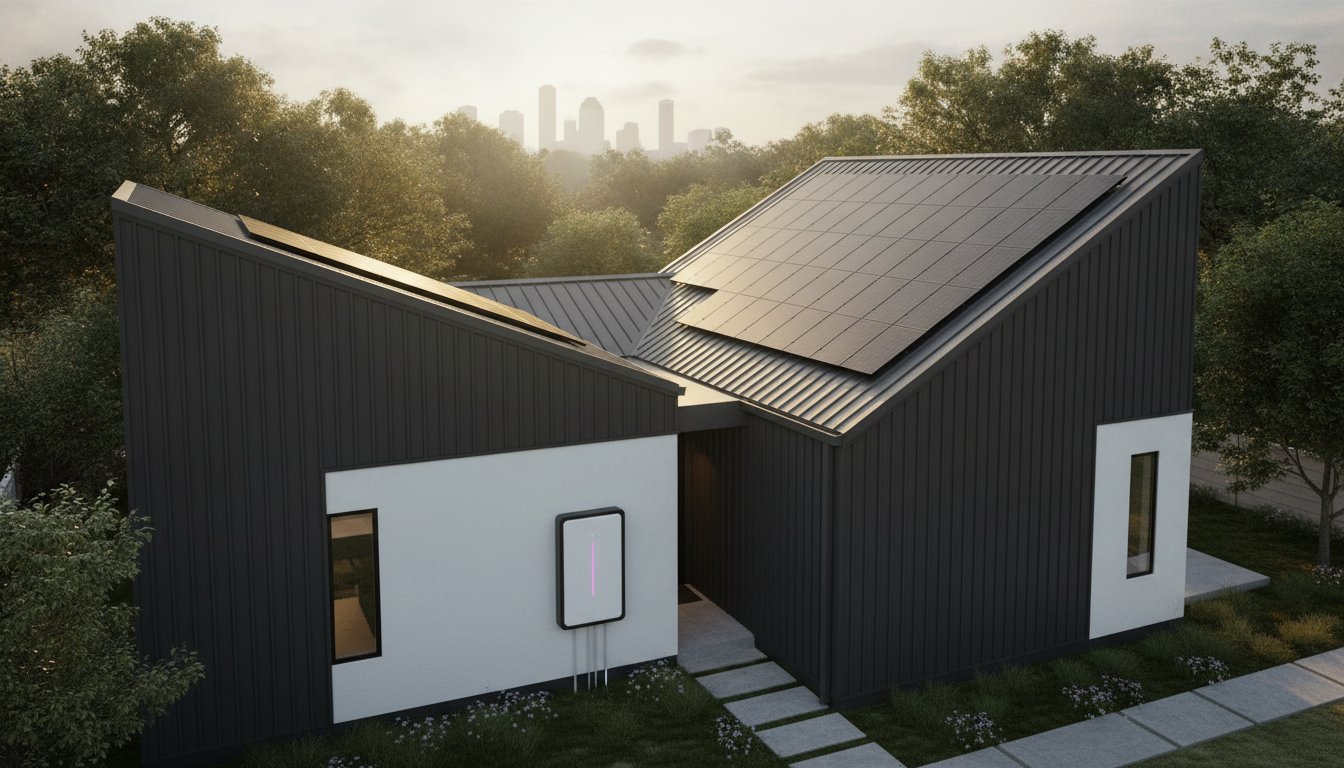
The long-held industry standard that south-facing arrays are the undisputed choice for efficiency is no longer the absolute truth in the 2026 Texas energy landscape. Selecting the best direction for solar panels in Texas now requires a precise engineering strategy that balances raw generation with the reality of peak demand periods and grid instability. With ERCOT forecasting record summer peaks of over 92,000 MW, the traditional model often fails to address the most expensive hours of the day when cooling costs are highest.
You are likely seeking a solution that does more than just lower a monthly bill; you require a system that offers genuine resilience against a volatile grid and rising electricity rates, which averaged 15.41¢/kWh this year. This guide provides the technical data necessary to optimize your solar orientation for maximum ROI and seamless battery performance. We will analyze why shifting toward west-facing configurations can better offset afternoon peak pricing and explain how to align your array with the 11.5 kW power output of the Tesla Powerwall 3 to ensure your home remains an operational stronghold during any utility disruption.
Key Takeaways
- Analyze the shift from traditional south-facing arrays to strategic west-facing placements that align with ERCOT peak demand windows and rising cooling costs.
- Identify the best direction for solar panels in Texas by balancing maximum raw energy production with high-value generation during the state’s critical afternoon heat.
- Discover how a precise 30-degree tilt and professional engineering assessments mitigate the impacts of regional humidity and cloud cover on total system yield.
- Integrate the Tesla Powerwall 3 into your configuration to manage the timing of energy storage and discharge for superior grid independence.
- Evaluate the necessity of PE-stamped engineering design to ensure your solar infrastructure is customized for the specific structural and thermal requirements of your property.
The Traditional Rule: Why South-Facing Panels Dominate Texas Solar
Engineering standards for solar design in the Northern Hemisphere have long centered on the 180-degree azimuth. This orientation aligns the array directly with the sun’s path as it traverses the celestial equator, ensuring the highest level of exposure throughout the daylight hours. For many property owners, determining the best direction for solar panels in Texas begins with this south-facing baseline. This configuration is mathematically designed to capture maximum photon density during “Solar Noon,” the specific point when the sun reaches its highest altitude in the sky and delivers its most intense energy.
South-facing systems remain the undisputed choice for properties located in utility territories with robust net-metering policies or high export rates. For instance, customers under Austin Energy’s 2026 Value of Solar (VoS) rate of 9.91¢/kWh often benefit most from maximizing raw volume. The Traditional Rule: Why South-Facing Panels Dominate is rooted in this desire for total kilowatt-hour (kWh) production. When a utility compensates for every unit of energy regardless of the time of day, a southern orientation provides the most consistent return on investment by generating the largest possible pool of energy credits.
Calculating Raw Energy Yield in the Lone Star State
Texas sits at a latitude of approximately 30°N, a geographic position that provides a high degree of annual irradiance. Engineering teams utilize this latitude to calculate the optimal tilt and orientation required to maximize total yearly production. Azimuth defines the horizontal angle of a roof plane relative to true North, serving as the primary coordinate for orienting Texas solar arrays. For south-facing roofs, this 180-degree azimuth ensures the panels receive direct sunlight for the longest possible duration, prioritizing a high annual yield for systems designed to meet heavy baseline energy demands.
When South-Facing is Not the Best Option
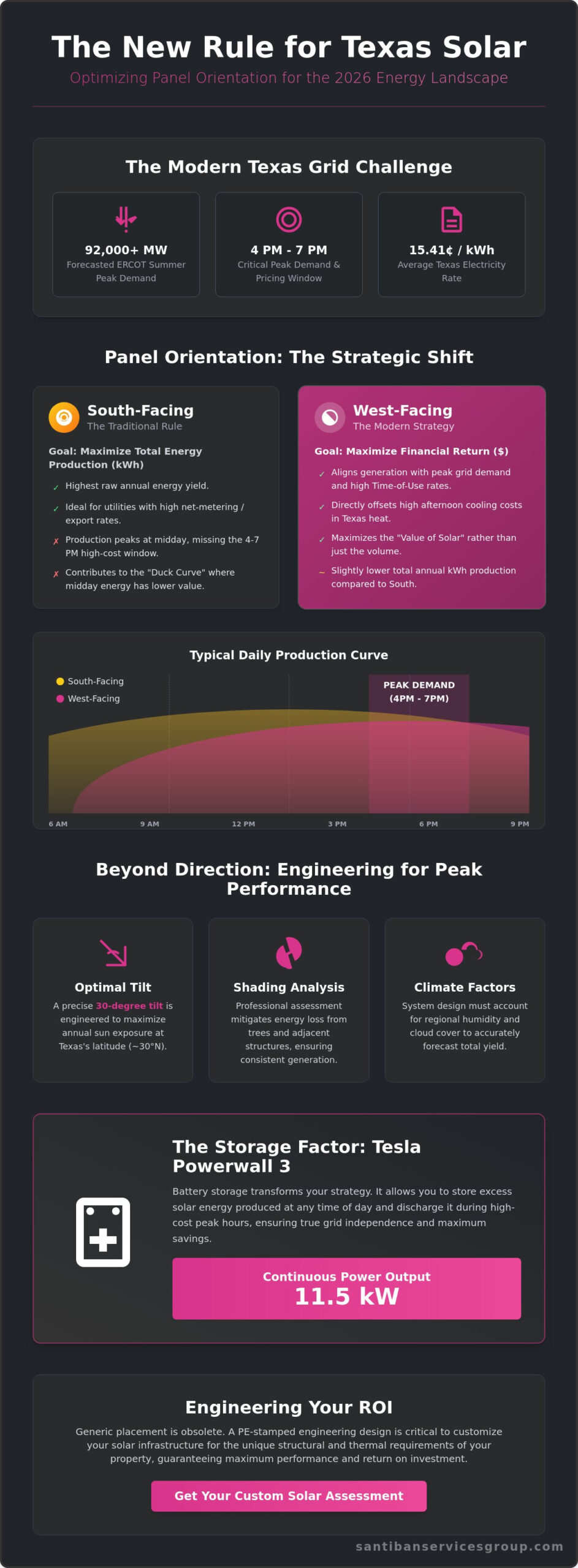
While south-facing arrays maximize raw production, they often underperform during the critical 4 PM to 7 PM window. This period marks the highest demand on the ERCOT grid, where temperatures and electricity prices frequently spike. Additionally, mature Texas oak trees or adjacent structures often create significant shading during the early morning or late evening, which can compromise the south-facing advantage.
The “Duck Curve” phenomenon illustrates the growing gap between midday solar oversupply and the rapid ramp-up in demand as the sun sets. In 2026, raw production is no longer the only metric for success. If your utility plan features time-of-use (TOU) rates or lacks a 1-to-1 net metering credit, the best direction for solar panels in Texas might shift away from the traditional south to better align with when your home actually consumes the most power, especially during the peak cooling hours of the afternoon.
The West-Facing Shift: Capturing Peak Energy in the Texas Heat
The engineering consensus regarding the best direction for solar panels in Texas is undergoing a significant transformation. While southern orientation provides the highest cumulative annual yield, it often fails to address the specific financial pressures of the modern Texas grid. ERCOT expects summer peak demand to reach 92,211 MW in 2026. This surge occurs primarily in the late afternoon when residential cooling systems operate at maximum intensity. By orienting panels toward the west, owners can generate power exactly when the utility grid is most strained and electricity is most expensive.
A kilowatt-hour produced at 5 PM in Houston holds greater utility than one produced at 12 PM. During the midday peak, many homes generate an excess of power that is exported to the grid at lower buyback rates. Conversely, a west-facing system targets the “Value of Solar” rather than simple volume. It directly offsets the heavy thermal load of the late afternoon sun, reducing the need to purchase power from the grid during peak pricing windows. For precise implementation, many clients rely on professional engineering design to determine if their roof structure supports this high-value orientation.
Texas Grid Dynamics and Time-of-Use (TOU) Rates
Retail Electric Providers (REPs) across Texas are increasingly adopting Time-of-Use billing structures. These plans charge significantly higher rates during the late afternoon and early evening hours. Facing an array at a 270-degree azimuth allows a system to remain productive until the sun is much lower on the horizon. This strategy mitigates the impact of the average residential rate of 15.41¢/kWh by ensuring the home uses its own solar energy during the most costly periods. The Department of Energy’s guide to solar notes that while south-facing is a standard baseline, regional grid dynamics like those in Texas often necessitate a more customized approach.
East-West Split: The Balanced Approach for Houston Homes
An East-West split configuration offers a compelling alternative for homes with high, consistent daytime energy needs. This setup involves placing panels on both the eastern and western roof planes to create a broader production curve. Instead of a single sharp peak at noon, the system provides steady power from early morning through the late afternoon. This approach is ideal for large families or businesses that maintain constant climate control and operational activity throughout the day. It effectively reduces the reliance on large inverter capacities by smoothing out the energy spike that typically occurs with a purely south-facing system.
Beyond Compass Points: Tilt, Shading, and Houston’s Climate Factors
Orientation is only one variable in the engineering of a high-performance system. While azimuth determines the primary path of energy capture, the tilt of the array and local shading profiles are equally critical. In Houston, a 30-degree angle is widely considered the sweet spot for residential installations. This angle aligns closely with the local latitude, balancing the need for high production during the summer when the sun is directly overhead with the requirements of the lower winter sun. Precise tilt ensures the panels maintain a perpendicular relationship with the sun’s rays for the longest duration possible.
Local weather patterns, specifically Houston’s high humidity and frequent cloud cover, introduce the variable of diffuse light. Unlike direct beam radiation, diffuse light is scattered by water vapor and aerosols in the atmosphere. This environmental factor means that even if a roof plane doesn’t face the statistically best direction for solar panels in Texas, it can still maintain high efficiency by capturing scattered photons. However, physical obstructions like mature oak trees or architectural features remain a deal-breaker. A western orientation with 0% shading will consistently outperform a perfect southern orientation that suffers from even 20% shading due to nearby structures.
Maintaining structural integrity is paramount in coastal regions prone to severe weather. Implementing Tesla and Solar Roof solutions in Houston provides a level of durability that traditional rack-mounted systems may lack. These integrated solutions are designed to withstand the extreme environmental stressors common to the Gulf Coast, ensuring the system remains operational throughout hurricane season. Engineering for resilience means looking beyond the compass to ensure the array stays attached to the structure during extreme events.
Optimizing Tilt for Seasonal Solar Performance
Fixed-tilt systems are the standard for Houston solar reroofing projects due to their simplicity and mechanical reliability. While the sun sits higher in the Texas sky during the summer months, a 30-degree pitch ensures a robust energy yield year-round. This fixed angle eliminates the need for complex tracking hardware, which reduces long-term maintenance requirements. It’s a calculated compromise that captures significant irradiance across all seasons without the failure points of moving parts.
Structural Resilience and Wind Load Engineering
Orientation decisions in Texas must account for prevailing wind directions and potential uplift during storm events. It’s not enough to simply find the best direction for solar panels in Texas; the installation must also be anchored to survive 100+ mph gusts. This is why obtaining PE Stamped Engineering for Solar Systems in Houston is a non-negotiable step in our process. We integrate precise engineering design with orientation data to ensure every array meets rigorous safety standards without compromising energy performance.
The Storage Factor: How Tesla Powerwall 3 Changes Your Orientation Strategy
The introduction of the Tesla Powerwall 3 has fundamentally altered the technical calculus used to determine the best direction for solar panels in Texas. It’s no longer just about raw production. The integration of a high-efficiency inverter with 11.5 kW of continuous power output allows for a direct-DC connection that minimizes energy loss during the conversion process. This changes the ROI. For homeowners focused on maximizing their grid returns, utilizing Tesla Electric in Houston requires a configuration that balances production with strategic storage timing.
A south-facing array ensures the battery is charged early in the day, providing a full reserve before the most expensive hours begin. Conversely, west-facing panels provide the late-day support needed to power the home directly while the battery remains at 100% capacity. This strategy is vital for maintaining resilience during the frequent grid instabilities experienced in the Texas market. After a major storm or outage, a south-east orientation often provides the fastest path to recovery by capturing the first available light of the morning to “fill the tank” for the day ahead.
Powerwall 3 and Direct DC Integration
The Powerwall 3 features six MPPT (Maximum Power Point Tracking) channels. This technical capability enables our engineering team to design systems across multiple roof planes without the efficiency losses common in older inverter technology. It’s a significant advantage for Houston’s complex residential architecture. In the high-irradiance environment of Texas, the Powerwall 3’s advanced MPPT strings allow even North-facing roof planes to contribute valuable supplemental power when South and West options are obstructed. This flexibility ensures that every square inch of available roof space is utilized for maximum operational benefit.
Strategic Charging for Grid Independence
Maximizing grid independence requires a precise balance between generation and reserve capacity. As a certified Tesla Powerwall installer, we program these systems to prioritize self-consumption or grid export based on your specific orientation and utility rate structure. South-facing panels are ideal for rapid charging, while west-facing configurations are better for offsetting the peak demand of 4 PM to 7 PM. Many clients also integrate EcoFlow battery backup solutions to provide tiered energy security for critical loads. To ensure your system is configured for optimal performance, you should schedule a technical consultation with our engineering department.
Engineering Your ROI: Why Professional Design Beats Generic Placement
Generic placement advice often relies on simplified models that fail to account for the unique thermal and structural demands of the Gulf Coast. While identifying the best direction for solar panels in Texas is a fundamental starting point, translating that data into a high-yield, long-term asset requires a higher level of technical scrutiny. A system designed without professional oversight risks premature equipment failure, inadequate energy offsets, and potential structural issues during extreme weather events. Reliable performance is the result of meticulous planning rather than broad industry assumptions.
Our approach integrates over 24 years of industrial electrical construction experience with the latest advancements in renewable technology. This background ensures that every residential solar installation meets the same rigorous standards required for large-scale industrial projects. We prioritize precision in every operational detail, from the initial site analysis to the final electrical configuration. By selecting the best direction for solar panels in Texas through an engineering lens, we ensure your system functions as a dependable power plant for your home or business.
The Value of PE-Stamped Engineering Design
Professional PE-stamped engineering design is a critical requirement for navigating the complex permitting landscape in Houston and surrounding municipalities. These stamps provide a formal guarantee that the system is structurally sound and electrically compliant with current codes. Beyond mere compliance, an engineered design prevents the formation of “hot spots” and uneven thermal distribution, which are leading causes of premature panel degradation in the intense Texas heat. Investing in a professionally engineered system ensures that your ROI is protected by a design tailored to the specific environmental stressors of your property.
Customized Results for Residential and Industrial Sites
Orientation strategies must be tailored to the specific energy profile of the site. A commercial facility requiring EV charging infrastructure necessitates a different production curve than a residence focused on backup power for critical cooling loads. We leverage our extensive history in industrial electrical construction to deliver customized results that generic providers cannot match. Our process moves beyond basic labor to provide a strategic partnership for your energy transition.
To finalize your solar strategy, consider the following technical checklist:
- Direction: Balance south-facing volume with west-facing peak value based on your specific utility rate structure.
- Tilt: Maintain a 30-degree angle for optimal year-round performance in the Houston area.
- Shading: Conduct a thorough horizon analysis to ensure zero obstruction during peak production hours.
- Storage: Align your array orientation with the charging requirements of your Tesla Powerwall 3 or EcoFlow system.
The next logical step in securing your energy future is a professional site analysis. Requesting an engineering-led quote allows you to see the data-driven potential of your specific roof plane and electrical infrastructure. Our team is ready to provide the technical expertise required for a seamless and high-performing installation.
Securing Your Energy Future with Precision Engineering
Determining the best direction for solar panels in Texas is no longer a matter of simple compass points. It requires a sophisticated understanding of ERCOT grid dynamics, local climate stressors, and the advanced integration capabilities of the Tesla Powerwall 3. As we have analyzed, the shift from maximizing raw volume to capturing high-value peak energy is essential for achieving true grid independence and superior ROI in the 2026 market. Professional oversight ensures that variables like tilt, shading, and structural wind loads are calculated with mathematical certainty.
Santiban Services Group leverages over 24 years of industrial electrical expertise to deliver residential solar solutions that exceed standard expectations. Every complex project we undertake includes PE-stamped engineering design to guarantee structural integrity and electrical safety. As a Tesla-certified installer for Powerwall 3 and Powerwall +, we specialize in configuring systems that remain operational through the most challenging Texas weather events. Our commitment to technical precision provides the corporate stability and reliability you require from an energy partner.
Take the next step toward a resilient energy profile. Request a Professional Solar Engineering Analysis from Santiban Services Group to receive a customized, data-driven assessment of your property. We look forward to engineering a system that provides consistent performance for decades to come.
Frequently Asked Questions
Is South always the best direction for solar panels in Texas?
No, South is not always the undisputed choice because it prioritizes raw energy volume over financial utility. While South-facing arrays capture the highest total number of photons annually, West-facing panels often provide a superior ROI by generating power during peak demand hours. Identifying the best direction for solar panels in Texas increasingly involves analyzing when your home consumes the most electricity rather than just total production.
Can I install solar panels on a North-facing roof in Houston?
Yes, you can install panels on a North-facing roof, though it is typically the least productive orientation for a primary array. In the high-irradiance environment of Houston, modern high-efficiency panels and advanced MPPT inverters like the Tesla Powerwall 3 can still extract usable energy from North planes. This is often a viable engineering strategy when South or West planes are obstructed by shading or architectural constraints.
How much energy do I lose if my panels face West instead of South?
You typically lose approximately 15% in raw annual kilowatt-hour production when facing West instead of South. However, this production loss is often offset by the higher financial value of late-afternoon energy. Since electricity rates frequently spike during the 4 PM to 7 PM window, the best direction for solar panels in Texas for many homeowners is West, as it directly reduces the most expensive utility costs.
What is the best tilt angle for solar panels in Texas?
A 30-degree tilt is considered the optimal angle for solar installations in the Houston area. This angle corresponds closely to the local latitude and balances performance across the four seasons. While a steeper angle improves winter production and a shallower angle maximizes summer yield, the 30-degree standard offers the most consistent year-round energy capture for fixed-tilt residential systems and industrial applications.
Does the best direction for solar panels change if I have a Tesla Powerwall?
Yes, having a Tesla Powerwall 3 allows for a more strategic approach to orientation. Instead of focusing solely on offsetting immediate consumption, you can prioritize South-facing panels to charge your battery early in the day. This ensures your storage system is at 100% capacity before the evening peak hours, providing a reliable reserve for grid independence and essential backup during utility outages.
How does Houston’s humidity affect solar panel performance and orientation?
Houston’s high humidity increases the amount of diffuse light, which is sunlight scattered by water vapor in the atmosphere. This environmental factor means panels can still produce significant energy even when they aren’t perfectly aligned with the sun’s direct path. Our engineering team accounts for these specific climate conditions to ensure that orientation choices maximize the capture of both direct and diffuse radiation throughout the year.
Do I need a PE-stamped drawing for my solar panel orientation in Texas?
Yes, a PE-stamped engineering design is a standard requirement for permitting solar installations in Houston and many other Texas municipalities. This document verifies that the system’s orientation and mounting hardware meet local wind load and structural codes. Beyond mere compliance, it provides a professional assurance that the array is engineered to withstand the extreme weather conditions common to the Gulf Coast region.
What happens if my roof has multiple directions (East, West, and South)?
Utilizing multiple roof directions can create a smoother, more consistent power curve throughout the day. An East-West-South split prevents a single midday production spike and provides steady energy from sunrise to sunset. Advanced systems like the Tesla Powerwall 3 handle these complex configurations efficiently by using multiple MPPT strings to optimize production from each independent roof plane without compromising system efficiency.