
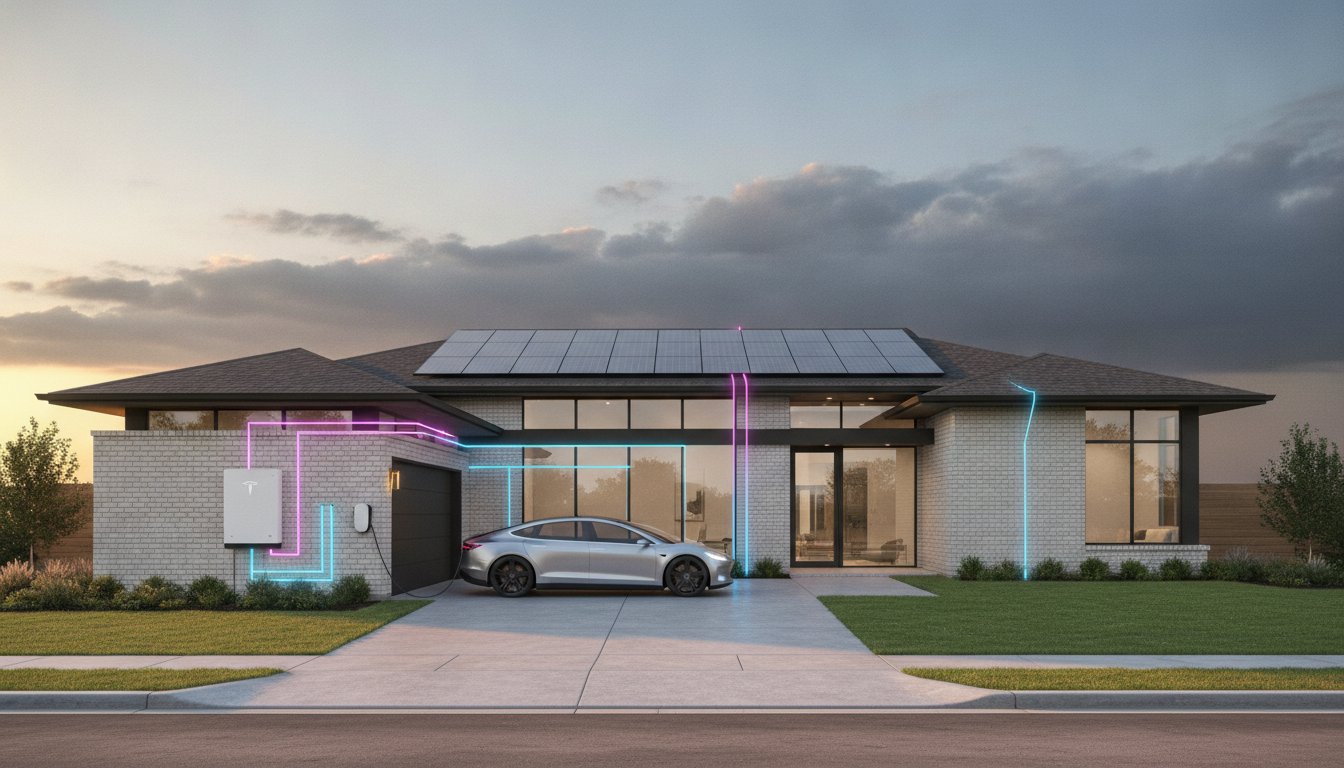
What if your home could predict a Texas grid failure before the lights even flicker? For many Houston residents, the anxiety of a fragile infrastructure is compounded by electricity rates that have climbed toward 18 cents per kWh. You likely recognize that solar panels alone aren’t enough; you need a system that thinks. Using the Tesla Powerwall for smart home energy management transforms your property from a passive consumer into a resilient, self-sufficient microgrid. It’s a shift from basic backup to total operational control.
We understand that the technical intersection of battery software, solar arrays, and EV chargers often feels unnecessarily complex. This 2026 guide clarifies how the Tesla Powerwall 3 acts as the central nervous system of your home, utilizing its 11.5 kW continuous power capacity to optimize efficiency automatically. While the federal tax credit for residential storage expired at the end of 2025, the precision of modern software and virtual power plant integration now offers new paths to reliability. We’ll examine the latest 26.18.1 software capabilities and explain how professional engineering ensures your system remains a silent, dependable engine for your household’s safety and independence.
Key Takeaways
- Analyze how the Tesla Powerwall 3 functions as a centralized gateway to balance electrical loads and ensure consistent operational stability.
- Configure advanced operational modes within the Tesla ecosystem to maximize solar consumption and enhance your long-term return on investment.
- Implement the Storm Watch feature to secure your home’s energy independence during the increasingly unpredictable Houston hurricane seasons.
- Understand the critical role of PE-stamped engineering when deploying a Tesla Powerwall for smart home energy management to meet rigorous safety and compliance standards.
- Leverage industrial-grade electrical construction expertise to transform your residential power system into a sophisticated and reliable microgrid.
What is Smart Home Energy Management with Tesla Powerwall?
Smart Home Energy Management (SHEM) represents a fundamental shift in residential infrastructure. It’s the active, strategic balancing of energy production, storage, and real-time consumption. While traditional backup systems remain dormant until a power failure occurs, utilizing the Tesla Powerwall for smart home energy management allows for a proactive approach to utility expenses and grid reliance. This system transforms the home into a self-governing microgrid. It makes millisecond-level decisions to optimize performance and ensures your property isn’t just reacting to the grid, but staying ahead of it.
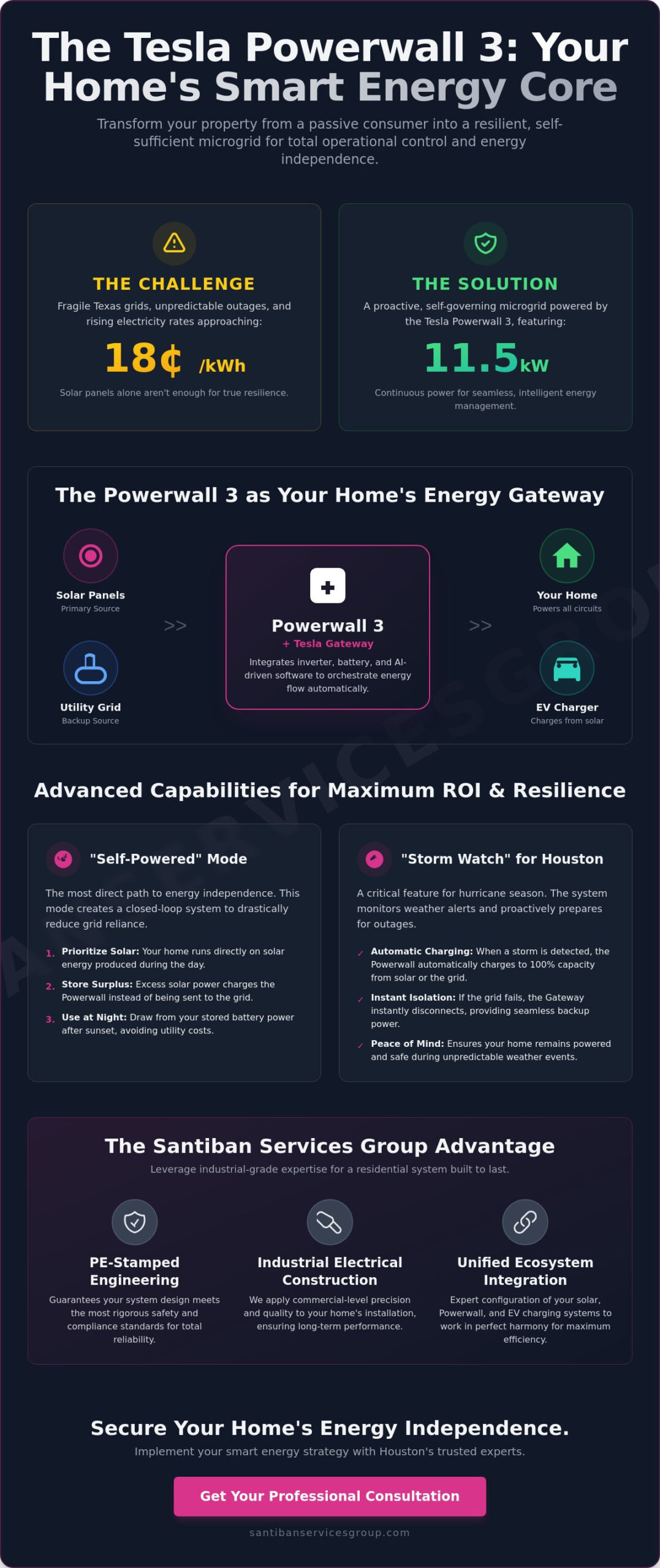
The Powerwall 3 serves as the primary gateway for all electrical loads. It integrates a high-efficiency solar inverter directly into the battery unit, which streamlines the path from the roof to your home’s circuits. This consolidated architecture reduces conversion losses and simplifies the overall system design. This is essential for Houston residents facing rising electricity rates that now reach approximately 18 cents per kWh. The Tesla Powerwall has evolved from a simple backup tool into the central nervous system of the modern home, moving the household from passive backup to active, AI-driven energy forecasting.
The Brain Behind the Battery: Tesla Gateway
The Tesla Gateway acts as the physical command center for your energy ecosystem. It maintains a constant connection with the local Houston utility grid, monitoring for voltage fluctuations or frequency shifts that often precede a major outage. When the Gateway detects grid instability, it isolates your home’s electrical system instantly. This facilitates a transition to off-grid mode that is often imperceptible to sensitive electronics. This hardware also coordinates the handshaking process between solar inverters and the battery, ensuring energy production remains synchronized with current demand without manual intervention.
Software-Driven Efficiency
True efficiency is achieved through energy orchestration, not just simple storage. Tesla’s software utilizes AI-driven forecasting to predict your home’s consumption patterns based on historical data and environmental variables. If the system anticipates high demand during peak rate periods, it prioritizes battery usage to shield you from inflated costs. For Houston homeowners, real-time visibility is a critical asset. The mobile interface provides granular data on energy flow, allowing you to verify that your system is operating at peak precision. This level of transparency ensures every operational detail is under expert control. It provides the quiet confidence that comes with a professionally engineered solution. The system doesn’t just react; it anticipates, ensuring your home remains resilient regardless of external grid conditions.
Optimizing the Tesla Ecosystem for Maximum ROI
Maximizing the return on investment for your energy system requires a disciplined approach to configuration. Using the Tesla Powerwall for smart home energy management allows you to toggle between distinct operational modes tailored to your specific financial or resilience goals. The Tesla app provides the interface for these adjustments, which ensures every kilowatt is accounted for and utilized with high standards of precision. It moves your home from a basic backup setup to a sophisticated, optimized energy asset.
Setting the system to “Self-Powered” mode is the most direct method to maximize solar consumption. In this configuration, your home prioritizes energy produced by your solar panels to meet immediate demand. Any surplus energy is then directed to the battery. Once the battery reaches its capacity, the system manages the overflow according to your local utility agreement. This creates a closed loop that significantly reduces your reliance on external providers during the day and provides stored power for use at night.
Achieving a unified energy ecosystem involves integrating your storage with Tesla Vehicle Charging. This connection allows for sophisticated coordination. You can configure your vehicle to charge exclusively from excess solar production, which prevents your EV from depleting the battery during high-demand periods. For those seeking to secure this level of technical integration, partnering with a firm experienced in industrial electrical construction ensures the installation meets all professional engineering standards for long-term reliability.
Navigating Time-of-Use (TOU) Rates
Texas energy providers frequently utilize Time-of-Use (TOU) structures to manage grid load. Peak hours typically occur during the late afternoon and early evening when electricity demand and pricing are at their highest. Off-peak hours usually fall during the late night or early morning. Time-Based Control allows the Powerwall to intelligently discharge during these expensive windows. By performing “peak shaving,” the system avoids drawing power when rates are highest, which provides a measurable impact on your monthly utility expenditures.
Solar and Battery Synergy
The system operates with a rigorous priority flow to ensure maximum efficiency. Solar energy is first directed to power your home’s active loads. Once domestic demand is satisfied, the system routes energy to the battery for storage. Only when the battery is fully charged does the system export energy to the grid. Net Metering is the process of selling excess energy back to the grid at retail or wholesale rates. This synergy ensures that even during the most intense Texas afternoons, your production is either stored for later use or used to offset your operational costs through grid export.
Advanced Resilience: Storm Watch and Off-Grid Management
Grid stability remains a primary concern for residents in the Houston metropolitan area. The recurring threat of hurricane season necessitates a system that can transition from financial optimization to total survival mode. Effectively utilizing the Tesla Powerwall for smart home energy management involves mastering the Storm Watch feature. This automated protocol monitors severe weather alerts from the National Weather Service. When a significant event is detected, the system overrides your daily settings to prioritize a 100% charge. It ensures your household is prepared for a potential multi-day outage before the first gust of wind reaches the coast.
Thermal management is equally critical during extreme Texas temperature swings. The Powerwall 3 utilizes a preconditioning feature to maintain internal cell temperatures. This proactive heating or cooling ensures the battery is ready to discharge at maximum efficiency regardless of external conditions. The “Off-Grid” mode also allows for intentional disconnection. This is a strategic move when the grid exhibits instability or frequent brownouts that could damage sensitive home electronics. By severing the connection to the utility, you rely entirely on your stored reserves and solar production.
Hurricane Season Preparedness
During the peak months of June through November, we recommend adjusting your reserve setting to 100%. This ensures no stored energy is used for daily peak shaving, keeping the full 13.5 kWh capacity available for emergencies. The Powerwall 3 is specifically engineered to handle the high inrush current required by large air conditioning units. Its 11.5 kW continuous power output provides the necessary surge capacity to keep your home habitable in the Gulf Coast humidity. For comprehensive protection, many clients integrate these systems with Tesla and Solar Roof solutions in Houston to create a reinforced, energy-independent structure.
Managing Loads During an Outage
The Tesla app provides granular control over your home’s electrical consumption during an extended blackout. You can monitor real-time usage and toggle non-essential loads to preserve your “Backup Buffer.” This buffer is a user-defined percentage of the battery that remains untouched during normal operation. If an outage lasts several days, prioritizing essential loads is vital for longevity. Strategic load management ensures your solar array can recharge the battery during the day faster than you deplete it at night, maintaining a sustainable energy cycle.
- Essential Loads: Refrigeration, medical equipment, well pumps, and basic lighting.
- Luxury Loads: Pool pumps, electric ovens, and laundry appliances.
The Technical Backbone: Engineering and Compliance
Deploying a Tesla Powerwall for smart home energy management involves complex electrical engineering that exceeds the scope of a standard residential permit. While a basic permit covers simple wiring, a sophisticated energy operating system requires a comprehensive design that accounts for bi-directional power flow and high-amperage storage. Integrating the Powerwall 3 into existing Houston electrical panels often necessitates precise load calculations to prevent overcurrent scenarios. This is particularly relevant for homes with legacy infrastructure that must now accommodate modern, high-output energy assets without compromising the integrity of the main service panel.
Professional engineering ensures that every component is sized correctly to handle the 11.5 kW continuous power output of the Powerwall 3. For properties that function as commercial-to-residential hybrids, such as home offices with industrial equipment or extensive EV charging needs, a unified design is mandatory. This methodical approach prioritizes the safety of your household and the longevity of the hardware. It transforms a standard battery installation into a high-end strategic energy asset that operates with the precision of an industrial facility.
Why PE-Stamping Matters for Your Permit
Securing a PE stamped engineering for solar systems is the most efficient way to accelerate the approval process with utility providers like CenterPoint or Entergy. A Professional Engineer (PE) validates the structural integrity of battery mounting locations, which is vital given the weight and footprint of the Powerwall 3. They also verify that the wiring schematics comply with local jurisdictional requirements. This level of oversight provides significant liability protections. It confirms that the installation has been vetted by an expert with a legal obligation to prioritize public safety and technical accuracy.
Grid Interconnection Standards in Texas
Compliance with Texas grid standards is a non-negotiable requirement for any interconnected system. One of the most critical technical requirements is “Anti-Islanding” technology. This safety mechanism ensures your system stops exporting power to the grid during a utility outage, which protects utility workers from unexpected live lines. In Harris County and surrounding areas, inspectors look for specific compliance markers that align with the latest NEC 2023 safety standards. A PE-stamped design validates that a system meets all NEC 2023 safety standards for energy storage.
To ensure your system meets these rigorous requirements, you should consult with a provider capable of delivering PE-stamped engineering design that aligns with industrial-grade standards.
Implementing Your Smart Energy Strategy with Santiban
Santiban Services Group is the premier certified Tesla Powerwall installer in Houston. Our organization applies over 24 years of industrial electrical construction experience to the residential sector. This ensures your system isn’t just installed, but engineered for long-term operational stability. Utilizing the Tesla Powerwall for smart home energy management requires a partner who understands the rigors of high-capacity electrical systems. We manage every detail of the transition, providing a turnkey solution that spans from initial PE-stamped design to final utility Permission to Operate (PTO).
A holistic view of your home’s infrastructure is essential for true resilience. This includes understanding EV charger installation costs and how those high-draw loads interface with your storage reserves. By coordinating these systems, we prevent unexpected depletion of your backup power. Our approach prioritizes a unified energy strategy where every component, from the solar roof to the battery stack, works in synchronized harmony.
The Santiban Installation Advantage
Precision is the hallmark of our execution. Our technicians utilize industrial-grade standards for wiring and component placement, which minimizes electrical resistance and maximizes system longevity. We don’t view a battery as a standalone appliance; we see it as a critical component of a larger infrastructure. This perspective is why we offer simultaneous solar reroofing and integration services. After the “Go Live” date, our monitoring services provide ongoing verification that your system maintains peak performance. This disciplined focus ensures your home’s energy engine remains a silent, dependable force in the background.
Your Path to Energy Independence
Achieving energy independence involves a methodical consultation process. We begin with a comprehensive site audit and load analysis to determine the exact system sizing required to sustain your household during a multi-day Houston grid failure. We also evaluate the potential for additional ROI through participation in Virtual Power Plant (VPP) programs. In Texas, these utility-driven initiatives allow homeowners to share stored energy during peak demand events. This creates a recurring revenue stream while stabilizing the local grid. We invite you to consult with our engineering team for a customized Tesla Powerwall 3 solution that meets your specific resilience and financial goals.
Securing Your Energy Future in Houston
Transitioning to a sophisticated energy ecosystem requires more than hardware; it demands a strategic integration of software and professional engineering. We’ve explored how utilizing the Tesla Powerwall for smart home energy management functions as a centralized intelligence hub, balancing solar production with household demand and grid volatility. By prioritizing PE-stamped engineering and precise load calculations, you ensure your system operates with the reliability of an industrial-grade facility. This methodical approach transforms your property into a resilient microgrid capable of withstanding the unique challenges of the Texas climate.
As a Tesla Certified Installer with over 24 years of Texas electrical expertise, Santiban Services Group provides the technical backbone necessary for this transition. Our turnkey approach includes PE-stamped engineering design as a standard requirement to guarantee both compliance and structural safety. Secure Your Houston Home with a Tesla-Certified Powerwall 3 Installation to achieve true energy independence and operational excellence. You can move forward with the quiet confidence that your home’s resilience is under expert control and prepared for the years ahead.
Frequently Asked Questions
Can Tesla Powerwall 3 run my entire Houston home during an outage?
A single Tesla Powerwall 3 can support many essential loads, but whole-home backup for a large Houston residence often requires multiple units. The system provides 11.5 kW of continuous power, which is sufficient for lights, refrigeration, and smaller air conditioning units. For larger central HVAC systems, we perform a detailed load analysis to determine if a multi-unit configuration is necessary to maintain operational stability during a grid failure.
How does the Tesla Powerwall integrate with my existing smart home automation?
The system integrates with smart home ecosystems through the Tesla API and various third-party management platforms. This connectivity allows the Tesla Powerwall for smart home energy management to share real-time data with your existing automation hubs. You can coordinate energy-intensive tasks, such as running a dishwasher or pool pump, with periods of high solar production or low utility rates to maximize your efficiency.
Does a Tesla Powerwall 3 require a specific solar panel brand for management?
No, the Powerwall 3 is compatible with most standard solar panel brands. It features an integrated solar inverter that simplifies the connection between your roof and the storage system. While it functions seamlessly within a full Tesla ecosystem, our engineering team can design the system to work with a wide variety of high-performance photovoltaic modules, ensuring your existing or new solar array remains highly productive.
What is the “Storm Watch” feature and how does it help during hurricane season?
Storm Watch is an automated software feature that monitors National Weather Service alerts for impending severe weather events. When an alert is active, the system automatically prioritizes charging the battery to 100% capacity from any available source, including the grid. This ensures your home has maximum reserves before a grid failure occurs, which is a vital safety measure during the Gulf Coast hurricane season.
How many Powerwalls do I need for 24-hour energy independence in Texas?
Most Texas homes require two to three units to achieve 24-hour energy independence, especially when running central air conditioning. Each unit provides 13.5 kWh of usable capacity. The exact number depends on your home’s square footage, insulation quality, and critical load requirements. We provide customized load calculations to ensure your system meets these specific needs and maintains a steady power supply through the night.
Is PE-stamped engineering required for a Powerwall installation in Houston?
Yes, PE-stamped engineering is a mandatory requirement for securing permits and utility interconnection in the Houston area. Utility providers like CenterPoint require professionally vetted designs to ensure the system meets all safety and grid-stability standards. Our process includes these stamped designs to accelerate the approval timeline and provide long-term liability protection. It’s a critical step that ensures every operational detail is under expert control.
Can I monitor my Powerwall’s energy management from my phone while away?
You can monitor and control your system’s performance from any location using the Tesla mobile application. The interface provides real-time visibility into energy production, storage levels, and household consumption. This level of transparency allows you to adjust your backup reserve or change operational modes instantly. It’s the most effective way to maintain control over your home’s energy microgrid while you’re away.
What is the expected lifespan of a Powerwall 3 under daily smart management?
The Powerwall 3 is designed for a service life exceeding 15 years under daily operational cycles. It comes with a 10-year warranty that guarantees a specific level of capacity retention over time. Because the system uses advanced liquid thermal management to regulate cell temperatures, it maintains high performance even during the intense heat cycles common in the Houston climate. It’s built to be a silent, dependable engine for your home’s power.