
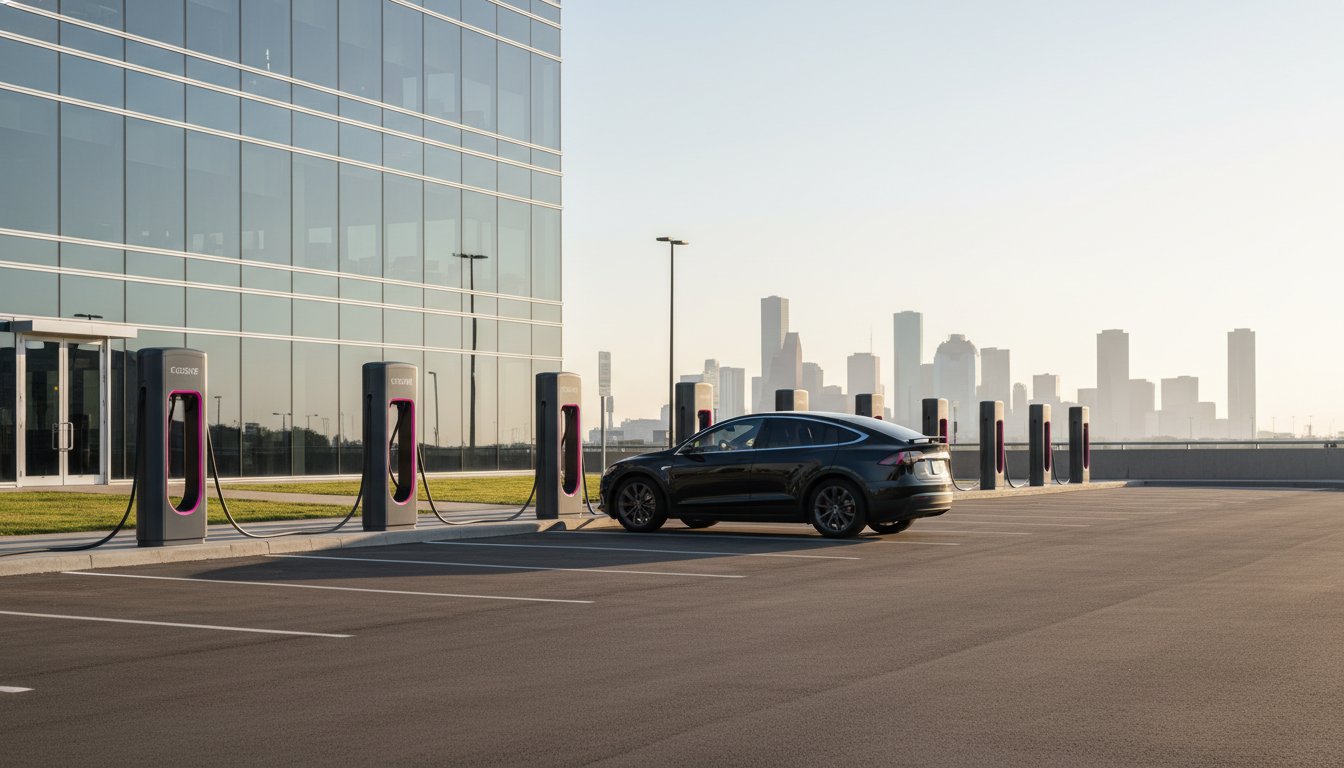
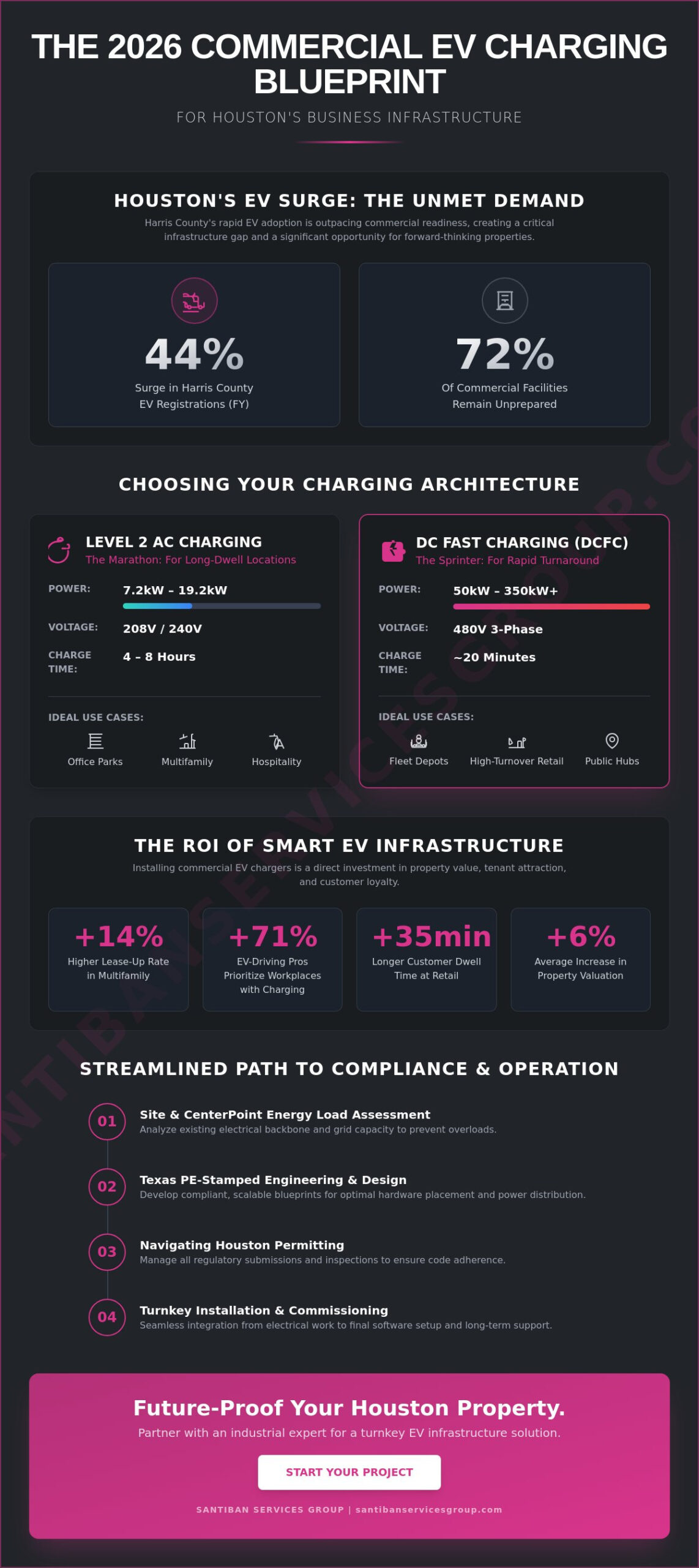
Harris County electric vehicle registrations surged by 44% in the last fiscal year, yet 72% of regional commercial facilities remain unprepared for the resulting power demand. You recognize that integrating a commercial ev charger is no longer a luxury amenity but a core infrastructure requirement. It’s a complex undertaking that forces facility managers to confront CenterPoint Energy’s strict grid capacity limits and the intricate layers of Houston’s specific building codes.
This 2026 Business Infrastructure Guide provides a comprehensive roadmap for deploying industrial-grade charging solutions that drive measurable ROI. We focus on delivering tailored excellence through Texas PE-stamped engineering, ensuring your property meets every regulatory standard while maintaining operational stability. You’ll gain the strategic insight necessary to avoid under-sizing your electrical backbone, protecting your investment against future growth.
Our analysis covers the essential technical requirements for scalable deployment, from initial site load assessments to the final integration of high-performance hardware. We’ll show you how to transform your parking assets into a reliable, compliant, and future-proof utility.
Key Takeaways
- Identify why industrial-grade EV infrastructure has become a non-negotiable amenity for Houston’s Class A office spaces and corporate sustainability initiatives.
- Evaluate the technical requirements of Level 2 versus DC Fast Charging to select the optimal architecture for your facility’s specific operational demands.
- Discover strategic revenue models and software integration techniques designed to maximize property value and ensure a measurable return on investment.
- Navigate the rigorous Houston permitting process, including the critical role of PE-stamped engineering and CenterPoint Energy load studies for your commercial ev charger project.
- Leverage a single-source industrial partner to streamline the transition from complex electrical design to seamless final commissioning and long-term reliability.
The Strategic Importance of Commercial EV Chargers for Houston Businesses
The 2026 Houston business landscape demands sophisticated infrastructure to match its status as the global energy capital. Installing a commercial ev charger is no longer a peripheral upgrade; it’s a foundational requirement for Class A office spaces and high-end commercial properties. By the start of 2026, electric vehicle registrations in Harris County increased by 22% compared to 2024 levels. This shift moved the expectation for on-site charging from a luxury perk to a standard utility. Property managers who integrate these systems now ensure their assets remain competitive and functionally relevant in a decarbonizing economy.
A robust electric vehicle charging network serves as the backbone of modern urban mobility. It allows Houston businesses to support the growing density of electrified fleets and private vehicles. This infrastructure represents a transition from a simple amenity to a vital revenue driver. In the retail and hospitality sectors, data from 2025 indicates that customers stay 35 minutes longer at locations offering high-speed charging. This increased dwell time translates directly into higher point-of-sale revenue and improved customer loyalty.
Attracting Tenants and Employees in the Energy Capital
Corporate entities in Houston now include EV infrastructure in their primary site selection criteria. In high-density districts like Uptown and Downtown Houston, multi-family residential developments report a 14% higher lease-up rate when dedicated charging stations are available. Employee satisfaction scores from 2025 corporate surveys show that 71% of EV-driving professionals prioritize workplaces that offer reliable daytime charging. Providing a commercial ev charger demonstrates a proactive commitment to modern workforce needs and operational excellence.
Sustainability and Corporate ESG Goals
Meticulous facility management involves aligning physical assets with corporate environmental, social, and governance (ESG) targets. Electrifying commercial properties directly supports the reduction of Scope 2 and Scope 3 emissions. Houston businesses leverage these installations to secure LEED certification points and qualify for state-level initiatives. Utilizing programs like the Texas Emissions Reduction Plan (TERP) allows companies to offset initial capital expenditures. This strategic alignment transforms a standard parking area into a sophisticated hub of sustainability. It’s a calculated investment that increases property valuation by an average of 6% according to recent 2025 real estate benchmarks. Tailored solutions ensure that every electrical upgrade meets the highest standards of safety and long-term reliability.
Technical Architecture: Level 2 vs. DC Fast Charging Infrastructure
Selecting the correct commercial ev charger requires a technical understanding of power delivery and site-specific load capacities. Santiban Services Group categorizes infrastructure into two primary tiers based on vehicle dwell time and industrial requirements. Every installation starts with a meticulous assessment of the existing electrical footprint to ensure long-term stability and safety.
Level 2 AC Charging for Long-Dwell Locations
Level 2 systems operate on 208V or 240V circuits. They produce outputs ranging from 7.2kW to 19.2kW. These units serve as the reliable workhorse for corporate office parks, multifamily residential complexes, and hospitality garages where vehicles remain stationary for four to eight hours. Integrated load management software is a critical component for these sites. It prevents expensive utility peak demand charges by distributing power across the fleet. This strategy ensures operational continuity without overstressing the facility’s existing electrical panel. Our teams implement these tailored solutions to balance user demand with grid constraints.
DC Fast Charging (DCFC) for Rapid Turnaround
DC Fast Charging demands industrial-grade 480V 3-phase power. These stations deliver anywhere from 50kW to 350kW. This makes them essential for fleet operations and high-turnover retail centers where a 20-minute charge is the standard expectation. Site selection for DCFC is a high-stakes decision. Proximity to the main service entrance is critical; reducing the distance of heavy-gauge copper runs significantly improves the project’s ROI. Houston’s climate presents specific challenges for these high-output units. Ambient temperatures exceeding 100°F during summer months require meticulous cooling strategies. Proper airflow and thermal management prevent equipment degradation and ensure consistent charging speeds during peak heat.
Beyond the visible pedestals, successful installations rely on robust upstream components. This “hidden” infrastructure includes dedicated transformers, switchgear, and comprehensive panel upgrades. Santiban recommends over-provisioning conduit by at least 50% during the initial trenching phase. It’s a strategic move that avoids the prohibitive costs of future excavation as your charging needs expand toward 2030. Our integrated facility solutions prioritize this forward-thinking approach to ensure your infrastructure remains relevant and scalable.
A single-source partner handles the complexity of these technical requirements. From initial load calculations to the final commissioning of the hardware, every step must meet rigorous safety standards. This disciplined approach eliminates the logistical friction often associated with multi-vendor projects. We focus on the excellence of the underlying electrical architecture, providing a seamless transition to electrified transport for your business or property.
Maximizing ROI and Property Value Through Smart Deployment
Strategic deployment of a commercial ev charger transforms a standard parking facility into a high-yield revenue center. Property owners achieve fiscal objectives by aligning their charging infrastructure with specific tenant profiles and occupancy goals. Recent market data indicates that commercial properties with integrated EVSE (Electric Vehicle Supply Equipment) command a 3% to 5% premium in valuation compared to traditional sites. This appreciation stems from the asset’s ability to attract high-income tenants and secure long-term lease commitments in a decarbonizing economy.
Monetization and Billing Strategies
Choosing the correct financial model is essential for capital recovery. Facility managers typically select from three primary structures. Free-to-use models function as a meticulous amenity for premium tenants or employees. Subscription-based systems provide predictable monthly revenue for residential or corporate fleets. Pay-per-charge frameworks utilize automated billing to generate immediate cash flow from the general public. Detailed analytics from commercial ev charger installation help stakeholders determine which path maximizes their internal rate of return. Modern networks integrate directly with property management software. This allows for seamless billing and real-time energy consumption tracking across the entire portfolio.
Long-Term Reliability and Maintenance
Houston’s climate presents unique challenges for electronic infrastructure. High humidity levels and salt air from the Gulf of Mexico accelerate corrosion in standard components. Santiban Services Group implements tailored protection protocols to ensure 98% uptime for every commercial ev charger. Meticulous preventative maintenance schedules include quarterly inspections of cable management systems and internal cooling fans. We prioritize industrial-grade hardware and physical safeguards to protect your investment from the elements and high-traffic wear.
- Physical Protection: Heavy-duty steel bollards prevent accidental vehicle impact and structural damage.
- Environmental Shielding: Weather-resistant enclosures and UV-rated cabling endure extreme Texas heat and tropical moisture.
- Security Lighting: Integrated LED systems enhance user safety and discourage vandalism during overnight charging sessions.
- 24/7 Monitoring: Remote diagnostics allow our dedicated teams to resolve software glitches before they impact the user experience.
Reliability dictates the success of your EV strategy. A broken charger creates negative brand associations and lost revenue. By deploying industrial-grade equipment and consistent monitoring, businesses safeguard their technological investments for a decade or longer. This proactive approach ensures the infrastructure remains a functional, profitable component of the building’s ecosystem. It’s a commitment to excellence that separates professional facilities from standard lots, a philosophy shared by specialized international providers like Plugmycar.
Navigating Houston Permitting and PE-Stamped Engineering
The regulatory environment in Houston for electrical infrastructure is rigorous and demands a high level of technical precision. Installing a commercial ev charger isn’t a simple plug-and-play task. It’s a complex modification to a building’s electrical system that requires formal approval from the City of Houston (COH) Building Code Enforcement. For any project involving structural modifications or significant electrical load increases, the city mandates plans sealed by a licensed Professional Engineer (PE). This ensures the facility’s existing systems can safely handle the new demand without risking fire hazards or equipment failure.
The Necessity of Professional Engineering Design
A PE stamp represents a legal guarantee that a qualified expert has verified every calculation and schematic. It’s a non-negotiable requirement for commercial safety in Texas. Professional design prevents the dreaded “red tags” from city inspectors, which often halt projects for 14 to 30 days while corrections are made. Santiban’s in-house engineering approach streamlines this phase. We integrate the design and permitting steps to ensure that every detail, from circuit breaker ratings to conduit sizing, meets the 2023 National Electrical Code (NEC) standards. If you’re managing multiple sustainable upgrades, you might also find value in our guide on PE stamped engineering for solar systems.
CenterPoint Energy and Grid Coordination
Coordination with CenterPoint Energy is the most critical logistical step in the installation process. The workflow begins with a formal service request to evaluate the site’s available capacity. If your facility’s current service cannot support the 50kW to 350kW required for high-speed charging, a transformer upgrade is necessary. This load study is mandatory to prevent local grid instability. Navigating the Texas Interconnection process requires precise documentation and technical drawings that Santiban prepares to ensure a seamless transition from planning to power-up. We manage the dialogue with utility engineers so your internal team doesn’t have to decipher complex grid requirements.
Compliance also extends to physical accessibility and environmental resilience. Every commercial ev charger installation must follow the Texas Accessibility Standards (TAS) to ensure ADA compliance. This includes specific requirements for reach ranges, clear floor space, and accessible routes from the charger to the building entrance. Additionally, structural integrity is paramount in the Gulf Coast region. Our engineers design pedestal mounts and concrete pads to withstand 110 mph wind loads, ensuring your investment remains secure during extreme weather events. We focus on these technicalities to provide a stable, long-term solution for your property.
Santiban Services Group: Your Industrial Partner for Turnkey EV Infrastructure
Santiban Services Group leverages over 24 years of industrial electrical expertise to deliver robust energy solutions. We operate as a single-source partner for Houston businesses. Our team manages the entire lifecycle of your project, from initial PE-stamped engineering designs to the final commissioning of every commercial ev charger on your property. We apply industrial-grade construction standards to ensure your infrastructure remains operational through Texas’s demanding climate and high-traffic usage cycles. This authoritative approach provides the corporate stability needed for long-term asset management.
Comprehensive Industrial Capability
Our history in heavy industrial construction provides a foundation for superior reliability in the EVSE sector. We don’t just install hardware; we build resilient electrical systems designed for 100% uptime. Our “Excellence in Every Detail” mantra guides every conduit run and transformer upgrade. This rigorous standard is why we often integrate charging systems with the Tesla Powerwall 3. By combining battery storage with active charging, facilities can utilize peak shaving to reduce demand-based utility charges by approximately 20%. Our Tesla-certified expertise ensures your energy ecosystem is efficient, scalable, and strategically optimized.
Getting Started with Your Site Assessment
A Santiban professional site walkthrough is a methodical technical audit. We examine your facility’s current switchgear capacity and utility transformer headroom to identify potential bottlenecks. This data allows us to create customized infrastructure roadmaps tailored to your specific operational goals. These roadmaps often feature phased rollouts, allowing you to scale your commercial ev charger count as your fleet or employee needs grow toward 2026 targets. Planning for future capacity now prevents the 40% cost increase typically seen when businesses must perform emergency retrofits on undersized electrical feeders. Our dedicated teams provide the following during your assessment:
- Meticulous electrical load analysis and future capacity forecasting.
- Strategic hardware placement recommendations for maximum site accessibility.
- Full compliance reviews for local Houston building codes and ADA requirements.
- Seamless integration plans for existing building management systems.
Securing your facility’s energy future is a strategic necessity for the modern business environment. Trust a partner that values long-term performance and disciplined execution over temporary fixes. Request your commercial EV infrastructure consultation today to ensure your project is handled with professional precision and industrial-grade quality.
Future-Proofing Your Houston Facility for the 2026 Infrastructure Shift
Modernizing your property with a commercial ev charger network is no longer a secondary consideration; it’s a critical component of 2026 facility management. Houston’s evolving regulatory landscape requires a meticulous approach to PE-stamped engineering and permitting to ensure long-term compliance and safety. By integrating a mix of Level 2 and DC Fast charging stations, businesses can simultaneously increase property valuation and provide essential services to a rapidly growing electric fleet. These tailored solutions represent a strategic investment in the functional longevity of your industrial or corporate site.
Santiban Services Group delivers a seamless, single-source solution backed by 24+ years of industrial electrical experience. Our dedicated teams provide the technical precision required for complex installations, including in-house engineering and Tesla-certified expertise. We manage every detail from initial site assessment through final commissioning, allowing your leadership team to focus on core operations while we maintain your infrastructure’s excellence. Our proactive approach ensures that every project meets superior standards of reliability and performance.
Secure your Houston commercial EV infrastructure with Santiban’s expert team. Investing in reliable power today ensures your business remains a leader in the Houston market for years to come.
Frequently Asked Questions
Is a PE-stamped engineering design required for all commercial EV charger installs in Houston?
Yes, the City of Houston Public Works department requires a PE-stamped electrical engineering design for every commercial installation to ensure total code compliance. These professional documents verify that your facility’s infrastructure can safely handle the increased electrical load. Santiban’s internal engineering team manages this meticulous documentation process to ensure your project moves through the permitting phase without administrative delays.
How much additional power capacity does my commercial building need for Level 2 chargers?
A standard Level 2 commercial ev charger typically requires a dedicated 40-amp or 50-amp circuit at 208/240 volts. If you plan to install 10 stations, your building may require an additional 400 amps of capacity to operate at full strength. We perform a comprehensive load calculation to determine if your current transformer or switchgear needs an upgrade to support these 2026 infrastructure standards.
Can I integrate commercial EV chargers with my existing solar and battery backup systems?
You can integrate charging hardware with solar arrays and Battery Energy Storage Systems (BESS) using an Open Charge Point Protocol (OCPP) compliant gateway. This configuration allows your facility to prioritize renewable energy during peak sunlight hours, which reduces reliance on the ERCOT grid. It’s a strategic way to ensure your fleet remains operational even during local power interruptions or grid instability.
What is the typical timeline for a commercial EV charger installation project in Houston?
The typical project timeline spans 8 to 16 weeks from the initial site assessment to final commissioning. This window includes 3 weeks for engineering design, 4 to 6 weeks for municipal permit approval, and 2 weeks for physical construction and testing. While equipment lead times for high-capacity hardware can vary, we provide detailed milestones to keep your facility management team informed at every stage.
Are there Texas state incentives or federal tax credits available for business EV charging in 2026?
Businesses currently qualify for the federal 30C tax credit, which covers up to 30% of the project cost for properties in eligible census tracts through 2032. Additionally, the Texas Commission on Environmental Quality (TCEQ) offers grants through the Texas Emissions Reduction Plan (TERP) to support clean air initiatives. These programs provide a superior opportunity to offset the capital expenditure of your commercial ev charger investment.
How do I manage electricity costs to avoid high peak demand charges from the utility?
You can mitigate high demand charges by implementing automated load management software that caps total power draw during peak utility hours. By scheduling charging sessions for off-peak windows, typically between 10:00 PM and 6:00 AM, you avoid the expensive surcharges common in the Houston market. Santiban configures these tailored software parameters to align perfectly with your specific utility rate structure and operational needs.
What happens if a charger fails? Does Santiban offer ongoing maintenance contracts?
Santiban provides comprehensive maintenance contracts that include quarterly physical inspections, firmware updates, and 24-hour emergency repair services. If a unit fails, our dedicated technical teams respond within 24 to 48 hours to restore functionality and minimize downtime. We serve as your single-source solution, ensuring your charging infrastructure maintains 99.9% uptime through disciplined and proactive facility management.
Can I restrict charging access to employees only during business hours?
Access control is managed through integrated software that requires RFID cards or mobile app authentication for every charging session. You can program the system to permit only authorized employee access during business hours while opening the chargers to the public on weekends or evenings. This flexible control ensures your company resources are utilized according to your specific corporate policies and security requirements.