
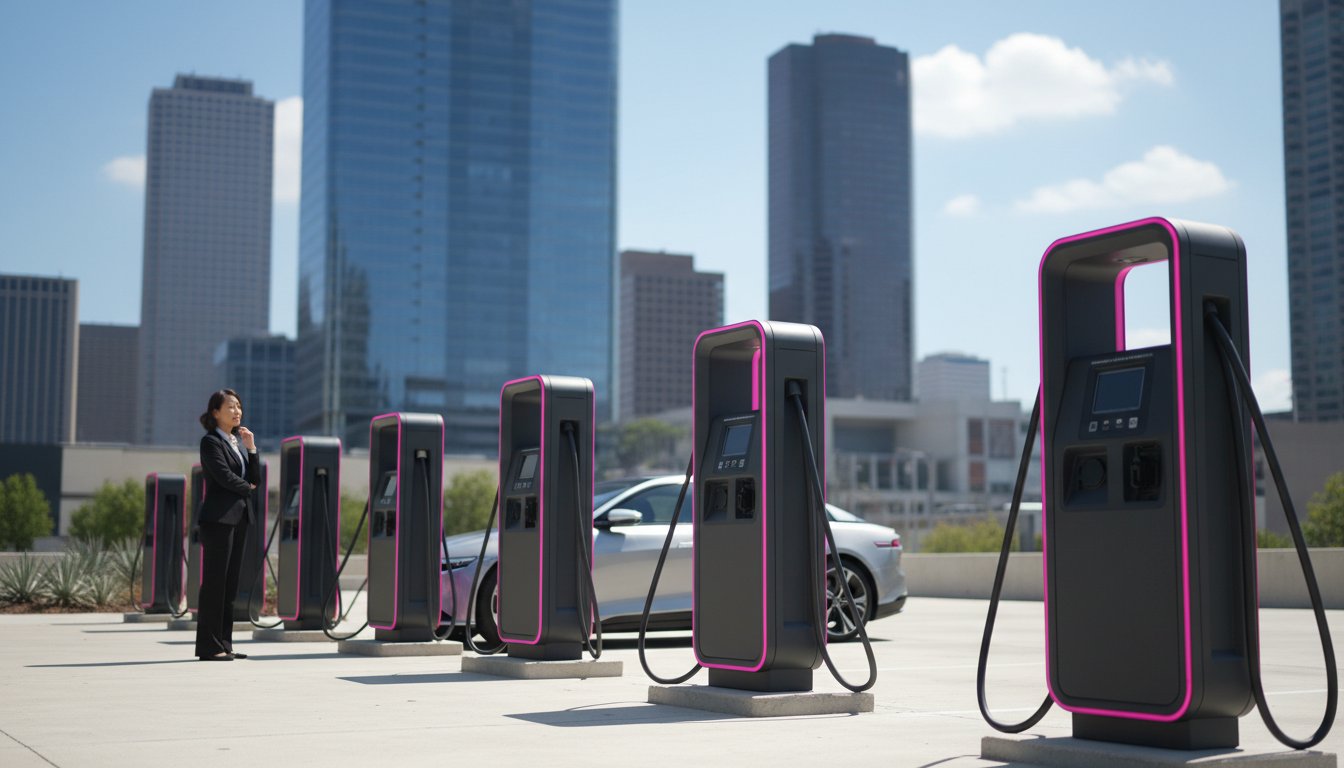
By 2026, a Houston commercial property lacking a robust commercial ev charging station infrastructure will face the same functional obsolescence as an office building without high-speed connectivity. This shift represents a fundamental transformation in how Texas enterprises manage their physical assets. You likely recognize that your tenants and fleet operators now view electrification as a baseline requirement, yet the path to implementation is often obscured by technical hurdles. The Santiban Services Group acknowledges the frustration of navigating the Houston Permitting Center’s rigorous codes and the grid capacity limitations defined by CenterPoint Energy.
This guide provides a comprehensive roadmap for deploying commercial-grade charging systems that are both permit-ready and future-proofed. You’ll learn the meticulous steps required for an integrated engineering design while identifying the specific Texas incentives that maximize your long-term ROI. We detail a methodical approach to infrastructure that avoids the common pitfalls of unqualified contractors and insufficient power planning. By following this 2026 framework, you can transform your facility into a sophisticated hub of modern mobility through excellence in every detail.
Key Takeaways
- Identify the strategic shift positioning infrastructure as a baseline requirement for maintaining high-value commercial assets in Houston’s competitive 2026 landscape.
- Navigate complex regulatory frameworks by utilizing PE-stamped engineering to ensure every commercial ev charging station installation adheres to stringent Harris County building codes.
- Evaluate the technical performance metrics of Level 2 versus DC Fast Charging to implement a tailored infrastructure solution that aligns with your facility’s specific operational demands.
- Optimize project ROI by mastering grid interconnection protocols with CenterPoint Energy and capturing available Texas-specific financial incentives and utility rebate programs.
- Secure a seamless deployment by partnering with a Tesla-certified team backed by over two decades of meticulous industrial electrical experience in the Texas market.
The Strategic Growth of Commercial EV Charging Stations in Houston
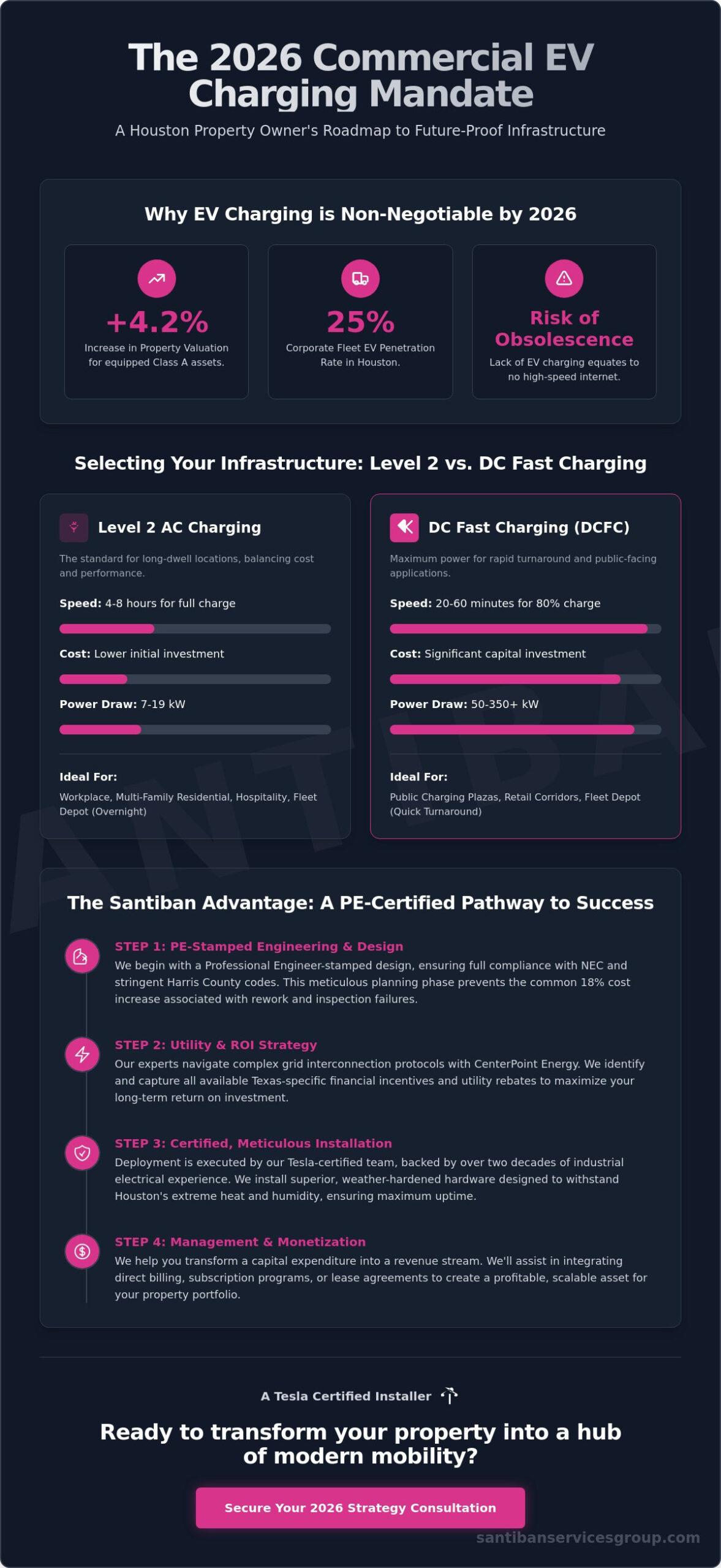
The 2026 Houston business landscape reflects a decisive shift toward electrification. As of January 2026, the City of Houston’s Climate Action Plan goals have accelerated the deployment of electric vehicle infrastructure across the Greater Houston area. For property managers in Downtown and the Energy Corridor, a commercial ev charging station is no longer a peripheral amenity. It’s a baseline requirement for Class A office designations. Real estate data from late 2025 indicates that properties equipped with integrated electric vehicle supply equipment (EVSE) command a 4.2% premium in valuation compared to unequipped counterparts. This infrastructure ensures long-term tenant retention by supporting the corporate sustainability mandates of major energy and technology firms. Santiban Services Group provides the meticulous planning required to transition these systems from simple perks to high-performance industrial assets. We prioritize reliability. We ensure excellence in every detail. Our approach transforms parking facilities into strategic components of a property’s value proposition.
Meeting the Demands of Houston’s 2026 EV Market
Corporate fleet adoption in Houston reached a 25% penetration rate by the start of 2026. This surge necessitates a move away from Level 1 emergency charging toward high-speed Level 2 and DC fast-charging solutions. Houston’s extreme humidity and heat, often exceeding 100 degrees for 45 days annually, demand superior, weather-hardened hardware. Santiban Services Group installs systems designed to withstand these rigorous Texas conditions. We deliver comprehensive facility management. We provide tailored installation strategies. Our approach ensures your commercial ev charging station remains operational during peak demand periods. We focus on durability to prevent the thermal degradation common in substandard equipment. This level of technical oversight is essential for maintaining the continuous uptime that corporate tenants expect in a competitive market.
Revenue Models for Houston Property Owners
Strategic property owners now utilize charging infrastructure as a consistent revenue stream rather than a fixed cost. Retail and hospitality sectors implement direct-to-consumer billing models that capture margins from transient visitors. Industrial campuses often prefer subscription-based employee programs to manage load distribution efficiently. Integrating these costs directly into commercial lease agreements offers a seamless way to recover capital expenditures. This method provides essential services to high-value tenants without increasing overhead. Our dedicated teams manage every detail of this integration to protect your corporate stability. We offer a single-source solution for installation and long-term maintenance. This structured financial approach turns a necessary utility into a profitable industrial asset that scales with your property portfolio.
Engineering Excellence: The Role of PE-Stamped Design in Houston EV Projects
PE-stamped engineering is the legal certification of a design by a Professional Engineer. In the rigorous regulatory landscape of Southeast Texas, this validation serves as the foundation for every commercial ev charging station project we undertake. Houston’s building codes are a complex intersection of the National Electrical Code (NEC) and Harris County amendments, which often require higher standards for flood resilience and grid integration. Meticulous engineering at the project’s inception prevents the 18% cost increase typically associated with rework during the final inspection phase. By securing professional validation early, property owners ensure that their infrastructure is not just functional but fully compliant with the latest safety protocols.
The engineering process involves a comprehensive analysis of the existing electrical load to verify that the facility’s transformer can handle the sudden demand of multiple high-output chargers. Our teams focus on creating a seamless integration between new equipment and legacy systems. This disciplined approach eliminates the risk of circuit overloads and protects the long-term health of the building’s electrical backbone. A professional design provides a clear, authoritative roadmap that contractors and inspectors follow with absolute precision.
Permitting with the Houston Permitting Center (HPC)
The Houston Permitting Center (HPC) maintains a strict review process that demands detailed documentation, including site plans, load calculations, and one-line diagrams. For clients managing a portfolio of properties, we often leverage the Master Plan process to standardize designs and accelerate the approval timeline across multiple sites. Our established expertise in PE stamped engineering for solar systems allows us to streamline the permitting of EV infrastructure by utilizing proven templates that the HPC recognizes and trusts. This proactive strategy reduces the time spent in administrative queues by approximately 30% compared to uncertified submissions.
Mitigating Risk through Professional Design
Professional design is essential for addressing the environmental challenges unique to the Gulf Coast. Navigating Houston Utility Requirements requires an understanding of how local humidity and extreme heat affect electrical components. Our engineers prioritize thermal management in every commercial ev charging station layout, ensuring that hardware remains operational even during Houston’s 100-plus degree summer afternoons. We also design with an eye toward 2028 and beyond by incorporating capacity for Vehicle-to-Grid (V2G) technology. This forward-thinking approach ensures your investment doesn’t become obsolete as bidirectional charging becomes a fleet standard. To ensure your facility is prepared for these technical demands, consider how our tailored infrastructure solutions can provide the stability your business requires.
Selecting Infrastructure: Level 2 vs. DC Fast Charging for Houston Businesses
Selecting the correct commercial ev charging station infrastructure requires a meticulous evaluation of site-specific operational demands. Houston businesses must balance initial capital expenditure against the long-term throughput requirements of their fleet or clientele. Reliability remains the primary metric for success in the Gulf Coast’s volatile climate. High humidity levels and seasonal storm surges necessitate hardware with NEMA 4X ratings to prevent internal corrosion and electrical failure. Our technical teams prioritize equipment that offers a seamless integration of durability and performance.
Level 2 Charging: Cost-Effective Scalability
Level 2 units utilize 208V or 240V alternating current (AC). They provide a stable solution for locations where vehicles remain parked for four hours or longer. These systems typically deliver between 7.2 kW and 19.2 kW of power. This output translates to roughly 25 to 35 miles of range per hour of charging. The installation footprint is minimal, which allows property managers to deploy multiple units across a parking garage without extensive structural modifications.
Multi-family housing developments and corporate offices represent the primary use cases for this technology. Employees and residents value the convenience of charging while they work or sleep. Because Level 2 chargers draw less power than fast chargers, they often avoid the need for expensive utility transformer upgrades. Facility managers should consult our guide on understanding EV charger installation costs in Houston to determine how these units fit into their 2026 fiscal planning.
DC Fast Charging: Industrial-Grade Throughput
DC Fast Charging (DCFC) converts AC power to direct current (DC) within the station itself. This allows electricity to bypass the vehicle’s onboard converter and flow directly into the battery. These units require 480V three-phase power. They offer charging speeds ranging from 50 kW to 350 kW. For Houston logistics and delivery companies, this technology is essential for maximizing fleet uptime. A delivery van can achieve an 80% charge in approximately 20 to 40 minutes, which keeps operations moving during tight delivery windows.
The role of Tesla Supercharger technology has expanded significantly within the commercial ev charging station market. With the industry shift toward the North American Charging Standard (NACS), many businesses now install universal fast chargers that accommodate both Tesla and non-Tesla fleets. These industrial-grade systems require a dedicated utility transformer and sophisticated thermal management systems. We ensure that every DCFC installation includes robust surge protection to handle the grid instability often seen during peak Texas summers. Our approach focuses on creating a high-turnover retail hub that serves the modern electric commuter with precision and speed.
Navigating Houston Utility Requirements and ROI in 2026
CenterPoint Energy Grid Coordination
Securing new commercial electrical service in Harris County involves a multi-step application process with CenterPoint Energy. This starts with a detailed load study to determine if existing transformers support the added capacity. Most complex commercial installations require 8 to 12 weeks for utility approval and transformer upgrades. Property owners can manage peak demand charges by deploying smart load balancing software that caps power draw during high-traffic periods. Integrating Tesla Electric solutions provides a strategic advantage; these systems buffer grid load during peak hours to avoid expensive utility surcharges and provide a layer of energy independence.
Federal and State Incentives for 2026
The financial viability of a commercial ev charging station often hinges on leveraging available tax credits and state grants. The 30C Alternative Fuel Vehicle Refueling Property Credit offers a tax credit of up to 30% of the project cost, capped at $100,000 for businesses located in eligible census tracts. The Texas Volkswagen Environmental Mitigation Plan (TXVEMP) remains a primary funding source for Level 2 and DC fast charging infrastructure across the state.
- Utilizing PE-stamped designs facilitates a smoother approval process with the City of Houston.
- Verified engineering standards help projects qualify for aggressive green energy grants.
- Local Houston sustainability initiatives influence project funding for companies committed to the 2020 Climate Action Plan goals.
Reliable performance and long-term stability depend on an integrated strategy that aligns technical engineering with fiscal responsibility. Every detail of the interconnection process must be managed with precision to avoid delays that inflate project budgets.
The Santiban Advantage: Industrial-Scale EV Infrastructure in Houston
Santiban Services Group leverages 24 years of industrial electrical construction experience to support the Texas market. We operate as a disciplined, single-source provider for Houston’s corporate sector. Our approach eliminates the fragmented communication often found in multi-vendor projects. We manage every phase of your commercial ev charging station project; this includes initial PE-stamped engineering, site preparation, and final utility commissioning. This integrated model ensures that your facility remains operational while we build for the 2026 energy landscape.
Our commitment to “Excellence in Every Detail” isn’t a simple slogan. It’s a rigorous operational standard that defines our corporate stability. We function as a silent engine for your business. We handle complex logistical challenges so your property managers can focus on core operations. By providing tailored solutions, we meet the specific high-voltage requirements of industrial sites and large-scale office complexes across the Greater Houston area. Our history in the region provides us with the local utility insights necessary for seamless grid integration.
Why Certification Matters for Commercial Projects
High-voltage industrial work carries inherent risks that demand certified expertise. Utilizing non-certified contractors for a commercial ev charging station can lead to catastrophic equipment failure or voided manufacturer warranties. Santiban mitigates these risks through a Tesla-certified installation team specialized in Powerwall 3 and commercial-grade charging systems. Our technicians follow meticulous safety protocols that exceed standard OSHA requirements. We prioritize professional reliability over speed. You can explore our broader commercial ev charger installation capabilities to understand our comprehensive approach to safety and performance.
Requesting a Professional Site Evaluation
The Santiban process begins with a data-driven load analysis. Our Houston-based engineering team evaluates your existing electrical capacity to determine the most efficient configuration for your fleet or tenant needs. We provide a clear, methodical path from the first consultation to the final PE-stamped delivery. This rigorous documentation ensures that your infrastructure meets all local municipal codes and utility standards. We don’t rely on estimates; we provide factual, engineered solutions that guarantee long-term performance.
Our dedicated teams remain focused on your project until the final commissioning is complete. We ensure that every component, from the transformer to the user interface, operates at peak efficiency. This focus on detail reduces long-term maintenance costs and improves user satisfaction. Partner with Santiban for your Houston commercial EV infrastructure and secure a dependable foundation for your business’s future energy needs.
Securing Your Industrial Edge in Houston’s 2026 EV Market
Success in the 2026 Houston energy landscape requires more than just hardware; it demands a meticulous approach to infrastructure. Transitioning your facility involves navigating complex utility requirements and selecting between Level 2 and DC Fast Charging to maximize long-term ROI. A high-performance commercial ev charging station relies on integrated engineering to ensure safety and operational continuity. By prioritizing PE-stamped designs, businesses eliminate compliance risks and streamline the installation process across industrial-scale properties.
Santiban Services Group brings over 24 years of industrial electrical experience to every project. As Tesla-certified energy solution installers, our dedicated teams provide in-house PE-stamped engineering design to guarantee excellence in every detail. We understand that your facility is a critical asset. Our disciplined methodology ensures that your transition to electric infrastructure is seamless and professional. We’re ready to help you deploy a scalable solution that meets the specific demands of the Houston market.
Take the first step toward a reliable energy future. Request an Industrial Site Evaluation from Santiban Services Group to begin your comprehensive facility upgrade today. It’s time to build a foundation that lasts.
Frequently Asked Questions
Do I need a special permit for a commercial ev charging station in Houston?
The Houston Public Works Department requires a commercial electrical permit for every professional installation. This process ensures the project adheres to the 2023 National Electrical Code standards adopted by the City of Houston. Our team manages the entire permitting lifecycle, from initial application to the final inspection, to guarantee your facility remains compliant with municipal safety regulations.
What is the average installation time for a commercial EV charger at a Houston office?
A standard commercial ev charging station installation typically requires four to six weeks from the initial site assessment to final commissioning. This timeline includes approximately 14 days for municipal permit approval and three days for physical hardware mounting and electrical wiring. Projects requiring extensive trenching or utility transformer upgrades may extend this duration to 10 weeks depending on site complexity.
How does CenterPoint Energy handle commercial EV charging service upgrades?
CenterPoint Energy requires a formal Service Request for any commercial facility adding a load that exceeds the current transformer capacity. They evaluate the existing grid infrastructure and may mandate a new secondary service drop or a transformer replacement. Santiban Services Group coordinates directly with CenterPoint technicians to synchronize utility-side work with interior facility upgrades, ensuring a seamless transition.
Is PE-stamped engineering required for all commercial EV projects in Texas?
The Texas Board of Professional Engineers and Land Surveyors mandates a Professional Engineer stamp for electrical plans on commercial projects exceeding $50,000 in value. This requirement also applies if the installation involves significant structural modifications to the building. Our integrated approach ensures that all technical drawings meet these rigorous engineering standards to maintain safety and long-term structural integrity.
What is the difference between Level 2 and DC Fast Charging for a business?
Level 2 chargers provide 19 to 48 miles of range per hour using 240V power, making them ideal for employees who park for eight hours. DC Fast Chargers deliver 100 to 200 miles of range in 30 minutes using 480V direct current. Choosing the right commercial ev charging station depends on whether your visitors require long-term dwell times or rapid vehicle turnover.
Are there specific Houston tax incentives for installing EV charging stations in 2026?
Houston businesses can utilize the federal Alternative Fuel Vehicle Refueling Property Tax Credit, which offers a 30 percent credit for hardware and installation through 2032. Enterprises may also qualify for the Texas Emissions Reduction Plan grants available in 2026. These financial programs provide a meticulous pathway for companies to offset the initial capital expenditure of transitioning to sustainable infrastructure.
Can I integrate my commercial EV charging station with existing solar or battery storage?
You can integrate charging hardware with existing solar arrays or Battery Energy Storage Systems to reduce peak demand charges. Smart energy management software balances the electrical load between the grid and your renewable sources. This configuration allows your facility to store energy during off-peak hours and deploy it during high-traffic periods, which optimizes your total cost of ownership.
What happens if my Houston facility does not have enough electrical capacity for EV chargers?
Facilities with limited capacity must implement intelligent Load Management Systems or undergo a formal electrical service upgrade. We install power-sharing modules that distribute available current across multiple ports without tripping the main breakers. If the deficiency exceeds 25 percent of the total required load, our dedicated teams manage the installation of new switchgear and upgraded panel boards.