
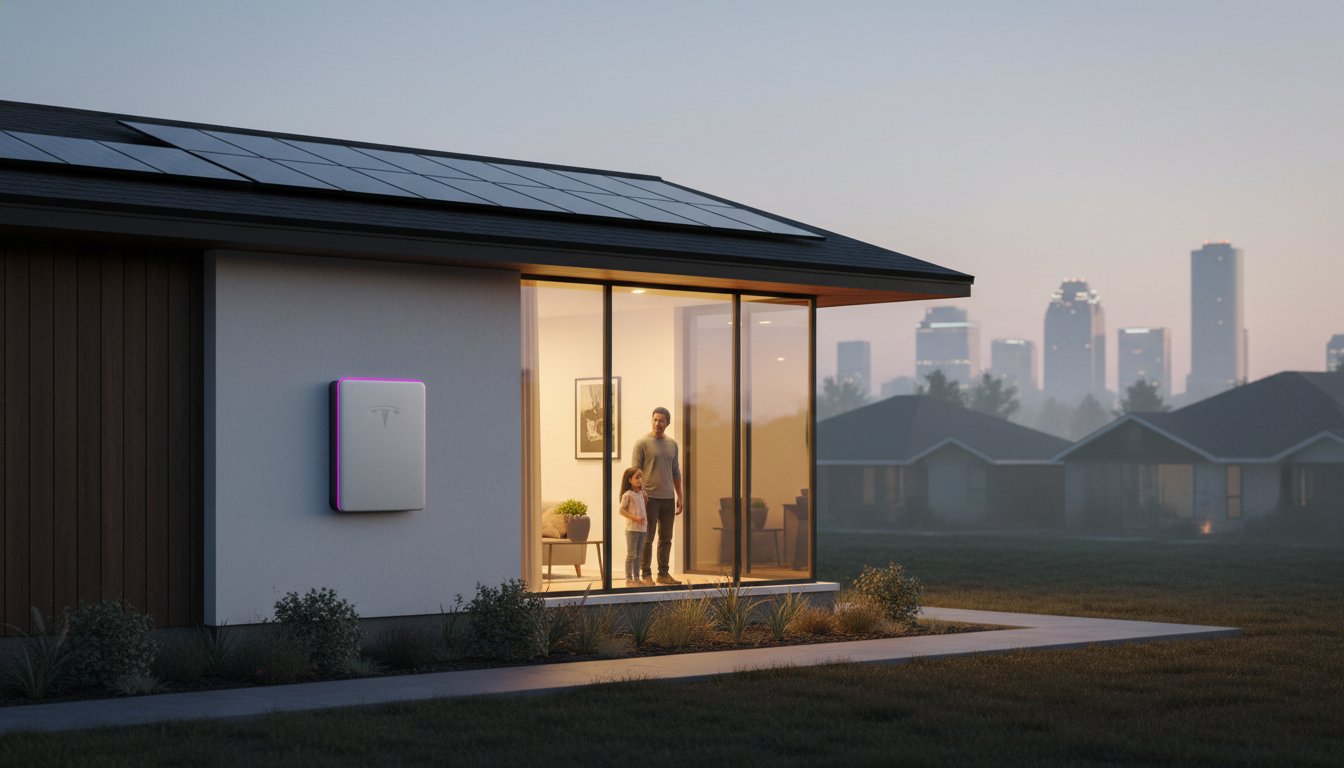
Texas leads the nation in weather-related grid failures, recording 210 major outages between 2000 and 2023. For property managers and homeowners, this statistic translates into lost revenue and the recurring anxiety of an unpredictable infrastructure. You shouldn’t have to monitor ERCOT demand charts to ensure your facility remains operational or your home stays comfortable during a heatwave. We understand that the stability of your operations depends on a reliable energy supply that functions independently of grid volatility.
This article provides a comprehensive look at professional ERCOT power outage solutions designed to secure your energy independence in 2026. You’ll learn how Santiban Services Group implements meticulous engineering and advanced battery storage to protect your assets. We’ll examine the technical advantages of Tesla Powerwall 3 installations and the necessity of PE-stamped designs for commercial resilience. Discover how a tailored, turn-key approach ensures a seamless transition to backup power even when the primary grid fails.
Key Takeaways
- Learn to navigate the ERCOT Energy Emergency Alert hierarchy and understand the mechanisms behind grid-directed controlled outages.
- Evaluate high-performance ERCOT power outage solutions, including Tesla Powerwall 3 and EcoFlow systems, to maintain operational continuity during grid instability.
- Compare the technical advantages of battery storage over traditional generators, focusing on instantaneous power transfer and silent, emission-free performance.
- Understand why Professional Engineer (PE) stamps are a critical requirement for ensuring the structural and electrical integrity of complex energy installations.
- Discover how a single-source, turn-key approach simplifies the integration of solar reroofing and battery storage for long-term energy independence.
Understanding ERCOT Grid Alerts and the Risk of Controlled Outages
The stability of the Texas power grid remains a primary concern for property owners as we move through 2026. While the state possesses a massive infrastructure capacity of 141,000 megawatts, its status as an isolated energy island creates unique vulnerabilities during peak demand. The Electric Reliability Council of Texas (ERCOT) manages this complex system by monitoring real-time reserves and issuing Energy Emergency Alerts (EEA) when supply tightens. Effective ERCOT power outage solutions require a deep understanding of these alert levels and the specific triggers that lead to mandatory load shedding.
Grid stress is projected to intensify this year. Industry data indicates a 9.2% increase in electricity sales for 2026, largely driven by the expansion of energy-intensive data centers and rapid population growth. When extreme summer heat or winter freezes push demand beyond available generation, ERCOT moves through a three-tier emergency hierarchy:
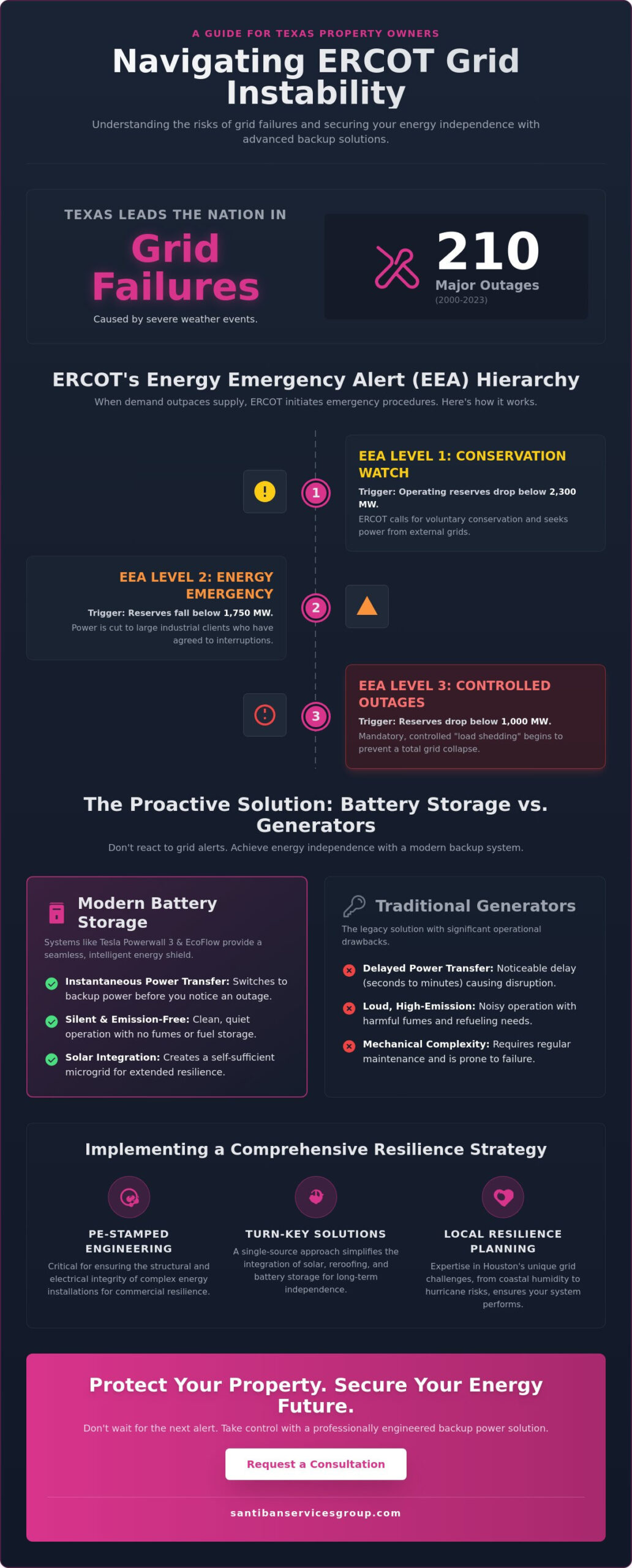
- EEA Level 1: Operating reserves drop below 2,300 MW. ERCOT calls for voluntary conservation and imports power from neighboring grids where possible.
- EEA Level 2: Reserves fall below 1,750 MW. ERCOT begins reducing power to large industrial customers who have agreed to be interrupted during emergencies.
- EEA Level 3: The most critical stage. When reserves drop below 1,000 MW, ERCOT mandates controlled outages to prevent a total grid collapse.
Relying solely on conservation is a reactive strategy that often fails during sustained weather events. Businesses and high-end residential properties need proactive ERCOT power outage solutions that provide a definitive barrier between their operations and grid instability.
The Reality of EEA 3 and Load Shedding
Controlled outages are not random accidents; they’re deliberate, high-speed engineering maneuvers. When the 1,000 MW threshold is breached, local transmission operators receive mandatory orders to “shed load” immediately. These operators disconnect specific distribution blocks to balance the system frequency. While these events are intended to be “rolling” and typically last 15 to 45 minutes, historical data from 2000 to 2023 shows that extreme weather can extend these durations significantly. Without an integrated battery backup, your facility is entirely dependent on the speed of these manual restorations.
Why the Houston Grid Faces Unique Challenges
Houston’s infrastructure faces environmental stressors that complicate grid reliability. High coastal humidity and extreme heat reduce the operational efficiency of transformers and transmission lines, making local equipment more prone to failure during demand spikes. Additionally, the region’s susceptibility to hurricane-related damage creates a dual risk: systemic grid alerts from ERCOT and localized physical damage to the distribution network. Meticulous local resilience planning is the only way to ensure continuous performance when the surrounding infrastructure is under duress.
Tesla Powerwall 3 and EcoFlow: Advanced Battery Backup Solutions
Modern ERCOT power outage solutions require a transition from reactive conservation to proactive energy management. While grid alerts signal potential instability, advanced battery hardware provides the physical infrastructure necessary to maintain total property autonomy. High-performance systems like the Tesla Powerwall 3 and EcoFlow battery backups serve as the foundation of a sophisticated energy strategy. These units don’t just store power; they act as intelligent hubs that manage loads and optimize performance during prolonged grid emergencies. By decoupling your property from the immediate risks of the high-voltage transmission network, you ensure that your operations continue regardless of external conditions.
Integrated smart software now allows these systems to monitor grid frequency and voltage in real-time. By detecting micro-fluctuations that precede a load-shedding event, the system can disconnect from the grid and transition to battery power before a visible interruption occurs. When paired with a professional solar panel installation, these batteries create a resilient microgrid capable of sustaining essential services for days. This integrated approach transforms a standard property into a self-sufficient energy plant that remains unaffected by ERCOT’s mandatory load shedding. It’s a level of security that traditional backup methods simply cannot match.
Tesla Powerwall 3: Whole-Home Backup
The Tesla Powerwall 3 represents a significant advancement in residential energy storage, offering a continuous power output of 11.5 kW. This superior capacity is facilitated by an integrated solar inverter that simplifies the electrical architecture and increases overall system efficiency. By consolidating hardware, the Powerwall 3 reduces installation complexity while maximizing energy conversion rates. For Texas homeowners, this system provides the high-surge current necessary to start and run demanding appliances like central air conditioning units without flickering or resets. It’s an ideal choice for those seeking a meticulous, professional-grade installation that handles the heaviest loads of a Houston summer.
EcoFlow Solutions for Scalable Power
EcoFlow provides a modular alternative that excels in both residential and light commercial applications. These systems allow for a tailored approach to energy security, where capacity can be expanded based on specific operational requirements. The DELTA Pro 3, priced at $1,999 in 2026, offers rapid charging capabilities and a compact footprint that is often more versatile than traditional wall-mounted configurations. This scalability ensures that property managers can implement a comprehensive backup plan that matches their precise load profile. Because these units are designed for seamless integration, they offer a flexible solution for facilities where space or structural constraints limit larger fixed installations.
Why Battery Storage Outperforms Traditional Generators in Texas
Traditional combustion generators have long served as the default response to grid instability, yet they introduce mechanical risks and logistical burdens that modern battery systems eliminate. While a generator relies on complex moving parts and a constant supply of volatile fuel, battery storage operates as a solid-state, silent engine. This distinction is critical during prolonged ERCOT power outage solutions where noise pollution and exhaust fumes can impact residential comfort and commercial compliance. Advanced battery systems provide a seamless transfer of power that occurs in less than 10 milliseconds. This speed ensures that sensitive electronics, server racks, and medical equipment don’t reset during a grid failure, a feat most mechanical generators cannot achieve.
Maintenance requirements further separate these two technologies. A standby generator requires monthly exercise cycles, regular oil changes, and fuel stabilization to ensure readiness. In contrast, battery storage utilizes over-the-air firmware updates and autonomous self-testing. This set-and-forget reliability appeals to property managers who value meticulous operational control without the need for manual intervention. By removing the human element from the maintenance equation, integrated battery systems offer a higher degree of certainty that the power will be there when the grid fails.
Operational Reliability During Extreme Cold
Extreme Texas freezes expose a significant vulnerability in gas-powered backup systems: fuel supply failure. During severe winter events, natural gas lines can lose pressure as demand spikes, or regulators can freeze, rendering even the most expensive generator useless. Tesla Powerwall 3 systems mitigate these environmental risks through integrated thermal management. These systems actively warm the battery chemistry to maintain peak performance even when external temperatures drop below zero. Because solar-plus-storage systems operate on a zero-fuel requirement, they remain functional as long as there’s light, providing a truly independent microgrid when the broader infrastructure is compromised.
Economic Advantages and Grid ROI
Modern energy storage provides financial benefits that extend beyond simple emergency backup. Property owners can leverage “load shifting” to draw power from the grid when rates are low, such as the 7.20 cents per kWh plans currently available, and discharge the battery during expensive peak demand periods. This strategy significantly lowers the average monthly electric bill, which typically ranges between $168 and $211 for Texas residences. While the federal clean energy tax credit expired at the end of 2025, property owners in 2026 can still benefit from local property tax exemptions and lucrative grid participation programs. For those interested in maximizing their investment, Tesla Electric in Houston offers a structured path to sell excess energy back to the grid, turning a resilience asset into a revenue-generating tool.
The Role of PE-Stamped Engineering in Grid-Tied Energy Projects
High-performance ERCOT power outage solutions require more than advanced hardware; they demand rigorous technical validation through Professional Engineer (PE) stamped designs. In Texas, most local Authorities Having Jurisdiction (AHJs) mandate a structural and electrical PE stamp for systems exceeding 10 kW. This requirement ensures that the integration of solar panels and heavy battery units does not compromise the structural integrity of the property. Structural engineers must calculate wind loads and weight distribution, particularly when a solar reroof is part of the implementation. Electrical engineers verify that the system adheres to the National Electrical Code (NEC), preventing hazardous thermal events or system failures during peak demand periods.
A residential PE stamp in Texas typically costs between $150 and $400, but the value it provides in liability protection and permitting speed is substantial. Santiban Services Group utilizes in-house engineering capabilities to ensure that every ERCOT power outage solutions strategy is backed by meticulous data. This proactive approach eliminates the friction often found in the permitting process, where third-party engineering delays can stall a project for weeks. By integrating design and construction, we provide a seamless path to energy independence that meets the highest industrial standards.
Permitting Resilience in Houston
Navigating the interconnection process with CenterPoint Energy requires meticulous documentation and technical accuracy. Utilizing PE stamped engineering for solar systems prevents costly project delays by ensuring all submittals meet local utility standards on the first attempt. For industrial electrical construction, these stamps provide the legal and technical assurance that the facility’s power infrastructure can handle the bidirectional flow of energy. Our teams prioritize these details to keep your project on schedule and in full compliance with local regulations.
Meticulous Design for Long-Term Safety
Engineering plays a critical role in fire safety and rapid shutdown compliance, which are essential for both residential and commercial protection. Load calculations are performed to ensure that the battery storage system can support essential operations without overloading circuits during grid-directed outages. These PE-stamped documents serve as a blueprint for reliability for commercial facilities, documenting every electrical connection and structural reinforcement. This level of detail is a prerequisite for insurance compliance and long-term asset protection. If you’re ready to secure your facility with an engineered solution, contact our dedicated engineering team today to begin your site assessment.
Implementing a Comprehensive Resilience Strategy with Santiban
Implementing a strategy for energy autonomy requires a partner capable of managing complex logistical and technical requirements. Santiban Services Group provides a single-source solution that integrates design, engineering, and execution under one professional umbrella. By consolidating these services, we eliminate the communication gaps that often occur between separate contractors, ensuring that every operational detail remains under expert control. Our teams specialize in developing customized ERCOT power outage solutions that address the specific environmental and regulatory challenges of the Houston region. We prioritize long-term stability over temporary fixes, projecting the quiet confidence that comes from decades of technical expertise.
Choosing a certified Tesla Powerwall installer is essential for maintaining the long-term reliability of your energy infrastructure. Certification ensures that the installation adheres to strict manufacturer standards and local safety codes, protecting both your investment and your property. With over 24 years of industry experience, Santiban brings a level of institutional knowledge that guarantees excellence in every detail. We don’t just install hardware; we build resilient systems designed to function as a silent engine for your home or business. This disciplined approach ensures your facility remains operational when the broader grid faces critical stress.
Tailored Solutions for Residential and Commercial Clients
Our approach begins with a comprehensive understanding of your facility’s load profile and structural capacity. For many Houston property owners, this involves a strategic integration of solar reroofing and battery storage to maximize energy capture and retention. On the commercial side, we offer sophisticated systems that include commercial EV charger installation. This allows businesses to provide superior amenities while maintaining grid independence. These integrated solutions are meticulously engineered to provide seamless performance, ensuring that your operations remain stable regardless of external grid alerts or extreme weather events.
Your Path to Grid Independence
The transition to a fully independent power system is a methodical process that prioritizes precision. It starts with a professional site assessment where our dedicated teams evaluate your current electrical service, roof condition, and backup requirements. Following this audit, we deliver a tailored design that optimizes your property for maximum resilience. Our commitment to your energy security continues long after the final connection is made. We provide ongoing system monitoring and professional support to ensure your ERCOT power outage solutions perform at peak efficiency year after year. Secure your property against the next grid emergency by partnering with an established leader in Texas energy resilience. Contact Santiban Services Group today to schedule your comprehensive site audit.
Securing Your Energy Future with Engineered Resilience
The persistent vulnerability of the Texas grid requires a transition from reactive observation to proactive, engineered independence. As electricity demand continues to grow and extreme weather events persist, the ability to maintain operational continuity is a critical priority for property owners. Implementing sophisticated ERCOT power outage solutions allows you to decouple your facility from the risks of mandatory load shedding and infrastructure failure. By integrating advanced Tesla Powerwall 3 technology with meticulous structural and electrical design, you ensure that your home or business remains a self-sufficient microgrid during the most demanding conditions.
Santiban Services Group brings over 24 years of industrial electrical experience to every project. Our dedicated teams provide a single-source solution that includes Tesla-certified installation experts and PE-stamped engineering for technical compliance. This comprehensive approach ensures that your backup system is not just functional, but optimized for the specific environmental challenges of the Houston region. We invite you to Request a Professional Consultation for ERCOT Resilience Solutions and begin the process of securing your property. Taking control of your energy destiny doesn’t have to be a burden when you have a partner committed to excellence in every detail.
Frequently Asked Questions
What is an ERCOT EEA 3 alert and how does it affect me?
An EEA 3 alert is the highest level of emergency, triggered when grid operating reserves drop below 1,000 MW. At this stage, ERCOT mandates controlled outages to prevent a total system collapse. For property owners, this results in immediate and involuntary power loss that can last from minutes to several hours depending on the severity of the generation shortage.
Can a Tesla Powerwall 3 power my whole home during a Texas grid outage?
The Tesla Powerwall 3 is designed for whole-home backup with its 11.5 kW continuous power output. This capacity is sufficient to start and run high-surge appliances like central air conditioning units and well pumps. For larger facilities with higher demand profiles, multiple units can be integrated to provide a comprehensive and tailored energy solution.
How long can a battery backup system last without solar panels?
A standalone battery typically provides 12 to 24 hours of power for essential loads depending on your specific consumption. Without a solar installation to recharge the cells during daylight hours, the system’s duration is limited to its stored capacity. Implementing meticulous load management is essential to extend the life of the battery during prolonged grid failures.
Do I need a special permit for a home battery installation in Houston?
Houston requires specific electrical permits and often a Professional Engineer (PE) stamp for any system exceeding 10 kW. These regulations ensure that the installation meets the National Electrical Code and structural safety standards. Santiban Services Group manages the entire permitting process, ensuring that every detail complies with local Authority Having Jurisdiction requirements.
What is the difference between a backup battery and a standby generator?
Batteries provide an instantaneous, silent transfer of power that prevents electronics from resetting during a grid failure. Unlike generators, they don’t require volatile fuel, monthly mechanical exercises, or oil changes. This makes them superior ERCOT power outage solutions for those seeking a reliable, low-maintenance system that functions regardless of fuel supply chain disruptions.
How does solar reroofing improve my home’s energy resilience?
Solar reroofing combines a high-durability roof with integrated photovoltaic panels to create a structurally sound energy platform. This approach ensures your building envelope is prepared for the weight and wind-load requirements of a modern solar array. By generating your own power, you create a self-sustaining microgrid that recharges your battery storage daily for indefinite grid independence.
Are there tax incentives for installing battery storage in Texas in 2026?
The 30% federal clean energy tax credit expired on December 31, 2025, and is currently unavailable for 2026 installations. However, many Texas property owners still benefit from property tax exemptions for renewable energy equipment and specific utility rebate programs. It’s advisable to consult with a financial professional to identify any localized incentives that can lower your total investment cost.
What happens if ERCOT orders a controlled outage and I have a Powerwall?
Your property will transition to battery power in less than 10 milliseconds, remaining fully operational while the surrounding grid goes dark. The system automatically detects the loss of utility power and disconnects from the grid to protect your internal circuits. You won’t experience the loss of productivity or the anxiety typical of ERCOT-directed load-shedding events.