
By 2026, a standard electrical permit won’t protect your Houston facility from the legal and operational liability of a non-compliant charging station. In a territory where 50 inches of annual rainfall and hurricane-force winds are the seasonal baseline, professional engineering isn’t a luxury; it’s a mandated safeguard for your corporate assets. Selecting the right commercial ev charger installers means finding a partner who understands that Harris County’s specific PE-stamped requirements are as critical as the hardware itself. You’ve likely realized that high upfront costs are only justifiable when the infrastructure delivers a consistent 10 year ROI without catastrophic operational failure.
This guide provides the authoritative framework you need to secure a turnkey, compliant solution that integrates seamlessly with your existing facility management. We’ll examine the meticulous engineering standards, hardware resilience, and strategic partnerships required to future-proof your commercial property. Our objective is to minimize your liability while maximizing the performance of your electric vehicle infrastructure through a disciplined, single-source approach that prioritizes long-term stability over temporary fixes.
Key Takeaways
- Evaluate the evolving 2026 landscape of Houston’s commercial real estate to implement integrated energy management solutions that enhance long-term asset value.
- Select the appropriate charging technology for your specific site requirements by analyzing the operational differences between Level 2 AC and Level 3 DC Fast Charging systems.
- Navigate Houston’s complex permitting requirements through the strategic application of PE-stamped engineering to ensure comprehensive structural and electrical safety.
- Establish rigorous selection criteria for commercial ev charger installers to secure a partner capable of delivering industrial-scale performance and meticulous technical oversight.
- Leverage the benefits of an established, single-source provider to achieve a seamless installation process backed by decades of Texas Gulf Coast industrial expertise.
The Strategic Value of Commercial EV Infrastructure in Houston
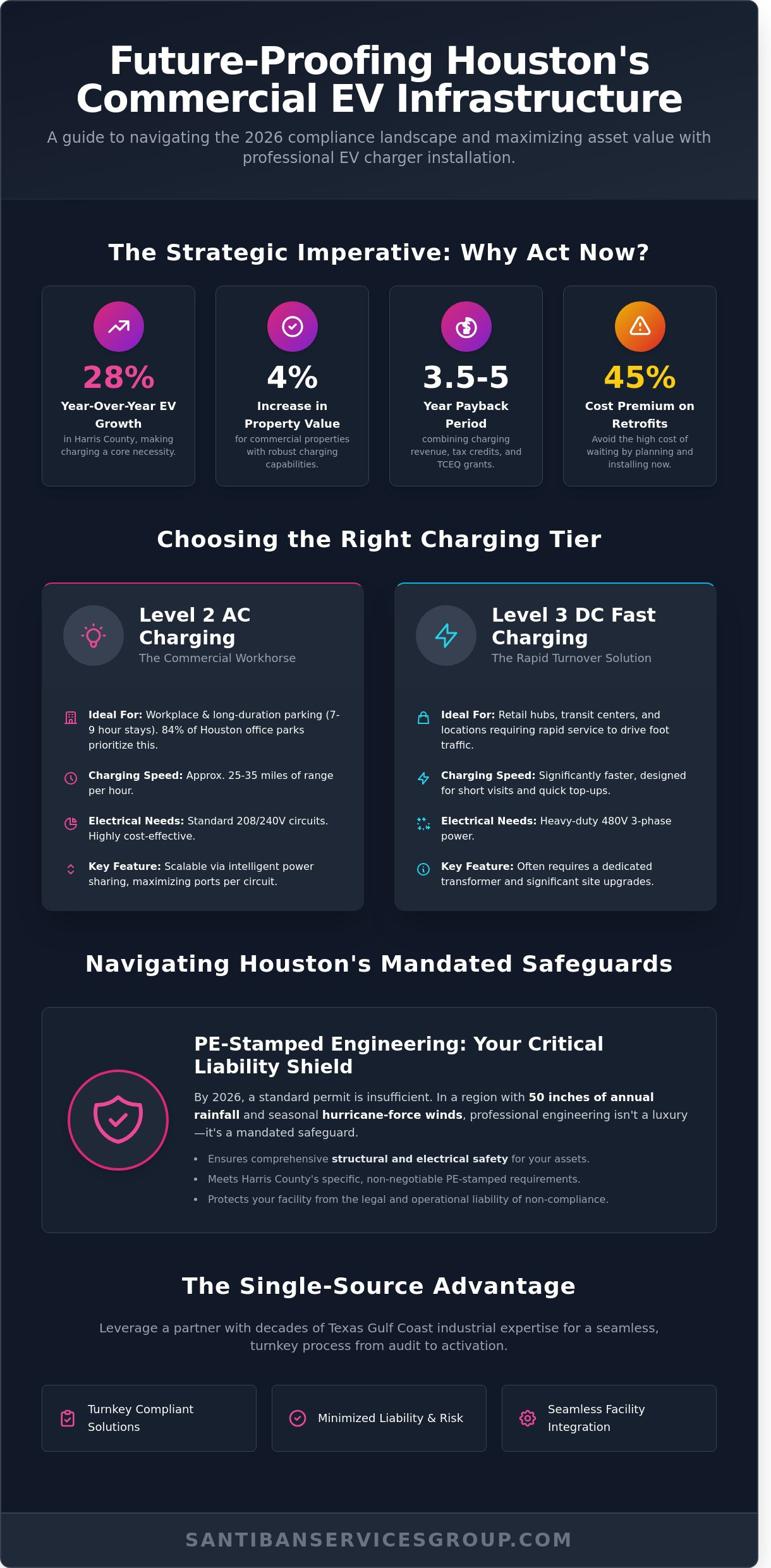
By January 2026, Houston’s transition into a diversified energy hub has reached a critical milestone. Registration data indicates a 28% year-over-year increase in electric vehicles across Harris County, fundamentally altering the requirements for commercial real estate. For property managers, this shift means that charging stations are no longer optional upgrades. They’re essential components of a building’s core infrastructure. Partnering with professional commercial ev charger installers allows businesses to move beyond the simple plug. We implement integrated energy management systems that utilize software-driven load balancing to protect your facility’s electrical grid while maximizing output.
The financial environment for these installations remains highly favorable. The federal 30C tax credit provides a robust incentive, covering up to 30% of hardware and installation costs with a $100,000 cap per location through the end of the decade. Texas-specific programs, including grants from the Texas Commission on Environmental Quality (TCEQ), further reduce the capital burden. These regulatory tailwinds provide a clear path for Houston firms to attract high-value tenants and top-tier talent who now view reliable charging as a baseline expectation for Class A office space.
Workplace vs. Retail vs. Fleet Charging
Santiban delivers tailored solutions based on specific site dwell times and operational needs. For workplace environments, we install Level 2 charging stations that provide approximately 25 miles of range per hour; it’s the standard for employees parked for eight-hour shifts. Retail centers require a different approach, often favoring DC fast charging to accommodate shorter visits and drive consumer foot traffic. Fleet electrification demands meticulous planning to support delivery and service vehicles. Our teams ensure your power capacity scales alongside your vehicle count to prevent operational bottlenecks.
ROI and Long-Term Asset Appreciation
Calculations for modern EV infrastructure show a typical payback period of 3.5 to 5 years when combining charging revenue with tax offsets. Beyond direct income, these installations drive significant asset appreciation. Data from 2025 suggests that Houston commercial properties with robust charging capabilities see a 4% increase in valuation compared to unequipped counterparts. By installing scalable capacity now, owners avoid the 45% cost premium associated with emergency retrofits. Our comprehensive approach ensures your facility remains a competitive, high-end strategic asset in a changing market. For business leaders also considering international expansion into thriving global hubs like the UAE, you can learn more about the corporate setup process. Property owners exploring revenue opportunities may also benefit from understanding the comprehensive framework for launching an EV charging business in Houston to maximize their infrastructure investment.
Technical Evaluation: Choosing the Right Charging Tiers for Your Facility
Selecting the correct charging tier requires a meticulous analysis of a facility’s electrical capacity and its occupants’ behavior. Professional commercial ev charger installers begin by auditing the existing kVA capacity to prevent system overloads during peak usage periods. This data-driven approach ensures that the chosen hardware aligns with both the building’s current limits and its future expansion goals. Utilizing a technical guide for commercial EV charging allows property managers to evaluate how integrated load management can mitigate the need for immediate, high-cost utility service upgrades.
Level 2 Charging: The Workhorse of Commercial EV
Level 2 stations operate on standard 208/240V requirements and represent the most cost-effective solution for long-duration parking. These units typically provide 25 to 35 miles of range per hour of charging. In Houston’s major office parks, 84% of facility managers prioritize Level 2 infrastructure for employees who remain on-site for 7 to 9 hours. Scalability is achieved through intelligent power sharing. This technology permits multiple ports to operate on a single circuit, maximizing the installation footprint without exceeding the panel’s rated amperage.
Level 3 DC Fast Chargers (DCFC)
DC Fast Chargers are essential for retail hubs and transit centers where rapid turnover is a priority. These systems require 480V three-phase power and often necessitate the installation of dedicated transformers. A DCFC unit can deliver an 80% charge to most modern vehicles in approximately 22 minutes, making them ideal for high-traffic corridors like the I-10 and Beltway 8. To manage the 60% to 75% increase in peak demand charges associated with these high-voltage units, sophisticated software and battery buffers are deployed to stabilize the local grid impact.
Environmental factors in the Gulf Coast region dictate specific hardware standards. Commercial ev charger installers must specify NEMA 4X rated enclosures to protect internal components from Houston’s high humidity and salt air. If you don’t account for these atmospheric conditions, standard equipment life cycles are reduced by nearly 40%. Meticulous equipment placement should be elevated at least 18 inches above the local flood plain to ensure resilience during extreme weather events. Implementing tailored facility management solutions during the design phase ensures that your infrastructure remains operational and secure regardless of external conditions. Facility operators seeking a scalable deployment strategy should also review the detailed roadmap for commercial electric car charger installation in Houston to align their electrical frameworks with 2026 CenterPoint Energy grid constraints.
Navigating Houston Permitting and PE-Stamped Engineering
Securing a standard electrical permit represents only the first step in a multi-layered compliance framework for Houston enterprises. Large-scale deployments require a comprehensive approach to satisfy the City of Houston (COH) and Harris County regulations. Professional commercial ev charger installers recognize that CenterPoint Energy’s 2025 Service Standards require specific grid interconnection studies for any installation exceeding 100kW. These studies prevent local transformer overloads and ensure the municipal grid remains stable during peak demand periods. Failure to provide these technical specifications often results in project stagnation during the COH plan review phase, which currently averages a 22-day turnaround for initial comments.
Meticulous documentation streamlines this process. Our teams utilize integrated site plans that address both high-voltage requirements and municipal zoning. We prioritize early-stage coordination with CenterPoint engineers to confirm that existing infrastructure can support the projected load. This proactive strategy eliminates the need for costly mid-construction utility upgrades that can exceed $15,000 per site. Reliability depends on this technical foresight. Facility managers seeking a detailed walkthrough of these requirements will find our commercial ev charger installation guide for Houston businesses an essential resource for navigating CenterPoint’s grid capacity requirements and the municipal inspection process.
The Necessity of Professional Engineering Design
Adherence to the National Electrical Code (NEC) 2026 standards is mandatory for all new commercial installations. Professional Engineering (PE) stamps on design documents provide more than just regulatory approval; they serve as a critical shield against corporate liability. A PE-stamped site plan ensures that civil, structural, and electrical disciplines are perfectly aligned. For example, a structural engineer must certify that existing parking garage slabs can support the additional 500-pound weight of rapid-charging cabinets. These stamped documents protect property owners by verifying that every component meets rigorous safety and performance benchmarks.
Local Permitting Hurdles and Solutions
Permit delays in Harris County frequently stem from drainage and easement conflicts. Approximately 30% of outdoor charging projects face setbacks because site plans interfere with established utility easements or fail to account for the county’s strict pervious cover requirements. We mitigate these risks by conducting topographical surveys before submitting applications. Additionally, Houston’s environmental conditions dictate specific hardware choices. Commercial ev charger installers must specify NEMA 4X rated enclosures to withstand 105-degree Fahrenheit heat and 90% humidity levels. This precision prevents premature component failure and ensures the longevity of your capital investment.
Criteria for Selecting Commercial EV Charger Installers in Texas
Selecting the right commercial ev charger installers requires a rigorous vetting process that extends far beyond basic electrical licensing. While a Master Electrician license is the baseline entry requirement, 84% of Houston industrial operators now prioritize contractors with EVITP (Electric Vehicle Infrastructure Training Program) certification. These specialized professionals understand the unique thermal demands of continuous high-amperage loads. Your chosen partner must provide a turnkey solution. This encompasses the initial site load study, utility coordination with CenterPoint Energy, and the final PE-stamped engineering drawings required for Houston’s 2024 building permits. Reliable installers offer 24-hour on-site response times within their maintenance contracts to maintain a 99.9% uptime standard. Property managers who want a structured framework for evaluating their options should consult our comprehensive guide to ev charging installation companies in Houston, which provides a meticulous 2026 selection checklist covering engineering rigor, code compliance, and contractor vetting criteria.
Evaluating Contractor Safety and Compliance
Safety metrics provide a transparent look at a contractor’s operational discipline. Industrial facilities should demand an Experience Modification Rate (EMR) below 0.85. This number confirms the team’s commitment to rigorous safety protocols and reduces your secondary liability. Compliance with the 2010 ADA Standards for Accessible Design is also mandatory for every installation. This requires specific stall widths and path-of-travel clearances that many general contractors overlook. Always verify manufacturer-specific training. Installers certified by brands like Tesla or ChargePoint have completed over 40 hours of specialized hardware training to ensure meticulous commissioning and valid warranties.
Software and Network Integration
Network architecture determines your long-term flexibility. Choosing Open Charge Point Protocol (OCPP) 2.0.1 compliant hardware ensures you aren’t locked into a single software provider for the 10-year lifespan of the unit. Meticulous network design includes integrated billing systems that allow for 100% cost recovery from tenants or employees. Cybersecurity remains a critical pillar of any modern installation. Quality commercial ev charger installers ensure the charging network is physically or logically isolated from the facility’s primary data infrastructure. This prevents a single charger vulnerability from compromising sensitive corporate data or building management systems.
Ensure your facility’s infrastructure is managed by experts who prioritize reliability. Contact Santiban Services Group for a tailored EV infrastructure assessment to begin your transition.
Santiban Services Group: Houston’s Industrial EV Infrastructure Experts
Santiban Services Group delivers 24 years of industrial electrical excellence to the Texas Gulf Coast region. We function as a silent engine for your business; our teams execute high-scale projects with zero disruption to your active operations. We distinguish ourselves through in-house PE-stamped engineering. This internal oversight ensures technical precision and accelerates the permitting process with local jurisdictions. As premier commercial ev charger installers, we provide the stability and expertise required for complex infrastructure that smaller contractors often lack.
This level of technical skill is vital across the entire Gulf Coast industrial landscape, from advanced commercial properties to the complex operational needs of the maritime sector, where entities like Panama Ship Service provide crucial support for global shipping.
The Santiban Advantage: Integrated Energy Solutions
We specialize in comprehensive energy ecosystems that maximize your return on investment. Our technicians combine solar reroofing with EV charging stations to transition facilities toward net-zero performance. We’re certified Tesla Powerwall 3 installers and provide EcoFlow battery integration for grid-independent charging capabilities. These systems ensure your fleet remains operational during peak demand or local grid outages. To protect your investment, we offer tailored maintenance programs designed to ensure 99.9% uptime for all charging hardware across your Houston portfolio.
Getting Started: Your Houston Site Audit
Your journey begins with a meticulous site audit. Our experts conduct a thorough electrical and structural assessment to determine your facility’s readiness for high-capacity charging. We analyze current transformer loads and panel capacities to provide a clear roadmap for expansion. Partnering with established commercial ev charger installers ensures your project meets the 2026 safety standards and local building codes. Following the audit, we deliver a tailored proposal and an engineering design timeline within three business days. This professional clarity allows property managers to make informed decisions without logistical uncertainty.
Contact Santiban for a Professional Commercial EV Consultation and experience the excellence of a dedicated industrial partner.
Future-Proofing Your Houston Facility for the 2026 Electric Transition
Securing your facility’s future requires more than just hardware; it demands a strategic alignment with Houston’s evolving regulatory landscape. By 2026, integrated EV infrastructure will transition from a luxury to a baseline requirement for competitive commercial properties. Successful implementation hinges on navigating meticulous PE-stamped engineering designs and local permitting processes that often stall inexperienced teams. Santiban Services Group brings 24+ years of Houston industrial experience to every project, ensuring your transition remains seamless and compliant. As a Tesla Certified Installer, we provide the technical precision required for high-stakes environments. Choosing the right commercial ev charger installers is the difference between a functional asset and a costly liability. Our dedicated teams manage every variable from initial design to final activation, providing a single-source solution that protects your capital investment. It’s time to move beyond the planning phase and establish a superior infrastructure that serves your tenants and fleet for decades. We’re ready to help you lead the market with confidence.
Schedule Your Commercial EV Infrastructure Site Audit
Frequently Asked Questions
How much does it cost to install commercial EV chargers in Houston?
Commercial EV charger installation costs in Houston range from $4,000 for a basic Level 2 pedestal to $120,000 for high-output DC fast charging systems. These figures include hardware, utility upgrades, and specialized labor. Professional commercial ev charger installers typically allocate 30% of the total budget to trenching and electrical infrastructure. Santiban Services Group provides meticulous cost breakdowns to ensure fiscal transparency for every corporate project.
Do I need a new transformer for Level 3 DC fast charging?
Most Houston commercial properties require a new dedicated transformer to support the high voltage demands of Level 3 DC fast charging. These units pull between 50kW and 350kW, which exceeds the capacity of standard 208V or 240V building service. We coordinate directly with CenterPoint Energy to manage these infrastructure upgrades. This ensures your facility’s existing electrical load remains stable while supporting rapid vehicle turnover.
What are the current Texas state incentives for commercial EV charging?
The Texas Commission on Environmental Quality provides grants through the Texas Volkswagen Environmental Mitigation Plan that cover 70% of installation costs for public-access chargers. Businesses also utilize the federal 30C tax credit, which offers a 30% credit up to $100,000 for installations in eligible census tracts through 2026. Our team tracks these specific deadlines to maximize your return on investment through strategic financial planning.
How long does the permitting process take for a commercial project in Houston?
The permitting process through Houston Public Works generally requires 4 to 8 weeks for a standard commercial project. This timeline includes plan review, electrical permits, and final inspections by city officials. We expedite this phase by submitting code-compliant blueprints that meet all City of Houston Chapter 10 requirements. Our structured approach minimizes delays, ensuring your project stays on its 2026 delivery schedule. For a comprehensive understanding of the entire process, including specific requirements for Harris County, refer to our detailed guide on how to install an EV charger at your Houston business.
Can I integrate my existing solar panels with new EV charging stations?
You can integrate existing solar arrays with new charging stations using smart energy management systems or dedicated microgrids. This configuration reduces peak demand charges by 25% during high-use periods. Santiban’s engineers design tailored interfaces that prioritize solar energy for vehicle charging before drawing from the grid. This technical synergy enhances your facility’s sustainability profile while lowering long-term operational expenses through integrated technology.
What is the difference between a networked and non-networked commercial charger?
Networked chargers utilize cellular or Wi-Fi connections to provide real-time data, remote diagnostics, and payment processing capabilities. Non-networked units operate as standalone devices without internet connectivity or user management features. Most Houston property managers choose networked solutions to track energy consumption and implement 100% cost-recovery models for tenants. As experienced commercial ev charger installers, we recommend networked hardware for its superior scalability.
How many EV charging ports should I install for my office building?
Office buildings should equip 5% to 10% of their total parking capacity with EV charging ports to meet 2026 demand. For a 200-employee facility, this translates to roughly 10 to 20 charging points. We analyze your specific tenant demographics and average dwell times to determine the optimal ratio. This proactive planning prevents future infrastructure bottlenecks as EV adoption rates in Texas continue to climb annually. When planning your installation, consider following our comprehensive guide on installing EV chargers at your Houston business to ensure proper capacity planning and regulatory compliance.
Does Houston require ADA-compliant parking spaces for EV charging?
Houston requires at least one ADA-compliant EV charging space per facility to satisfy the Texas Accessibility Standards. These spots must feature a 96-inch wide vehicle space and a 60-inch wide access aisle to ensure full maneuverability for all users. Our installation teams strictly adhere to these 2026 regulatory mandates during the initial site design phase. We ensure your project remains compliant with all local and state accessibility laws.