
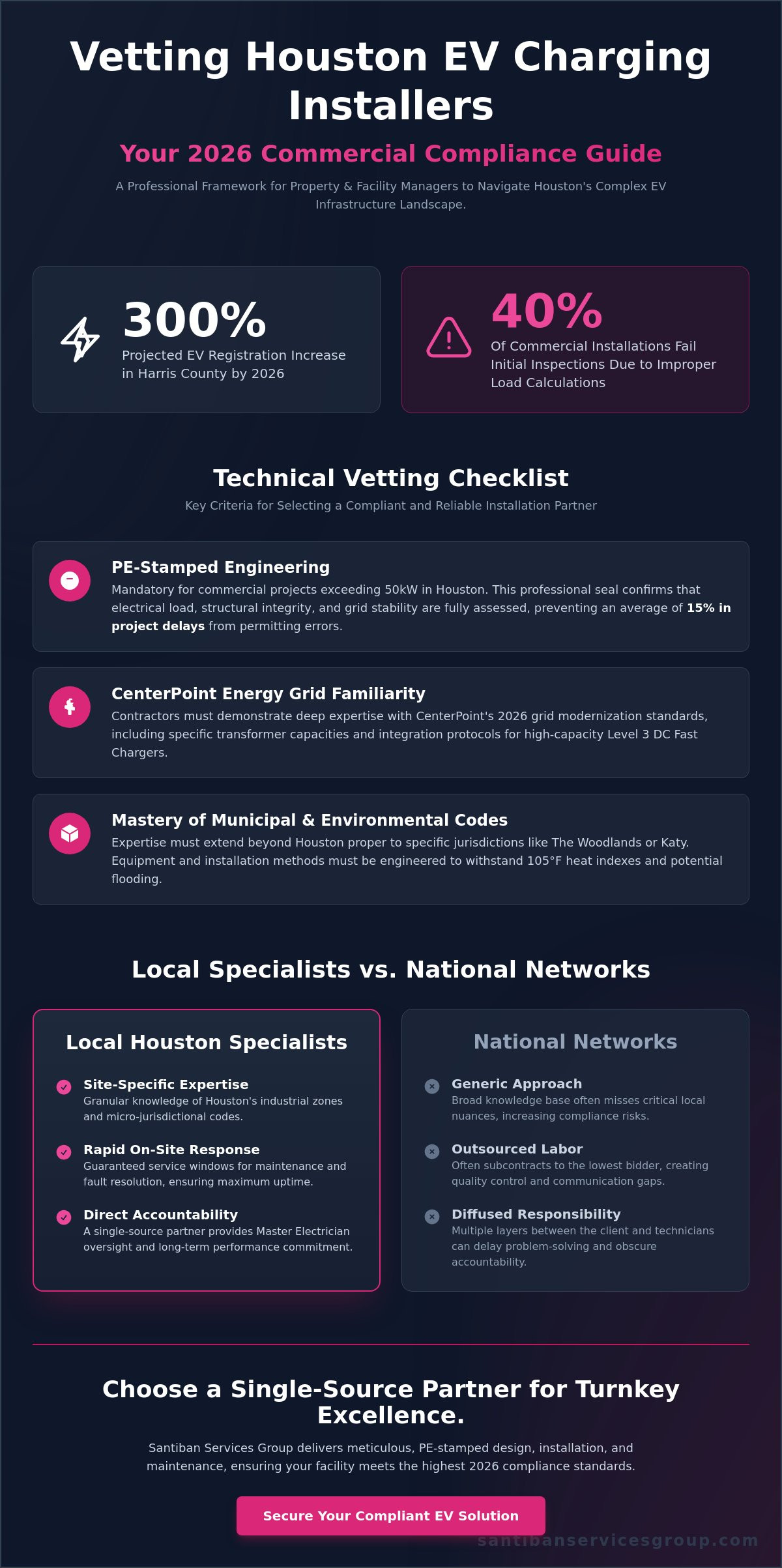
By 2026, the Texas Department of Transportation projects a 300% increase in electric vehicle registrations across Harris County, yet nearly 40% of commercial installations fail initial code inspections due to improper load calculations. You likely recognize that expanding your facility’s infrastructure is no longer optional, but the technical complexity of Texas-specific permitting and grid stability creates a significant barrier to entry. Selecting the right partner from the available pool of ev charging installation companies requires more than a simple bid comparison; it demands a thorough evaluation of engineering rigor and regulatory expertise.
This guide provides a professional framework for vetting contractors, ensuring your project meets strict 2026 compliance standards and secures the PE-stamped engineering required for commercial durability. We’ll examine the critical technical requirements, local rebate structures, and the necessity of integrated maintenance plans to protect your long-term investment. By following this meticulous selection checklist, property managers can achieve a turnkey, compliant solution that balances immediate operational needs with future scalability. Our focus remains on delivering excellence through disciplined engineering and a commitment to your facility’s long-term operational stability.
Key Takeaways
- Identify the essential criteria for vetting ev charging installation companies, focusing on firms that demonstrate deep familiarity with Houston’s CenterPoint Energy grid requirements.
- Ensure technical excellence by verifying a contractor’s ability to provide PE-stamped engineering and Master Electrician oversight for complex commercial infrastructure.
- Analyze the operational advantages of local Houston specialists over national networks, specifically regarding responsiveness and site-specific knowledge of industrial zones.
- Minimize project overhead by conducting precise site load studies and strategic planning to optimize electrical capacity and reduce trenching costs.
- Leverage the benefits of a single-source partner to secure meticulous, turnkey design and installation services that adhere to the highest 2026 compliance standards.
Evaluating EV Charging Installation Companies in Houston (2026)
Selecting from the pool of ev charging installation companies in Houston requires a transition from viewing electrical work as a commodity to seeing it as a strategic infrastructure investment. These specialized firms operate as turnkey partners; they handle everything from initial load calculations and municipal permitting to the final commissioning of high-voltage systems. By 2026, the technical gap between residential installers and industrial-grade contractors has widened significantly. A reliable partner must demonstrate a history in heavy industrial electrical construction to ensure the longevity of your facility’s assets.
Before initiating a project, stakeholders should understand EV charging station basics to better evaluate the technical proposals provided by potential contractors. The complexity of modern systems demands meticulous attention to detail, especially when integrating with existing building management software. Santiban Services Group positions itself as a single-source solution, providing the corporate stability necessary for large-scale deployments that smaller, less organized entities cannot match.
The Houston EV Infrastructure Landscape
Commercial EV adoption in the Greater Houston area surged by 32% between 2024 and 2025, driven by corporate fleet transitions and new sustainability mandates. This growth places immense pressure on local power distribution. Professional ev charging installation companies must now navigate CenterPoint Energy’s 2026 grid modernization standards, which dictate specific transformer capacities for new commercial builds. Houston’s environmental variables also play a critical role. Equipment must withstand 105-degree heat indexes and potential localized flooding. We’ve seen a decisive shift toward high-capacity Level 3 DC Fast Charging for local fleets, which requires robust thermal management and specialized concrete pad engineering to prevent equipment failure during extreme weather events.
Why Local Accountability Matters
National referral networks often outsource labor to the lowest bidder, creating significant risks for Houston property managers. These networks lack the granular knowledge of municipal codes in specific jurisdictions like The Woodlands or Katy. Local specialists provide integrated maintenance plans that ensure your chargers remain operational 24/7. Relying on a Houston-based partner guarantees that a technician can reach your site within a defined service window if a system fault occurs. Our dedicated teams prioritize long-term performance over quick installations, ensuring that every project meets the rigorous safety standards required for high-voltage industrial environments.
Technical Vetting Checklist: Engineering and Compliance Standards
Selecting between various ev charging installation companies involves scrutinizing their ability to manage complex load distributions and municipal mandates. In Houston, the 2026 regulatory landscape demands more than basic electrical knowledge; it requires a firm that understands the intersection of high-voltage infrastructure and local code. A meticulous vetting process ensures your facility avoids the 15% project delay average typically caused by permitting errors or equipment mismatches.
The Necessity of PE-Stamped Engineering
Houston permitting offices now mandate PE stamped engineering for solar systems and EV designs for all commercial projects exceeding 50kW. This professional seal confirms that the electrical load won’t compromise the existing building structure or grid stability. Engineering design prevents costly site corrections during the inspection phase by identifying potential failures before they occur. It ensures that 100% of the installation meets structural and electrical safety benchmarks. Without these stamps, projects often stall at the municipal review level, leading to significant budget overruns.
Safety and Industrial Certifications
Reliability stems from adherence to established industrial protocols. Vetting a firm’s OSHA records is a non-negotiable step for property managers; a superior partner maintains a TRIR (Total Recordable Incident Rate) below the 2.4 industry average. They must employ Master Electricians who stay current with the latest federal standards for EV charging to ensure long-term compliance. These standards dictate everything from connector interoperability to data privacy for charging networks.
Advanced ev charging installation companies also hold manufacturer-specific credentials, such as Tesla-certified status. This specialization is vital when executing a commercial ev charger installation at scale. Modern sites often require switchgear upgrades to handle the 480V requirements of Level 3 fast chargers. A disciplined firm assesses the existing electrical capacity to prevent transformer overloads. This technical foresight is what separates a standard contractor from a strategic infrastructure partner.
For property managers seeking a seamless transition to electrified fleets, Santiban Services Group provides tailored solutions that integrate engineering precision with industrial scale. Their teams focus on the excellence in every detail, ensuring your facility remains compliant with National Electrical Code (NEC) 2026 updates while maintaining operational continuity.
Local Specialists vs. National Networks: A Comparative Analysis
Choosing between local specialists and national networks defines the long-term reliability of your infrastructure. National ev charging installation companies often operate through decentralized subcontractors. This distance frequently leads to communication gaps during the critical 48-hour window following a technical fault. In contrast, local Houston teams provide immediate, on-site diagnostics. They maintain a physical presence that national call centers cannot replicate. This proximity ensures that your facility remains operational and your users remain satisfied.
Houston’s industrial landscape, from the Port of Houston to the Energy Corridor, possesses unique grid constraints. A local firm understands the specific transformer capacities of CenterPoint Energy’s network. They manage the complex interconnection applications that national firms often overlook; this ensures your project meets the 2026 municipal codes without delay. We prioritize a single-source solution where engineering, construction, and maintenance are handled by one entity. This integrated model eliminates the logistical friction common when multiple vendors manage different project phases.
Accountability and Long-Term Support
National networks frequently struggle with local warranty claims. When a charging station fails, a decentralized provider might take weeks to dispatch a technician from outside Harris County. A dedicated Houston team ensures emergency electrical repairs happen within 24 hours. Local firms build long-term relationships with property managers by delivering consistent, superior performance. We believe that reliability is the cornerstone of corporate stability. Our teams are trained to provide meticulous service that protects your capital investment for the next decade.
Navigating Texas-Specific Incentives
Maximizing the ROI of your ev charging business requires deep knowledge of regional grants. Local experts track the Texas Commission on Environmental Quality (TCEQ) programs and specific utility rebates available in 2026. A local expert utilizes a comprehensive EV charging installation checklist to streamline the procurement process; this ensures all federal and state standards are met before construction begins. Timely filing for local environmental tax credits can offset a significant portion of your initial expenditure. Professional ev charging installation companies with deep roots in Texas provide the strategic oversight necessary to capture these financial benefits. We focus on tailored solutions that align your environmental goals with your fiscal requirements.
Pre-Installation Checklist for Houston Commercial Properties
Successful deployment requires a rigorous technical evaluation before the first shovel hits the ground. Professional ev charging installation companies prioritize a comprehensive site load study to verify that current switchgear can handle the 40-amp to 80-amp draws typical of Level 2 commercial stations. Property managers must identify port locations that minimize trenching requirements. Reducing the distance between the electrical room and the parking stalls can lower civil engineering costs by 18% to 26% based on 2024 industry averages. Meticulous planning at this stage prevents expensive mid-project corrections.
- Conduct a site load study to confirm existing electrical capacity.
- Select locations that minimize the need for extensive concrete cutting and trenching.
- Procure PE-stamped designs to meet City of Houston regulatory standards.
- Contact CenterPoint Energy to evaluate transformer readiness for high-demand loads.
- Design a phased scalability plan that accounts for a 35% increase in EV adoption by 2028.
Site Assessment and Load Management
Evaluating existing switchgear and panel capacity is the foundation of a reliable system. Many older Houston commercial buildings operate on electrical margins that won’t support multiple high-draw stations simultaneously. Load management is the strategic distribution of power to prevent system overload. By implementing smart load balancing, facilities can install more charging ports without the $50,000 to $150,000 expense of a full transformer upgrade. This integrated approach ensures the building’s core operations remain stable while providing essential services to tenants and fleet vehicles.
The Permitting and Approval Workflow
Houston’s regulatory environment demands precision and adherence to the 2023 National Electrical Code. All commercial projects must secure PE-stamped designs from a licensed Professional Engineer to satisfy the City of Houston Building Code Enforcement requirements. Learning how to install ev charger at business sites involves coordinating with utility providers early. CenterPoint Energy often requires a 10 to 14-week lead time for service upgrades, so early application is critical to maintaining your schedule.
Experienced ev charging installation companies manage the inspection timeline to avoid operational bottlenecks. This process typically includes a rough-in inspection of conduits and a final sign-off on the energized equipment. Scheduling inspections at least 72 hours in advance ensures the project stays on track. Our dedicated teams handle these bureaucratic hurdles, providing a seamless transition from design to active charging.
Secure your facility’s future with a technical consultation from our experts. Request a comprehensive site assessment from Santiban Services Group today.
Santiban Services Group: Your Houston Single-Source EV Partner
Santiban Services Group leverages more than 24 years of industrial electrical experience to deliver high-capacity infrastructure projects across the Texas Gulf Coast. We stand out among ev charging installation companies by offering a single-source solution that encompasses engineering, construction, and long-term maintenance. Our firm manages every technical detail, allowing facility managers to focus on their core operations while we handle the complexities of high-voltage systems and grid integration.
Our Houston-based team consists of licensed professionals who understand the specific demands of the local power environment. We utilize in-house PE-stamped engineering to guarantee that every design is technically sound and fully compliant with 2026 municipal codes. This rigorous internal oversight eliminates the delays often caused by third-party engineering firms. We function as a silent engine for your business, providing the disciplined, hardworking presence needed to keep your facility running smoothly in the background.
Our Industrial-Grade Approach
Our background in complex industrial electrical construction informs our approach to every EV project. We apply the same high standards to a commercial charging bank that we apply to large-scale industrial facility builds. The Santiban promise of “excellence in every detail” means we prioritize safety and durability over simple speed. We specialize in creating resilient systems by integrating tesla electric storage and grid-interactive solutions. This strategy provides 24/7 reliability for your fleet or employee parking area, protecting your investment against energy price volatility and grid instability. Our meticulous execution ensures your infrastructure handles peak loads without compromise.
- Professional PE-stamped engineering for technical excellence and code compliance.
- Direct employment of dedicated Houston-based electrical crews for superior quality control.
- Integration of Tesla-certified energy storage systems for maximum site resilience.
- Comprehensive site assessments that include detailed load calculations and future-proofing strategies.
Ready to Power Your Houston Facility?
The move from initial engineering design to physical installation is a seamless process with our team. We deliver tailored solutions that align with your specific corporate sustainability goals and budget requirements. Our project managers provide clear timelines and consistent communication, ensuring your infrastructure is ready for the increasing demands of the EV market. We don’t just provide labor; we provide a strategic partnership that scales with your business needs. As one of the leading ev charging installation companies in the region, we’re ready to solve your complex logistical challenges. Contact Santiban Services Group today to schedule a professional infrastructure consultation and secure your facility’s energy future.
Future-Proofing Your Houston Commercial EV Strategy
Navigating the evolving landscape of ev charging installation companies demands a commitment to technical precision and rigorous compliance. By 2026, Houston commercial properties must move beyond basic setups toward integrated systems that feature PE-stamped engineering and full adherence to local municipal codes. Success requires a partner that understands the intersection of industrial-grade electrical capacity and modern user demand. Choosing a local specialist with established roots ensures your infrastructure remains resilient as regional energy requirements shift.
Santiban Services Group stands as your dedicated strategic partner, bringing over 24 years of industrial electrical experience to every project. We eliminate the friction of multi-vendor coordination by offering in-house PE-stamped engineering design and deploying Tesla-certified installation experts for every site. Our team’s methodical approach guarantees that every detail of your facility management is under expert control. Request a Professional EV Infrastructure Consultation from Santiban Services Group to secure a high-performance solution tailored to your specific operational goals. We’re ready to build the reliable foundation your business deserves.
Frequently Asked Questions
How do I choose between different EV charging installation companies in Houston?
Select ev charging installation companies based on their capacity to deliver a single-source solution that encompasses engineering, procurement, and construction. You’ll need to verify the firm holds a Texas Electrical Contractor License and has documented at least 20 commercial deployments within the Houston city limits. A professional partner assigns a dedicated project manager to ensure the seamless integration of hardware and sophisticated power management software.
Why is PE-stamped engineering required for commercial EV charging in Texas?
Texas law mandates that a Professional Engineer (PE) stamps electrical plans for commercial projects that involve public safety or high-voltage infrastructure. This certification confirms your system adheres to the National Electrical Code 2023 and specific Houston amendments. Without this stamp, the Houston Public Works department won’t issue the necessary construction permits. It’s a critical step that protects your property from electrical failures and mitigates long-term corporate liability.
What is the average timeline for a commercial EV charger installation in Houston?
A typical commercial installation requires 12 to 18 weeks from the initial site assessment to the final utility activation. This duration includes 4 weeks for PE-stamped engineering, 8 weeks for equipment procurement, and 3 weeks for physical construction. Timelines often depend on current lead times for Level 2 or DC Fast Charging hardware. Our team maintains a disciplined schedule to navigate these phases without unnecessary delays.
Can a solar installation company also handle my EV charging infrastructure?
While solar firms handle energy generation, specialized ev charging installation companies focus on the complex distribution and load management required for vehicle fleets. Solar projects prioritize DC-to-AC conversion, but EV infrastructure demands sophisticated grid integration and high-amperage circuit design. Santiban Services Group provides a tailored solution that manages these industrial-scale requirements. We ensure your charging stations operate at maximum efficiency without compromising your grid stability.
What are the specific CenterPoint Energy requirements for EV charging stations?
CenterPoint Energy requires a formal Service Set application for any project that adds a new meter or exceeds 50kVA of additional load. You must provide a site plan and a one-line electrical diagram that follows the 2024 Service Standards manual. They often mandate a dedicated transformer for large-scale charging hubs. Our team coordinates directly with CenterPoint engineers to manage transformer placement and secondary service lines within established utility easements.
Is a panel upgrade always necessary for commercial EV charging?
A panel upgrade is required in approximately 70 percent of commercial retrofits to accommodate the continuous load of EV chargers. Most existing switchgear lacks the 40 to 100 amps of spare capacity needed for a multi-port station. We conduct a 48-hour load study to measure your building’s peak demand. If the results show your system is operating at 80 percent capacity, an upgrade ensures long-term safety and reliability.
How does Santiban Services Group handle permitting for Houston projects?
Santiban Services Group manages the entire permitting lifecycle through the City of Houston iPermits system. Our dedicated team submits all electrical and structural drawings for review by municipal examiners. We monitor every application daily to address feedback within 24 hours. This meticulous approach eliminates the typical 14-day delays caused by administrative errors. We ensure your project remains compliant with all local building codes and safety regulations.
What maintenance is required for commercial-grade EV charging stations?
Commercial charging stations require a professional maintenance inspection every 6 months to maintain peak performance. Technicians examine cable insulation, connector pins, and internal cooling systems for signs of wear. We also execute remote firmware updates every 30 days to enhance software security and user interface speed. Consistent testing of the Ground Fault Circuit Interrupter systems is essential to meet OSHA safety standards and Houston fire department codes.