
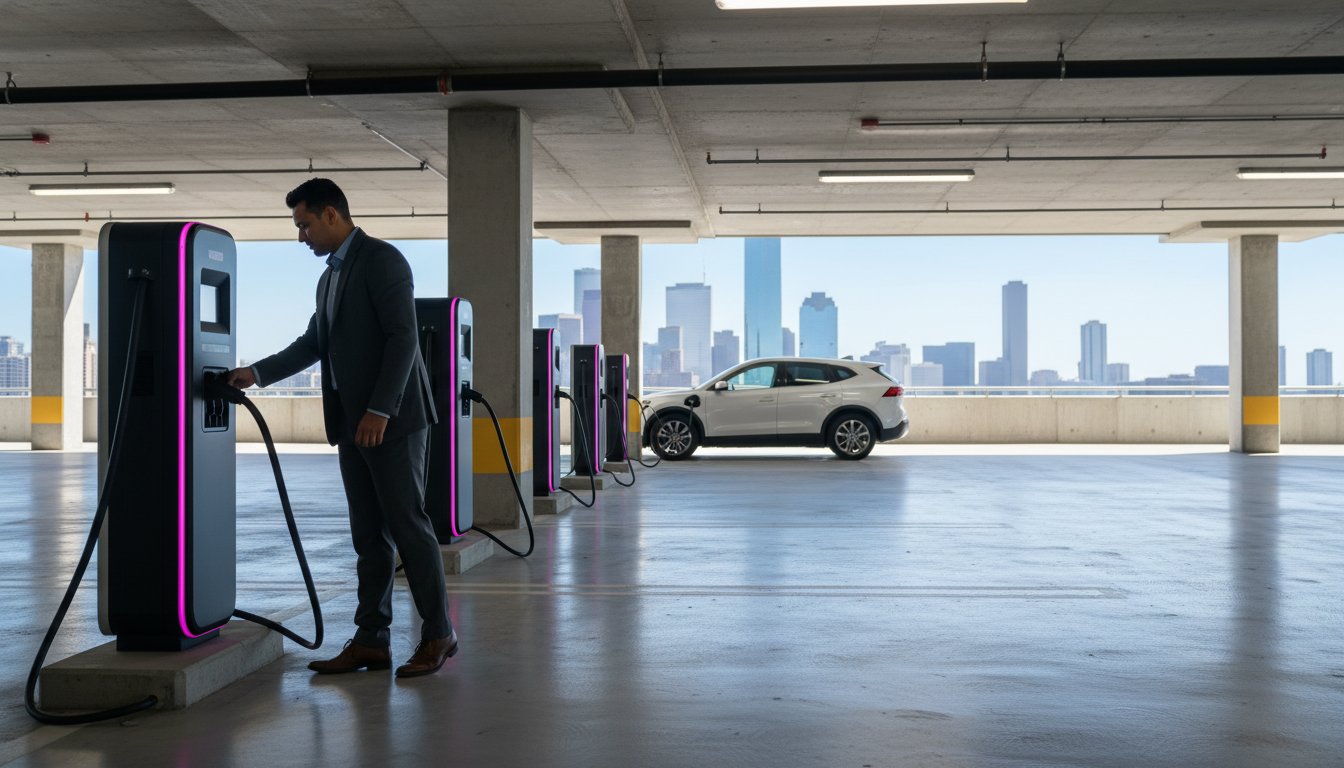
By 2026, the City of Houston projects that nearly 20% of vehicles in Harris County will require plug-in access, yet many commercial properties remain anchored to outdated electrical frameworks. You recognize that staying competitive requires more than just a functional parking lot; it demands a resilient system capable of withstanding both shifting energy loads and the volatile Gulf Coast climate. It’s a complex transition that requires a disciplined approach to facility management and engineering excellence.
This guide provides a comprehensive roadmap to deploying a scalable commercial electric car charger network that integrates PE-stamped engineering with meticulous planning for CenterPoint Energy grid constraints. We’ll examine the precise pathways to secure municipal permits, leverage Texas-specific incentives, and ensure your facility remains a high-performance asset. You’ll discover how to transform infrastructure challenges into long-term corporate stability through a single-source solution tailored for the unique Houston business landscape.
Key Takeaways
- Understand why high-capacity EVSE has transitioned from a luxury amenity into a fundamental operational requirement for Houston businesses in 2026.
- Evaluate the strategic ROI differences between Level 2 and DC Fast Charging to determine the optimal configuration for your specific property and dwell-time requirements.
- Learn how to navigate the City of Houston’s stringent permitting process by utilizing PE-stamped engineering to ensure structural integrity and electrical compliance.
- Maximize your capital investment by leveraging the Federal 30C tax credit and Texas-specific TCEQ grants for your commercial electric car charger deployment.
- Discover the benefits of a single-source, turnkey implementation strategy that manages every detail from professional design to final utility interconnection.
Understanding Commercial Electric Car Charger Infrastructure in Houston
A commercial electric car charger represents more than a simple power outlet. It is a sophisticated piece of Electric Vehicle Supply Equipment (EVSE) engineered for high-frequency usage in multi-user environments. By 2026, these systems have transitioned from optional amenities to essential infrastructure for Houston enterprises. Reliable charging solutions now dictate tenant retention rates and influence corporate procurement decisions across Harris County. The shift is driven by a fundamental change in driver expectations and municipal sustainability mandates.
Unlike residential units designed for single-vehicle overnight cycles, industrial-grade chargers feature ruggedized components. These systems manage higher electrical loads and provide the data transparency required for meticulous commercial accounting. The City of Houston reported a 42% increase in electric vehicle registrations between 2024 and early 2026. This rapid adoption has directly correlated with property value premiums. Facilities equipped with integrated charging stations often see a 5% to 8% increase in asset valuation compared to non-equipped competitors in the local market.
The Three Pillars of Commercial EVSE
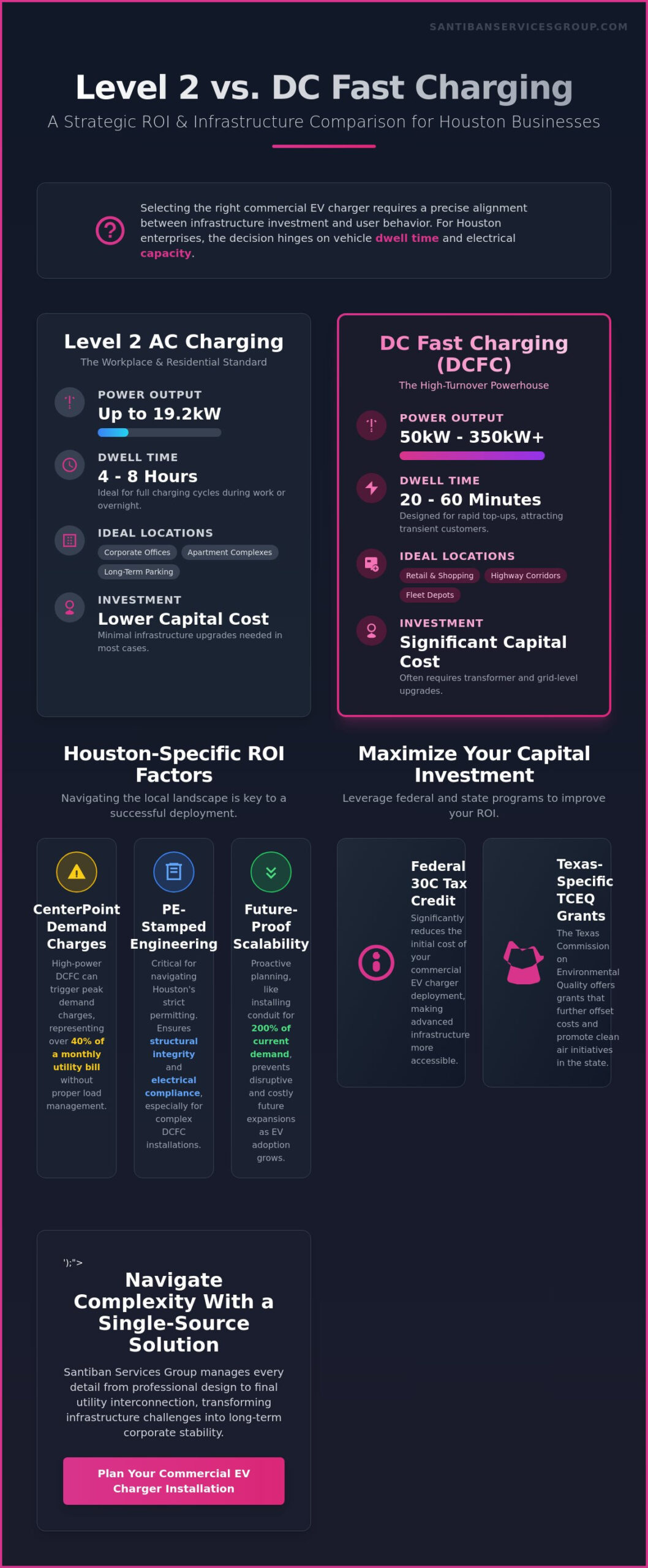
Successful deployment depends on three technical foundations. First, hardware durability is paramount. Houston’s average humidity levels frequently exceed 70%, necessitating equipment with NEMA 4X ratings to prevent internal corrosion and electrical failure. Second, software connectivity allows property managers to implement load balancing and automated payment gateways. Third, power delivery must be strategic. While Level 2 stations provide cost-effective convenience for employees, DC Fast Charging serves high-turnover retail environments where speed is the primary requirement.
Why Houston Businesses Prioritize Scalability
Strategic facility management involves planning for 2030 requirements today. Santiban Services Group emphasizes that initial conduit runs should accommodate 200% of current demand to ensure future-proof operations. This proactive approach prevents the need for disruptive trenching or pavement demolition during the next phase of expansion. Professional commercial ev charger installation integrates these units directly into existing Building Management Systems (BMS). This integration ensures that electrical draws are monitored in real-time; it protects the facility’s main transformer from peak-load stress while providing comprehensive usage reports for sustainability audits and carbon footprint tracking.
The decision to install a commercial electric car charger is a long-term investment in a property’s operational viability. By selecting high-capacity, networked hardware, Houston business owners secure their position in a rapidly evolving transportation landscape. It’s about maintaining a competitive edge through superior infrastructure and reliable service delivery.
Comparing Level 2 vs. DC Fast Charging for Business ROI
Level 2 Chargers: The Workplace Standard
- Lower infrastructure requirements minimize the need for immediate transformer upgrades.
- Dual-port configurations often reduce the installation cost per port by 25% compared to two single-port units.
- They align perfectly with install ev charger at business protocols that prioritize long-term scalability.
DC Fast Charging: The Fleet and Retail Solution
The Critical Role of PE-Stamped Engineering and Permitting
Houston’s regulatory environment mandates a disciplined approach to electrical infrastructure. The City of Houston Public Works department requires Professional Engineer (PE) stamps for any commercial electrical modification involving high-capacity equipment. This requirement ensures that the addition of a commercial electric car charger doesn’t compromise the facility’s existing electrical distribution system. Meticulous engineering prevents costly rework, which historical data suggests can account for 15% of project overruns when uncertified plans fail final inspections. When evaluating ev charging installation companies for your project, verifying their in-house PE engineering capabilities is a critical first step in avoiding these costly compliance failures.
Engineers focus on structural integrity for every component. Pedestal mounts must withstand local wind load requirements, which often exceed 150 mph in coastal zones. Overhead cable management systems require precise tension calculations to prevent mechanical failure. Beyond structural safety, engineered designs integrate the 2023 Texas Accessibility Standards (TAS). Compliance isn’t optional; it requires specific reach ranges, clear floor spaces, and accessible routes to ensure every commercial electric car charger meets ADA mandates.
Navigating Houston’s Permitting Maze
Securing approval from CenterPoint Energy is a multi-stage process that typically spans 30 to 60 days. It begins with a formal interconnection application to verify that the local grid can support the increased demand. For facilities aiming for energy independence, Santiban provides PE stamped engineering for solar systems to ensure seamless integration between renewables and EVSE infrastructure. Our teams strictly adhere to NEC 2023 and 2026 updates, focusing on new requirements for emergency disconnects and specialized circuit labeling that Houston inspectors prioritize during site walks.
Load Management and Grid Resilience
Santiban engineers implement dynamic load shedding to protect your facility’s primary transformer from EV-induced overloads. This technology allows chargers to throttle power delivery during peak building demand, maintaining operational stability without requiring expensive utility upgrades. We design every system with a focus on future-readiness. By preparing the underlying infrastructure for Vehicle-to-Grid (V2G) capabilities today, we ensure your property remains relevant as energy markets evolve through 2026 and beyond. This proactive strategy transforms a standard parking lot into a resilient energy asset.
- Code Compliance: Precise alignment with NEC 2023/2026 standards.
- Structural Assurance: Wind-rated mounting and cable management.
- Accessibility: Full TAS and ADA site integration.
- Risk Mitigation: PE-stamped designs that pass inspections the first time.
Strategic ROI: Incentives, Tax Credits, and Resilience
Installing a commercial electric car charger represents a high-yield capital investment rather than a mere utility expense. The primary financial driver for 2026 is the federal 30C tax credit, which provides a 30% credit for hardware and installation costs. For commercial properties in eligible census tracts, this credit caps at $100,000 per location. This incentive remains a cornerstone of the fiscal strategy for Houston developers and facility managers aiming to lower their initial capital expenditure.
Texas businesses can leverage regional funding through the Texas Commission on Environmental Quality (TCEQ). The Texas Emissions Reduction Plan (TERP) frequently releases grant cycles that offset up to 80% of project costs for charging infrastructure. These programs prioritize corridors with high traffic volume; this makes Houston a prime candidate for maximum funding. Strategic monetization further accelerates the return on investment. Facility owners can implement tiered subscription models for long-term tenants or dynamic pay-per-charge pricing for the general public. This flexibility converts standard parking spaces into active revenue streams that pay for themselves over a calculated period.
Beyond direct revenue, charging infrastructure serves as a critical recruitment tool. By 2026, electric vehicle adoption among Houston professionals is expected to exceed 20% of the local workforce. Providing reliable charging on-site gives companies a competitive edge in securing top-tier talent. These high-value employees prioritize sustainable workplaces and the convenience of charging while they work. It’s a clear signal that your business is prepared for the future of transportation.
Combining EV Infrastructure with Energy Storage
Integrating your charging stations with tesla electric technology creates a resilient energy ecosystem. Utilizing the Powerwall 3 allows businesses to store energy during low-cost periods and discharge it during peak demand hours. This strategy effectively eliminates the expensive demand charges often levied by Houston utility providers during high-use periods. It also ensures your charging fleet remains operational during the power outages that frequently impact the Gulf Coast region, maintaining business continuity when competitors are dark.
Environmental and Social Governance (ESG) Benefits
Modern charging software provides meticulous data tracking for ESG reporting. Businesses can monitor real-time carbon offset metrics and total kilowatt-hours delivered to demonstrate environmental impact. This transparency is essential for maintaining LEED certification and attracting high-value corporate tenants with strict sustainability mandates. Positioning your business as a leader in Houston’s energy transition builds long-term brand equity and demonstrates a commitment to regional environmental goals. To begin your transition to a resilient energy model, partner with our infrastructure specialists for a comprehensive site evaluation.
Expert Implementation with Santiban Services Group
Santiban Services Group brings over 24 years of industrial electrical expertise to every commercial electric car charger project. This longevity isn’t just a number; it represents a deep understanding of Houston’s complex power grid and regulatory environment. We provide a comprehensive turnkey solution. Our process manages every phase from initial PE-stamped engineering designs to the final utility interconnection with providers like CenterPoint Energy.
As a Tesla-certified partner, we integrate commercial Powerwall systems with high-capacity charging stations. This ensures energy resilience and peak-shaving capabilities for your facility. We maintain meticulous safety standards specifically designed for high-voltage industrial environments. Our teams prioritize operational continuity, ensuring your existing electrical infrastructure remains stable during and after installation. We act as a silent engine, keeping your business running while we upgrade your capabilities.
The Santiban Difference: Engineering-First
Most installers outsource their technical drawings. Santiban utilizes internal engineering teams to handle the complex load calculations and structural requirements that others avoid. Our engineering-first philosophy ensures that every installation is a tailored solution built for long-term reliability. We focus on excellence in every detail, from conduit placement to load balancing. We serve as your single-source solution for electrical infrastructure and facility management.
- Internal engineering teams manage the technical hurdles that typically cause project delays.
- We recently resolved a 40% capacity deficit for a 150,000-square-foot Houston industrial site by redesigning their primary distribution architecture.
- Dedicated project managers oversee every milestone to ensure on-time delivery and professional accountability.
Next Steps for Your Houston Business
Preparing for the 2026-2030 transition requires a strategic approach. We recommend starting with a professional site assessment and a detailed load analysis. This data allows our team to develop a phased rollout plan that matches your projected growth. You can scale your commercial electric car charger infrastructure as your fleet or employee needs expand without unnecessary capital expenditure.
Our disciplined approach ensures that your facility remains at the forefront of the energy transition. We value long-term relationships and consistent performance above all else. Establishing a reliable charging network is a strategic investment in your property’s value and operational readiness. Contact Santiban Services Group for a Professional Consultation to secure your facility’s future with a partner you can trust.
Future-Proofing Your Houston Facility for 2026 and Beyond
Houston’s commercial landscape is shifting toward electrification at a rapid pace. Selecting the right commercial electric car charger configuration requires more than just hardware; it demands a strategic alignment of Level 2 efficiency with DC Fast Charging speed to maximize your property’s ROI. Successful implementation hinges on technical precision, specifically the integration of in-house PE-stamped engineering and rigorous adherence to municipal permitting standards. These foundational elements protect your capital investment and ensure long-term operational resilience as demand for EV infrastructure scales across the Gulf Coast.
Santiban Services Group brings over 24 years of Houston industrial experience to every complex installation. As a Tesla Certified Installer, we ensure your infrastructure meets the highest global standards for reliability and performance. Our dedicated teams manage every phase from initial design to final commissioning, providing a seamless transition to sustainable energy solutions. We’ve built our reputation on meticulous execution and a commitment to being the single-source partner for sophisticated facility needs. Secure Your Houston Business’s Energy Future with Santiban. Your facility’s readiness for the next decade of transportation begins with a single, expert decision today.
Frequently Asked Questions
What is the average cost to install a commercial electric car charger in Houston?
Total investment for a commercial electric car charger installation varies based on infrastructure requirements and site conditions. According to 2024 industry benchmarks from the Department of Energy, Level 2 ports typically cost between $2,500 and $10,000 per unit. DC Fast Charging stations represent a higher tier, often exceeding $50,000 per station due to specialized equipment needs. Santiban provides tailored assessments to ensure your facility’s electrical capacity aligns with these hardware investments.
Do I need a new transformer for DC Fast Charging at my business?
Most Houston businesses require a dedicated transformer or a significant service upgrade to support DC Fast Charging. These units demand 50kW to 350kW of power, which often exceeds the existing capacity of standard 480V commercial electrical panels. Our engineering teams perform meticulous load calculations to determine if your current infrastructure can sustain this high-voltage demand. We manage the entire integration process with CenterPoint Energy to ensure a seamless power transition.
How many EV charging ports should I install for my employee parking lot?
We recommend allocating 10% to 15% of your total parking capacity for electric vehicle charging to meet 2026 workplace demands. This ratio aligns with current corporate sustainability trends and ensures your facility remains competitive as EV adoption increases. Starting with a scalable foundation allows for future expansion without redundant trenching costs. Santiban designs these systems with modularity in mind, allowing your infrastructure to grow alongside your workforce’s evolving needs.
Is there a tax credit for commercial EV charger installation in 2026?
The federal Alternative Fuel Vehicle Refueling Property Credit, extended under the Inflation Reduction Act, offers a tax credit of up to 30% for qualified installations. This incentive is capped at $100,000 per location for businesses located in eligible census tracts. You must meet specific prevailing wage and apprenticeship requirements to claim the full percentage. Our project managers provide the comprehensive documentation necessary for your financial department to pursue these strategic tax advantages.
Can I restrict my commercial EV chargers to employees only?
You can easily restrict access to your commercial electric car charger stations through integrated software management systems. These platforms utilize RFID cards or mobile authentication to ensure only authorized personnel utilize the equipment. This level of control prevents unauthorized usage and allows for detailed reporting on energy consumption per employee. We implement these tailored access solutions to maintain the security and exclusivity of your corporate parking assets.
What happens to EV chargers during a Houston hurricane or flood?
Commercial chargers are engineered with NEMA 3R or NEMA 4 ratings to withstand heavy rain and wind, but they’re not submersible. In Houston, we prioritize installing equipment at least 12 inches above the 100-year flood elevation to mitigate water damage. Our technical teams focus on meticulous site placement and robust anchoring to ensure your infrastructure remains resilient during extreme Gulf Coast weather events. Safety disconnects are standard to prevent electrical hazards during flooding.
How long does the permitting process take for commercial EVSE in Houston?
The permitting process through the City of Houston Public Works department typically spans 4 to 8 weeks. This timeline includes the initial plan review, electrical permits, and site inspections required for commercial compliance. We handle all administrative logistics and coordination with local authorities to expedite these approvals. Our established presence in the Houston market ensures that your project moves through the regulatory pipeline with professional precision and minimal delays.
Does Santiban provide maintenance for commercial charging stations?
Santiban Services Group provides comprehensive maintenance programs designed to ensure the continuous uptime of your charging infrastructure. Our dedicated teams perform routine inspections, firmware updates, and physical hardware checks to identify potential issues before they cause service interruptions. This proactive approach reflects our commitment to excellence and reliability in facility management. We serve as your single-source partner for both the initial installation and the long-term operational health of your stations.