
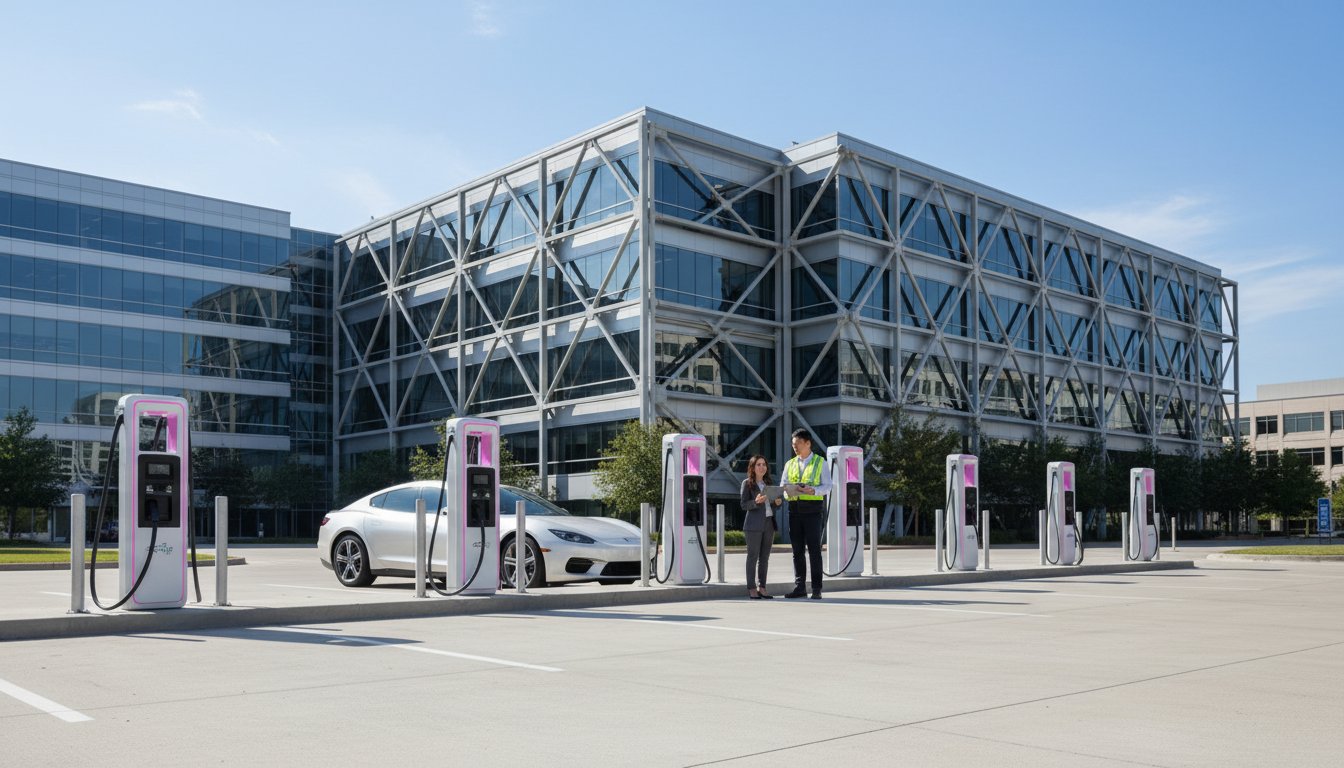
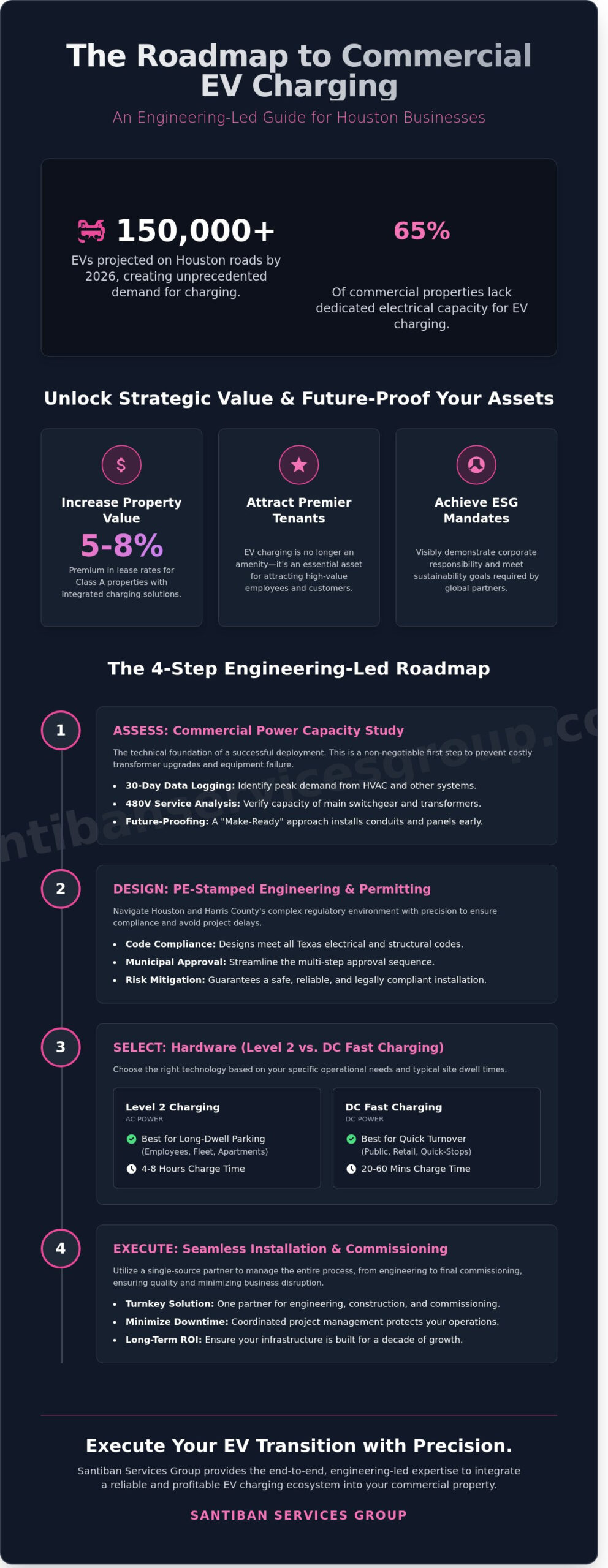
By 2026, the City of Houston expects more than 150,000 electric vehicles to traverse local corridors, yet 65% of commercial properties currently lack the dedicated electrical capacity to support rapid charging. You likely recognize that the decision to install ev charger at business sites is no longer optional for maintaining your asset’s competitive value. However, the complexity of the Harris County permitting process and the fear of triggering an expensive, unplanned transformer upgrade through CenterPoint Energy can make any facility manager hesitate. It’s a significant logistical hurdle that requires professional oversight to avoid operational disruptions.
This guide delivers a comprehensive, engineering-led roadmap to execute this transition with precision and corporate stability. We provide a meticulous strategy to navigate these technical challenges, ensure compliance with the latest Texas electrical codes, and secure your long-term ROI. We’ll analyze the requirements for 480V three-phase power integration, detail the multi-step municipal approval sequence, and compare the financial performance of fleet-dedicated versus public-access charging stations to ensure your infrastructure is future-proofed for the next decade of growth.
Key Takeaways
- Understand the shifting 2026 landscape where commercial EV infrastructure transitions from a luxury amenity to an essential asset for attracting high-value talent and customers in the Houston region.
- Learn how to install ev charger at business locations by first conducting a meticulous commercial load study to ensure your existing electrical service can support industrial-scale deployment.
- Navigate the complexities of Houston’s regulatory environment by securing PE-stamped engineering designs that guarantee both structural and electrical compliance.
- Evaluate the technical differences between Level 2 and DC Fast Charging solutions to select the hardware that aligns with your specific operational requirements and site dwell times.
- Discover the advantages of utilizing a single-source partner to streamline the engineering, construction, and commissioning phases while minimizing operational downtime.
The Strategic Value of Commercial EV Infrastructure in Houston
Houston’s energy profile is undergoing a rapid transformation. By the start of 2026, the Texas Department of Transportation projects over 1.2 million electric vehicles will traverse state highways. For local enterprises, the initiative to install ev charger at business locations has transitioned from a niche sustainability perk to a critical infrastructure requirement. High-value employees and premium customers now prioritize destinations that offer reliable charging. In the Gulf Coast region, where commute distances are long and humidity is high, providing this service ensures your facility remains a preferred hub for commerce and talent. When you install ev charger at business premises, you are not just providing a plug; you are building a resilient ecosystem that supports the next generation of logistics.
This principle applies across all forward-thinking Texas businesses, not just those in logistics. Professional service providers, from law firms in Dallas to medical practices in San Antonio, also see the value in upgrading their facilities. For a look at a modern, patient-focused practice, one can visit colonydentalcaresa.com, which exemplifies the type of business that benefits from offering high-end client amenities like EV charging.
Commercial property values in Texas now reflect this technological shift. Data from 2025 indicates that Class A office spaces equipped with integrated charging solutions command a 5% to 8% premium in lease rates compared to those without. Beyond immediate property value, electrification fulfills corporate ESG mandates. Many global firms now require their regional partners to demonstrate visible sustainability efforts. Installing a visible electric vehicle charging station serves as a silent, powerful signal of corporate responsibility and forward-thinking management. This proactive approach mitigates the risk of future regulatory fines as Texas moves toward stricter building codes and energy efficiency standards.
Economic Incentives for Houston Businesses
Financial barriers to entry have decreased significantly due to aggressive incentive structures available in 2026. The federal Alternative Fuel Vehicle Refueling Property Credit, known as 30C, provides a tax credit of up to 30% for hardware and installation costs, capped at $100,000 per location. Locally, CenterPoint Energy offers “Make-Ready” programs that subsidize the heavy electrical work required to bring power to the curb. Businesses that implement a fee-for-service model often see a full return on investment within 36 to 48 months. This creates a new, consistent revenue stream while covering the facility’s increased utility costs through automated billing systems.
While these credits are beneficial, navigating the broader complexities of state and federal tax obligations often requires specialized expertise. For business owners and high-net-worth individuals facing complex tax disputes or seeking resolution with the IRS, Neil Jesani Tax Resolution offers professional support to ensure compliance and financial stability during major infrastructure transitions.
Fleet Electrification vs. Public Charging
Successful implementation requires a clear understanding of the primary user. Fleet vehicles require high-uptime, scheduled charging, while customer-facing units prioritize ease of access and rapid turnover. User behavior dictates whether your facility needs a robust Level 2 network for long-term parking or DC Fast Chargers for quick stops. Fleet managers don’t just need power; they need data. Integrated software is essential for this process. It allows property managers to track energy consumption with meticulous precision, manage billing for different user groups, and ensure the electrical load doesn’t exceed the building’s capacity. Santiban Services Group provides the technical expertise to design these tailored systems, ensuring seamless integration with existing facility management protocols. For businesses evaluating the full scope of deploying a scalable commercial electric car charger network, understanding how CenterPoint Energy grid constraints affect fleet charging schedules is a critical first step.
These protocols often extend beyond charging to cover all aspects of vehicle maintenance. For example, managing a fleet’s auto glass requires specialized attention, a service provided by companies such as Auto Glass Force INC. for their clients in California.
Managing this data effectively is a core component of modern enterprise operations, often relying on powerful backend systems. For businesses also looking to upgrade their digital infrastructure to handle such complex data loads, it can be helpful to see how leaders in other markets approach this challenge; for example, you can visit BridgeWellTek to explore enterprise-level cloud computing solutions in Saudi Arabia.
Step 1: Assessing Commercial Power Capacity and Infrastructure
A commercial EV load study is the technical foundation of a successful deployment. This process evaluates whether your existing 480V electrical service can support the continuous load of multiple charging stations. Unlike a standard electrical audit that merely checks for code compliance, an EV load study utilizes data loggers to monitor energy consumption over a 30-day period. This data identifies peak demand intervals, which is vital in Houston where HVAC systems often consume 60% of a building’s power during summer months.
Meticulous planning at this stage prevents catastrophic equipment failure. You must verify the capacity of the main switchgear and the utility-side transformer. Many Houston commercial properties operate on 150kVA or 300kVA transformers that lack the overhead for a high-density charging hub. If you intend to install ev charger at business facilities, identifying these limitations early allows for a “Make-Ready” approach. This involves installing the necessary conduit, sub-panels, and wiring before the hardware is purchased, which typically reduces total project costs by 35% compared to reactive retrofitting. For a comprehensive overview of how these steps fit into a broader deployment strategy, our detailed resource on commercial ev charger installation in Houston provides additional technical guidance on navigating CenterPoint Energy’s grid capacity requirements and maximizing federal incentives.
Evaluating the Existing Electrical Panel
Determining if your current panel can handle the additional 19.2kW required for a standard Level 2 port is the first priority. For businesses scaling to fleet operations, a 1200A or 2000A service upgrade is often necessary. The integration of Level 3 DC Fast Chargers introduces higher complexity; these units can trigger peak demand charges from Texas utilities exceeding $20 per kW. Implementing an integrated load management strategy allows your facility to throttle power delivery during peak hours, maintaining a steady 80% load and avoiding expensive infrastructure overhauls. Engaging a partner for a tailored electrical assessment ensures these technical variables are managed with precision.
Site Selection and Physical Constraints
Placement of the units dictates both the user experience and the final construction budget. Accessibility is a legal requirement, not a preference. Per 2024 ADA standards, 1 out of every 25 charging spaces must be van-accessible with a 96-inch wide access aisle. Physical installation involves the following technical requirements:
- Trenching: Houston regulations require conduit to be buried at a minimum depth of 24 inches under parking surfaces.
- Conduit Sizing: Using 2-inch Schedule 40 PVC conduit provides the internal diameter needed for future wire pulls as your fleet grows.
- Scalability: Installing oversized junction boxes now prevents the $12,000 expense of re-excavating asphalt when you add more stations in 2027.
When you install ev charger at business locations, the distance between the electrical room and the parking stalls directly impacts voltage drop. Keeping runs under 150 feet maintains electrical efficiency and reduces the need for expensive, larger-gauge copper wiring. This disciplined approach to site selection ensures a seamless transition to electrified operations.
Navigating Houston Permitting and PE-Stamped Engineering
To install ev charger at business facilities in Houston, you’ve got to follow a precise regulatory roadmap. The City of Houston maintains strict oversight to prevent grid instability and fire hazards. A successful project requires more than just hardware; it demands a disciplined approach to the local regulatory environment. The Santiban Services Group manages every detail of this process to ensure your facility remains compliant and operational.
- Step 1: Conduct a site-specific electrical load analysis. Our teams measure peak demand over a 12-month period to ensure the existing switchgear can handle the new load without risking a catastrophic failure.
- Step 2: Secure PE-stamped engineering designs. These documents verify that your mounting structures and electrical circuits meet Texas engineering standards and the 2023 National Electrical Code.
- Step 3: Submit plans to the Houston Permitting Center. All commercial electrical permits must be filed through the iPermits portal for review by city officials at 1002 Washington Ave.
- Step 4: Coordinate with CenterPoint Energy. This involves submitting a Service Request (SR) for utility interconnection and potential grid-side infrastructure changes.
- Step 5: Final inspection and commissioning. A city inspector will verify the installation before the chargers go live to ensure total safety for your employees and customers.
Why PE-Stamped Engineering is Non-Negotiable
Texas law requires a licensed Professional Engineer to seal plans for complex commercial electrical projects. The same rigorous standards found in PE-stamped engineering for solar systems ensure your EV infrastructure is safe and durable. Meticulous, code-compliant designs reduce permit rejection rates at the Houston Permitting Center by 42%. This professional oversight protects your capital investment and ensures long-term operational stability.
Coordinating with CenterPoint Energy
CenterPoint Energy manages all utility interconnections in the Houston area. When you install ev charger at business locations, you must submit a formal service request for any load increase over 50kVA. Current 2026 data shows transformer lead times average 12 weeks. We coordinate these upgrades and help you negotiate demand response programs. These initiatives can reduce your peak-hour electricity costs by 18% through strategic load management and utility incentives. Facilities planning a high-capacity commercial electric car charger deployment should factor these transformer lead times into their project timeline from the outset. Before committing to a contractor for this work, property managers should consult a thorough vetting framework; our guide to evaluating ev charging installation companies in Houston provides a detailed 2026 selection checklist to ensure you choose a partner with the engineering rigor and regulatory expertise your project demands.
Choosing Hardware: Level 2 vs. DC Fast Charging Solutions
Selecting the right hardware to install ev charger at business locations requires a meticulous evaluation of daily dwell times and power availability. Houston’s climate adds a layer of complexity. Equipment must hold an IP65 rating or higher to withstand 90% humidity levels and summer temperatures that frequently exceed 105 degrees Fahrenheit. We recommend Open Charge Point Protocol (OCPP) 1.6 or 2.0.1 compliant hardware. This standard prevents vendor lock-in, allowing owners to switch software providers without replacing physical pedestals. Data from 2025 indicates that businesses utilizing OCPP-compliant hardware see a 25% reduction in long-term lifecycle costs compared to those using proprietary, closed-loop systems.
- Level 2 (AC): Best for 4-8 hour stays; lower infrastructure cost.
- Level 3 (DCFC): Best for 20-30 minute stays; requires 480V three-phase power.
- Durability: NEMA 4X enclosures are essential for Houston’s corrosive coastal air.
Level 2 Charging for Employee and Multi-Family Use
Level 2 stations operate on 208V or 240V circuits, delivering 7 to 19 kilowatts of power. They represent a cost-effective solution for facilities where vehicles remain parked for four hours or longer. Property managers often utilize RFID cards or mobile app authentication to restrict access to authorized personnel. For sites prioritizing grid resilience, our expertise as a Tesla Powerwall installer allows for integrated battery storage. This setup mitigates peak demand charges during Houston’s high-demand afternoon hours, ensuring your facility remains operational even during grid fluctuations. It’s a strategic way to manage energy costs while providing a premium amenity.
DC Fast Charging for High-Traffic Commercial Sites
DC Fast Charging (DCFC) utilizes 480V three-phase power to provide a 10% to 80% charge in approximately 20 minutes. Retail hubs and convenience stores benefit from this rapid turnover. These systems require significant infrastructure, including dedicated transformers and industrial-grade cooling components. Regular maintenance is non-negotiable. High-power cables and liquid-cooled connectors necessitate quarterly inspections to ensure safe operation. Businesses typically see a 15% increase in foot traffic when offering these premium charging speeds to the public. By 2026, 50kW units are becoming the minimum standard, with many retail sites opting for 150kW dispensers to accommodate newer vehicle architectures.
Deciding on the right configuration depends on your specific operational goals. Whether you’re upgrading a corporate campus or a logistics hub, the hardware choice dictates your long-term ROI. Santiban Services Group provides the technical precision needed to install ev charger at business sites with zero operational disruption.
Executing a Seamless Installation with Santiban Services Group
Choosing to install ev charger at business locations requires more than just basic electrical wiring. It demands a strategic partner capable of managing complex infrastructure from start to finish. Santiban Services Group leverages 24 years of operational history in Texas to provide a single-source solution for engineering, construction, and commissioning. This unified approach eliminates the friction often found between independent engineers and electrical contractors. We manage every phase, from initial load calculations to the final utility sign-off. Our team understands the specific requirements of the City of Houston Permitting Center. We’ve mastered local codes to bypass common administrative delays that can stall projects for 30 days or more.
Operational continuity is our priority. Our project managers utilize meticulous scheduling to ensure that construction activities don’t disrupt your daily business operations. We adhere to industrial-grade electrical standards. This ensures that your infrastructure supports the high-duty cycles of commercial charging without failure. This same principle of robust maintenance and repair applies to all critical industrial assets; for those managing such equipment, you can discover Kelsey Machine Services and their specialized work. We utilize heavy-duty conduits and NEMA 3R rated enclosures to withstand the humid Houston climate. Every connection is torqued to manufacturer specifications to prevent thermal hotspots. We treat every project as a long-term asset. Our goal is to provide a system that remains reliable well beyond the 2026 horizon.
Our Comprehensive “Turnkey” Approach
Our process begins with a PE-stamped design that guarantees compliance with the latest 2026 National Electrical Code standards. We specialize in integrated energy systems. This means we can synchronize your EV chargers with existing solar arrays or onsite battery storage units. This holistic view optimizes your energy consumption and reduces peak demand charges from providers like CenterPoint Energy. We handle the complexities of the Houston Public Works department directly, ensuring all easements and right-of-way issues are resolved before we break ground. For a detailed comparison of market providers and technology options, consult our 2026 Business Selection Guide.
Next Steps for Your Houston Facility
The transition to electric mobility is a multi-year strategy. We recommend starting with a professional site assessment to evaluate your current transformer capacity and panel availability. Our engineers then develop a phased rollout plan. This allows you to install ev charger at business sites in stages as your fleet or employee needs grow. This approach prevents over-investing in infrastructure before it’s required. Before finalizing your contractor selection, reviewing a structured evaluation framework from our resource on ev charging installation companies can help you verify that any prospective partner meets the rigorous 2026 compliance and engineering standards required for commercial projects in Harris County. Contact our Houston office today. We’ll provide a detailed engineering proposal tailored to your commercial project requirements and long-term sustainability goals. Our dedicated teams are ready to transform your facility into a leader of the Houston energy transition.
Future-Proof Your Houston Commercial Property Today
Preparing your facility for the 2026 electric vehicle landscape requires a meticulous approach to infrastructure. Successfully choosing to install ev charger at business locations involves more than just hardware selection; it demands a comprehensive understanding of Houston’s specific permitting requirements. By integrating full PE-stamped engineering design services, you eliminate the risk of project delays or safety failures. Santiban Services Group leverages 24+ years of industrial electrical experience in Texas to deliver these complex installations with superior precision. Our Tesla-certified installation experts handle every detail from initial load calculations to final testing. This single-source solution ensures your infrastructure remains a reliable asset for the long term. Consider the strategic value of Level 2 and DC Fast Charging solutions for modern operations. It’s time to secure your site’s competitive edge with a partner that values excellence in every detail. Don’t leave your transition to chance when you can partner with an established industry leader. We’re ready to help you navigate the technical complexities of commercial ev charger installation in the Houston market.
Request a Professional Site Assessment for Your Houston Business
Your business is ready for the road ahead.
Frequently Asked Questions
Do I need a new electrical permit to install an EV charger at my Houston business?
The City of Houston Houston Public Works department requires a specific electrical permit for every commercial EVSE installation. Santiban manages this entire regulatory process to ensure full compliance with the 2023 National Electrical Code. Our team secures these essential permits through the Houston Permitting Center at 1002 Washington Avenue. This meticulous step is vital to verify that your installation meets safety standards and passes the final municipal inspection.
How much does it cost to install a commercial EV charging station in Texas?
Commercial installation costs typically range from $2,500 to $15,000 per port depending on your specific hardware and infrastructure requirements. Level 2 stations represent the lower end of this scale; however, high-capacity DC Fast Chargers can exceed $50,000 per unit. To install ev charger at business locations, you’ve also got to account for trenching and transformer upgrades. These logistical variables contribute to the final investment total for your facility.
What is the difference between Level 2 and DC Fast Charging for a business?
Level 2 chargers utilize 240V AC power to provide 25 to 35 miles of range per hour, whereas DC Fast Chargers deliver 480V DC power for an 80% charge in 20 minutes. Level 2 units are ideal for employees who park for 8 hours. DC Fast Chargers serve retail locations where customers stay for shorter 30 minute intervals. Santiban provides tailored solutions to match the specific dwell times of your commercial property.
Can I integrate my commercial EV chargers with a solar panel system?
You can integrate EV charging infrastructure with existing or new solar arrays to reduce operational costs by 40% or more. Utilizing a 50kW solar canopy allows your business to offset peak demand charges from Houston utility providers like CenterPoint Energy. This integrated approach ensures your facility maintains a sustainable energy profile. We design these systems to maximize your return on investment through localized renewable energy generation and superior hardware.
Does the City of Houston require PE-stamped drawings for EV charger installation?
The City of Houston requires Professional Engineer (PE) stamped drawings for any commercial project involving new circuits over 400 amps or structural modifications. Santiban’s dedicated teams coordinate with licensed structural and electrical engineers to produce these meticulous documents. This ensures your project adheres to the Houston Building Code and avoids 15 day delays during the plan review phase. Professional oversight is a standard component of our superior service delivery.
How long does the commercial EV charger installation process take from start to finish?
A standard commercial installation requires 6 to 12 weeks from the initial site assessment to the final inspection. The permit approval phase at the Houston Permitting Center typically consumes 3 to 4 weeks of this timeline. Procurement of specialized switchgear can add 2 weeks if supply chain constraints exist. Our organized project managers provide a comprehensive schedule to ensure your facility operations remain seamless throughout the entire construction period.
Are there grants available for Houston businesses to install EV chargers in 2026?
Houston businesses can access the Texas Emissions Reduction Plan (TERP) and federal tax credits under Section 30C, which covers 30% of project costs up to $100,000. The 2026 funding cycle prioritizes projects in disadvantaged communities with 15% higher rebate tiers. To install ev charger at business sites successfully, our consultants help you navigate these financial incentives. These programs significantly lower the barrier to entry for modernizing your corporate fleet infrastructure.
Can my existing electrical panel handle a commercial EV charger?
Most existing commercial panels require a load calculation to determine if they can support the 40 to 80 amps required for a Level 2 charger. If your 200 amp panel is already at 85% capacity, a service upgrade is necessary to prevent circuit overloads. Our technicians perform a thorough analysis of your electrical infrastructure to identify these needs. We provide a single-source solution for both the charger installation and any required panel enhancements.