
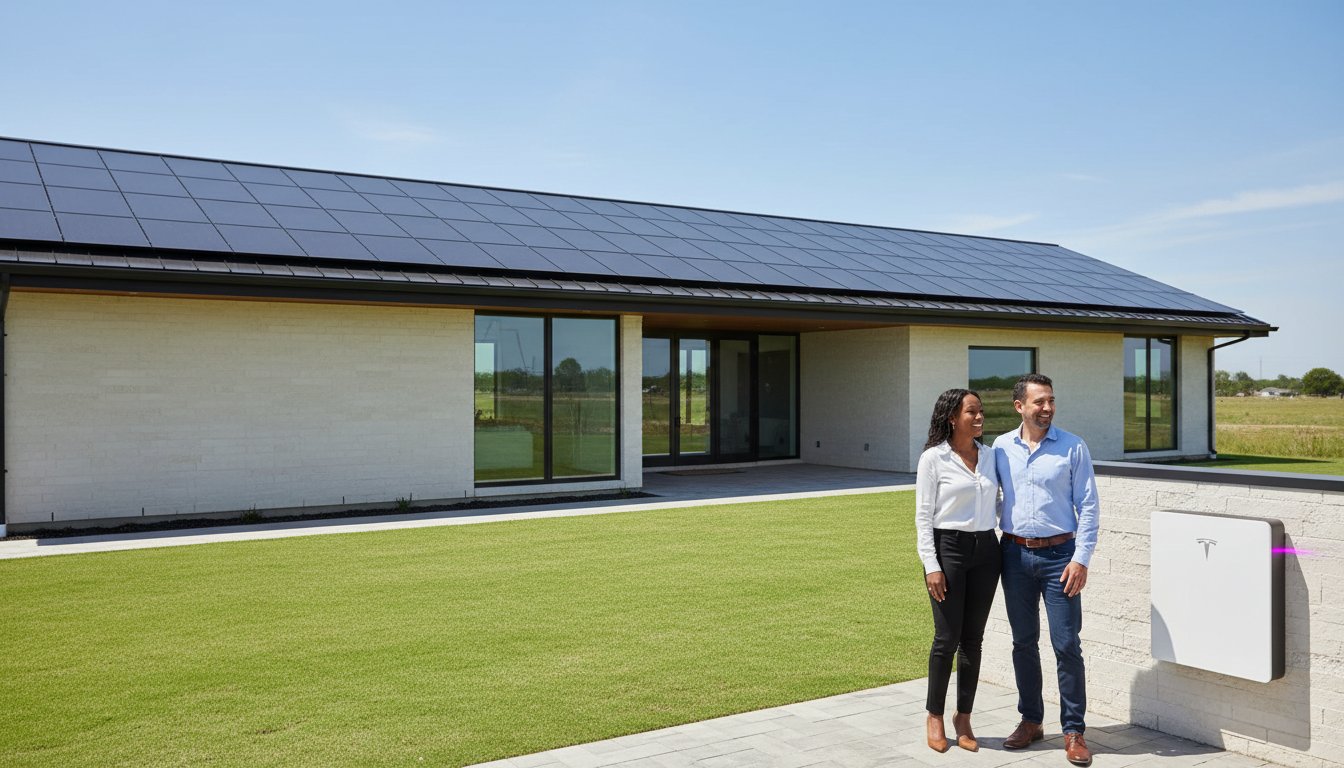
During the 2021 Texas power crisis, more than 4.5 million residents faced prolonged outages, highlighting a systemic need for resilient, localized energy solutions. You recognize that securing your property against Houston’s increasingly unpredictable grid requires more than a standard backup plan; it demands a sophisticated, integrated power strategy. Determining the current tesla solar cost is the essential first step toward this operational autonomy. In 2026, Houston property owners typically encounter an average price-per-watt ranging from $2.50 to $3.30 before applying federal or local incentives.
This comprehensive guide delivers a precise analysis of the capital investment required to achieve total energy independence. We’ll examine the 30% federal Investment Tax Credit alongside specific CenterPoint energy rebates to ensure your financial projections are meticulous and accurate. You’ll also discover why the Powerwall 3 serves as a superior stabilizer for high-demand residential systems. Our dedicated teams provide the professional oversight needed to manage complex Harris County permitting and installation logistics, ensuring a seamless transition to a sustainable, independent power source.
Key Takeaways
- Analyze the 2026 price-per-watt benchmarks to establish a precise expectation for your total tesla solar cost and system configuration.
- Distinguish between essential hardware components and necessary soft costs, such as permitting and engineering, to ensure comprehensive financial planning.
- Assess the long-term value of integrating Tesla Powerwall 3 to provide superior resilience and whole-home backup during Houston’s volatile storm seasons.
- Model your potential return on investment by aligning high summer cooling demands with current Texas net metering policies and utility incentives.
- Leverage the advantage of a certified installation partner to secure meticulous engineering and a seamless, single-source solution for your energy infrastructure.
Understanding Tesla Solar Cost Factors in Houston (2026 Update)
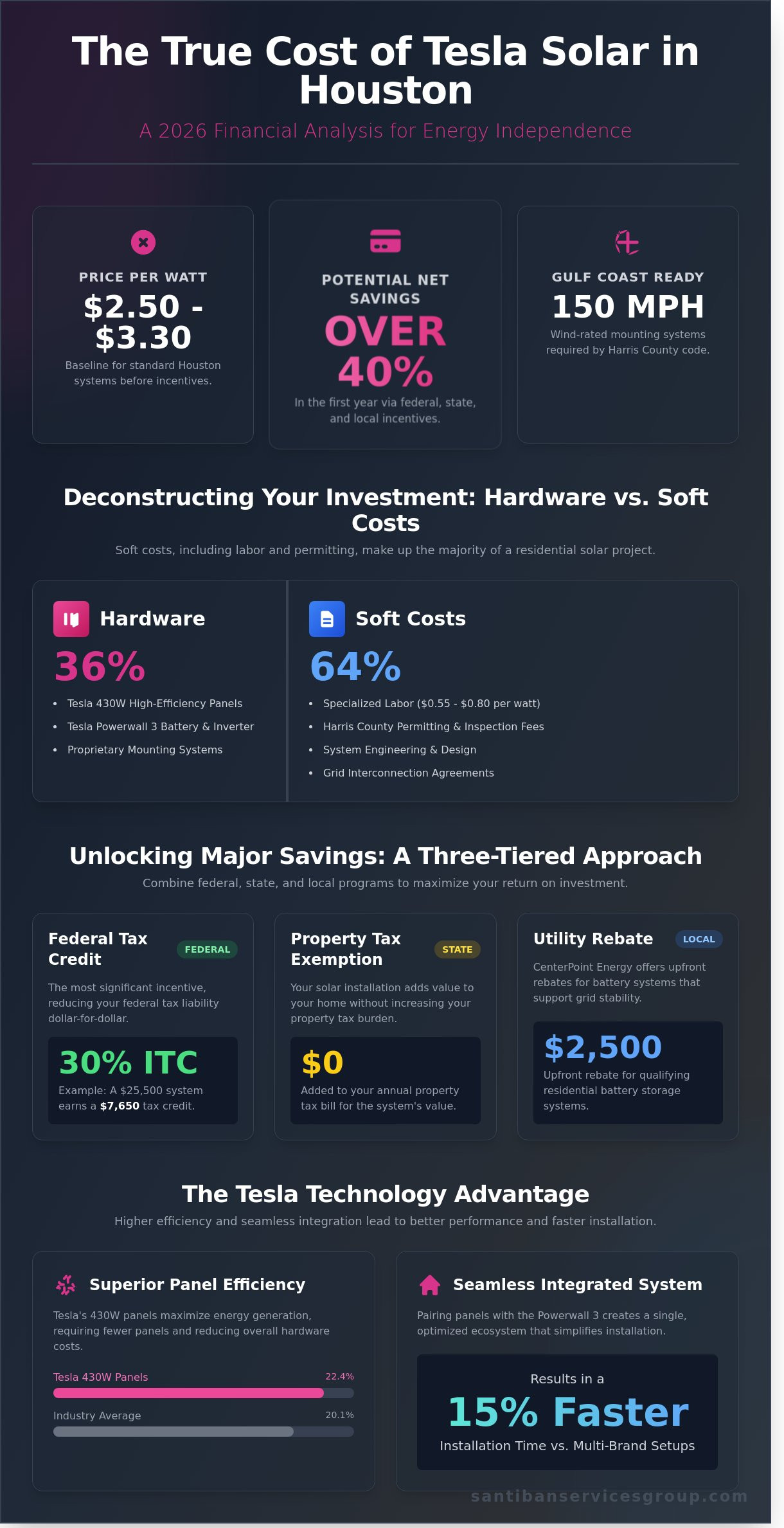
Determining the tesla solar cost in the Houston market requires a meticulous analysis of hardware efficiency and regional labor variables. By early 2026, the Texas solar market has stabilized around a baseline of $2.55 per watt for standard residential installations. Large-scale systems often achieve a lower price point due to economies of scale; however, smaller arrays carry higher per-watt premiums to cover fixed permitting and engineering expenses. This pricing structure reflects a mature industry where hardware costs have plateaued while installation precision has reached new heights.
Houston’s specific logistical environment introduces unique cost drivers that diverge from national averages. Local building codes in Harris County require mounting systems to withstand wind speeds of up to 150 mph. These structural reinforcements add approximately 8% to the total labor and material expenditure compared to inland Texas markets. Our analysis confirms that while the initial investment is substantial, the long-term reliability of these reinforced systems prevents costly maintenance after Gulf Coast weather events.
The 2026 Price-Per-Watt Benchmark
Tesla’s 2026 hardware suite utilizes high-efficiency 430-watt monocrystalline panels. These modules offer a 22.4% efficiency rating, which exceeds the 20.1% industry average seen in previous cycles. This technological advancement directly impacts the levelized cost of electricity for Houston homeowners. It ensures a faster return on investment by maximizing energy harvest in the limited roof space typical of suburban Houston developments.
High-efficiency hardware reduces the total number of panels needed to reach a specific kilowatt target. This reduction lowers the total tesla solar cost by minimizing the required mounting hardware and electrical components. Tesla’s integrated ecosystem, which pairs these panels with the Powerwall 3, provides a seamless energy solution that simplifies the installation process. Our data shows that integrated systems reduce installation timelines by 15% compared to fragmented, multi-brand setups.
Federal and State Incentives in Texas
The 30% Federal Investment Tax Credit remains the most critical financial lever for reducing the total system cost in 2026. For a standard 10kW system priced at $25,500, this credit provides a direct $7,650 reduction in tax liability. It’s a dollar-for-dollar credit that applies to both the solar panels and integrated battery storage units, provided they’re installed simultaneously.
Homeowners in Houston benefit from Texas Tax Code Section 11.317, which offers a comprehensive property tax exemption for solar installations. This statute ensures that the added value of your solar equipment doesn’t increase your annual property tax bill. It’s a vital protection for your long-term equity.
Local utility providers like CenterPoint Energy have introduced tailored programs to support grid stability. These include $2,500 upfront rebates for residential battery storage systems that participate in virtual power plant initiatives. These incentives, when combined with federal credits, can reduce the net investment by over 40% in the first year of operation.
Hardware vs. Soft Costs: What You Are Actually Paying For
Understanding the total tesla solar cost requires a clear breakdown between physical components and the professional services required for a legal, safe installation. Hardware includes the Tesla solar panels, the integrated Powerwall 3 inverter system, and the proprietary mounting hardware. These tangible assets represent the visible portion of your investment. However, data from the DOE solar cost benchmarks reveals that soft costs frequently account for 64% of the total residential system price. These expenses cover the meticulous background work that ensures your system operates within Texas regulatory frameworks.
Labor remains a primary driver of these soft costs. Certified Tesla Powerwall 3 installers in Texas typically charge between $0.55 and $0.80 per watt for specialized labor. This premium reflects the training required to handle high-voltage DC systems and integrated battery storage. Choosing a single-source provider allows for a seamless transition between the design and installation phases; it reduces the risk of expensive errors during the construction process. This methodical approach ensures that every connection meets the high standards established for the 2026 energy market.
The Value of PE-Stamped Engineering
Houston’s unique climate demands more than standard solar designs. Professional PE stamped engineering for solar systems is a mandatory requirement for structural safety. Engineers must certify that your roof can withstand 150 mph wind loads during Gulf Coast hurricane events. This rigorous vetting process prevents costly permit delays at the municipal level. Standard designs often fail local inspections. An engineered solution provides a tailored approach that guarantees structural integrity. The cost difference for this specialized service is a small fraction of the total tesla solar cost, yet it protects the entire investment from environmental failure.
Permitting and Interconnection with CenterPoint
The Houston Permitting Center enforces strict documentation standards for all renewable energy projects. You must submit comprehensive site plans, electrical diagrams, and structural calculations to secure a building permit. After installation, CenterPoint Energy requires a formal interconnection agreement before you can activate the system. Interconnection fees in the Houston area generally range from $150 to $300 for residential applications. Meticulous documentation is the only way to avoid hidden municipal costs or extended timelines. Our integrated facility management teams specialize in managing these complex logistical challenges to ensure your project remains on schedule and within budget.
Integrating Tesla Powerwall 3: Cost vs. Resilience
Reliability in Houston requires more than just energy production. It demands storage. The 2024 hurricane season demonstrated that grid dependence carries significant operational risks for homeowners. Integrating a Powerwall 3 into your configuration shifts the focus from simple savings to total energy independence. While a single unit increases the tesla solar cost by an average of $9,500 to $11,500, the value lies in its 11.5 kW continuous power output. This capacity allows for whole-home backup, including high-draw appliances like central air conditioning units that previous generations couldn’t start as efficiently. Our engineering team ensures each unit is positioned for optimal thermal performance in the Texas heat.
It’s vital to maximize synergy pricing. Installing solar and storage simultaneously reduces total project expenses by eliminating redundant permitting fees and site mobilization costs. Beyond storm resilience, owners benefit from energy arbitrage. By discharging stored power during CenterPoint’s peak demand windows, you avoid the highest utility rates. This practice can accelerate your return on investment by 15% to 20% over the system’s lifespan. Our clients don’t just buy a battery; they secure a predictable energy future through a meticulously managed asset. We provide the technical expertise to configure these systems for maximum financial return. For a comprehensive technical roadmap on deploying this technology, our powerwall home battery implementation guide details the precise steps Houston homeowners need to achieve total energy independence.
Powerwall 3 Performance and Cost Breakdown
The Powerwall 3 represents a fundamental shift in value. It features an integrated solar inverter, which simplifies the hardware stack and reduces potential failure points. For those researching Tesla batteries for solar in Houston, the 2026 pricing reflects a more efficient installation process. Our dedicated teams manage the complexities of whole-home backup, ensuring critical loads remain operational without manual intervention. We prioritize a seamless transition that protects your household’s safety through professional-grade execution.
Solar Reroofing: Protecting Your Investment
A solar array is a 25-year commitment. Placing high-efficiency panels on a roof nearing the end of its life is a tactical error. Santiban provides a single-source solution by integrating reroofing into the project scope. This prevents the double-labor expense of removing and reinstalling the system, which typically costs $3,000 or more in Houston. Our meticulous assessment ensures the structural integrity supports the tesla solar cost and long-term performance. We deliver a tailored solution that secures your building envelope while maintaining aesthetic excellence.
Calculating Your ROI: Energy Savings in the Houston Climate
Solar ROI in the Houston market is defined as the fixed period required for cumulative utility bill avoidance to offset the total system investment based on current CenterPoint Energy delivery charges and retail provider rates. This calculation serves as a rigorous financial assessment of asset performance over a 25-year lifecycle. When analyzing the tesla solar cost, homeowners must view the initial expenditure as a capital improvement that generates predictable monthly dividends. In the current 2026 economic environment, meticulous modeling of these savings is essential for any disciplined property owner.
Houston Energy Consumption Patterns
A standard 2,500 sq. ft. Houston residence typically requires 15,500 to 21,000 kWh annually to manage the region’s intense humidity and sustained heat. Tesla solar systems are specifically engineered to maximize output during peak Texas heatwaves when HVAC systems consume up to 60% of a home’s total power. By integrating high-efficiency panels with a Powerwall, homeowners can achieve a significant energy offset even during the most demanding July afternoons. Performance remains consistent because Tesla provides a 25-year performance warranty, ensuring the system maintains at least 85% of its original capacity after two decades of service.
While solar panels address energy production, it’s also crucial to ensure your HVAC system is operating at peak efficiency, as it’s often the largest consumer of power in a Houston home. A modern, well-maintained air conditioner will significantly lower your overall energy demand, making your solar investment even more effective. For those researching how to choose a quality service provider, the guide from BulletProof Air offers helpful criteria that apply in any market.
- Thermal Resilience: Systems are designed to operate efficiently despite roof temperatures that often exceed 115 degrees in Southeast Texas.
- Net Metering Dynamics: Utilizing buy-back programs from local providers allows you to receive credits for excess generation, effectively turning your meter backward.
- Appraisal Impact: Data from 2025 indicates that solar installations increase Houston property values by an average of $18,500, providing immediate equity growth.
The Cost of Inaction: Rising Grid Prices
The Texas electricity market has experienced substantial volatility, with average residential rates climbing 14% between 2022 and 2025. Relying exclusively on the ERCOT grid exposes households to unpredictable price surges and delivery fees. Transitioning to Tesla solar energy in Houston provides a strategic hedge against this inflation. It’s a proven method of locking in energy costs at a fixed rate while ensuring whole-home resilience during grid emergencies. When you factor in the 30% Federal Tax Credit, the tesla solar cost becomes a manageable investment that protects your long-term financial stability.
The Santiban Services Group provides comprehensive energy assessments to ensure every installation is sized for maximum efficiency and reliability. Contact our dedicated team to request a professional solar ROI analysis for your property.
The Santiban Advantage: Excellence in Tesla Installation
Santiban Services Group operates with the disciplined precision of a high-end industrial contractor. We bring over 24 years of local electrical expertise to every residential project, ensuring your transition to renewable energy is managed by seasoned professionals. Selecting a certified Tesla Powerwall installer is a critical step in protecting your investment. Tesla mandates that only certified technicians perform these installations to validate the 10-year equipment warranty. Our team meets these rigorous standards, providing the technical proficiency required to integrate complex battery storage with your home’s existing electrical infrastructure.
Our integrated approach distinguishes us from standard solar contractors. We serve as a single-source provider, managing everything from initial engineering and structural reroofing to the final electrical commissioning. This eliminates the logistical friction of coordinating multiple subcontractors. We apply industrial-grade standards to residential work, focusing on meticulous cable management and weatherproof seals that exceed standard building codes. Our goal is 100% operational reliability from the moment your system goes live.
Tailored Solutions for Houston Homeowners
Santiban engineers develop customized system designs based on your specific 12-month energy consumption profile. We don’t rely on generic templates. Instead, we analyze your home’s orientation and shading to maximize kilowatt-hour production. You’ll maintain direct communication with a dedicated project team throughout the process. This ensures a seamless transition from the design phase to grid-connected operation without the delays common in larger, less organized firms. We prioritize functional clarity and keep you informed at every milestone.
Requesting Your Tesla Solar Quote
Transparency is the cornerstone of our client relationships. When you analyze your tesla solar cost, you deserve a comprehensive breakdown that includes hardware, labor, and local permitting fees. During your initial consultation, we provide a factual assessment of your site’s potential and a clear financial roadmap. We focus on long-term value rather than temporary incentives. Our quotes reflect the high-quality components and expert labor necessary for a system that lasts 25 years or more. Understanding every factor influencing your tesla solar cost allows you to make an informed decision for your property’s future.
Ready to secure your home’s energy independence with a system built to industrial standards? Contact Santiban Services Group for a professional Tesla solar estimate and experience the excellence of an established Houston partner.
Securing Your Houston Energy Independence
Investing in sustainable infrastructure requires a meticulous assessment of long-term value and technical precision. By 2026, the tesla solar cost in the Houston market reflects a strategic balance between high-efficiency hardware and localized soft costs. Integrating the Tesla Powerwall 3 ensures your property maintains a seamless power supply during grid interruptions while optimizing your energy ROI through advanced load management. Santiban Services Group leverages over 24 years of Houston industrial electrical experience to deliver these complex systems with professional authority. We include PE-stamped engineering on every project to guarantee structural integrity and compliance with rigorous municipal codes. Our dedicated, Tesla-certified installers focus on excellence in every detail, providing you with a reliable energy foundation that’s built for the next two decades. It’s time to transition your property to a more stable and cost-effective future with a partner who understands the demands of the Texas climate. Get a Professional Tesla Solar and Powerwall 3 Quote from Santiban to begin your comprehensive energy assessment today. Your path to resilient, independent power starts with a proven engineering leader.
Frequently Asked Questions
How much does a Tesla solar system cost for a 2,000 sq. ft. home in Houston?
A standard 2,000 sq. ft. home in Houston typically requires an 8.6 kW system, which carries an average tesla solar cost of $21,500 before federal incentives. This pricing reflects the 2026 market rates for hardware and professional installation. Your final investment depends on specific roof orientation and annual kilowatt-hour consumption. Santiban provides a meticulous analysis of your energy profile to ensure the system size aligns with your operational requirements and budget constraints.
Does Tesla solar include the cost of a new roof if I need one?
Tesla doesn’t include the price of a traditional roof replacement in its standard solar panel quotes. If your home requires structural repairs or new shingles, you must budget approximately $9,000 to $16,000 for these preparatory services. However, the Tesla Solar Roof product serves as a comprehensive replacement that integrates glass solar tiles with steel roofing components. This premium solution offers a seamless aesthetic while providing a durable, weather-resistant barrier for your property.
Can I install a Tesla Powerwall 3 without solar panels in Texas?
You can install the Powerwall 3 as a standalone energy storage solution in Texas to provide reliable backup power and peak-shave your utility bills. This configuration allows the 13.5 kWh battery to charge directly from the grid during low-demand periods. It’s an excellent strategy for Houston residents who want to maintain essential services during localized outages without committing to a full solar array. The system integrates with the Tesla app for real-time monitoring and management. For a detailed overview of sizing and deployment considerations, our powerwall home battery implementation guide provides the technical specifications Houston homeowners need to make an informed decision.
What is the current federal tax credit for Tesla solar in 2026?
The federal Residential Clean Energy Credit remains at 30 percent for all qualified systems installed through December 31, 2026. This incentive applies to the total tesla solar cost, encompassing all equipment, permitting fees, and labor expenses. For a system priced at $28,000, the credit provides an $8,400 reduction in your federal tax liability. Our team recommends consulting a certified tax professional to confirm your eligibility and maximize the financial benefits of this significant government incentive.
How long is the payback period for Tesla solar in Houston?
The average payback period for a solar investment in the Houston metropolitan area is 7.5 to 9 years. This timeline accounts for the 30 percent federal tax credit and the consistent 14 cents per kWh average utility rate in Harris County. Systems typically achieve a 12 percent annual return on investment by offsetting high summer cooling costs. Your specific break-even point is influenced by your chosen retail electric provider and their specific net-metering or buy-back policies.
Is a PE-stamped engineering design required for all Houston solar projects?
The City of Houston and the Harris County Engineering Department require a PE-stamped structural report for every solar permit application. This professional certification confirms that your roof can safely support the 3.5 pounds per square foot of additional weight. Santiban manages this sophisticated documentation process, utilizing licensed engineers to verify that the installation meets the 150 mph wind load standards. This meticulous approach ensures your system remains secure during the severe weather events common to the Gulf Coast.
How does the Powerwall 3 handle Houston hurricane seasons?
The Powerwall 3 is engineered with an IP67 waterproof rating, allowing it to remain operational in high-moisture environments typical of Houston hurricane seasons. Its Storm Watch feature automatically monitors National Weather Service data and prioritizes a 100 percent charge when a tropical system approaches the region. With a 11.5 kW continuous power output, a single unit can start a 5-ton central air conditioner. This capability ensures your family maintains a climate-controlled environment during extended grid failures.
Does Tesla offer financing for solar and battery systems in Texas?
Tesla provides internal financing options for Texas homeowners with terms ranging from 10 to 20 years and down payments as low as 10 percent. In 2026, interest rates for qualified applicants generally range between 6.49 percent and 7.99 percent depending on credit history. Many clients also utilize Texas-specific green energy loans or HELOC products to fund their systems. We provide a tailored overview of these financial vehicles to help you select a path that preserves your capital and maximizes long-term savings.