
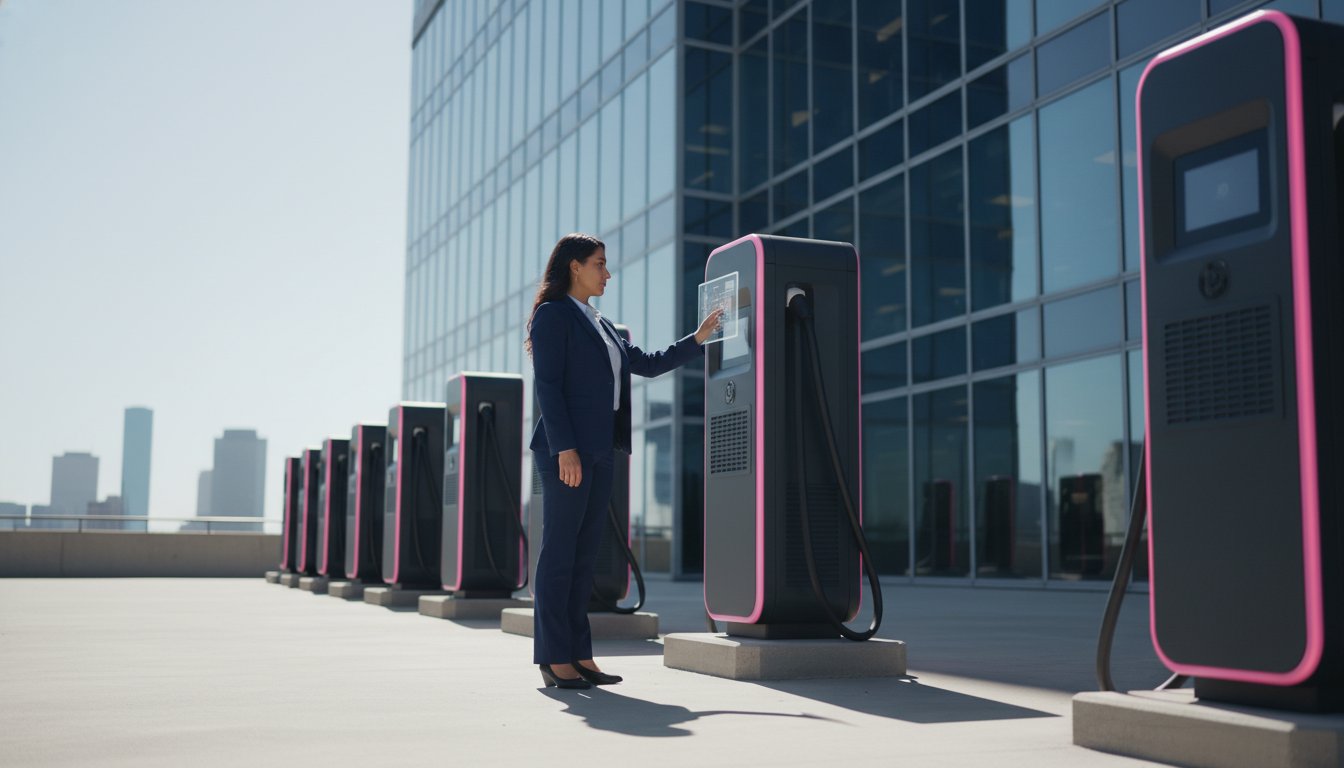
With the City of Houston aiming for 500,000 electric vehicles on local roads by 2030, the requirement for robust commercial ev charger installation has transitioned from a future consideration to an immediate operational priority. You likely recognize that deploying a scalable charging network involves far more than simply selecting hardware. It’s a complex logistical undertaking where Houston’s unique permitting hurdles and CenterPoint Energy’s specific grid capacity requirements can stall even the most well funded projects.
The Santiban Services Group provides this 2026 roadmap to help facility managers and developers secure a PE-stamped, compliant infrastructure that stands the test of time. We’ll show you how to navigate the meticulous municipal inspection process and maximize your long term ROI by leveraging federal incentives like the 30C tax credit. This guide details the essential steps for achieving a seamless integration with your existing electrical systems, ensuring your facility maintains its reputation for excellence and reliability in a rapidly evolving energy environment.
Key Takeaways
- Understand how Houston’s 2026 market dynamics and accelerating adoption in the Medical Center and Energy Corridor impact your facility’s long-term strategic value.
- Evaluate the technical architecture of Level 2 versus DC Fast Charging to determine the optimal commercial ev charger installation for your specific user dwell times.
- Navigate the complexities of Houston’s regulatory landscape, including the critical role of PE-stamped engineering and the city’s specific permitting process for commercial electrical work.
- Maximize project ROI by leveraging the Federal 30C tax credit and Texas-specific financial incentives like the TERP and NEVI formula programs.
- Learn how to integrate high-capacity charging with advanced energy storage solutions to ensure superior site resilience and operational stability.
The Strategic Value of EV Infrastructure for Houston Businesses in 2026
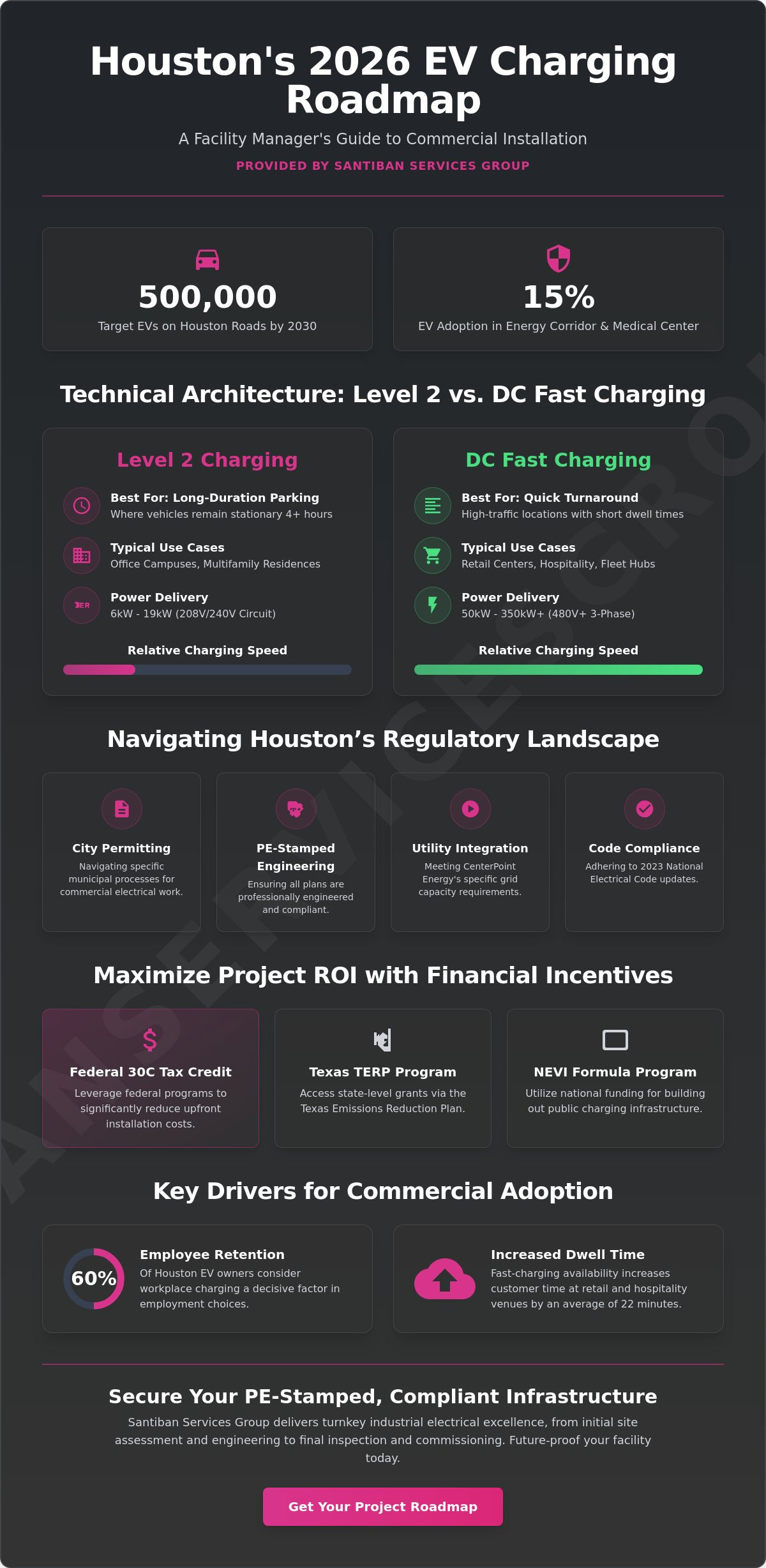
Commercial EV charger installation is the meticulous process of deploying high-capacity charging infrastructure to support employees, customers, and corporate fleets. By 2026, the Houston market has matured into a leading hub for electrification. The Energy Corridor and the Texas Medical Center now lead the region in electric vehicle adoption. Data from the Houston-Galveston Area Council indicates that 15% of registered vehicles in these specific districts are now electric. This rapid growth transforms charging stations from elective perks into essential infrastructure for any competitive commercial property.
Property owners who integrate electric vehicle supply equipment (EVSE) see a direct impact on asset valuation. High-value tenants now require sustainable amenities as a prerequisite for long-term leases. Beyond immediate tenant satisfaction, these installations future-proof buildings against evolving Texas building codes. The 2023 National Electrical Code updates, which many Houston jurisdictions fully adopted by 2025, necessitate specific load management capabilities. Santiban Services Group manages these requirements through tailored engineering solutions. Preparing for these standards now prevents costly retrofits as environmental mandates tighten across the state.
Meeting the Demand of the Houston Workforce
Employee retention is closely linked to workplace amenities. A 2025 survey of Houston professionals found that 60% of EV owners consider workplace charging a decisive factor in their employment choices. Santiban Services Group specializes in Level 2 charging solutions for corporate campuses. These systems provide the steady power delivery required for standard eight-hour workdays. Houston’s corporate sector is also accelerating fleet electrification. Local companies in the logistics and service industries are transitioning 30% of their light-duty vehicles to electric models to capitalize on lower operational costs and reduced maintenance requirements.
Retail and Hospitality: Charging as a Revenue Driver
For retail centers and hospitality venues, commercial ev charger installation acts as a powerful catalyst for consumer behavior. Fast-charging availability increases customer dwell time by an average of 22 minutes. This extra time directly correlates with higher transaction values in shops and restaurants. Hospitality managers use these stations to attract a premium demographic that prioritizes sustainability and convenience. By integrating charging data with local loyalty programs, Houston businesses can create targeted marketing campaigns that reward frequent users. Santiban Services Group delivers these integrated systems as a single-source partner, ensuring every operational detail aligns with the client’s commercial goals.
Technical Architecture: Level 2 vs. DC Fast Charging for Commercial Sites
Selecting the appropriate technical architecture is a foundational step in a successful commercial ev charger installation. Decision-makers must align hardware capabilities with the specific dwell times of their users to ensure maximum utility. The U.S. Department of Energy provides comprehensive data on Level 2 and DC fast charging, illustrating how each system serves distinct operational needs. Santiban Services Group approaches these installations through a lens of long-term reliability and site-specific engineering.
Level 2 Charging for Long-Duration Parking
Level 2 systems operate on 240V or 208V circuits, delivering between 6 kW and 19 kW of power. These units are the standard for environments where vehicles remain stationary for four hours or more. Our technical teams prioritize these for specific Houston asset classes.
- Multifamily and Office Use: These sites benefit from Level 2 units because residents and employees typically park for 8 to 10 hours.
- Electrical Load: A multi-unit deployment requires meticulous panel capacity planning. A standard 40-amp circuit supports one Level 2 port, but 2026 standards often favor 80-amp circuits to accommodate higher-capacity vehicle batteries.
- Scalability: We implement modular “make-ready” infrastructure. This allows property managers to add ports as tenant demand increases without repeating expensive trenching or conduit work.
DC Fast Charging for High-Turnover Locations
For retail centers and fleet hubs near Houston transit corridors like Interstate 10 or Highway 290, Level 3 DC Fast Charging (DCFC) is essential. These systems bypass the vehicle’s onboard charger to deliver direct current to the battery, providing an 80% charge in 20 to 30 minutes. DCFC hardware requires 480V three-phase power and sophisticated thermal management systems. In the Houston climate, where summer temperatures frequently exceed 100°F, we specify industrial-grade units with liquid cooling or high-airflow cabinets. This prevents the derating of power output during peak heat periods, ensuring consistent performance for your customers.
Smart Load Management and Houston Resilience
Managing the electrical demand of a commercial ev charger installation is critical for controlling operational costs. High-speed charging can trigger significant peak demand charges from local utilities. Our integrated solutions utilize smart load balancing software to distribute power across active units. This technology can reduce peak demand costs by up to 45% by shifting charging speeds during periods of high building usage. For a stable, single-source approach to your facility’s energy transition, consider a tailored consultation with our technical team. This ensures every component meets our meticulous standards for excellence and operational stability.
Navigating Houston’s Regulatory Landscape: Permits, PE-Stamps, and Utility
Executing a successful commercial ev charger installation in Houston requires strict adherence to municipal codes and utility standards. The City of Houston Public Works department enforces rigorous permitting processes that demand precision from the initial application. Projects typically require an electrical permit and, in many cases, a structural permit for the concrete pads supporting charging pedestals. Maintaining compliance with the 2023 National Electrical Code (NEC) is mandatory, as local inspectors prioritize safety and load management in high-density commercial zones. Failure to secure proper documentation leads to project delays that can exceed 12 weeks during peak construction cycles. Partnering with qualified ev charging installation companies that understand Houston’s specific code requirements is essential to avoiding these costly setbacks.
The Necessity of PE-Stamped Engineering Design
The Texas Board of Professional Engineers mandates that commercial electrical modifications undergo professional review. Utilizing PE stamped engineering for solar systems and EV infrastructure ensures that the proposed design handles the increased thermal load without compromising the building’s existing electrical integrity. Meticulous engineering prevents costly mid-construction revisions that often occur when uncertified designs fail city inspections. These stamps serve as a legal guarantee of safety, reducing long-term liability for property owners while ensuring the structural stability of outdoor equipment against Gulf Coast weather conditions.
CenterPoint Energy Interconnection Process
Coordination with CenterPoint Energy represents a critical path in the project timeline. New installations often necessitate a formal Service Order for a dedicated meter drop or a transformer upgrade to handle Level 3 fast-charging demands. Early engagement with utility engineers allows for a comprehensive grid capacity assessment, preventing the 16-week lead times common when equipment upgrades are requested late in the process. Facility managers must evaluate existing switchgear to determine if current systems can support the added amperage or if integrated load management software is required to balance the demand across the site.
Compliance also extends to accessibility and state-level mandates. Following Texas EV incentives and regulations ensures that your facility remains eligible for state grants while meeting Texas Accessibility Standards (TAS). Key compliance factors include:
- ADA Accessibility: Ensuring charging handles are placed at a height between 15 and 48 inches for universal access.
- Clear Floor Space: Maintaining a 30-by-48-inch zone to accommodate wheelchairs at the charging station.
- Load Calculations: Providing documented proof that the commercial ev charger installation won’t exceed 80% of the circuit’s rated capacity.
Our dedicated teams manage these logistical hurdles with a focus on excellence in every detail. By acting as a single-source solution, we simplify the complex intersection of utility requirements and city ordinances, providing a seamless path to operational readiness for your business.
Calculating ROI: Incentives, Tax Credits, and Operational Models
Securing a high return on investment for commercial ev charger installation requires a meticulous approach to capital stack management. In 2026, Houston businesses can leverage a sophisticated array of federal and state mechanisms to offset up to 80% of initial deployment costs. Strategic planning ensures these assets transition from capital expenditures to profit centers within accelerated timelines. We provide the technical expertise to help property managers identify every available fiscal advantage.
Federal and State Financial Incentives
The Federal 30C Tax Credit remains a cornerstone for infrastructure development. This provision offers a credit of 30% for hardware and installation costs, capped at $100,000 per location. Eligibility depends on the project’s location within specific census tracts. These areas currently cover approximately 40% of the Houston metropolitan area. Beyond federal support, the Texas Emissions Reduction Plan (TERP) provides competitive grants that prioritize high-traffic corridors. The NEVI formula program further supplements these funds, specifically targeting fast-charging stations along designated Alternative Fuel Corridors. Local utility providers like CenterPoint Energy often offer rebates for smart-charging hardware that manages grid load effectively. Property managers should also utilize MACRS depreciation. This allows for the recovery of investment costs over a five-year period, which significantly enhances short-term cash flow and tax efficiency.
Revenue Generation and Cost Recovery
Operational profitability hinges on selecting the right business model. Owner-operated systems grant full control over dynamic pricing; this allows businesses to adjust rates based on peak demand or fluctuating electricity costs. Conversely, third-party partnerships reduce upfront liabilities but involve revenue-sharing agreements. Analyzing the ROI of commercial EV charging stations in Texas reveals that secondary revenue often outweighs direct charging fees. Data from 2025 indicates that retail tenants see a 22% increase in dwell time when charging is available. Additionally, companies can explore carbon credit aggregation through Texas-based markets to create recurring passive income streams. This multi-layered financial strategy transforms a utility service into a robust asset class. Our dedicated teams ensure that every commercial electric car charger installation is optimized for both performance and maximum cost recovery.
Ready to optimize your facility’s infrastructure with precision? Contact Santiban Services Group to discuss a tailored installation plan today.
The Santiban Approach: Turnkey Industrial Electrical Excellence
Santiban Services Group brings over 24 years of specialized expertise to the Houston market. We’ve built a reputation for managing complex industrial electrical construction with a focus on corporate stability and reliability. Our team provides a comprehensive, single-source solution for every project. This integrated approach covers everything from PE-stamped engineering designs to the final commissioning of the site. We handle the technical burdens so property managers can maintain focus on their core operations. Our commitment to excellence in every detail ensures your commercial ev charger installation meets the highest safety standards and regulatory requirements.
We operate as a silent engine for your facility. Our process is methodical and predictable, prioritizing long-term performance over temporary fixes. We don’t just install hardware; we build a strategic partnership that values consistent performance. Every project begins with a meticulous assessment of your current electrical capacity to ensure the new infrastructure supports your 2026 growth targets without compromise.
Industrial-Scale Deployment Capabilities
Large-scale facilities require more than standard wiring. We manage high-voltage upgrades for industrial parks and logistics hubs without halting your daily workflow. Our teams use specialized equipment to install 480V systems and dedicated transformers that support rapid charging speeds. We currently support over 50 commercial charging networks across the Houston metro area with ongoing maintenance programs. This proactive support prevents downtime and extends the lifecycle of your hardware. Our highly trained teams follow strict safety protocols, ensuring every connection is secure and every component functions at peak efficiency.
Strategic Energy Integration
Modern commercial infrastructure demands resilience. We integrate EV charging with advanced storage systems to manage peak demand effectively. By performing a Tesla Powerwall 3 installation, businesses protect their operations against the frequent instability of the local grid. Our consultants help you identify the best commercial ev charger installers to ensure long-term ROI and system compatibility. We utilize EcoFlow and Tesla technologies to provide essential backup power during unexpected outages.
This integrated approach allows for strategic peak shaving, which can reduce energy costs by as much as 30% for high-consumption facilities. We tailor these solutions to your specific site needs, combining solar arrays with battery storage to create a self-sustaining energy ecosystem. Your commercial ev charger installation becomes a value-adding asset rather than just a utility expense. We provide the disciplined, organized execution required to keep your business running smoothly in a changing energy landscape.
Future-Proofing Your Houston Facility with Advanced EV Infrastructure
The transition to electric mobility in 2026 requires a strategic approach to commercial ev charger installation that balances technical performance with Houston’s rigorous regulatory standards. Successful deployment hinges on selecting the correct architecture, whether it’s Level 2 for employee dwell times or DC Fast Charging for rapid fleet logistics. Our in-house PE-stamped engineering services eliminate the friction of municipal permitting, ensuring every project meets superior safety protocols from the start.
Santiban Services Group leverages 24+ years of industrial electrical experience to deliver comprehensive infrastructure that’s built for long-term reliability. As Certified Tesla Powerwall 3 Installers, we provide the sophisticated energy storage and tailored charging solutions modern corporate campuses require. This disciplined focus on meticulous technical excellence ensures your facility remains a high-performing asset. Your business deserves an established partner that manages every operational detail with quiet confidence. For a deeper look at deploying a scalable commercial electric car charger network that integrates PE-stamped engineering with CenterPoint Energy grid constraints, our 2026 business guide provides the comprehensive roadmap your facility needs.
Request a Professional Consultation for Your Houston EV Project and position your business at the forefront of industrial innovation.
Frequently Asked Questions
What is the average timeline for commercial EV charger installation in Houston?
A standard commercial ev charger installation in Houston typically spans 4 to 12 weeks from the initial site assessment to final commissioning. The City of Houston permitting process currently requires 3 to 6 weeks for review, while utility coordination with CenterPoint Energy can add 30 days for service upgrades. Santiban Services Group manages these timelines through meticulous project scheduling to ensure your facility remains operational throughout the deployment.
Do I need a panel upgrade to install multiple Level 2 chargers at my business?
You’ll require a panel upgrade if your current electrical infrastructure cannot support the 40 to 80 amps required by each Level 2 station. National Electrical Code 2023 standards mandate that continuous loads don’t exceed 80% of the circuit breaker’s rating. Our engineers conduct a comprehensive load study to determine if your existing 208V or 480V distribution system can handle the increased demand without compromising safety.
What are the specific ADA requirements for commercial EV charging spots in Texas?
Texas Accessibility Standards require that at least 5% of charging stalls, or a minimum of one per 25 spots, meet specific ADA criteria. These spots must provide a 5 foot wide access aisle and ensure that operable parts like screens and plugs are positioned between 15 and 48 inches from the ground. We integrate these meticulous design requirements into every site plan to ensure your business maintains full regulatory compliance.
How does the Houston climate affect commercial charging station durability?
Houston’s average of 100 days above 90 degrees Fahrenheit can cause thermal throttling, which reduces charging speeds by 20% to prevent hardware damage. High humidity levels exceeding 90% also accelerate the corrosion of internal components. We specify NEMA 4X rated enclosures and integrated cooling systems to ensure your commercial ev charger installation remains durable against the Gulf Coast’s extreme environmental stressors.
Can I integrate solar panels with my commercial EV charging station?
You can seamlessly integrate solar panels with your charging infrastructure using either AC-coupled or DC-coupled systems. A standard 10kW solar canopy typically offsets 30% of the energy demand for a dual-port Level 2 station during peak daylight hours. This integrated approach reduces operational costs and aligns with corporate sustainability targets by utilizing renewable energy for vehicle fleet maintenance.
What is a PE-stamped engineering design and why is it required for my project?
A PE-stamped design is a technical document certified by a licensed Professional Engineer that validates the safety and structural integrity of your electrical system. The City of Houston requires these stamped drawings for commercial projects exceeding 50kW or those requiring new concrete foundations. It’s a critical safeguard that confirms your installation adheres to rigorous engineering standards and municipal building codes.
What are the most common mistakes businesses make when installing EV chargers?
The most frequent error is failing to install oversized conduit, which leads to 200% higher costs when businesses eventually expand their fleet. Approximately 40% of property managers also overlook the importance of cellular signal strength for payment processing. Our tailored solutions avoid these pitfalls by conducting thorough site surveys and installing scalable infrastructure that accommodates future growth from day one. A thorough vetting process using a structured checklist for evaluating ev charging installation companies can help property managers avoid these common and costly oversights.
How do I choose between a networked and a non-networked commercial charger?
Networked chargers provide 99% uptime through remote monitoring and allow you to bill users via integrated software platforms. Non-networked units are simpler, standalone devices with no monthly subscription fees, but they lack data tracking capabilities. We recommend networked systems for retail or multi-family properties where capturing revenue and monitoring energy consumption are essential for operational excellence.