
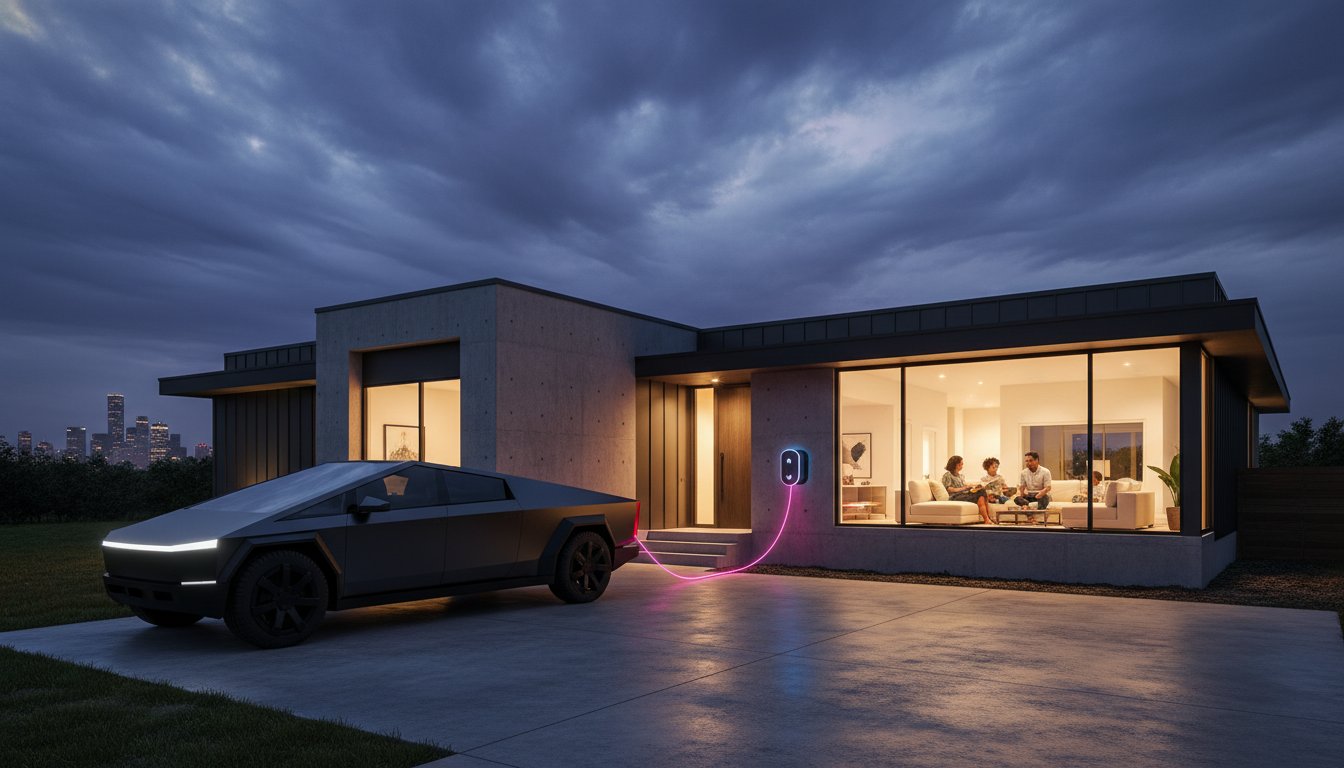
During the May 2024 derecho, over 900,000 Houstonians experienced the vulnerability of the regional energy infrastructure when the grid buckled under extreme pressure. You likely recognize that relying solely on traditional utility providers often leaves your property exposed during critical weather events. The Santiban Services Group understands that maintaining operational continuity is a meticulous requirement for modern Houston homeowners. By integrating a bidirectional ev charger into your electrical system, you transform your vehicle from a simple mode of transport into a sophisticated, mobile backup power plant.
We agree that the recurring instability of the ERCOT grid demands a more resilient, integrated approach to energy management. This article provides a comprehensive guide to utilizing Vehicle-to-Home (V2H) and Vehicle-to-Grid (V2G) technologies to secure your home’s power supply. You’ll discover how these systems interface with existing home energy management hardware and learn the precise steps for a seamless installation in the Texas market. We examine the technical specifications and strategic advantages of bidirectional charging to ensure your facility remains powered when the grid fails.
Key Takeaways
- Understand how a bidirectional ev charger transforms your vehicle from a simple transport tool into a sophisticated mobile backup power plant for your Houston residence.
- Learn to mitigate the risks of Texas grid instability and ERCOT price volatility by leveraging your vehicle’s stored energy during peak demand periods.
- Evaluate the performance differences between mobile EV storage and stationary solutions like the Tesla Powerwall 3 to determine the most effective backup strategy for your specific needs.
- Discover the critical engineering and regulatory requirements in Houston, including the necessity of PE-stamped designs for complex energy integrations.
- Explore Santiban’s meticulous approach to deploying resilient, industrial-grade energy systems that ensure seamless operational continuity for your home or business.
What is a Bidirectional EV Charger? Beyond One-Way Power
A bidirectional EV charger is a sophisticated power management system designed to facilitate energy flow in two distinct directions. Traditional charging, known as Grid-to-Vehicle (G2V), functions as a one-way street where electricity moves from the utility grid into the vehicle battery. A true bidirectional ev charger breaks this limitation by allowing the battery to discharge power back to external loads. This technology transforms a standard passenger car into a mobile energy asset. By 2026, the global automotive market expects a standardized shift toward these bidirectional ecosystems, moving away from isolated charging hardware toward integrated energy solutions.
Houston residents frequently face grid instability during extreme weather events. This reality has accelerated the demand for “batteries on wheels” as a primary resilience strategy. While a standard smart charger can schedule charging sessions to save costs, it cannot export energy. A bidirectional system requires specialized power electronics to manage the complex handshake between the car and the home. The Santiban Services Group approaches these installations as critical infrastructure projects, ensuring that every connection meets rigorous safety and performance standards. This technology isn’t just a convenience; it’s a strategic tool for energy independence.
Understanding the V2X Alphabet: V2H, V2G, and V2L
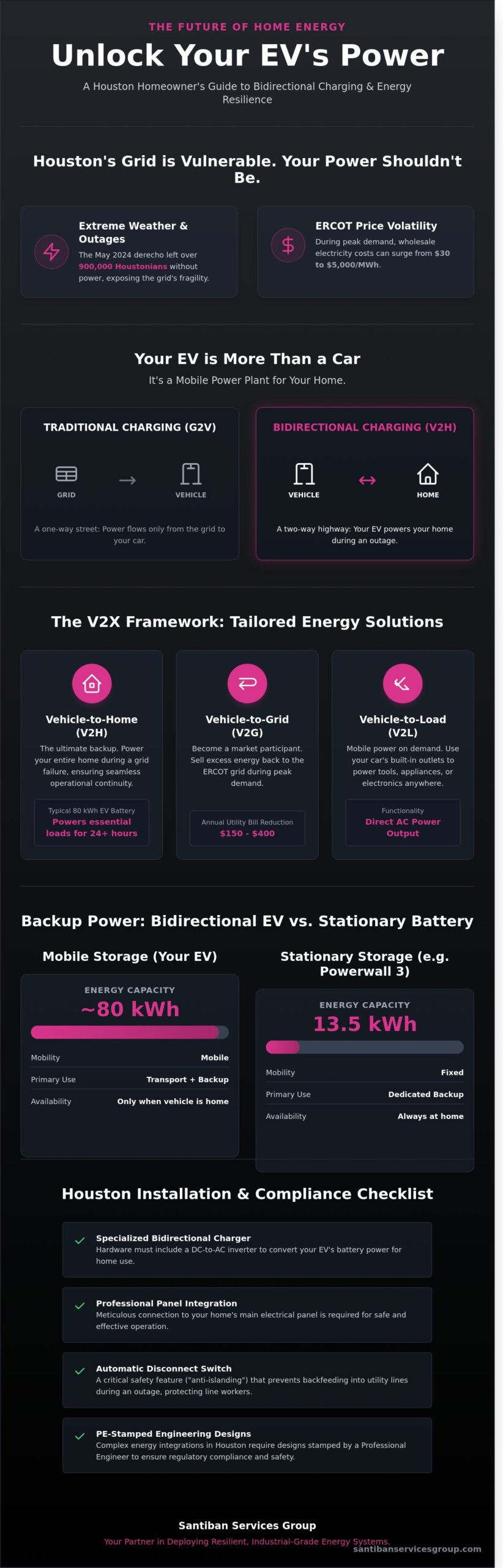
The V2X (Vehicle-to-Everything) framework provides tailored solutions for different energy needs. Vehicle-to-Home (V2H) is the most critical for Houstonians, as it allows an EV to power a house during a total grid failure. During a typical 24-hour outage, a fully charged 80 kWh battery can sustain essential household loads without interruption. Vehicle-to-Grid (V2G) allows users to sell energy back to the ERCOT market during peak demand, potentially reducing annual utility costs by $150 to $400. Vehicle-to-Load (V2L) provides a simpler interface, enabling the car to power specific tools or appliances directly through built-in outlets.
The Hardware: How Bidirectional Conversion Works
The technical complexity of a bidirectional ev charger lies in its internal inverter. This component must convert the battery’s Direct Current (DC) back into Alternating Current (AC) that matches the home’s 60Hz frequency. Standard Level 2 chargers don’t include these conversion circuits, as they rely on the car’s onboard charger for one-way rectification. Effective 2026, most new EV models will support either the North American Charging Standard (NACS) or Combined Charging System (CCS) protocols for bidirectional use. These systems require meticulous integration with the home’s electrical panel and a dedicated disconnect switch to prevent backfeeding into the utility lines during repairs.
The Strategic Advantage for Houston Homeowners and Businesses
The Texas energy landscape presents unique challenges that demand sophisticated management solutions. Residents and facility managers often face extreme price volatility within the ERCOT market, where wholesale electricity costs can surge from $30 per megawatt-hour to the $5,000 cap during peak demand. Utilizing The Strategic Advantage for Houston Homeowners and commercial entities involves more than basic convenience; it’s a calculated move toward total energy independence. By integrating a bidirectional ev charger, property owners can decouple their operations from the grid during these expensive intervals. This meticulous approach to energy consumption reduces monthly utility overhead by an estimated 15% to 25% during the high-heat months of July and August.
Industrial clients prioritize 24/7 uptime to maintain operational continuity. A bidirectional system serves as a silent engine for facility resilience, ensuring that critical systems remain functional even when the external grid falters. For businesses planning to scale their electric vehicle operations, implementing commercial EV charging infrastructure in Houston requires the same level of precision and engineering expertise. Santiban Services Group provides the technical expertise required to implement these integrated energy systems, positioning your property as a high-end, future-proof asset. Advanced infrastructure like this increases property valuation, as modern buyers and corporate tenants prioritize sites with built-in energy redundancy and sustainable technology.
Backup Power During Houston Storms and Hurricanes
Houston’s climate necessitates robust contingency planning. Traditional home battery units typically offer 13.5 kWh of storage, which is often insufficient for extended outages. In contrast, an electric vehicle battery generally holds between 60 kWh and 100 kWh of energy. This massive capacity allows a bidirectional ev charger to sustain a standard 2,500-square-foot home for three to five days. It provides a mobile, high-capacity reservoir that offers peace of mind during hurricane season. This level of reliability ensures that refrigeration, medical equipment, and climate control remain active when local infrastructure fails.
While securing your home’s power provides critical peace of mind, managing the personal stress of potential emergencies is just as important for your family’s well-being. For those interested in holistic approaches to personal resilience, you can learn more about SoliVana Wellness and the services they offer to support overall health.
Economic Benefits: Arbitrage and Grid Services
The deregulated Texas market creates a prime environment for energy arbitrage. This strategy involves charging the vehicle during off-peak hours when rates are lowest and discharging that power back into the home or grid when prices peak. In 2023, ERCOT launched the Aggregate Distributed Energy Resource (ADER) pilot program, which allows participants to earn incentives by contributing to grid stability. These programs effectively lower the total cost of EV ownership by generating passive revenue. For those seeking tailored infrastructure solutions, these financial benefits transform a vehicle from a depreciating asset into a functional component of a profitable energy ecosystem.
Bidirectional Charging vs. Tesla Powerwall 3: Which is Better?
Choosing the right energy architecture requires a meticulous assessment of your facility’s power demands. Stationary storage systems like the Tesla Powerwall 3 offer a permanent, always-active solution. Mobile storage via an electric vehicle provides a massive energy reservoir on wheels. When evaluating a Bidirectional Charging vs. Tesla Powerwall 3 setup, property owners must analyze their specific load requirements and frequency of grid instability. Santiban Services Group specializes in deploying these technologies to create a resilient, single-source energy ecosystem that prioritizes operational continuity.
Response Time and Reliability
The Tesla Powerwall 3 functions as a dedicated safeguard with a 10-millisecond response time. This speed is critical for maintaining the operation of medical equipment and home servers without interruption. An EV battery is only a resource when the vehicle is parked and plugged in. This creates a readiness variable that may leave a home vulnerable during unexpected outages. Santiban integrates both systems to eliminate this risk. We position the Powerwall as the primary gateway, ensuring a seamless transition while the bidirectional ev charger acts as an extended duration backup. This layered approach guarantees that your home remains powered even if the vehicle is in use during the onset of a blackout.
Capacity and Discharge Rates
EV batteries offer superior total capacity, often exceeding 80 kWh. This is nearly six times the storage of a standard 13.5 kWh Powerwall unit. Despite this, the Powerwall 3 excels in discharge performance. It provides 11.5 kW of continuous power, which is necessary to cycle heavy industrial-grade HVAC units during a Houston heatwave. Many vehicle-to-home systems are currently limited in their peak discharge rates.
- Powerwall 3: 11.5 kW continuous power for heavy motor starts and HVAC loads.
- EV Battery: 60 to 100 kWh total capacity for long-term energy endurance.
- Hybrid Setup: Uses the Powerwall for peak surges and the EV for sustained base loads.
Investing in a second stationary battery typically costs $11,000 or more. Utilizing a bidirectional ev charger allows you to leverage an asset you already own. This approach delivers a more favorable cost-per-kWh ratio for long-term energy independence. Santiban’s tailored configurations ensure your car maintains a 20% minimum reserve. This prevents you from being stranded after a storm while still providing days of backup power. Our teams focus on the excellence of every detail to ensure these two systems communicate flawlessly within your home’s electrical panel.
Houston Installation Requirements: Engineering and Compliance
Integrating a bidirectional ev charger into a Houston residence involves technical complexities that exceed standard electrical work. Texas regulations, specifically those governed by the 2023 National Electrical Code (NEC), treat these systems as distributed energy resources. This classification means your vehicle essentially functions as a localized power plant. CenterPoint Energy requires a formal Interconnection Agreement for any system capable of two-way flow. This protocol ensures that power doesn’t backfeed into the municipal grid during outages, which protects utility technicians working on downed lines. Houston’s proximity to the Gulf Coast also necessitates specific structural considerations for outdoor equipment to withstand wind speeds of 130 mph or higher.
The Role of PE-Stamped Engineering
Professional Engineer (PE) stamps are mandatory for V2H integrations in the Greater Houston area. Our engineers perform meticulous load calculations to ensure the existing electrical panel handles the reverse current without exceeding the 120% busbar capacity rule. We analyze the home’s peak demand, which often exceeds 18,000 watts during peak summer months, to prevent thermal overloads during discharge cycles. The foundation of any reliable bidirectional system starts with proper electrical infrastructure, including installing a NEMA 14-50 outlet for EV charging in Houston that meets industrial-grade standards. Santiban’s in-house engineering department manages these technical designs. This integrated approach ensures every project meets rigorous standards before the first wire is pulled. We provide a single-source solution that eliminates the friction between third-party designers and local installers.
Permitting and Inspections in Houston, TX
Securing a permit from the City of Houston Building Code Enforcement requires detailed site plans and equipment specifications. The process is disciplined and follows a specific sequence to ensure residential safety. The city requires proof of automatic islanding, a safety feature that isolates your home from the grid during a blackout. This is a non-negotiable requirement for all V2H systems installed in 2024. Working with a qualified professional ev installer near me ensures your project meets the 2026 Houston building codes and CenterPoint Energy regulations from the outset. The inspection process typically involves three distinct phases:
- Plan Review: Submission of an integrated electrical diagram showing the automatic transfer switch placement.
- Equipment Verification: Confirming the inverter meets UL 1741 SB standards for grid-supportive utility-interactive equipment.
- Final Field Inspection: A physical test where city officials verify the system disconnects from the grid within 100 milliseconds of a simulated failure.
Our dedicated teams coordinate these inspections to ensure a seamless transition from installation to operation. We focus on the excellence of every detail, from conduit weatherproofing to the final software configuration. This methodical approach guarantees your system is both legal and safe for long-term use.
Implementing Your Resilient Energy Solution with Santiban
Santiban Services Group applies industrial-grade precision to residential energy infrastructure. We recognize that a bidirectional ev charger is a strategic asset rather than a simple appliance. Our approach prioritizes corporate-level stability for the Houston homeowner. Every project begins with a rigorous site assessment. We examine your electrical panel capacity, existing solar inverter configurations, and structural mounting requirements. Our internal engineering team manages the transition from initial design to final PE-stamped commissioning. This professional oversight ensures your system meets the highest safety standards and operational benchmarks. We function as a silent engine, managing the complexities of permitting and grid synchronization so you don’t have to. Our commitment to excellence in every detail means we treat your home’s energy resilience with the same gravity as a commercial facility.
Custom Tailored Energy Design
Individual energy needs vary based on household consumption and vehicle specifications. We evaluate your vehicle’s battery chemistry and discharge rates to optimize the integration. If your home utilizes a 12kW solar array—or if you’re considering one, like a solar panel installation San Antonio to complement your EV—we synchronize the bidirectional ev charger to capture excess generation. Planning for solar requires precise roof measurements, and many contractors use 1ESX Roof & Wall Reports to ensure an accurate design. This configuration can lower peak-time energy costs by 25% or more. Our team provides the precise documentation required for Texas energy incentives. We help you navigate the 30% federal tax credit and local utility rebates. This meticulous attention to detail maximizes your return on investment while enhancing home reliability. We ensure your system is ready for the specific demands of the Texas power market, including participation in demand response programs where applicable.
Start Your Houston Energy Upgrade Today
Selecting a Tesla-certified installer is essential for seamless backup integration. Our technicians hold the specialized certifications necessary to install the Tesla Universal Wall Connector and Powerwall systems. We maintain a disciplined timeline for every deployment. Most Gulf Coast installations move from audit to activation within 45 to 60 days. This period includes the necessary coordination with local utility providers like CenterPoint Energy. Our dedicated teams focus on excellence in every detail to ensure your home remains powered during grid instability. We understand the unique challenges of Houston’s energy future, from seasonal hurricanes to grid congestion. You can take the first step toward energy independence by contacting our specialists for a comprehensive home audit. We’re ready to provide the high-end strategic partnership your home deserves.
Secure Your Resilience with Houston’s Energy Leaders
Adopting a bidirectional ev charger shifts your vehicle from a simple transport tool to a critical component of your property’s infrastructure. This technology provides an integrated solution for Houston’s unique energy challenges, offering a reliable power source during grid fluctuations. Our team ensures every installation meets meticulous standards through in-house PE-stamped engineering design, ensuring your system is both compliant and durable. We leverage 24 years of Texas industrial electrical experience to manage the complex logistics of these high-capacity systems.
Santiban Services Group operates as a single-source partner for sophisticated energy needs. As Tesla-Certified Energy Installers, we provide the technical expertise required for seamless integration between your vehicle and your electrical panel. We prioritize excellence in every detail, from initial load calculations to final testing. You’ll gain a partner dedicated to maintaining your property’s operational stability through superior craftsmanship and authoritative industry knowledge.
Secure Your Houston Home with Professional Bidirectional EV Charging Solutions
We look forward to fortifying your home’s energy future with a solution built for long-term reliability.
Frequently Asked Questions
Is my EV compatible with bidirectional charging in 2026?
Most major automotive manufacturers have committed to full bidirectional compatibility for their 2026 model lineups. General Motors confirmed that all Ultium-platform vehicles will support vehicle-to-home power by 2026. Brands like Hyundai and Kia already utilize the E-GMP architecture to support these functions. You should verify your specific VIN with the manufacturer to ensure the onboard software supports bidirectional energy flow.
Does using my car to power my home void the battery warranty?
Using a bidirectional ev charger doesn’t void your battery warranty if you use manufacturer-approved equipment. The Magnuson-Moss Warranty Act protects your rights as a consumer in these instances. Manufacturers like Ford and Nissan explicitly support vehicle-to-home discharge within their standard 8-year or 100,000-mile battery warranties. Our team ensures that every installation adheres to these specific manufacturer guidelines to maintain your coverage.
How much does a bidirectional EV charger installation cost in Houston?
A professional installation in the Houston area typically costs between $4,500 and $8,200 for residential properties. This total includes the hardware unit, which ranges from $2,000 to $5,000, and professional labor for electrical upgrades. Costs vary based on your home’s existing electrical panel capacity. For a detailed breakdown of all factors affecting your investment, including permit fees and electrical upgrades, you can review our comprehensive guide on EV charger installation costs in Houston. Santiban Services Group provides meticulous site assessments to deliver a fixed-price quote that covers all necessary copper wiring and permit fees.
Do I need a special permit from CenterPoint Energy for bidirectional charging?
You must file an Interconnection Agreement with CenterPoint Energy before operating a bidirectional system in the Houston territory. This administrative process requires a $75 application fee and a technical review of your equipment. The permit ensures your system includes an automatic disconnect switch to prevent backfeeding the grid. This safety measure protects utility technicians who work on local lines during widespread power outages.
Can a bidirectional charger replace a Tesla Powerwall 3?
A bidirectional ev charger serves as a viable alternative to a Tesla Powerwall 3 by utilizing the massive battery already in your driveway. While a Powerwall 3 stores 13.5kWh of energy, a standard electric truck offers between 98kWh and 131kWh of capacity. This represents nearly ten times the storage potential for a lower total investment. It’s a superior, integrated solution for homeowners who prioritize high-capacity emergency backup.
What happens to my car’s range if I use it for home backup power?
Powering a standard home for 24 hours typically reduces your driving range by 35 to 45 miles. Most Houston households consume approximately 30kWh of electricity daily. If your vehicle has a 100kWh battery, you’ll still have 70% of your charge remaining after a full day of backup use. You can set a discharge limit in your car’s settings to ensure you always keep enough range for emergency travel.
Is bidirectional charging safe during a Houston hurricane?
Bidirectional systems are engineered for safety during extreme weather if the hardware is installed 12 inches above the 100-year flood plain. We utilize NEMA 4X rated enclosures that are tested against wind-driven rain and salt spray. The system automatically isolates your home from the external grid within 100 milliseconds of a detected failure. This prevents electrical surges and keeps your family safe while the primary infrastructure is compromised.
How long can an EV power a typical Houston home?
A fully charged electric vehicle can power a typical Houston residence for 3 to 10 days depending on your energy management. A vehicle with a 131kWh battery supports essential loads like refrigeration, fans, and LED lighting for over a week. If you choose to run a 3-ton central air conditioning unit, the duration drops to roughly 48 hours. For homeowners considering their charging infrastructure needs, understanding the fundamentals of level 2 charger installation in Houston provides the foundation for building a comprehensive home energy system. We provide tailored solutions to help you prioritize critical circuits during extended outages.