
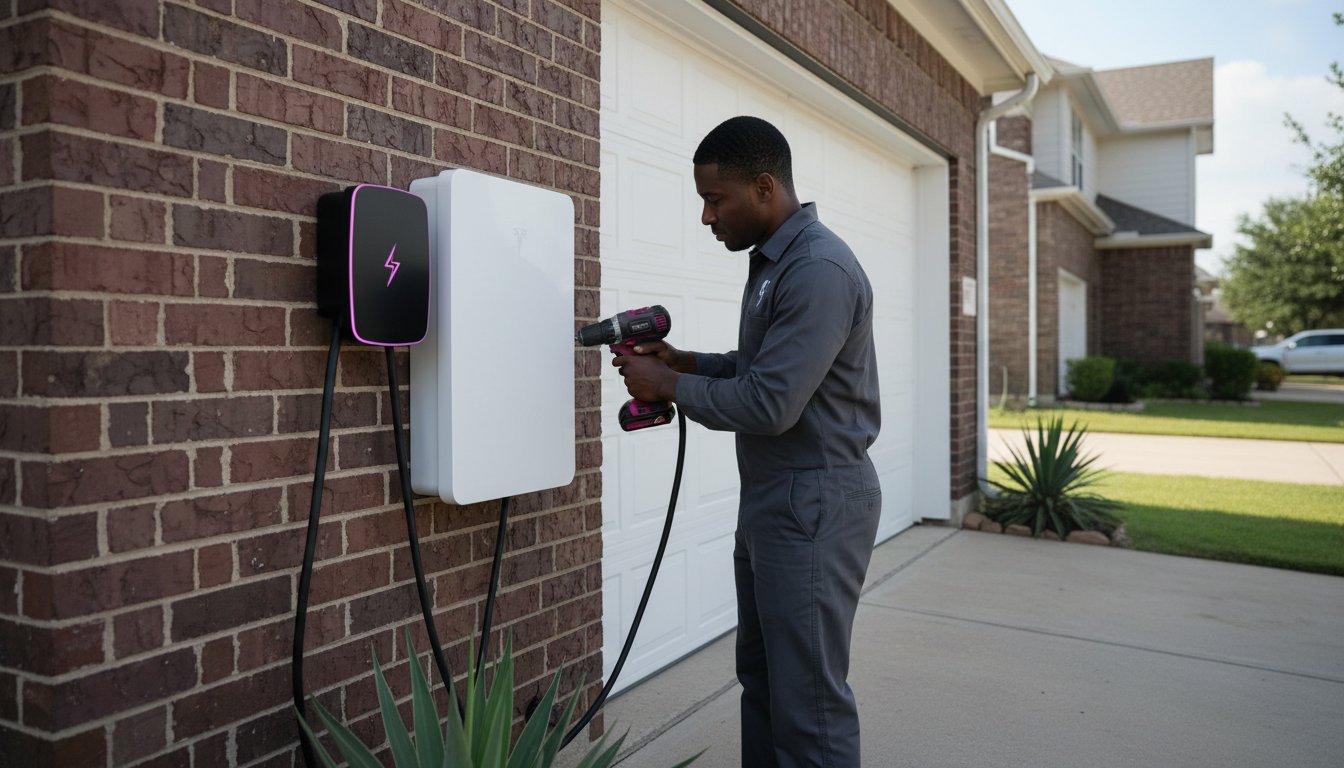
The City of Houston’s Climate Action Plan targets 500,000 electric vehicles on local roads by 2030, which transforms home charging from a luxury into a critical infrastructure requirement. Finding a professional ev installer near me is no longer just about convenience; it is about ensuring your residence meets the rigorous 2026 Houston building codes. You’ve likely felt the frustration of deciphering Level 2 versus Level 3 requirements or the genuine fear that an uncertified installation might lead to a panel overload. These concerns are valid in a landscape where electrical safety and municipal compliance are non-negotiable.
We understand that reliability is your primary concern when upgrading your home’s electrical system. This guide provides the expert clarity you need to navigate CenterPoint Energy regulations and complex local permitting. We’ll show you how a meticulous engineering approach ensures a safe, fast, and reliable charging setup that integrates perfectly with your solar or battery storage. You’ll gain a comprehensive understanding of the technical standards required to protect your property and ensure your transit remains uninterrupted.
Key Takeaways
- Identify the critical certifications and licensing requirements necessary to distinguish a qualified professional from a standard contractor.
- Compare the performance metrics of high-capacity hardwired stations to select the ideal ev installer near me for your specific charging needs.
- Understand the necessity of PE-stamped engineering and comprehensive load calculations to ensure your electrical infrastructure remains compliant and safe.
- Evaluate the long-term financial benefits of smart charging technology in navigating the unique fluctuations of the Texas energy market.
- Discover the essential verification steps for hiring a contractor with the industrial expertise required for complex Houston installations.
Why EV Installer Near Me Searchers in Houston Require Specialized Expertise
Identifying a qualified ev installer near me in the Houston metropolitan area is a critical step for modern homeowners. A professional installer isn’t merely a technician; they are a licensed electrical contractor with specialized certifications in electric vehicle supply equipment (EVSE). This expertise is vital because residential Level 2 charging differs fundamentally from the high-voltage infrastructure found in industrial settings. Our team provides the technical precision required to bridge that gap safely.
Houston residents face unique environmental challenges, specifically a high-heat climate where summer temperatures frequently surpass 100 degrees Fahrenheit. These conditions increase electrical resistance and can degrade inferior components quickly. Professional teams integrate tailored thermal management strategies to maintain charging efficiency even during a Texas heatwave. For those planning their infrastructure budget, the baseline ev charger installation cost reflects these high standards of safety and localized engineering.
The Limitations of Standard Residential Outlets
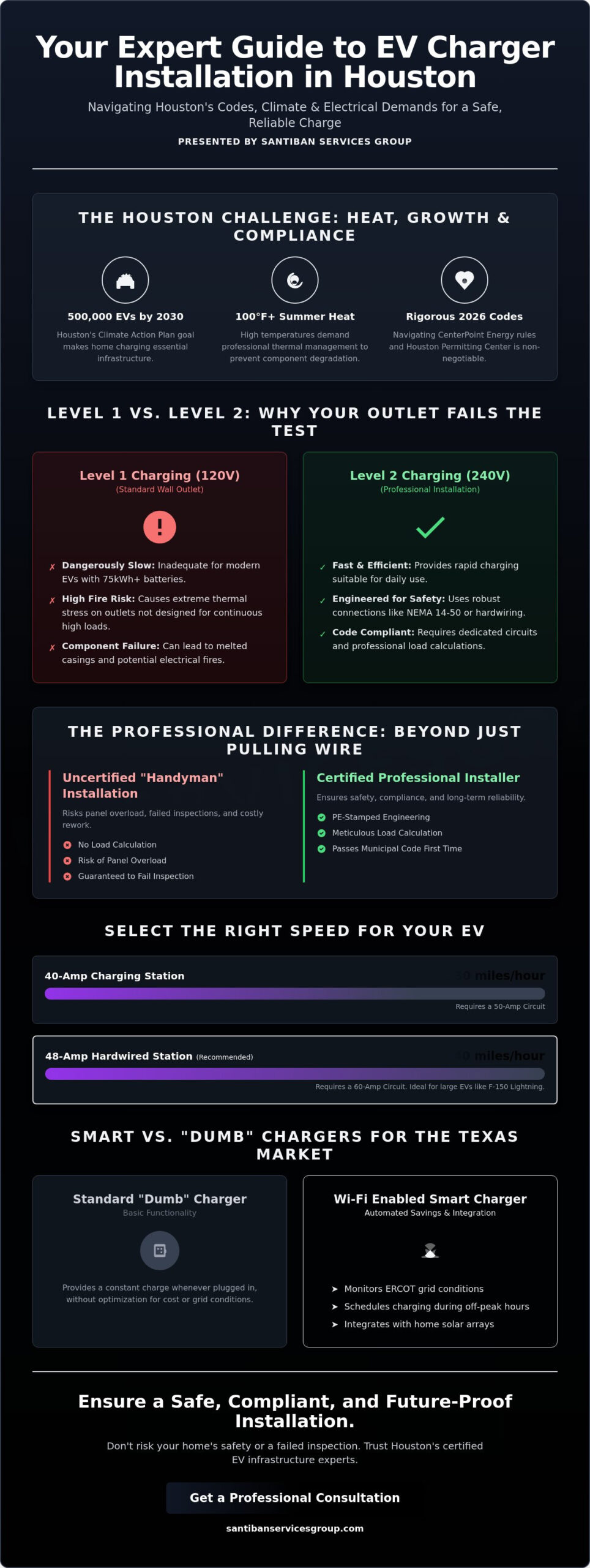
A standard 120V Level 1 outlet cannot meet the demands of a 2026 commuter. With average battery sizes now exceeding 75kWh, Level 1 charging is too slow for daily use. Constant draws on a standard household outlet create extreme thermal stress, as these sockets weren’t designed for continuous high-amperage loads. This often leads to melted casings or electrical fires. We recommend the 14-50 outlet as the absolute minimum standard for any professional installation. It provides the robust connection needed for consistent, safe power delivery.
The Professional Difference: Beyond the Wire
Professionalism extends beyond simply pulling wire through a wall. It involves a meticulous load calculation to ensure your electrical panel can support an additional 32 to 48 amps. Without this analysis, you risk frequent circuit breaker trips or damage to your home’s main service. Dedicated circuits are mandatory to isolate the vehicle’s draw from the rest of the house. Opting for uncertified “handyman” services often leads to expensive rework after a failed inspection at the Houston Permitting Center. A reputable ev installer near me provides the documentation and technical precision required to pass municipal codes and ensure long-term reliability.
Comparing EV Charging Solutions for Texas Homeowners
Selecting the appropriate charging hardware requires a meticulous evaluation of daily driving habits and your home’s electrical capacity. A 40-amp charging station typically delivers about 30 miles of range per hour of charging. In contrast, a 48-amp hardwired unit increases this delivery to approximately 36 to 40 miles per hour. For many Houston residents searching for an ev installer near me, the 48-amp solution is the preferred choice for high-capacity vehicles like the Ford F-150 Lightning or the Rivian R1S. These higher-output stations require a dedicated 60-amp circuit to maintain the 80 percent continuous load safety margin required by electrical codes.
The distinction between smart chargers and “dumb” chargers is particularly relevant given the volatility of the Texas energy market. Smart chargers utilize Wi-Fi connectivity to monitor ERCOT grid conditions and schedule charging during off-peak hours when rates are lower. This functionality is essential for homeowners who want to automate their savings without manual intervention. These systems also allow for seamless integration with existing solar panel arrays. By prioritizing excess solar generation for your vehicle, you create a self-sustaining energy loop that maximizes your renewable assets. You can find detailed technical specifications for these units in our level 2 charger installation near me guide.
Hardwired vs. Plug-In Installations
Hardwired installations offer superior long-term reliability and are the professional standard for high-amperage 48-amp stations. While plug-in solutions using a NEMA 14-50 outlet provide flexibility for equipment upgrades, they introduce additional points of failure. Current electrical codes require GFCI protection for plug-in chargers, which can sometimes lead to nuisance tripping with certain EV models. For Houston properties where the charger is located in an outdoor driveway, a hardwired connection provides a more robust, weather-resistant seal against high humidity and coastal storms. Securing a safe and code-compliant installation ensures that your setup adheres to the latest 2026 safety standards for residential electrical systems.
Future-Proofing with Bidirectional Charging
Vehicle-to-Home (V2H) technology is transforming the EV from a simple transport tool into a strategic home energy asset. By 2026, bidirectional capabilities will be a standard requirement for homeowners seeking grid resilience during Texas weather events. A bidirectional ev charger allows your car to act as a mobile battery, supplementing systems like the Tesla Powerwall to keep critical loads running during an outage. This setup requires specialized power conversion hardware and a compatible vehicle interface. Consulting with an experienced ev installer near me is the most effective way to ensure your panel is ready for these advanced integrations. Our team can provide a tailored infrastructure assessment to help you determine the best path forward for your specific property.
The Critical Role of PE-Stamped Engineering and Panel Upgrades
Finding a qualified ev installer near me involves more than a simple equipment purchase; it requires a partner capable of managing Houston’s specific infrastructure challenges. In historic neighborhoods like The Heights or established areas like River Oaks, many residences operate on 100-amp or 150-amp electrical services. These systems weren’t designed for the 48-amp continuous draw required by modern Level 2 chargers. Santiban provides PE stamped engineering for solar systems and EV chargers to ensure every installation remains compliant with 2026 safety standards. Our in-house engineering team manages the technical complexities of industrial-scale projects, bringing that same level of meticulous oversight to sophisticated residential setups.
Homeowners often question the necessity of a panel upgrade for a single charger. The reality is that overloading an aging panel creates significant thermal stress, increasing the risk of equipment failure or electrical fires. We prioritize reliability by conducting detailed load calculations before any hardware is mounted. This authoritative approach ensures your home’s electrical backbone can support new demands without compromising existing appliances.
Assessing Your Electrical Service Capacity
A standard 100-amp service often reaches its maximum capacity when the HVAC system and electric dryer run at the same time. Adding an EV circuit to an already taxed system leads to frequent breaker trips and potential damage to sensitive electronics. Santiban manages the entire service entrance upgrade process. We coordinate directly with CenterPoint Energy to increase the feed from the utility pole to your meter, providing a seamless transition to a 200-amp or 400-amp service. This integrated strategy is vital for multi-EV households where improper load management can lead to catastrophic system failure. We ensure your infrastructure is ready for the future, not just the current week.
Why Engineering Stamps Matter for Permitting
The Houston Permitting Center maintains strict requirements for structural and electrical compliance. A Professional Engineer (PE) stamp acts as a formal guarantee that your project design adheres to the National Electrical Code (NEC). This certification minimizes administrative delays and ensures your project moves through the approval phase without friction. While the technical requirements are rigorous, property owners can access Texas incentives to assist with the financial aspects of these critical infrastructure upgrades. As a single-source provider, Santiban eliminates the need for separate contractors and consultants. We provide the design, the engineering, and the construction, acting as a silent engine that keeps your project on schedule and within 2026 compliance guidelines.
Actionable Steps to Hiring a Houston EV Installer
Selecting a professional ev installer near me requires more than a simple digital search; it demands a rigorous vetting process based on technical certification and local compliance. You must first verify the contractor’s Texas Electrical Contractor License (TECL). This credential confirms the firm meets the Texas Department of Licensing and Regulation (TDLR) standards for safety and insurance. A valid TECL ensures the team possesses the specialized training to handle high-voltage equipment safely.
Insist on a comprehensive load calculation rather than a verbal estimate. A meticulous installer will evaluate your property’s existing electrical capacity, often a 200-amp or 400-amp service, to determine if it can support the 40-amp to 80-amp draw of a Level 2 charger. This data-driven approach prevents circuit overloads and ensures your home’s electrical system remains stable. Additionally, confirm the installer’s familiarity with CenterPoint Energy interconnection standards. Proper coordination with the local utility is essential for maintaining grid stability and meeting specific equipment requirements.
Property managers and business owners should prioritize different criteria. Evaluate the contractor’s specific experience with commercial ev charging if you are managing a multi-family complex or office park. These large-scale deployments involve complex power distribution and software integration that differ significantly from residential setups. When you need a reliable ev installer near me, Santiban Services Group offers the structured, disciplined approach required for these sophisticated infrastructure projects.
Questions to Ask During the Quote Process
- Will you be pulling a permit with the City of Houston? Legal permitting ensures the work undergoes a third-party safety inspection, which is vital for insurance compliance and resale value.
- How do you handle thermal management for outdoor charger placements? Houston’s 100-degree summer temperatures can degrade hardware performance. A professional installer should recommend shaded placements or hardware with superior heat dissipation.
- Do you provide a comprehensive warranty on both labor and materials? Reputable firms stand behind their work with clear, written guarantees that protect your investment long after the initial setup.
Navigating Local Rebates and Incentives
The Federal Alternative Fuel Vehicle Refueling Property Credit remains a critical financial tool in 2026. This incentive allows eligible residents to claim a 30% credit on installation costs, capped at $1,000 for residential properties. Your installer must provide detailed, line-item invoices to support this claim during tax season.
Locally, Houston residents should investigate CenterPoint Energy’s time-of-use programs. These initiatives offer lower electricity rates for charging during off-peak hours, typically between 10:00 PM and 6:00 AM. Your contractor should help you select “smart” chargers that can be programmed to automate this process. Ensure your installer provides the specific technical documentation required by these utility programs to secure your financial benefits.
Experience the precision and reliability of a dedicated facility partner by contacting Santiban Services Group for your infrastructure needs.
Santiban Services Group: Authoritative EV Infrastructure in Houston
Santiban Services Group leverages more than 24 years of industrial electrical expertise to redefine residential power standards in Houston. As a Tesla-certified installer for both the Powerwall 3 and advanced charging solutions, the firm operates with a level of technical precision that standard contractors rarely match. Finding a reliable ev installer near me involves more than a simple search; it requires vetting for a partner that understands the rigorous demands of high-voltage infrastructure. We position ourselves as the premier choice for homeowners who value meticulous planning and tailored energy systems over quick, superficial fixes. Our background in large-scale facility management ensures that every residential project benefits from a disciplined, corporate-grade approach to safety and performance.
Comprehensive Energy Ecosystems
Modern residential energy needs are becoming increasingly complex. We address this by integrating EV charging hardware with the Tesla Powerwall 3 to create a total home resilience package. This ecosystem allows users to manage energy flow during peak demand periods, ensuring the vehicle stays charged even when the local grid fluctuates. Our services also include solar reroofing to support the increased electrical load of multiple electric vehicles. This ensures the roof structure can support the 25-year lifespan of a modern solar array. We bring industrial-grade reliability to every home installation. By utilizing heavy-duty components and precise load balancing, we ensure your system handles the continuous 11.5 kW draw of a Level 2 charger without the risk of overheating or circuit degradation.
Our Commitment to Professional Excellence
The Santiban mantra, “Excellence in every detail,” isn’t just a slogan. It’s a disciplined operational standard. Our dedicated teams receive continuous training on the NEC 2026 standards, which introduce stricter requirements for residential battery backup and high-capacity circuits. This commitment ensures that every installation is compliant, safe, and built for the next decade of automotive technology. We act as a silent engine for your home, providing the stable power needed to keep your life moving forward without interruption. If you’re searching for a professional ev installer near me, you need a provider that treats your garage like a mission-critical facility.
Our process is designed for clarity and predictable outcomes. To begin your upgrade, we recommend the following steps:
- Professional Site Assessment: Our experts conduct a thorough evaluation of your electrical panel, existing wiring, and structural capacity.
- Tailored Proposal: We provide a comprehensive, data-driven plan that outlines the necessary infrastructure for your specific vehicle and home layout.
- Seamless Execution: Our technicians handle the permitting and installation with minimal disruption to your daily operations.
Contact Santiban Services Group today to schedule a formal consultation. Whether you are preparing for your first electric vehicle or upgrading an existing industrial site, we deliver the authoritative expertise required for 2026 energy solutions.
Future-Proof Your Houston Property with Expert EV Infrastructure
As Houston moves toward the 2026 energy landscape, securing a reliable charging solution is a critical step for modern homeowners and facility managers. A successful transition requires more than a simple plug; it demands the technical precision of in-house PE-stamped engineering design to guarantee long-term safety and code compliance. Santiban Services Group leverages over 24 years of industrial electrical experience to deliver these results. We don’t just install hardware; we provide integrated systems that protect your property’s electrical integrity through meticulous planning.
When you’re searching for a qualified ev installer near me, it’s vital to choose a partner with proven credentials. As a Tesla Certified Installer, our team ensures every detail aligns with manufacturer standards. We offer tailored solutions that fit your specific load requirements, preventing the need for future costly retrofits. Our disciplined approach provides the corporate stability you need for a seamless infrastructure upgrade that lasts.
Request a Professional EV Infrastructure Consultation with Santiban Services Group
Take the proactive step today to ensure your charging capabilities remain robust and reliable for years to come.
Frequently Asked Questions
How do I find a qualified EV installer near me in Houston?
Search for a licensed Texas electrical contractor specializing in EVSE infrastructure through the Texas Department of Licensing and Regulation (TDLR) database. Selecting an ev installer near me ensures they understand Houston’s specific 2026 building codes and CenterPoint Energy utility requirements. Our dedicated teams provide a single-source solution for residential and commercial installations across Harris County, maintaining excellence in every technical detail for your peace of mind.
Do I need a permit to install an EV charger at my Houston home?
Yes, the City of Houston Building Code requires a formal electrical permit for all Level 2 EVSE installations. According to the Houston Public Works department, electrical work must be performed by a licensed professional to ensure compliance with the 2023 National Electrical Code. Our team manages the entire permitting process to provide a seamless and compliant integration into your home infrastructure, ensuring your project meets every regulatory standard.
What is the difference between a Level 2 and Level 3 charger for home use?
Level 2 chargers utilize 240V AC power, while Level 3 chargers require high-voltage DC current typically found in industrial settings. Most Houston homes are equipped for Level 2 units that provide 25 to 40 miles of range per hour. Level 3 systems are rarely installed in residential environments because they require 480V three-phase power, which is absent from 99 percent of the Houston residential electrical grid.
Will installing an EV charger require a full electrical panel upgrade?
An upgrade is required if your existing electrical panel cannot accommodate the additional 40 to 60 amp load required by a Level 2 charger. Many older Houston homes built before 1990 feature 100-amp panels that lack the capacity for modern EVSE. We conduct a meticulous load calculation to determine if a panel expansion or a smart load management system is necessary for safe, integrated operation.
Can I install my own EV charger to save on costs?
You shouldn’t attempt a DIY installation because it violates local Houston building codes and can void your vehicle’s manufacturer warranty. Improper wiring of a 240V circuit poses significant fire risks and safety hazards to your household. Professional installation ensures that every connection meets the rigorous standards of the 2023 NEC, protecting your property and investment through disciplined, expert workmanship and a serious commitment to safety.
How long does a professional EV charger installation take in Texas?
A standard residential installation typically takes between 3 and 5 hours to complete once the permit is secured. This timeframe includes the mounting of the unit, wiring the dedicated circuit, and performing comprehensive system testing. Finding a reliable ev installer near me allows for a predictable schedule. Our organized approach ensures that your charging station is operational with minimal disruption to your daily routine.
Is bidirectional charging available in Houston for 2026?
Bidirectional charging is becoming more accessible in Houston as of early 2026. Models like the Ford F-150 Lightning and the 2026 Hyundai IONIQ 5 support these capabilities when paired with compatible home integration systems. We provide tailored solutions that enable your vehicle to function as a backup power source during grid outages, enhancing your home’s energy resilience through sophisticated, high-end strategic planning.
What are the specific electrical requirements for a Tesla Powerwall 3 integrated charger?
The Tesla Powerwall 3 features an integrated solar inverter and EV charger that requires a 60-amp circuit breaker for maximum output. It delivers up to 11.5 kW of power, which is a 15 percent increase over some previous generation stand-alone units. This superior technology requires a direct connection to the Powerwall’s internal bus, necessitating a precise and professional installation by a certified technician to ensure optimal performance.