
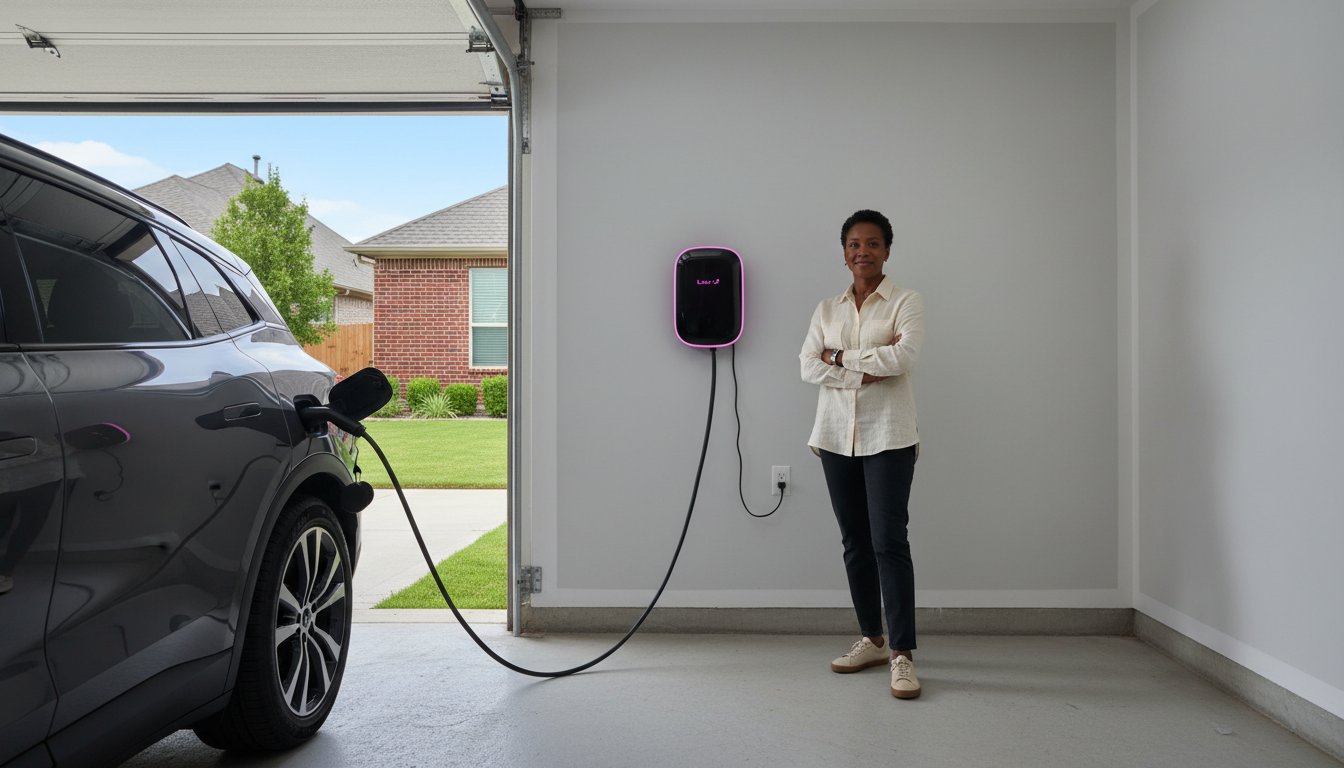
Did you know that Harris County recorded a 42% surge in electric vehicle registrations during the 2025 fiscal year? As more Houstonians transition to sustainable transport, the search for “level 2 charger installation near me” has shifted from a luxury to a technical necessity. You likely understand that relying on a standard wall outlet is inadequate for a 40-mile daily commute. It’s frustrating to face the uncertainty of electrical panel overloads or the complexities of City of Houston permitting codes.
Santiban Services Group provides the authoritative clarity you need to ensure your home infrastructure meets 2026 safety standards. We promise to detail the precise technical requirements, from meticulous load calculations to the seamless integration of your existing solar or battery arrays. This guide outlines the essential steps for a permit-compliant installation that prioritizes long-term reliability and the protection of your property. By following these professional standards, you’ll secure a tailored solution that transforms your garage into a high-performance fueling station while maintaining absolute compliance with local regulations.
Key Takeaways
- Understand why upgrading to a 240V Level 2 system is critical for Houston drivers to eliminate the inefficiencies of standard trickle charging.
- Evaluate the technical benefits of hardwired charging stations versus NEMA 14-50 outlets to achieve superior weatherproofing and higher amperage.
- Navigate the complex 2026 Harris County permitting process and load calculation requirements to ensure a compliant and safe electrical installation.
- Discover how a professional level 2 charger installation near me protects your home infrastructure against high-heat environments and grid instability.
- Learn how integrated energy solutions from Tesla-certified professionals provide the reliability and stability required for complex residential power systems.
What is Level 2 Charging and Why is it Essential for Houston Drivers?
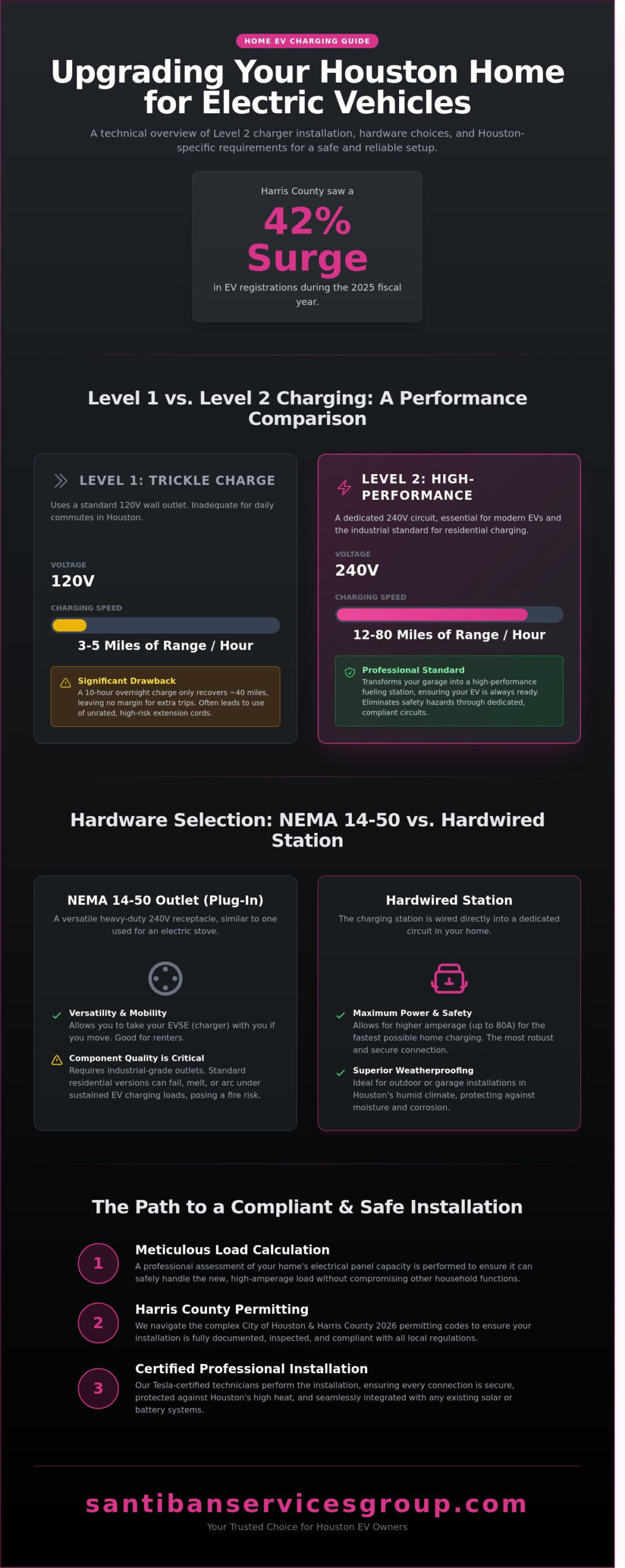
Level 2 charging represents a significant advancement in residential energy infrastructure, utilizing 240V AC power to deliver between 12 and 80 miles of range per hour of connectivity. For homeowners seeking a level 2 charger installation near me, understanding the mechanics of this technology is vital. Unlike basic outlets, a dedicated electric vehicle charging station acts as a sophisticated safety gateway. This equipment, formally known as Electric Vehicle Supply Equipment (EVSE), manages the handshake between the grid and the vehicle. It ensures that high-amperage current only flows when a secure, fault-free connection is established. This meticulous control protects your home’s electrical system and optimizes the long-term performance of the vehicle’s battery by maintaining stable thermal conditions during the charging cycle.
The Technical Advantage of 240V Power
The primary benefit of Level 2 systems lies in the transition from standard 120V residential current to 240V service. By doubling the voltage, the system effectively quadruples the power delivery to the vehicle’s onboard charger. This efficiency is no longer a luxury in 2026; it’s a requirement for modern EVs equipped with high-capacity batteries often exceeding 85 kWh. Level 2 charging serves as the industrial standard for residential energy efficiency. Our dedicated teams provide integrated solutions that ensure your electrical panel can handle these increased loads without compromising other household functions. Transitioning to this standard ensures your vehicle is always ready for immediate deployment, mirroring the reliability expected in professional logistics environments.
Level 1 vs. Level 2: A Practical Comparison
Houston’s sprawling geography creates unique demands for local drivers. With average daily commutes in the Greater Houston area often exceeding 40 miles, Level 1 “trickle charging” fails to meet basic logistical needs. A standard 120V outlet provides roughly 3 to 5 miles of range per hour. In a typical 10-hour overnight window, a driver might only recover 40 miles of range, leaving zero margin for additional errands or emergency trips. This creates a deficit that compounds over the work week. Beyond the range deficit, relying on Level 1 charging often leads to the dangerous use of unrated extension cords. These cords aren’t designed for the sustained, high-heat loads required by EV batteries and pose a documented fire risk. Professional level 2 charger installation near me eliminates these hazards through tailored electrical circuits designed for continuous operation. We prioritize safety and precision, ensuring your home infrastructure matches the sophistication of your vehicle.
Hardware Selection: Comparing NEMA 14-50 Outlets and Hardwired Stations
Selecting the appropriate equipment is a critical step in a successful level 2 charger installation near me. The decision centers on whether a plug-in NEMA 14-50 outlet or a hardwired station better serves your long-term operational needs. High-quality Level 2 charging hardware operates at 240 volts; it provides significantly faster replenishment than standard household outlets. Homeowners must evaluate their vehicle’s on-board charger capacity. A 48-amp station won’t provide its full benefit if the vehicle is limited to 32 amps. Smart features like WiFi connectivity and load shedding allow for precise energy management and integration with Houston’s fluctuating utility rates. These integrated systems help prevent panel overloads by managing the power draw across multiple household appliances simultaneously.
The NEMA 14-50 Plug-In Option
A NEMA 14-50 outlet offers a versatile solution for residents who value mobility or plan to relocate. This configuration uses a heavy-duty 240V receptacle, which is the same type used for large electric appliances. For those considering installing a NEMA 14-50 outlet for EV charging in Houston, it’s vital to specify industrial-grade components. Standard residential-grade outlets often fail under the sustained, high-amperage draw of an EV. This leads to potential arcing or melting. While convenient, plug-in units are generally capped at 40 amps of continuous output to meet National Electrical Code safety standards. This setup is ideal for renters who need to take their charger with them at the end of a lease.
Hardwired Level 2 Charging Stations
Hardwired installations represent the gold standard for reliability and performance. By connecting the charging station directly to the electrical panel, the system eliminates the plug and receptacle as potential failure points. This method supports higher power delivery, often reaching 48 or 80 amps, which reduces charging times for vehicles with large battery packs. Hardwiring also provides superior weatherproofing for outdoor setups in the Houston humidity. Preparing for a level 2 charger installation near me with a hardwired unit ensures your home is future-proofed for the higher-capacity batteries expected in 2027 and beyond. It’s a permanent solution that adds measurable value to the property.
Santiban Services Group provides meticulous assessments to help you determine which hardware configuration aligns with your facility’s infrastructure. Our tailored electrical solutions ensure your installation meets every safety and performance benchmark. We prioritize long-term reliability by utilizing components that exceed standard residential requirements. This disciplined approach ensures that your charging infrastructure remains a silent, dependable engine for your daily commute.
The Installation Process: Permits, Panels, and Professional Engineering
Professionalism and reliability are the cornerstones of a successful Level 2 charger installation. Homeowners often search for level 2 charger installation near me expecting a simple plug-and-play setup, but the 2026 standards in Houston require a more rigorous technical approach. Every project begins with a meticulous load calculation. This assessment determines if your home’s total electrical demand, including HVAC systems and major appliances, can safely accommodate the sustained high-amperage draw of an EV station. Without this data, you risk localized grid failures or thermal damage to your equipment.
Navigating the City of Houston and Harris County permitting requirements in 2026 involves strict adherence to the latest National Electrical Code (NEC) updates. These regulations ensure that every residential installation meets industrial safety benchmarks. Santiban Services Group manages this entire administrative process, securing the necessary documentation to protect your property value and ensure insurance compliance. A typical timeline for a standard installation spans seven to ten business days, moving from the initial site assessment and engineering design to the physical wiring and final municipal inspection. Working with a qualified professional EV installer near me ensures that every phase of this process adheres to CenterPoint Energy regulations and the latest Houston building codes.
Electrical Panel Upgrades and Capacity
Determining if your 100A or 200A panel can handle an additional 40A to 60A load is a critical safety step. Many Houston residences built before 1995 operate on 100A service, which often reaches 85% capacity during peak summer cooling months. In these instances, a service upgrade to 200A or the integration of a dedicated sub-panel is the most reliable solution. For detailed budget planning regarding these infrastructure improvements, refer to our guide on understanding EV charger installation costs in Houston.
The Necessity of PE-Stamped Engineering
Professional engineering ensures your installation remains compliant with 2026 structural and electrical codes. This level of oversight mirrors the rigorous standards found in PE stamped engineering for solar systems, preventing costly permitting delays and technical errors. Professional engineering is the only way to guarantee industrial-grade safety in a residential setting. Furthermore, a certified engineering plan provides the documentation required to claim the federal tax credit, which currently offers significant incentives for homeowners investing in refueling property. When you prioritize level 2 charger installation near me through a licensed firm, you’re investing in a system designed for long-term stability.
The Santiban Installation Timeline:
- Day 1: On-site load calculation and electrical infrastructure audit.
- Days 2-4: PE-stamped engineering design and permit filing with Harris County.
- Day 5: Physical installation of the dedicated circuit and charging hardware.
- Days 6-10: Final city inspection and system performance verification.
Houston-Specific Factors: Grid Resilience and Environmental Challenges
Houston’s unique climate and infrastructure require a meticulous approach to electrical upgrades. Homeowners must account for the 45 days of 100-degree weather recorded in recent peak summers when planning their energy systems. These environmental stressors dictate the standards for a reliable level 2 charger installation near me. Santiban Services Group ensures every installation meets the rigorous demands of the Gulf Coast environment, prioritizing long-term stability over basic functionality.
Charging in the Houston Heat
Thermal management is a critical consideration for any outdoor-rated charging station in Texas. High ambient temperatures increase electrical resistance, which can lead to equipment derating or hardware failure if not properly managed. Our technicians specify NEMA 4X enclosures to provide superior protection against both heat and humidity. Choosing the correct wire gauge is vital; we often utilize larger conductors than the minimum code requires to mitigate heat buildup during extended charging cycles. Professionals recommend locating chargers on north-facing walls or within shaded areas to minimize direct solar gain. This proactive placement preserves the lifespan of the internal electronics and maintains peak charging speeds throughout the summer months.
Integration with Backup Power Systems
The 2026 energy landscape in Houston emphasizes residential self-sufficiency. Many homeowners now utilize bidirectional EV chargers in Houston to transform their vehicles into mobile power plants during grid instabilities. This technology creates a seamless synergy with systems like the Tesla Powerwall 3, allowing for a robust off-grid strategy. A sophisticated installation includes load shedding protocols. These automated controls ensure your charger doesn’t deplete your home battery during a blackout, prioritizing essential appliances like medical equipment or refrigeration. Our integrated solutions provide the technical precision required to manage these complex energy flows safely.
CenterPoint Energy has updated its 2026 residential requirements to favor smart chargers that support demand-response programs. These initiatives often include utility rebates for homeowners who install grid-aware hardware. Beyond daily efficiency, preparing for hurricane season is a logistical necessity. We advise homeowners to install dedicated surge protection devices at the primary panel to shield sensitive EV components from lightning strikes. During active storm warnings, the safest protocol involves disconnecting the charging cable and securing the unit to prevent water intrusion or wind damage. Reliability in a crisis starts with a professional level 2 charger installation near me from a team that understands local risks.
Contact Santiban Services Group today for a comprehensive site assessment.
Why Santiban Services Group is the Trusted Choice for Houston EV Owners
Santiban Services Group operates as a disciplined, invisible force behind Houston’s most reliable electrical systems. We’ve spent more than 24 years mastering the industrial electrical and renewable energy sectors. This history allows us to provide a comprehensive single-source solution for your property. Our team handles every phase of the project, from initial load calculations to final inspection. Having in-house PE-stamped engineering means your level 2 charger installation near me rests on a foundation of technical excellence. It eliminates the guesswork often found in standard residential work and ensures your home remains compliant with evolving 2026 safety codes.
Certified Tesla Expertise
We serve as a certified Tesla Powerwall installer, which gives our team a unique advantage when managing complex EV integrations. Tesla certification requires a high level of technical proficiency and a commitment to precision. We apply this same meticulous attention to detail to every residential charging project. Our mantra, “Excellence in Every Detail,” drives our staff to exceed standard residential electrical codes. We don’t just pull wires; we design integrated energy ecosystems that support your vehicle and your home’s long-term resilience. This level of expertise ensures that your charging station operates at peak efficiency without compromising the rest of your electrical system.
Commercial and Industrial Standards
Our background in high-voltage systems allows us to apply commercial EV charging infrastructure safety protocols to every residential property. Homeowners benefit from the same load-balancing strategies and safety redundancies we use in large-scale industrial facilities. If you’re searching for a level 2 charger installation near me, you need a partner who understands the cumulative impact on your electrical panel. We provide tailored solutions that consider your specific property layout and your long-term energy goals. Our industrial standards mean we use superior components and wiring methods that are built to last for decades, not just years.
Choosing Santiban Services Group means choosing an established partner that values corporate stability and consistent performance. We offer a range of specialized capabilities to ensure your project is a success:
- Technical Precision: Every project is overseen by experts with 24 years of field experience.
- Seamless Permitting: Our in-house engineering team handles all documentation to avoid delays.
- Integrated Solutions: We manage everything from panel upgrades to solar and battery storage integration.
- Safety Focus: We utilize industrial-grade safety standards to protect your home and vehicle.
Our communication rhythm is steady and professional. We avoid marketing hype in favor of a factual, sober presentation of our capabilities. This transparency builds the trust necessary for a high-end strategic partnership. Request a tailored solution from our dedicated team to secure your home’s energy future with an infrastructure that’s as reliable as it is efficient.
Future-Proofing Your Home for the 2026 Electric Vehicle Standard
As the automotive landscape shifts toward full electrification by 2026, Houston homeowners must prioritize infrastructure that withstands both environmental demands and grid fluctuations. Reliable charging requires more than a simple outlet; it demands a meticulous approach to electrical engineering and local permit compliance. Santiban Services Group provides this stability through 24 years of industrial experience and a specialized team of Tesla Certified Installers. Every project benefits from in-house PE-stamped engineering, ensuring your system meets the highest standards of safety and performance. When you’re searching for level 2 charger installation near me, you need a partner that functions as a silent engine for your home’s operational efficiency. Our comprehensive solutions address everything from panel upgrades to seamless hardware integration, providing the tailored results your property deserves. We’ve built our reputation on corporate stability and a relentless focus on excellence in every detail. You can trust our disciplined teams to handle the complex logistics of your transition to sustainable energy. Schedule your professional Houston EV charger consultation with Santiban Services Group today. We’re ready to power your journey forward with confidence and precision.
Frequently Asked Questions
Do I need a permit to install a Level 2 charger in Houston?
Yes, the City of Houston Houston Public Works department requires a residential electrical permit for all Level 2 EVSE installations. This regulatory requirement ensures your system meets National Electrical Code standards and passes a safety inspection. Our dedicated teams manage the entire permitting process to guarantee your installation is fully compliant with local municipal codes.
How much does Level 2 charger installation cost in Houston for 2026?
Homeowners should budget between $800 and $2,000 for professional labor and materials based on 2024 industry benchmarks from HomeAdvisor. This price range excludes the cost of the charging unit itself and assumes your existing panel has sufficient capacity. Factors like the distance between your electrical panel and the charging port will dictate the final project investment.
Can my existing electrical panel handle a Level 2 EV charger?
Your electrical panel must have at least 40 to 60 amps of available capacity to support a dedicated Level 2 circuit. We perform a meticulous load calculation to determine if your current 100-amp or 200-amp service can sustain the additional demand without overloading. If your panel operates at 90% capacity during peak usage, a smart load-management device or consultation with a certified ev installer near me about a service upgrade is necessary.
What is the difference between a NEMA 14-50 outlet and a hardwired charger?
A hardwired charger provides a superior connection that supports higher charging speeds up to 48 or 80 amps. In contrast, a NEMA 14-50 outlet is limited to 40 amps and requires a GFCI breaker under NEC 2023 guidelines. Hardwiring offers a more integrated and reliable solution for homeowners seeking the fastest possible replenishment of their vehicle’s battery overnight.
Is it safe to install a Level 2 charger outside in Houston weather?
It’s entirely safe to install a Level 2 charger outdoors if the unit carries a NEMA 3R or NEMA 4 weather-resistance rating. These specialized enclosures protect sensitive internal components from Houston’s 50 inches of annual rainfall and extreme humidity levels. When searching for level 2 charger installation near me, ensure your provider uses weather-rated conduits and sealed fittings for all exterior placements.
Will a Level 2 charger work with my Tesla Powerwall 3 system?
The Tesla Powerwall 3 integrates seamlessly with most Level 2 chargers through its advanced energy management software. This configuration allows you to utilize the system’s 11.5 kW continuous power output to charge your vehicle directly from stored solar energy. You can optimize your home’s efficiency by scheduling charging sessions during periods of peak solar production through a single interface.
How long does a professional Level 2 charger installation take?
A standard professional level 2 charger installation near me typically takes between 2 and 4 hours to complete. This timeframe includes mounting the charging station, running the dedicated circuit, and performing comprehensive safety testing. More complex projects that require trenching or main electrical panel upgrades can extend the total duration to a full 8-hour workday.
Are there any Texas state rebates for home EV charger installation?
Texas doesn’t offer a universal state-level rebate, but homeowners can access the federal 30C Alternative Fuel Infrastructure Tax Credit for up to $1,000. Local utility providers like Austin Energy or CPS Energy often provide specific incentives, though Houston residents should verify current programs with CenterPoint Energy. These credits significantly offset the initial costs of hardware and professional labor for eligible residential properties.