

While the average Houston resident consumes 1,419 kWh of electricity per month, that figure tells you almost nothing about your ability to survive a grid failure in triple-digit humidity. Mastering the process of calculating your home energy needs Houston requires a shift in focus from total monthly consumption to instantaneous peak demand. You likely recognize that relying on the Texas grid during a summer heatwave is a significant risk. The common confusion between kilowatt-hours and the surge power required to start a central air conditioner often leads to backup systems that are either dangerously undersized or unnecessarily expensive.
This 2026 resilience guide provides a disciplined framework for auditing your electrical load to size a solar and battery system that actually performs. We will evaluate the specific capabilities of the Tesla Powerwall 3 and EcoFlow solutions, while highlighting why a PE-stamped engineering audit is essential for professional-grade reliability. With the federal solar tax credit having expired at the end of 2025 and the current Tesla rebate deadline approaching on September 30, 2026, maximizing the precision of your system design is now the most effective way to ensure your property remains operational and secure regardless of external conditions.
Key Takeaways
- Distinguish between peak demand measured in kilowatts and total consumption in kilowatt-hours to ensure your backup system maintains critical operations during grid instability.
- Follow a structured methodology for calculating your home energy needs Houston, focusing on appliance nameplate wattage and essential load prioritization.
- Identify the specific surge requirements of your HVAC system to prevent inverter overloads during the peak humidity and extreme heat of a Texas summer.
- Compare the technical specifications of Tesla Powerwall 3 and EcoFlow solutions to select the storage capacity that aligns with your property’s unique energy profile.
- Understand the importance of a PE-stamped engineering audit for streamlining the permitting process and guaranteeing the long-term reliability of your energy infrastructure.
Understanding Your Houston Home Energy Profile
The energy profile of a Gulf Coast residence differs fundamentally from national averages. While generic online calculators often rely on square footage to estimate usage, professional precision requires an analysis of how your home interacts with local environmental stressors. In Houston, the high volume of cooling degree days means your HVAC system operates as the primary driver of both operational costs and infrastructure requirements. Evaluating these variables is the first step in calculating your home energy needs Houston to ensure your backup system remains functional during a grid outage.
The Difference Between Load and Consumption
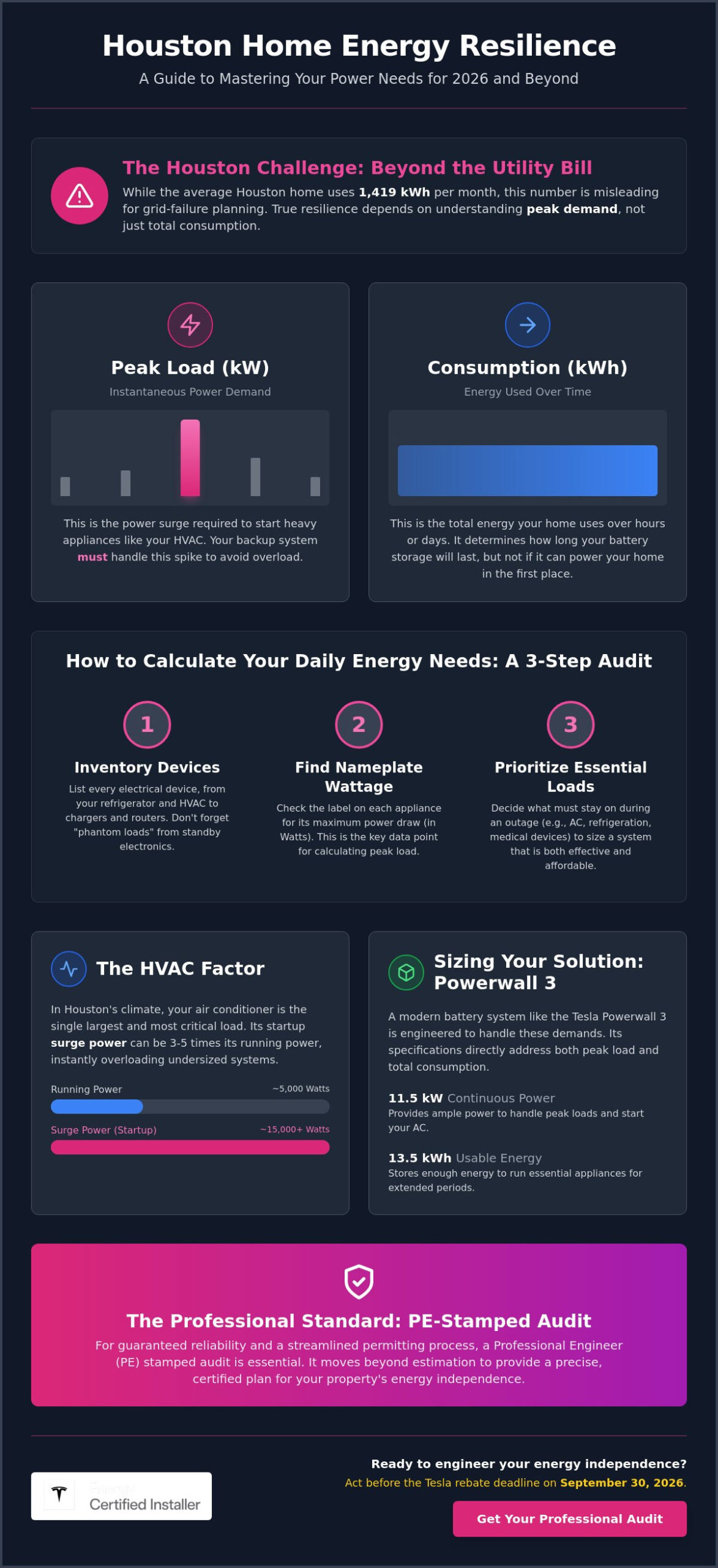
Precision in engineering begins with a clear distinction between load and consumption. Load represents the instantaneous power, measured in kilowatts (kW), required to operate your home at any specific second. Consumption is the cumulative energy used over time, expressed as the kilowatt-hour (kWh). While your monthly utility bill focuses on consumption for billing purposes, the design of a resilient battery backup system relies almost entirely on your peak load. A battery must be capable of discharging enough kilowatts to start a heavy compressor; it doesn’t matter how many total kilowatt-hours it holds in reserve if it cannot handle that initial surge.
Identifying Your Baseline vs. Peak Demand
Every property maintains a baseline energy state, often called the “vampire load” or “phantom load.” These are the small, persistent draws from standby electronics, network routers, and security systems that run continuously. While individually minor, they create a constant floor of energy usage that depletes battery reserves overnight. Peak demand occurs when these baseline loads coincide with high-draw appliances. If your electric vehicle charger, clothes dryer, and central air conditioner activate simultaneously, your peak load spikes dramatically. This intersection defines the maximum stress on your electrical system.
Your electrical panel serves as the central data point for these calculations. It dictates the maximum capacity your home can draw and establishes the boundaries for any solar or battery integration. CenterPoint Energy provides smart meter data that allows residents to review historical 15-minute interval peaks. This granular data is superior to monthly averages because it reveals exactly how much power you need during the most demanding hours of a summer afternoon. By 2026, new energy standards in Texas have improved the efficiency of individual appliances, yet the trend toward whole-home electrification means total peak demand often remains high. Successful system sizing requires balancing these modern efficiency gains against the rising total electrical load of a contemporary household.
Step-by-Step: Calculating Your Daily Energy Consumption
Executing a precise audit of your property’s electrical requirements is the foundation of energy resilience. While utility bills provide a retrospective view, calculating your home energy needs Houston requires a forward-looking, itemized approach to ensure your backup infrastructure handles real-world stress. Begin by conducting a comprehensive inventory of every electrical device. This list should include fixed appliances like refrigerators and HVAC units, alongside portable electronics and intermittent loads. Identifying every draw on your system prevents the common error of undersizing battery arrays, which can lead to system shutdowns during critical grid failures.
Once your inventory is complete, locate the technical specifications for each item. You can estimate your energy use by identifying the nameplate wattage, which is typically found on a sticker or embossed plate on the rear or underside of the device. Nameplate Wattage is the maximum power a device can legally draw. For appliances without a visible label, industry averages provide a reliable baseline, though actual measurements are always preferred for high-draw equipment. Account for the seasonal variation in Houston’s climate; an air conditioner’s run time on a 100-degree August afternoon will significantly exceed its operation in April.
Formula for Individual Appliance Estimation
To determine the daily energy impact of a single device, use the following standard calculation: (Watts × Hours Used Per Day) / 1000 = Daily kWh. This formula provides a clear metric for consistent loads like lighting or fans. However, appliances with variable cycles, such as dishwashers and washing machines, require a more nuanced approach. These devices don’t draw constant power throughout their operation; they spike during heating or high-speed spin cycles. In these instances, use the average cycle wattage provided by the manufacturer to maintain accuracy in your total daily budget.
Aggregating Data for a Whole-Home Audit
Effective energy management involves categorizing your inventory into critical and luxury loads. Critical loads include essential refrigeration, medical equipment, and basic security lighting. Luxury loads encompass pool pumps, electric ovens, and non-essential entertainment systems. By grouping these items, you create a tiered energy budget that allows for strategic power conservation during extended outages. Visualizing this data through a load calculation worksheet ensures every watt is accounted for before hardware is purchased.
Incorporate a 20% safety margin into your total daily Kilowatt-hour calculation. This buffer accounts for unexpected surges and the extreme humidity that forces electrical components to work harder. For high-stakes residential projects, professional verification is a prudent step. Utilizing PE stamped engineering for solar systems ensures your calculations meet technical compliance standards and local permitting requirements. Establishing this level of precision allows for a seamless transition to energy independence. If you require a more detailed technical review of your property’s capacity, our team at Santiban Services Group provides comprehensive assessments tailored for the unique demands of the Houston climate.
The Houston Variable: HVAC Loads and Climate Resilience
In the Houston market, the HVAC system is the single most influential variable when calculating your home energy needs Houston. During peak summer months, air conditioning can account for 60-70% of a residence’s total energy consumption. This dominance is not merely a matter of comfort; it is a critical engineering constraint for any backup power infrastructure. As of 2026, the adoption of SEER2 efficiency ratings has improved the operational efficiency of new units, yet the fundamental physics of cooling a Gulf Coast home remains energy-intensive. Properly calculating your home energy needs Houston involves analyzing the condenser label for specific electrical data rather than relying on square-footage estimates.
Calculating AC Inrush Current (Surge)
Precision in system sizing requires looking beyond the “Running Watts” listed in a generic U.S. Department of Energy guide. The most significant technical challenge for a home battery is the “Starting Watts,” also known as the inrush current. This represents the momentary surge of power required to move a compressor from a standstill to operational speed. You must locate the outdoor condenser label and identify the Locked Rotor Amps (LRA). LRA represents the maximum current the motor will draw when starting. If your battery system cannot provide this instantaneous peak, the system will trip, leaving the home without cooling during a grid failure.
Many Houston property owners utilize Soft Starters to mitigate this issue. These devices gradually ramp up the voltage, effectively reducing the peak demand and allowing battery arrays to manage large HVAC loads safely. By lowering the inrush current, you can often power a central air conditioner with fewer battery units, optimizing the overall cost of your resilience strategy.
The Impact of Houston Humidity on Run Times
Humidity levels in the Gulf Coast region introduce a secondary energy burden known as latent heat. While sensible heat refers to the actual temperature of the air, latent heat involves the energy required to remove moisture. Dehumidification requires sustained energy draw, not just cooling. This is why a 100-degree day in Houston is significantly more taxing on your electrical infrastructure than a similar temperature in a dry climate like Austin or El Paso.
When humidity reaches 90%, your HVAC system must run longer cycles to maintain a stable indoor environment. These extended run times deplete battery reserves faster than expected. When adjusting your energy calculations, you must factor in these prolonged operational windows. A resilient design accounts for the reality that your system will run almost continuously during a Houston heatwave. This requires a larger energy capacity to ensure the home remains habitable throughout the night when solar production is zero.
Sizing for Storage: Tesla Powerwall 3 vs. Traditional Generators
Selecting the appropriate storage technology is the final technical bridge in calculating your home energy needs Houston. While traditional standby generators have long been the default for Texas homeowners, the introduction of the Tesla Powerwall 3 has shifted the engineering landscape. This system provides 13.5 kWh of energy capacity and a continuous power output of 11.5 kW. The Powerwall 3 features an integrated solar inverter, which simplifies the infrastructure required for solar reroofing projects. This unified design reduces installation complexity and improves the efficiency of energy conversion compared to older, modular configurations.
A standard 2,500 sq. ft. Houston residence typically requires two to three Powerwall units to achieve a whole-home backup configuration. This setup allows for the simultaneous operation of essential lighting, refrigeration, and a central HVAC system equipped with a soft starter. Homeowners must decide between a “Partial Home” backup, which isolates critical circuits, and a “Whole Home” strategy. While a partial backup is more cost-effective, a whole-home approach provides the convenience of uninterrupted operations across all outlets. Transitioning to a battery-based system eliminates the mechanical upkeep, noise, and fuel logistics associated with traditional gas or propane generators.
Calculating Backup Duration
To determine how long your system will last during a grid failure, apply this basic formula: (Total Battery Capacity in kWh) / (Hourly Essential Load in kW) = Hours of Backup. For example, if you have two Powerwalls providing 27 kWh of storage and your average essential draw is 2 kW, you have approximately 13.5 hours of reserve. However, solar recharging extends this duration indefinitely during sunny Houston days. As your panels generate power, they simultaneously run your home and replenish the batteries, creating a self-sustaining energy loop. To ensure your system is sized with this level of precision, consult a certified Tesla Powerwall installer in Houston to review your specific load profile.
Tesla Powerwall 3 vs. EcoFlow Solutions
The Tesla Powerwall 3 is engineered for high-demand residential integration, offering superior continuous power for starting heavy appliances. In contrast, EcoFlow Battery Backup solutions provide a modular alternative that is often suitable for smaller properties or targeted backup needs. While EcoFlow systems offer flexibility in scaling, the Powerwall 3 remains the industry standard for permanent, high-capacity residential installations. Choosing between these technologies depends on whether you prioritize a unified, grid-tied infrastructure or a more adaptable, component-based system. If you are ready to secure your property against future grid instability, our team at Santiban Services Group can design a customized storage solution that aligns with your technical requirements.
Engineering Your Energy Independence with Santiban Services Group
Precise energy modeling is the difference between a system that survives a Houston hurricane and one that fails when the grid drops. While the steps outlined in this guide provide a foundation for calculating your home energy needs Houston, relying on “napkin math” for high-stakes infrastructure is a significant risk. Residential energy systems in 2026 have become increasingly complex, requiring a level of technical sophistication that mirrors industrial operations. Santiban Services Group leverages over 24 years of experience in industrial electrical construction to bring this professional rigor to your property. We ensure that every calculation, from inrush current to total battery capacity, is validated through a disciplined engineering lens.
Our approach integrates solar reroofing with the Tesla Powerwall 3 to create a unified, high-performance energy hub. This process requires more than a standard installation; it demands a comprehensive site audit that evaluates your existing panel capacity, structural roof integrity, and specific load requirements. By bridging the gap between residential needs and industrial standards, we provide a level of reliability that basic labor services cannot match. This commitment to precision ensures your investment provides the security you expect during the most extreme Texas weather events.
The Professional Audit Process
Moving from a personal estimate to a professional engineering design is a critical step for technical compliance. Santiban Services Group provides PE-stamped engineering design services that are essential for streamlining the permitting process with local municipalities and CenterPoint Energy. These stamped documents verify that your home’s electrical infrastructure is capable of handling modern, industrial-grade storage solutions safely. This level of oversight guarantees that your system adheres to the latest 2026 safety standards and operational requirements. You can explore our specific approach to high-performance integration by reviewing our guide on Tesla and solar roof solutions in Houston.
Ready for Houston’s Next Storm?
The path from calculating your home energy needs Houston to achieving total energy independence requires a partner who understands the high stakes of the Gulf Coast climate. We focus on delivering customized results that align with your property’s unique energy profile, ensuring you are never left with an undersized or inefficient system. Our industrial expertise allows us to solve complex organizational and technical challenges that standard residential contractors often overlook. When the next major storm hits, your home should be a silent engine of reliability. Schedule a professional energy audit with Santiban Services Group today to begin the transition to a truly resilient energy future.
Securing Your Energy Future in the Gulf Coast
Mastering the technical nuances of load management ensures your property remains operational during grid instability. Precision in calculating your home energy needs Houston prevents the common pitfalls of system failure and unnecessary expenditure. By prioritizing surge requirements and humidity-driven run times, you establish a resilient foundation for long-term independence. Every watt accounted for today is a safeguard against the unpredictable nature of the Texas grid.
Santiban Services Group provides the industrial expertise required for these high-stakes residential projects. As Tesla-certified installers with 24+ years of industrial electrical experience, we deliver customized results anchored in technical accuracy. Our in-house PE-stamped engineering design guarantees permit approval and seamless integration of solar reroofing and Powerwall 3 systems. We specialize in Houston-specific climate resilience, ensuring your infrastructure is built to withstand local environmental stressors with quiet confidence.
Request a Professional Load Calculation & Tesla Powerwall Quote. Take the first step toward a secure, self-sustaining home today.
Frequently Asked Questions
How many kWh does the average Houston home use per day in 2026?
A typical Houston residence utilizes approximately 47.3 kilowatt-hours per day, derived from an average monthly consumption of 1,419 kWh. This daily figure fluctuates significantly based on seasonal environmental factors and household size. During peak summer months, daily usage often doubles as HVAC systems work to manage extreme thermal loads and persistent Gulf Coast humidity levels.
Can one Tesla Powerwall 3 run my central air conditioner?
A single Tesla Powerwall 3 is capable of supporting most modern central air conditioning units due to its 11.5 kW continuous power output. However, the system’s ability to handle the initial inrush current depends on the specific Locked Rotor Amps of your condenser. Installing a soft starter is a recommended technical measure to ensure the battery manages these startup surges without triggering internal circuit protection.
What is the difference between starting watts and running watts?
Starting watts represent the instantaneous surge of power required to initiate a motor’s rotation, while running watts are the continuous energy needed for sustained operation. In Houston, this distinction is critical for HVAC systems, where the startup load can be three to five times higher than the steady state. Accurate system sizing requires accounting for these momentary peaks to prevent inverter overloads during grid outages.
Do I need a PE-stamped engineering design for a home battery system in Houston?
Professional engineering (PE) stamps are frequently required by municipal permitting offices and utility providers to verify the safety and technical compliance of energy storage installations. While a June 2025 Texas law limits how municipalities regulate residential backup systems, a PE-stamped design ensures your infrastructure meets rigorous industrial standards. This documentation provides a verified blueprint that streamlines the approval process and guarantees long-term operational reliability.
How do I calculate my energy needs if I plan to add an EV charger later?
When calculating your home energy needs Houston, you must account for the high-amperage draw of Level 2 EV charging stations, which typically require 7.2 kW to 11.5 kW of dedicated capacity. Professional audits involve adding these projected loads to your current peak demand to ensure future-proof battery and solar sizing. This proactive approach prevents the need for costly panel upgrades or system expansions after the initial installation is complete.
Is it better to size my solar system for my current use or future needs?
Engineering best practices suggest sizing solar and storage arrays for projected future demands, including home electrification and increased cooling requirements. Sizing based strictly on historical data often results in an undersized system as household energy profiles evolve. By accounting for potential additions now, you ensure the infrastructure remains a comprehensive solution for your property’s long-term resilience and energy security.
What happens to my energy calculation if I install a solar reroof?
A solar reroofing project integrates photovoltaic generation directly into the building envelope, requiring a recalibration of your property’s energy balance. This unified approach optimizes energy production by utilizing the maximum available roof surface area for generation. The resulting calculations focus on maximizing self-consumption and ensuring the Tesla Powerwall 3 manages the increased DC input efficiently, providing a more streamlined and integrated energy infrastructure.
How does Houston humidity affect the efficiency of my battery storage system?
High humidity levels indirectly impact battery efficiency by forcing HVAC systems to run longer cycles for dehumidification, which accelerates the depletion of stored energy. While the battery units themselves are environmentally sealed, the increased latent heat load on the home requires a larger energy reserve to maintain indoor comfort. Precise modeling must factor in these extended operational windows to ensure your backup duration remains sufficient during periods of extreme humidity.