
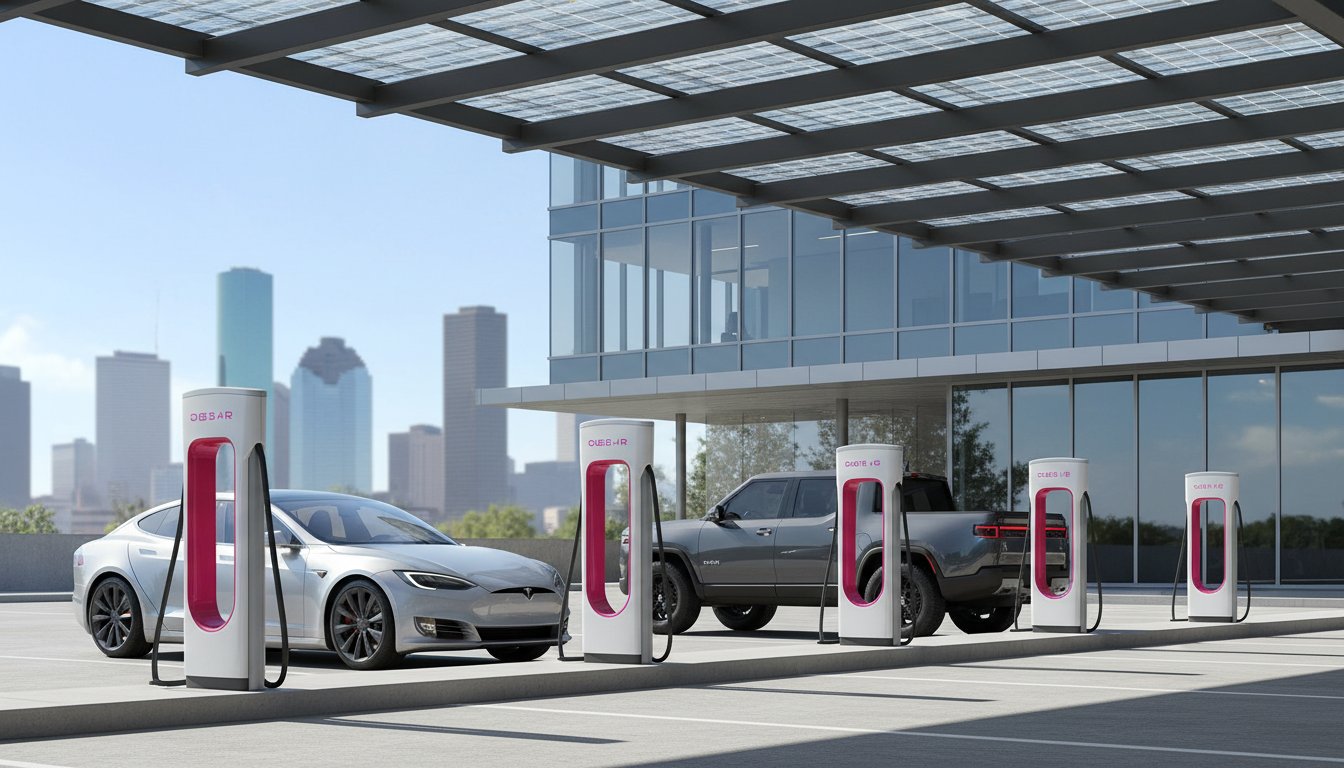
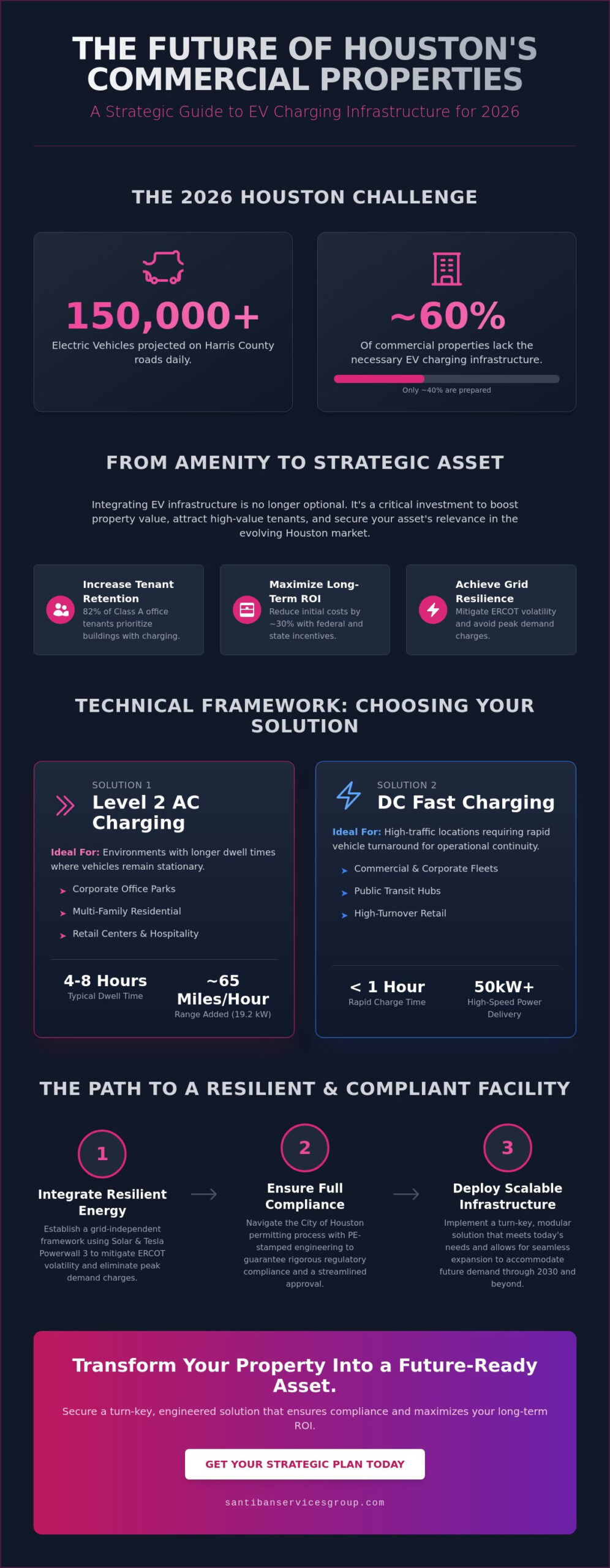
By 2026, Harris County projections indicate over 150,000 electric vehicles will travel our roads daily, yet nearly 60% of local commercial properties lack the infrastructure to support them. Integrating commercial electric vehicle charging stations into your Houston facility isn’t merely an upgrade; it’s a strategic necessity to maintain asset relevance. You’re likely aware that the shift toward electric mobility is accelerating across Texas. However, the persistent volatility of the ERCOT grid and the technical rigors of City of Houston PE-stamp requirements present significant hurdles for even the most established property managers.
We understand that balancing high upfront costs with the need for grid resilience requires a disciplined approach to facility management. This guide provides a comprehensive strategic framework to help you deploy scalable infrastructure that maximizes your long-term ROI. You’ll learn how to secure a turn-key, engineered solution that ensures compliance with 2026 energy standards while increasing tenant retention. From meticulous site analysis to seamless execution, we outline the exact steps to transform your property into a reliable hub for the future of transportation.
Key Takeaways
- Identify the transition of EV infrastructure from a basic amenity to a strategic facility asset essential for the 2026 Houston market.
- Evaluate the technical requirements of Level 2 versus DC Fast Charging to select the optimal configuration for your specific commercial application.
- Analyze how the strategic deployment of commercial electric vehicle charging stations drives ROI through increased property valuation and improved tenant retention.
- Understand the critical necessity of PE-stamped engineering to streamline the City of Houston permitting process and ensure rigorous regulatory compliance.
- Explore integrated solar and Tesla Powerwall 3 solutions to establish a resilient, grid-independent energy framework for your facility.
The State of Commercial Electric Vehicle Charging Stations in Houston (2026)
By 2026, the Houston business landscape has undergone a fundamental shift. Commercial electric vehicle charging stations are no longer viewed as optional amenities for high-end retail centers. They’ve become essential facility assets that drive property value and operational efficiency. Unlike residential setups designed for intermittent use, commercial installations must withstand rigorous duty cycles and constant demand. These systems rely on sophisticated electric vehicle supply equipment (EVSE) that integrates with building management systems to monitor energy flow and hardware health in real time.
Commercial infrastructure differs from residential Level 2 units in both scale and technical complexity. A standard home charger lacks the load-balancing capabilities required to manage forty vehicles simultaneously. In a professional setting, the equipment must provide seamless authentication, billing integration, and high-speed data connectivity. This meticulous approach to hardware selection ensures that the infrastructure serves as a reliable backbone for corporate fleets and visitor services alike.
Why Houston Businesses are Leading the 2026 Electrification Wave
Houston’s energy and medical sectors have adopted aggressive corporate sustainability mandates. By the start of 2026, ESG reporting has moved from a voluntary disclosure to a core requirement for institutional investors. In the Energy Corridor and Downtown Houston, 82% of Class A office tenants now prioritize buildings with integrated charging solutions. Providing these services is a proven strategy for attracting and retaining top-tier talent who have transitioned to electric transport. Additionally, federal tax incentives available in 2026, paired with Texas-specific utility grants, have reduced the initial capital expenditure for commercial electric vehicle charging stations by approximately 30%. This financial environment creates a compelling ROI for property owners who act decisively.
Grid Resilience: The ERCOT Factor in Commercial Charging
The Texas power grid presents unique challenges that require expert logistical planning. Houston’s intense summer humidity and heat put immense pressure on ERCOT resources. Strategic facility management now incorporates onsite battery storage to mitigate peak demand charges. This localized storage allows a business to draw power during off-peak hours and distribute it to vehicles when grid prices spike. It’s a “silent engine” approach to infrastructure that ensures 24/7 business operations remain uninterrupted. Meticulous planning around these power peaks protects the facility’s electrical switchgear from thermal stress and prevents costly utility penalties. For the Houston market, resilience isn’t just a goal; it’s a requirement for maintaining a stable and professional corporate environment.
Technical Framework: Level 2 vs. DC Fast Charging for Commercial Use
Selecting the appropriate hardware for commercial electric vehicle charging stations requires a precise understanding of dwell times and energy requirements. Level 2 AC charging serves as the primary solution for environments where vehicles remain stationary for four to eight hours. This includes corporate office parks, multi-family residential complexes, and retail centers. DC Fast Charging (DCFC) fulfills the high-speed requirements of commercial fleets and transit hubs where rapid turnaround is vital for operational continuity.
Calculating a property’s power budget is a critical first step. Most existing commercial electrical services weren’t designed for the simultaneous load of multiple high-capacity chargers. A meticulous audit identifies how many ports your current transformer can support. We prioritize modular hardware configurations. This strategy allows property owners to install foundational infrastructure now while scaling capacity as demand increases through 2030. It’s a proactive approach that prevents the need for redundant construction costs in the future.
Level 2 Solutions for Multi-Family and Office Parks
Commercial Level 2 installations typically utilize 11.5 kW or 19.2 kW configurations. The 19.2 kW units deliver up to 80 amps of power, providing approximately 65 miles of range per hour of charging. Managing this energy delivery requires integrated load management software. These digital systems distribute available power across the network to prevent circuit overloads during peak morning or evening hours. Property managers can implement seamless user authentication through RFID cards or mobile applications. These platforms facilitate automated billing and point-of-sale integration, ensuring a reliable revenue stream or cost-recovery model for the facility.
DC Fast Charging for Fleet and Industrial Applications
Industrial operations and heavy-duty fleets require the high-output capabilities of DC Fast Charging. These systems range from 50 kW units for light delivery vans to 350 kW plus for Class 8 trucks. Houston’s environmental conditions demand specific hardware resilience. The city recorded 45 days with temperatures exceeding 100 degrees in 2023, which places extreme stress on charging components. High-utilization commercial electric vehicle charging stations in this region must utilize advanced thermal management and liquid-cooled cables to maintain peak performance. Meticulous maintenance protocols are mandatory for these assets. Regular inspections prevent downtime and extend the lifecycle of the power modules in high-heat environments. A tailored infrastructure assessment helps determine which thermal management solutions best suit your specific site coordinates.
The ROI of Commercial EV Infrastructure: Beyond the Charging Fee
Quantifying the return on investment for commercial electric vehicle charging stations requires a shift from viewing them as a simple utility to seeing them as a strategic asset. Houston property owners realize appreciation through both immediate utilization and long-term equity growth. A 2024 analysis of Texas commercial real estate indicates that properties with EV infrastructure see a 3.5% increase in valuation compared to non-equipped counterparts. This growth reflects the market’s demand for future-ready facilities.
Fleet operators transitioning from internal combustion engines to electric powertrains report a 40% reduction in maintenance costs annually. These savings, combined with lower fuel expenses, create a compelling financial case for rapid adoption. Utilizing commercial EV charger installation as a capital improvement allows for accelerated depreciation under current tax codes. Santiban Services Group ensures these installations meet rigorous corporate standards, positioning the infrastructure as a high-end strategic partner in facility management.
Attracting Premium Tenants and Customers
Retailers in major Houston hubs like the Galleria or CityCentre benefit from increased dwell time. Data shows EV drivers spend an average of 52 minutes in retail environments while charging, which is 22 minutes longer than the average shopper. This extended presence directly correlates with higher per-visit spending. In the luxury multi-family sector, Houston properties offering charging amenities maintained a 94% occupancy rate through 2025, significantly outperforming the city’s baseline average. EV charging is no longer a luxury perk. It’s the new high-speed internet for Class A office leasing. Corporations now prioritize sites that support their employees’ sustainability needs and commute requirements.
Mitigating Demand Charges and Operational Costs
Managing energy expenses is critical for maintaining profitability. CenterPoint Energy utilizes complex commercial rate structures where peak demand penalties can account for 50% of a monthly utility bill. Our integrated systems use smart scheduling to distribute power loads during off-peak hours, protecting your bottom line from unnecessary surcharges. This proactive energy management reduces the long-term ev charger installation cost by preventing the need for expensive electrical service upgrades. By integrating charging hardware with existing facility management systems, property managers gain seamless oversight and meticulous data for ESG reporting. This structured approach ensures that your infrastructure remains a disciplined, hardworking component of your business operations.
Houston Permitting and PE-Stamped Engineering: The Path to Compliance
Securing approval for commercial electric vehicle charging stations in Houston involves a rigorous regulatory process that prioritizes grid stability and public safety. By 2026, the City of Houston Permitting Center has standardized requirements that mandate professional oversight for any high-voltage installation. Projects lacking technical validation often face significant delays. Data indicates that the city rejects approximately 30 percent of initial permit submissions due to insufficient documentation or load analysis errors. Professional engineering isn’t just a hurdle; it’s a foundational requirement for industrial-grade reliability.
Integrating PE stamped engineering for solar systems and EV infrastructure ensures that your facility’s electrical architecture can sustain the 2026 demand. Santiban Services Group manages the complex coordination required with CenterPoint Energy, specifically focusing on transformer capacity and the necessity for new 480V service drops. We conduct site-specific load calculations to confirm your existing transformer can handle the simultaneous draw of multiple Level 3 DC fast chargers without compromising the building’s primary operations. This meticulous approach prevents equipment failure and ensures your commercial electric vehicle charging stations remain operational during peak demand periods.
Why Professional Engineering is Non-Negotiable
Professional engineering guarantees structural and electrical safety in high-density commercial environments. A PE-stamped design serves as a legal shield, often lowering insurance premiums by proving the installation meets the 2023 National Electrical Code (NEC) standards. Meticulously documented plans streamline the inspection process at 1002 Washington Avenue. They allow city officials to verify compliance quickly, which prevents costly rework during the final commissioning phase. This level of precision protects your investment and ensures long-term liability protection for property owners.
Step-by-Step: The Houston Installation Timeline
- Initial Site Audit: We apply the Santiban Method to perform a comprehensive capacity analysis of your current switchgear and utility service.
- Drafting and Stamping: Our engineers develop detailed electrical and structural documents, providing the PE stamp required for municipal approval and safety compliance.
- Permit Submission: We manage the interface with the Houston Permitting Center and coordinate with CenterPoint Energy for any necessary meter upgrades or new service drops.
- Industrial Construction: Our dedicated teams execute the installation, followed by a final commissioning report to ensure 100 percent operational readiness and safety.
Ready to upgrade your facility’s infrastructure with professional precision? Contact Santiban Services Group for an engineering-led EV charging consultation today.
Integrated Resilience: Solar, Tesla Powerwall 3, and EV Charging
Houston’s energy landscape is evolving rapidly. High-capacity commercial electric vehicle charging stations require a robust backbone to remain viable during peak demand periods. Adopting tesla electric represents a strategic shift toward business resilience. This integrated ecosystem allows facilities to move beyond simple utility dependence. By pairing onsite generation with advanced storage, companies secure their operational continuity through 2026 and beyond. It’s a move toward total energy autonomy that protects the bottom line from volatile grid pricing.
The Powerwall 3 Advantage for Houston Businesses
The Tesla Powerwall 3 serves as the foundational unit for modern energy management. It provides 11.5 kW of continuous backup power per unit. This ensures critical charging infrastructure remains active during grid instability or localized outages. Storing solar energy allows fleet managers to charge vehicles at night. This practice bypasses high daytime utility rates and reduces operational costs by up to 30 percent in many industrial applications. The system’s scalable architecture supports growing industrial needs. Facilities can expand storage capacity as their electric fleet grows, maintaining a balanced load profile. This technology excels at peak shaving. The battery discharges during high-demand periods to avoid expensive utility demand charges that often plague large-scale charging operations.
Executing Large-Scale Industrial Electrical Projects
Achieving true energy independence requires more than hardware; it demands a sophisticated installation strategy. Integrating tesla and solar roof solutions with high-capacity charging units requires meticulous planning and industrial-grade execution. Santiban Services Group operates as a “Silent Engine” for your facility. We manage complex electrical upgrades with zero business disruption. Our teams adhere to rigorous safety protocols and high-voltage standards to protect your assets and personnel. We favor directness and functional clarity in every phase of the project.
We provide a single-source solution for the entire lifecycle of your commercial electric vehicle charging stations. This includes:
- Initial site feasibility and energy load analysis
- Navigating complex Houston permitting and utility interconnects
- Deployment of integrated solar and battery storage systems
- Long-term preventative maintenance and performance monitoring
Our comprehensive approach ensures your facility meets the demands of a decarbonized economy. We prioritize precision in every connection. Contact Santiban Services Group today for a comprehensive facility energy audit to begin your transition to an integrated resilience model.
Secure Your Competitive Advantage in the 2026 Houston Market
Houston’s transition to a high-density EV market by 2026 demands a meticulous approach to facility management. Selecting the right balance between Level 2 and DC Fast Charging units isn’t just a technical decision; it’s a strategic move to maximize property value and operational uptime. Integrating solar arrays with Tesla Powerwall 3 technology ensures your facility remains resilient against grid instability while lowering long-term energy costs through sophisticated, integrated systems.
Navigating the path to compliance requires precise execution. Our in-house PE-stamped engineering design streamlines the complex Houston permitting process, ensuring every installation meets rigorous municipal standards. Santiban Services Group leverages 24 years of industrial electrical expertise to serve as your reliable partner for deploying commercial electric vehicle charging stations that stand the test of time. As a Tesla-certified installation partner, we maintain excellence in every detail of your facility’s modernization. Schedule a Professional Facility Energy Audit with Santiban Services Group to begin your infrastructure transition today. Your facility’s readiness starts with a partner who understands the demands of the future.
Frequently Asked Questions
How much does it cost to install commercial EV charging stations in Houston?
Commercial installation costs vary based on hardware selection and site labor requirements. U.S. Department of Energy data shows hardware for Level 2 units ranges from $400 to $6,500 per port. Installation labor adds between $600 and $12,700 per unit depending on the distance from the power source. Santiban manages these complexities through meticulous site assessments to ensure your project remains within a predictable budget.
Do I need a new transformer from CenterPoint Energy for EV charging?
You’ll need a new transformer if your current electrical service lacks the capacity to handle the added load. CenterPoint Energy requires a formal load study for any commercial installation that exceeds 50kW. If the study shows insufficient capacity, CenterPoint coordinates the transformer upgrade. Our team manages this communication to ensure a seamless integration with the local grid while maintaining your facility’s operational stability.
What is the difference between Level 2 and Level 3 DC Fast chargers for my business?
Level 2 chargers provide 20 to 40 miles of range per hour using AC power, while Level 3 DC Fast Chargers deliver an 80% charge in 20 to 60 minutes. Level 2 is ideal for locations where vehicles park for four hours or more. Level 3 serves high-traffic commercial electric vehicle charging stations where rapid turnover is essential for business operations and customer convenience.
Why does my Houston EV project require PE-stamped engineering drawings?
Houston’s building code mandates PE-stamped engineering drawings for all commercial electrical modifications to guarantee safety and compliance. These drawings verify that the proposed system meets the 2023 National Electrical Code standards. Santiban provides these professional services to prevent delays during the city’s rigorous inspection process. This meticulous documentation ensures that every component of your infrastructure is legally compliant and structurally sound.
Can I integrate solar panels and Tesla Powerwalls with my commercial charging stations?
You can integrate solar panels and Tesla Powerwalls with commercial electric vehicle charging stations to optimize energy consumption and reduce costs. This setup reduces reliance on the grid during peak hours when electricity prices are highest. By storing solar energy, your facility achieves greater resilience and lowers long-term operational expenses through strategic load management. Our integrated solutions allow for a tailored approach to your building’s energy footprint.
How long does the permitting process take for commercial EV chargers in Houston?
The City of Houston Permitting Center usually completes the review process within 15 to 30 business days for commercial projects. This duration depends on the project’s scale and the completeness of the initial engineering submission. Our dedicated teams handle the entire application process to ensure your project stays on its projected timeline. We prioritize accuracy in the initial filing to avoid the common delays associated with incomplete documentation.
Are there tax credits or rebates available for Houston businesses installing EV chargers in 2026?
The federal Alternative Fuel Vehicle Refueling Property Credit provides a tax credit of up to 30% for businesses, with a maximum of $100,000 per location. This credit is available through December 31, 2032, under the Inflation Reduction Act. To receive the full 30% rate, your project must adhere to specific prevailing wage and apprenticeship standards. These incentives significantly lower the initial capital investment required for modern infrastructure.
What maintenance is required for commercial-grade charging stations?
Routine maintenance requires semi-annual inspections of cables, connectors, and internal cooling systems. Proactive service prevents hardware failure and extends the lifespan of the equipment. Charging Interface Initiative reports indicate that regular maintenance programs reduce equipment downtime by 25%. Santiban offers comprehensive service plans to keep your infrastructure operational 24/7. Our disciplined approach to facility management ensures that your charging assets remain a reliable resource for your stakeholders.