
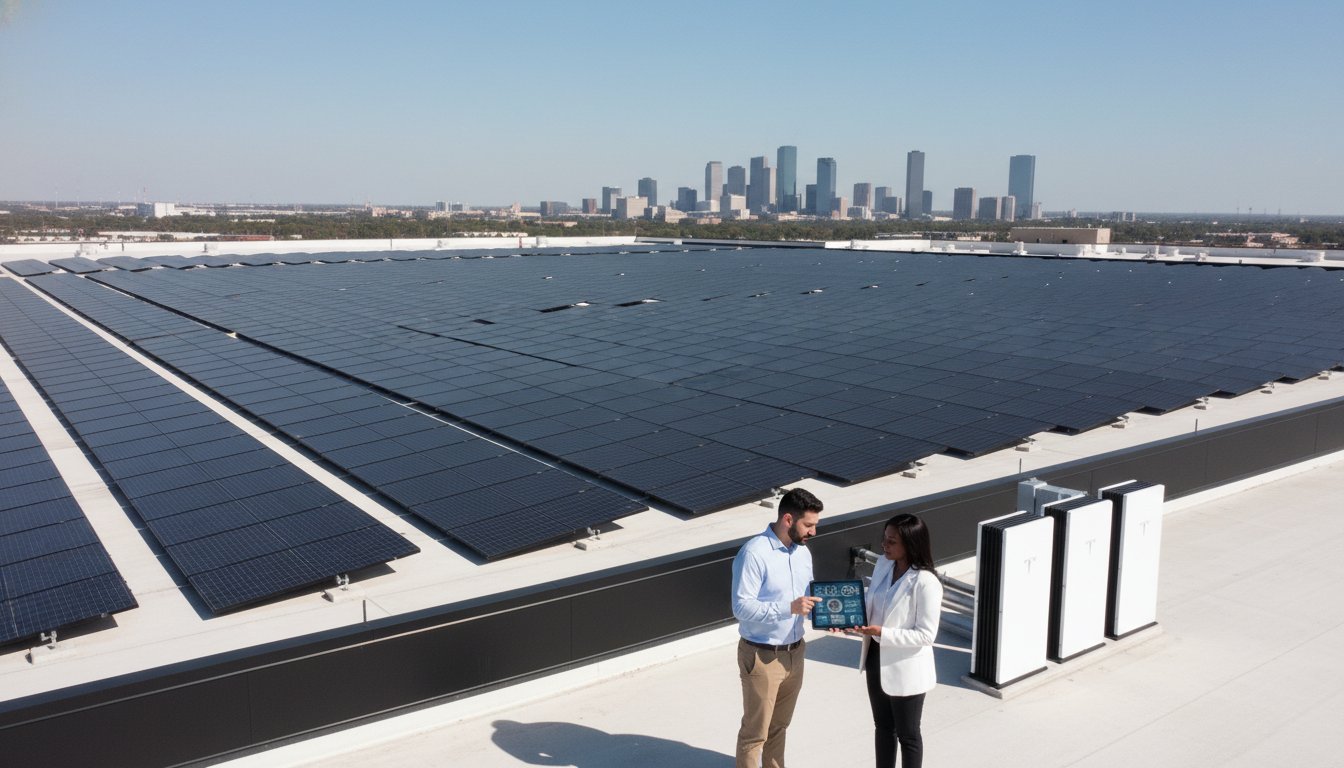
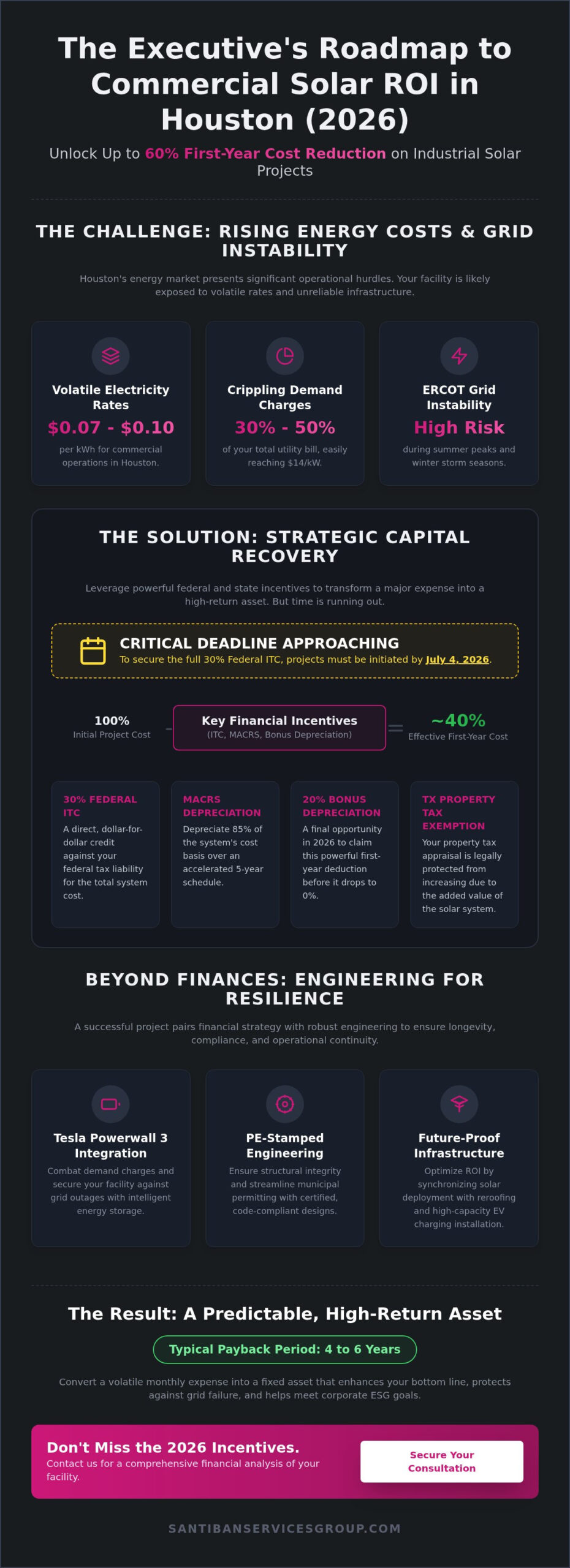
Most Houston executives are unaware that the strategic combination of the federal Investment Tax Credit and MACRS depreciation can effectively reduce the first-year cost of a solar project by up to 60%. With local commercial electricity rates currently ranging from $0.07 to $0.10 per kWh, the financial pressure on industrial operations has reached a critical threshold. You likely recognize that volatile grid reliability during storm seasons and rising demand charges, which now account for 30% to 50% of your utility bill, require a more resilient energy strategy. A successful commercial solar panel installation Houston project requires more than just hardware. It demands meticulous engineering and structural compliance to meet strict municipal permitting standards.
This guide provides a comprehensive roadmap for managing the complexities of industrial-grade energy systems in 2026. You’ll learn how to integrate the Tesla Powerwall 3 to mitigate demand charges and secure your facility against grid instability. We also examine the critical July 4, 2026, safe harbor deadline for the 30% federal tax credit and the 20% bonus depreciation available this year. This analysis ensures your organization captures maximum ROI through PE-stamped engineering and superior system design.
Key Takeaways
- Secure substantial capital recovery by initiating projects before the July 4, 2026, federal Investment Tax Credit deadline.
- Mitigate structural risks and streamline municipal approvals through meticulous PE-stamped engineering for your commercial solar panel installation Houston.
- Combat rising demand charges and grid instability by integrating Tesla Powerwall 3 systems into your industrial energy profile.
- Identify and capture additional localized financial incentives through utility-specific rebates and Houston-based property tax exemptions.
- Optimize facility longevity by synchronizing solar reroofing with the deployment of high-capacity commercial EV charging infrastructure.
The Business Case for Commercial Solar Panel Installation in Houston (2026)
Hedging Against Texas Grid Volatility
The ERCOT grid faces increasing pressure during summer peaks and winter storm seasons. Local solar production serves as a critical defense against the resulting price spikes. When demand surges, businesses without on-site generation remain vulnerable to spot market pricing and potential load shedding. Reliable energy independence is no longer a luxury in the Texas deregulated market; it is a strategic necessity. The Business Case for Commercial Solar is built on this ability to maintain operational continuity when the centralized grid falters. Houston facilities that integrate solar can bypass peak demand charges, which frequently account for 30% to 50% of an industrial utility bill. This localized generation creates a buffer that protects the bottom line from the unpredictability of the state’s power infrastructure.
Financial Drivers: MACRS and the 2026 Investment Tax Credit (ITC)
Fiscal timing is paramount for projects initiated this year. The federal Investment Tax Credit offers a 30% credit for commercial solar projects, provided construction begins by July 4, 2026. This incentive, combined with the Modified Accelerated Cost Recovery System, creates a superior financial profile for capital improvements. These mechanisms often lead to an effective first-year cost reduction of 50% to 60% for most commercial solar projects. For warehouses and distribution centers, these drivers shorten the payback period to approximately 4 to 6 years. Consider these primary tax advantages available in 2026:
- 30% Federal ITC: A direct credit against federal tax liability for the total system cost.
- MACRS Depreciation: The ability to depreciate 85% of the system’s cost over a five-year period.
- 20% Bonus Depreciation: A final opportunity to claim 20% bonus depreciation in the first year before the rate drops to 0% in 2027.
- Texas Property Tax Exemption: State-level protection that prevents your property tax appraisal from increasing due to the added value of the solar installation.
By leveraging these financial instruments, Houston businesses can secure their energy future while significantly improving immediate cash flow. Aligning solar reroofing with these incentives ensures that the building’s envelope and its energy production systems are optimized for maximum long-term ROI.
Engineering Excellence: PE-Stamped Design and Solar Reroofing
A successful commercial solar panel installation Houston project begins long before the first panel is mounted. In 2026, the City of Houston has heightened its scrutiny of solar permit applications, making Professional Engineer (PE) stamped drawings a non-negotiable requirement for all industrial facilities. These certifications provide legal and technical assurance that the existing structure can support the added dead load of a large-scale array. They also verify that the system design accounts for Houston’s unique environmental challenges, such as extreme wind uplift during hurricane seasons. Professional engineering isn’t just about compliance. It’s about protecting the long-term structural integrity of your industrial asset.
The Necessity of PE-Stamped Engineering Design
Securing a PE stamp involves a meticulous review of the facility’s electrical and structural capacity. This process streamlines the permitting timeline by providing municipal officials with a verified, code-compliant blueprint. Our teams focus on technical precision, ensuring every component meets the latest 2025 Texas electrical codes and safety standards. This proactive approach prevents costly field modifications and ensures a seamless transition from the design phase to physical construction. According to technical reports on PE-Stamped Design and Solar Reroofing from the National Renewable Energy Laboratory, integrating these engineering considerations early reduces total project risk and improves the overall reliability of the energy system.
Solar Reroofing: Protecting the Industrial Asset
The health of your roof is the most critical factor in the ROI of a solar investment. It’s a strategic mistake to install a high-performance system on a roof nearing the end of its functional life. Solar reroofing allows businesses to address structural vulnerabilities before they become liabilities. By coordinating these efforts, you can synchronize the warranties for both the roof and the solar array, providing comprehensive protection for the full 25-year lifespan of the hardware. The integration of Tesla and solar roof solutions offers a superior, unified approach to building resilience. This single-source methodology eliminates the friction often found between separate roofing and solar contractors.
Choosing a partner who manages both industrial electrical construction and roofing provides a more efficient project lifecycle. It ensures that every penetration is properly sealed and that the electrical layout doesn’t compromise the roof’s drainage or thermal performance. A meticulous approach to PE-stamped engineering design ensures your facility remains compliant and operational through any Houston weather event.
Integrating Tesla Powerwall 3 and Commercial EV Infrastructure
Industrial facilities in Houston are moving toward a unified energy ecosystem. A standalone solar array provides the generation, but the true ROI is realized through the intelligent integration of high-capacity storage and charging infrastructure. By pairing a commercial solar panel installation Houston with the Tesla Powerwall 3, businesses gain granular control over their energy profile. This hardware configuration allows for peak shaving, where the system discharges stored energy during periods of high demand to avoid utility charges that can reach $14 per kW. While these integrated systems enhance facility value, the Texas Property Tax Exemption for Solar protects the asset from increased appraisal costs. This ensures your capital improvement remains a lean operational advantage.
Commercial Energy Storage with Tesla Powerwall 3
The Tesla Powerwall 3 represents a significant advancement for commercial applications. Each unit provides 13.5 kWh of energy capacity and a continuous power rating of 11.5 kW. Strategic use of tesla electric systems allows for intelligent grid interaction and redundant backup for critical infrastructure. During the 2026 storm season, this storage capacity serves as a silent engine that maintains operations when the external grid fails. Our teams deploy these units in scalable configurations, tailoring the storage volume to the specific load requirements of your facility. This meticulous approach to energy management ensures that your most vital systems remain online without interruption.
Deploying Commercial EV Charger Installation
Executing a Commercial EV Charger Installation requires a sophisticated electrical backbone. In 2026, the federal 30C tax credit offers 30% coverage for charger costs, worth up to $100,000 per port. Integrating these stations with your solar and battery storage allows you to fuel your fleet using captured sunlight, effectively bypassing utility rates altogether. This synergy is essential for future-proofing industrial sites as heavy-duty electric vehicles become the standard. We design these hubs with the capacity to handle Level 2 and DC Fast Charging, ensuring your infrastructure is ready for the next decade of logistical demands. By utilizing stored solar energy for EV fleets, you eliminate the risk of high demand charges associated with simultaneous vehicle charging. This integrated strategy transforms your facility into a self-sustaining energy hub that supports both operational resilience and long-term corporate stability.
Navigating Houston Solar Incentives and Permitting in 2026
A disciplined approach to documentation is the foundation of a successful commercial solar panel installation Houston project. While federal tax credits provide the primary financial engine, capturing localized incentives requires a deep understanding of the Houston regulatory environment. Executive teams must recognize that the administrative phase of a solar deployment is as critical as the physical construction. In 2026, the complexity of municipal codes and utility requirements demands a partner who manages every operational detail with professional precision. Proper alignment with local utility programs and state consumer protection laws, such as SB 1036 and SB 1697 which took effect in September 2025, ensures your investment remains compliant and secure.
Local Rebates and Utility Incentives
Texas does not offer a statewide commercial solar rebate, making local utility programs the primary source of additional capital recovery. CenterPoint Energy continues to offer specific incentives for non-residential projects in 2026, with rebates often ranging from $250 to over $1,000 depending on the system’s capacity and the utility’s current program cycle. Qualifying for these credits requires meticulous reporting and technical verification of the system’s performance metrics. Our teams facilitate this process by preparing all necessary technical documentation and liaising directly with utility representatives. This proactive management minimizes the administrative burden on your staff and ensures that no available financial benefit is overlooked during the project lifecycle.
The Permitting and Interconnection Roadmap
The path to an operational solar array follows a methodical sequence of milestones. It begins with a comprehensive site survey and preliminary engineering design to establish the project’s technical feasibility. The most critical step in the Houston permitting process is the submission of PE stamped engineering for solar systems. These certified drawings provide the structural and electrical assurances required by the City of Houston building department. Once permits are secured and construction is finalized, the system must undergo a rigorous final inspection before the utility grants Permission to Operate (PTO). This interconnection agreement is the final legal hurdle that allows your facility to begin exporting excess power and realizing the full ROI of your installation.
Managing these complex logistical challenges requires a partner with a serious commitment to safety and professional excellence. You can secure your project’s timeline and financial incentives by engaging our dedicated industrial electrical teams for a comprehensive consultation on your facility’s solar potential.
Industrial-Grade Solar Solutions with Santiban Services Group
Santiban Services Group operates as a silent engine for Houston’s industrial sector. Our organization brings over 24 years of disciplined experience in industrial electrical construction to every energy project. We recognize that a commercial solar panel installation Houston is a significant capital commitment that requires more than basic labor. It demands a partner with the corporate stability to support a 25-year asset. We provide a single-source solution that integrates PE-stamped engineering, solar reroofing, and advanced electrical design. This comprehensive approach eliminates the communication gaps that occur when multiple contractors manage a single facility. Our dedicated teams are Tesla-certified, ensuring that high-capacity storage systems like the Powerwall 3 are deployed with superior technical precision.
Our Meticulous Approach to Industrial Solar
Execution begins with a comprehensive site analysis. We don’t just evaluate roof space; we analyze your facility’s entire load profile to develop a tailored energy strategy. This includes identifying opportunities for peak shaving and demand charge reduction through intelligent battery management. Our teams prioritize safety and structural compliance above all else. We manage the complex electrical construction required for large-scale facilities, ensuring that every connection meets the highest professional standards. This commitment to “excellence in every detail” allows our clients to focus on their core operations while we maintain the background infrastructure. We ensure your system is optimized to capture the 20% bonus depreciation available throughout 2026 before it expires in 2027.
Schedule Your Commercial Site Assessment
The July 4, 2026, deadline for the 30% federal Investment Tax Credit is a critical driver for current capital planning. Securing this credit requires a proactive timeline for engineering and permitting. We provide transparent ROI projections based on current Houston utility rates and your specific industrial energy usage. Our technical consultations offer a sober, factual assessment of your facility’s solar and storage potential. We help you transition from a passive consumer to an active energy producer with a roadmap that prioritizes long-term financial performance. This methodical process ensures that your investment provides the resilience needed for the Texas energy market. To begin your facility’s transformation, Contact Santiban Services Group for a Professional Consultation and secure your organization’s energy future.
Securing Your Industrial Energy Future in 2026
The 2026 fiscal landscape for Houston industrial facilities is defined by a critical intersection of tax deadlines and energy volatility. Capturing the 30% federal Investment Tax Credit requires initiating construction by July 4, 2026. This financial advantage, combined with the integration of Tesla Powerwall 3 technology, transforms energy from a variable overhead into a resilient, fixed asset. A successful commercial solar panel installation Houston strategy relies on technical precision and structural compliance. Santiban Services Group provides the authoritative oversight necessary for these complex deployments.
With 24+ years of industrial electrical experience, our dedicated teams manage every meticulous detail from initial site assessment to final utility interconnection. We operate as a single-source partner, offering Tesla Certified expertise and a relentless focus on PE-stamped engineering compliance. This disciplined approach ensures your facility meets all municipal requirements while maximizing long-term ROI. Request a PE-Stamped Engineering Design & Solar Quote to begin your facility’s transition to energy independence. We look forward to securing your organization’s operational stability through superior engineering and sustainable power solutions.
Frequently Asked Questions
What is the average ROI for commercial solar panel installation in Houston in 2026?
Most industrial facilities, such as warehouses and distribution centers, achieve a full payback period within 4 to 6 years. This financial performance is driven by the 30% federal Investment Tax Credit and MACRS depreciation, which often result in an effective first-year cost reduction of 50% to 60%. These incentives allow businesses to hedge against Houston’s commercial electricity rates, which currently range from $0.07 to $0.10 per kWh.
Why is PE-stamped engineering required for my commercial solar project?
The City of Houston building department mandates Professional Engineer (PE) stamped drawings to ensure every commercial solar panel installation Houston project meets strict structural and electrical safety codes. These certified designs verify that your facility’s roof can support the added weight of the array and withstand local wind uplift requirements. Professional engineering oversight is a legal necessity for securing the permits required to begin construction.
Can I install solar panels if my commercial roof is more than 10 years old?
It’s a strategic mistake to mount a 25-year solar system on a roof nearing the end of its functional life. We recommend a solar reroofing approach for any roof over 10 years old to synchronize the warranties of the building envelope and the energy system. This single-source solution prevents the high costs associated with removing and reinstalling the solar array when the roof eventually requires replacement.
How does the Tesla Powerwall 3 benefit a commercial facility compared to a generator?
The Tesla Powerwall 3 provides instantaneous backup power without the mechanical lag or fuel maintenance associated with traditional generators. Each unit features an energy capacity of 13.5 kWh and a continuous power rating of 11.5 kW. Beyond emergency resilience, these batteries allow for intelligent peak shaving, which helps mitigate demand charges that can account for 30% to 50% of your industrial utility bill.
Are there specific 2026 CenterPoint Energy rebates for Houston businesses?
Yes, CenterPoint Energy continues to offer non-residential solar incentives in 2026 for qualifying commercial projects. These utility-specific rebates often range from $250 to over $1,000 depending on the system’s capacity and the current program funding levels. Capturing these local incentives requires meticulous documentation and technical verification, which our teams manage as part of our comprehensive installation service.
How long does the permitting process take for commercial solar in Houston?
The permitting and interconnection process in Houston typically takes between 4 and 8 weeks to complete. This timeline depends heavily on the complexity of the facility’s electrical load and the accuracy of the permit application. Utilizing a PE-stamped engineering design from the outset is the most effective way to streamline municipal approvals and avoid delays during the city’s review phase.
What maintenance is required for a commercial-grade solar array?
Industrial solar systems are designed for high durability and require minimal annual maintenance to maintain efficiency. Standard protocols include an annual electrical inspection and periodic panel cleaning to remove dust and debris that can hinder production. Integrated monitoring software provides real-time data, allowing our technical teams to identify and resolve any performance issues before they impact your ROI.
Does commercial solar qualify for the 30% Investment Tax Credit (ITC) in 2026?
Commercial solar projects remain eligible for the 30% federal Investment Tax Credit provided that construction begins by the July 4, 2026, safe harbor deadline. This credit can be carried forward for up to 20 years, providing long-term tax relief for corporate entities. Businesses should also take advantage of the 20% bonus depreciation available throughout 2026, as this incentive is scheduled to drop to 0% in 2027.