
In 2026, Houston businesses can write off 40% of their solar investment basis in the very first year through MACRS bonus depreciation and federal credits. You likely recognize that CenterPoint Energy rates remain volatile, with commercial costs averaging 7.51¢/kWh and rising up to 5% annually. This instability makes long-term budgeting difficult for even the most disciplined facility managers. Our commercial solar ROI calculator Houston framework provides a meticulous analysis of how these variables, combined with the 30% Investment Tax Credit, accelerate your break-even point to a range of four to eight years.
We’ll help you master the financial metrics of Houston commercial solar by integrating tax incentives with resilience-based ROI. You’ll gain a comprehensive understanding of the 2026 tax landscape before the bonus depreciation schedule shifts. This guide examines the strategic value of solar as a single-source solution for energy independence, property tax exemptions, and protection against the escalating costs of grid downtime during Houston storms.
Key Takeaways
- Identify how the 30% Investment Tax Credit and 2026 MACRS bonus depreciation schedules combine to accelerate your capital recovery.
- Utilize our commercial solar ROI calculator Houston framework to account for regional irradiance and the specific impact of humidity on long-term system efficiency.
- Quantify the “Cost of Downtime” for your facility to determine how integrated energy storage like the Tesla Powerwall 3 enhances your total return on investment.
- Navigate the City of Houston’s rigorous permitting requirements by ensuring all structural and electrical designs include necessary PE-stamped engineering.
- Streamline your transition through a single-source partnership that manages everything from reroofing to Tesla-certified microgrid deployment.
Understanding the Financial Landscape of Houston Commercial Solar in 2026
Calculating the financial performance of a renewable energy asset requires a precise definition of Return on Investment (ROI). In a corporate context, ROI represents the ratio of cumulative net profit to the total cost of the solar installation throughout its operational lifespan, which typically spans 25 to 30 years. Utilizing a commercial solar ROI calculator Houston allows facility managers to model these outcomes with regional accuracy, accounting for both immediate tax benefits and long-term utility savings. This calculation isn’t merely about energy production; it’s a comprehensive look at capital recovery and risk mitigation.
The “Houston Factor” introduces specific environmental variables that differ from national averages. High ambient humidity levels can impact the thermal efficiency of photovoltaic cells, while local solar irradiance determines the actual energy yield. Additionally, Houston’s unique storm patterns necessitate a focus on structural resilience. Reliable systems must be engineered to withstand high wind loads to protect the capital investment. These regional nuances mean that a generic calculator won’t suffice; you need a framework that respects the Gulf Coast’s specific operational challenges.
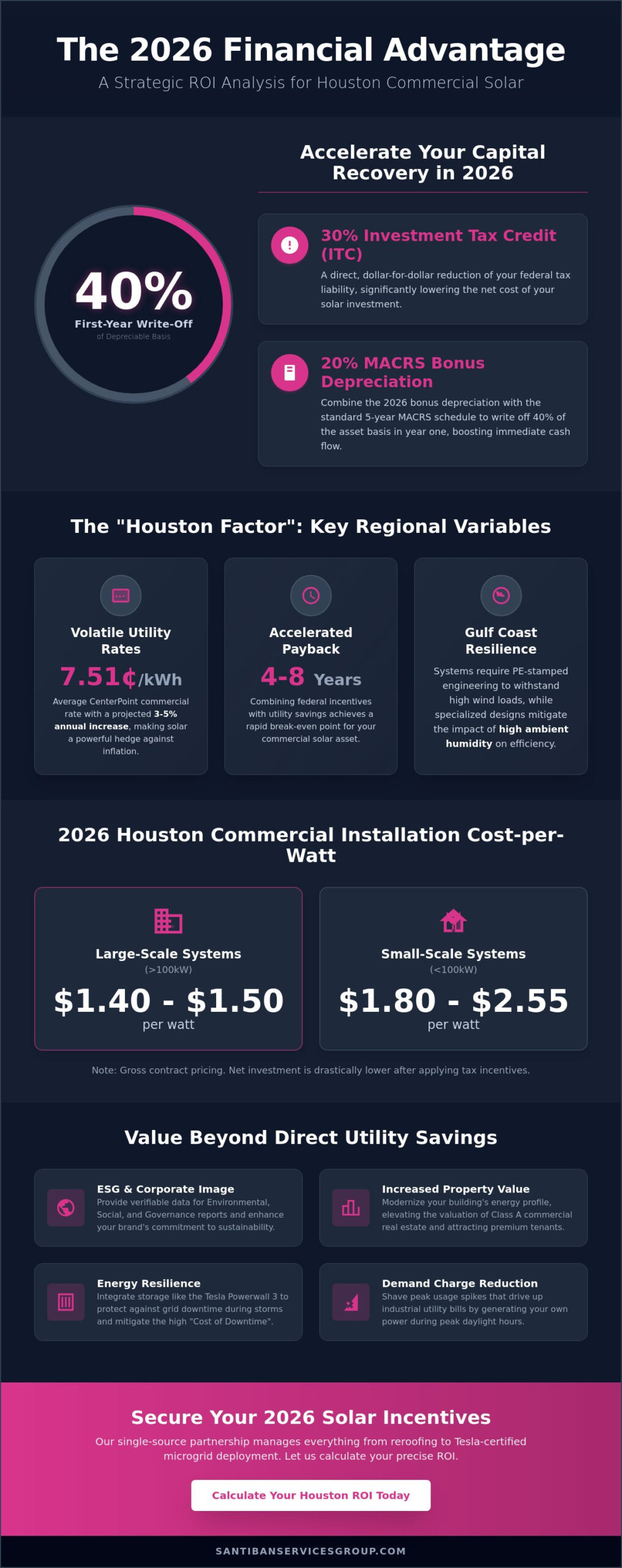
Current data from April 2026 indicates that CenterPoint Energy commercial rates average 7.51¢/kWh, with some delivery costs pushing the effective rate even higher. With a projected annual increase of 3% to 5%, solar serves as a fixed-cost hedge against utility volatility. 2026 stands as a pivotal year because the federal financial incentives for photovoltaics, specifically the 30% Investment Tax Credit (ITC), remain at their peak levels. When combined with the 20% MACRS bonus depreciation available this year, businesses can write off a significant portion of the system cost almost immediately.
The Core Components of a Houston Solar Payback Period
A standard commercial solar ROI calculator Houston focuses on three primary pillars. First, the direct energy offset reduces the total kilowatt-hour (kWh) volume purchased from the grid. Second, solar installations are highly effective at demand charge reduction. By providing power during peak daylight hours, solar shaves the usage spikes that often drive up industrial utility bills. Finally, meticulous Operations and Maintenance (O&M) projections are essential. In the Gulf Coast climate, regular inspections ensure that salt air and humidity don’t degrade system components over time.
Intangible ROI: ESG and Property Value
Beyond the ledger, solar infrastructure provides significant intangible value. It elevates the valuation of Class A commercial real estate by modernizing the building’s energy profile. For corporate entities, these systems provide verifiable data for ESG (Environmental, Social, and Governance) reporting, which is now a standard requirement for institutional investors. Sustainable infrastructure also serves as a silent engine for tenant retention, offering more predictable utility costs and demonstrating a commitment to long-term corporate stability.
Key Variables for Calculating Your Solar Return on Investment
Precision in financial modeling is paramount when evaluating distributed energy resources. To produce an accurate result from a commercial solar ROI calculator Houston, facility managers must input verified 2026 data points rather than relying on outdated national averages. The primary driver of immediate liquidity is the Section 48 Investment Tax Credit (ITC). For projects that commence construction before July 4, 2026, the base credit remains at a robust 30%. This incentive provides a dollar-for-dollar reduction in federal tax liability, significantly lowering the initial capital threshold for Houston enterprises.
Current market data from early 2026 indicates that commercial-scale installation costs in Southeast Texas range between $1.40 and $1.50 per watt for systems exceeding 100kW. Smaller installations typically command a premium, ranging from $1.80 to $2.55 per watt. While these figures represent the gross contract price, the net investment is drastically lower once you apply the Modified Accelerated Cost Recovery System (MACRS). In 2026, businesses can utilize a 20% bonus depreciation. This allows for a total of 40% of the depreciable basis to be written off in the first year of operation, providing an immediate cash flow advantage that traditional facility upgrades cannot match.
Federal and State Incentives for 2026
The 2026 incentive landscape requires a meticulous approach to compliance. Beyond the 30% base ITC, systems under 1MW may qualify for additional “adders” if they utilize domestic content or are located in designated energy communities. While Texas does not offer a state-level income tax credit, the state provides a vital property tax exemption for the value added by a solar energy system. For businesses located in rural-adjacent areas of Greater Houston, the USDA REAP grant program can potentially cover up to 50% of total project costs, further compressing the payback period.
Calculating Net System Cost
Determining the true net cost involves more than subtracting credits from the sticker price. If your facility requires structural upgrades, integrating a Tesla and solar roof solution can consolidate reroofing and energy generation into a single capital project with shared soft costs. Financing structures also play a critical role; while cash purchases maximize the Internal Rate of Return (IRR), low-interest commercial solar loans allow for cash-flow positive operations from day one. You can refine these projections by consulting with an established facility partner to ensure every meticulous detail of the 2026 tax code is leveraged for your benefit.
Beyond Utility Bills: Factoring Resilience and Storage into Your ROI
A comprehensive commercial solar ROI calculator Houston must account for the financial impact of grid instability. This factor is frequently overlooked by generic models. While utility savings are predictable, the “Cost of Downtime” represents a critical risk variable for Houston businesses facing frequent extreme weather events. If a facility loses power for even one hour, the resulting loss in labor productivity, data integrity, and inventory spoilage can exceed the monthly cost of the energy itself. Integrating storage solutions transforms solar from a passive cost-saving measure into a resilient microgrid that ensures operational continuity.
The deployment of Tesla Powerwall 3 systems allows for sophisticated energy arbitrage. By storing solar energy during midday production peaks and discharging it during high-demand periods when CenterPoint rates are at their highest, businesses effectively shave their peak demand charges. This capability is further enhanced through Tesla Electric in Houston. This program enables commercial entities to participate in grid services, generating a new revenue stream by providing support to the ERCOT grid. This participation directly improves the project’s Internal Rate of Return beyond simple bill reduction.
The ROI of Energy Security
Quantifying energy security requires a meticulous comparison between solar-plus-storage and traditional diesel generators. Unlike generators that require fuel deliveries and high maintenance costs, solar microgrids offer a silent and seamless transition during grid failures. Some commercial insurance providers now offer premium reductions for facilities that demonstrate superior redundant power systems. This reduction in risk exposure is a tangible financial benefit that you should include in every long-term facility strategy.
Industrial EV Infrastructure Integration
Modern facility management increasingly involves commercial EV charger installation to support fleet electrification or employee benefits. This infrastructure increases the self-consumption of on-site solar production. It ensures that energy generated on the roof is utilized directly by company assets rather than being sold back to the grid at lower wholesale rates. By balancing solar production with EV charging demand, businesses optimize their ROI while creating a sophisticated energy ecosystem that appeals to high-value tenants and institutional investors.
Navigating Houston Permitting and Engineering Requirements
The accuracy of any commercial solar ROI calculator Houston depends heavily on accounting for “soft costs,” which include permitting, engineering, and administrative fees. In the City of Houston (COH), these expenses are not static. As of early 2026, solar permit fees typically range from $128 to $500, depending on the system’s size and complexity. While these fees are relatively modest, the financial risk lies in project delays caused by non-compliant designs. Meticulous planning ensures that these administrative hurdles don’t extend your payback period by months or lead to expensive structural retrofits during the construction phase.
Securing an Interconnection Agreement with CenterPoint Energy requires a professional and disciplined approach to electrical design. CenterPoint maintains high standards for grid-tied systems to ensure local network stability. A well-documented design reduces the back-and-forth during the utility review process, allowing your business to begin generating energy and capturing savings sooner. This phase is a critical component of the overall project timeline. Professional management of these technical requirements is the silent engine that keeps a complex installation on schedule and within budget.
PE-Stamped Engineering: A Risk Mitigation Strategy
Houston’s proximity to the Gulf Coast makes wind load a primary engineering concern. Utilizing PE stamped engineering for solar systems is a mandatory requirement for ensuring structural integrity against extreme weather. This professional certification serves as a fundamental risk mitigation strategy. Most commercial financing entities and insurance providers require these stamps as a prerequisite for capital approval or policy issuance. Our integrated approach to engineering ensures that every technical detail meets the 2026 building codes, protecting your asset from both physical and financial liability.
The Permitting Timeline in Houston
In the current 2026 Houston market, the commercial solar permitting timeline generally spans six to ten weeks. This duration includes the structural review by the COH and coordination with local fire marshals for battery storage placement. Compliance with fire codes is essential for microgrid deployments involving the Tesla Powerwall 3. Pitfalls in industrial electrical construction, such as improper setbacks or inadequate labeling, often cause inspection failures that delay the activation of your system. You can ensure a predictable and steady project flow by scheduling a professional site assessment with our dedicated engineering team today.
Strategic Implementation: Securing Your Commercial Solar Investment
Securing a high-performing renewable asset requires more than a favorable output from a commercial solar ROI calculator Houston. It demands a strategic partnership with an entity capable of managing the complex intersection of structural engineering, industrial roofing, and high-voltage electrical construction. Selecting a single-source provider ensures that responsibilities for reroofing, structural reinforcement, and solar integration remain under one roof. This integrated approach eliminates the logistical friction often found when coordinating multiple subcontractors, which can otherwise lead to project delays and inflated soft costs that erode your initial financial projections.
For energy storage deployments, verify that your partner maintains a Tesla-certified status. This certification is a prerequisite for ensuring that systems like the Tesla Powerwall 3 operate within manufacturer specifications and remain eligible for full warranty support. A local Houston presence is equally indispensable for long-term Operations and Maintenance (O&M). The specific environmental challenges of the Gulf Coast necessitate a partner who can respond promptly to warranty claims or system optimizations after seasonal storm events. Before signing a commercial solar contract in Texas, ensure the following criteria are met:
- The proposal includes PE-stamped structural and electrical plans tailored for City of Houston compliance.
- The financial model accounts for the 2026 MACRS bonus depreciation and the 30% Investment Tax Credit.
- The installation team has a documented history of industrial electrical expertise.
- The contract provides a comprehensive O&M service agreement for the system’s 25-year lifespan.
The Santiban Advantage for Houston Businesses
The Santiban Services Group leverages over 24 years of industrial electrical expertise to manage complex solar projects with quiet confidence. We apply an “excellence in every detail” mantra to every phase of development, from the initial PE-stamped engineering to the final interconnection with the grid. Our disciplined approach ensures that your project remains a stable, predictable engine for cost savings. Rather than providing generic estimates, we deliver a tailored commercial solar ROI calculator Houston analysis that reflects the specific structural and electrical realities of your facility.
Next Steps for Houston Facility Managers
Transitioning to solar is a meticulous process that begins with accurate data. Facility managers should prioritize gathering 12 months of CenterPoint Energy utility data to establish a consumption baseline. This information allows for a precise sizing of the photovoltaic array and storage capacity. Once this data is secured, the next logical step is scheduling a site-specific structural and electrical assessment to identify any necessary infrastructure upgrades before the 2026 tax window closes.
Request a Professional Commercial Solar ROI Analysis from Santiban Services Group to secure your firm’s energy future with an established partner.
Securing Your Enterprise’s Energy Future in 2026
The 2026 financial window offers a rare convergence of 30% federal tax credits and significant first-year depreciation benefits. Leveraging a commercial solar ROI calculator Houston framework allows your facility team to transform volatile utility expenses into a predictable, tax-advantaged asset. By integrating resilient storage and meticulous structural design, you protect your operations against both grid instability and the specific environmental demands of the Gulf Coast. This strategic approach ensures that your capital investment delivers measurable value from the first day of activation.
Santiban Services Group serves as a disciplined, single-source partner for this transition. We bring 24+ years of industrial electrical experience to every deployment. Our dedicated teams provide in-house PE-stamped engineering and are recognized as Tesla-certified Powerwall 3 installers. This internal capability ensures your infrastructure meets the highest standards of safety and technical excellence. We invite you to Request a Meticulous Commercial Solar ROI Analysis for Your Houston Business to begin your facility’s modernization. It’s time to solidify your long-term operational stability with a partner that values precision and consistent performance above all else.
Frequently Asked Questions
How long is the typical payback period for commercial solar in Houston?
Most commercial solar projects in the Houston area achieve a full return on investment within 4 to 8 years. This timeline depends on your facility’s specific energy consumption patterns and the utilization of 2026 federal tax incentives. A commercial solar ROI calculator Houston framework integrates these variables with local utility rates to provide a precise capital recovery schedule for your organization.
Does the 30% Federal Investment Tax Credit (ITC) still apply in 2026?
Yes, the Section 48 Investment Tax Credit is available at a 30% base rate for commercial projects that begin construction before July 4, 2026. Organizations may also qualify for additional “adders” if the project utilizes domestic content or is located in a designated energy community. This credit represents a significant dollar-for-dollar reduction in federal tax liability, which drastically lowers the net cost of the installation.
What is the financial benefit of adding a Tesla Powerwall 3 to a commercial solar system?
The Tesla Powerwall 3 provides a financial hedge against grid volatility and high demand charges. By storing solar energy during peak production and discharging it when utility rates are highest, businesses can significantly lower their operational expenses. This technology also allows for participation in grid services, creating a secondary revenue stream while ensuring 24/7 operational continuity during Houston’s storm seasons.
How much does PE-stamped engineering add to the cost of a Houston solar project?
PE-stamped engineering is a necessary administrative cost that ensures structural compliance with City of Houston building codes. While solar permit fees themselves range from $128 to $500 as of early 2026, professional engineering fees are typically bundled into the total project soft costs. This meticulous design is a prerequisite for securing commercial financing and maintaining comprehensive insurance coverage for the asset.
Can I install commercial solar panels on an older roof in Houston?
Installing solar on a roof with less than 10 to 15 years of remaining life is generally not recommended. The cost to remove and reinstall a solar array for roof repairs can compromise the project’s long-term ROI. We advocate for a single-source solution where reroofing and solar installation are coordinated, ensuring the structural integrity of the facility remains intact for the system’s 25-year lifespan.
What are the maintenance costs for a commercial solar system in the Texas Gulf Coast climate?
Annual maintenance costs for commercial systems in the Houston area typically range from 1% to 2% of the initial system cost. The Gulf Coast climate requires meticulous attention to salt air corrosion and humidity, which can impact electrical components over time. Regular professional inspections and panel cleanings are essential to maintain the performance levels forecasted by your commercial solar ROI calculator Houston.
Does solar energy reduce demand charges on my CenterPoint bill?
Solar energy effectively reduces demand charges by providing on-site power during peak daylight hours. Many Houston industrial facilities incur high fees based on their highest 15-minute usage window each month. By utilizing solar production to meet this peak demand, businesses can lower the demand portion of their utility bill by 20% to 40%, depending on their specific load profile.
Is there an ROI for installing EV charging stations alongside commercial solar?
Installing EV charging stations alongside solar provides a measurable ROI by increasing the self-consumption of on-site energy. This strategy ensures that power generated by your array is used directly by fleet vehicles or employees rather than being sold back to the grid at lower wholesale rates. Additionally, monetized charging stations can create a new revenue stream while supporting corporate ESG goals and employee retention.