

What if your facility’s most volatile operational expense became its most predictable asset by 2026? As CenterPoint utility rates continue their upward trajectory and ERCOT grid reliability remains a primary concern for Houston stakeholders, the shift toward localized energy production is no longer a luxury. You’ve likely recognized that waiting for market stability is a strategy with diminishing returns. Understanding the cost of solar panels in Houston TX 2026 is the first step in securing your financial perimeter against rising energy inflation.
We promise to deliver a comprehensive analysis of the current fiscal landscape, including the transition to Section 48E clean energy credits and the tangible ROI of high-performance hardware. This guide examines how a professionally engineered system transforms immediate capital expenditure into a long-term engine for property value and operational independence. We’ll explore the technical specifications and financial incentives that make 2026 a pivotal year for Houston’s energy transition.
Key Takeaways
- Analyze current price-per-watt metrics to accurately project the cost of solar panels in Houston TX 2026 for your residential or commercial property.
- Leverage the Section 48E Clean Electricity Investment Tax Credit to secure a 30% federal incentive on both solar arrays and integrated battery storage.
- Integrate solar installation with specialized reroofing services to ensure structural longevity and optimize your total project ROI.
- Evaluate the technical resilience of the Tesla Powerwall 3 compared to standard grid-tied configurations for the evolving Houston energy landscape.
- Identify the essential qualifications of certified installation partners to mitigate the operational risks and high maintenance costs of substandard systems.
The 2026 Houston Solar Landscape: Market Trends and Pricing
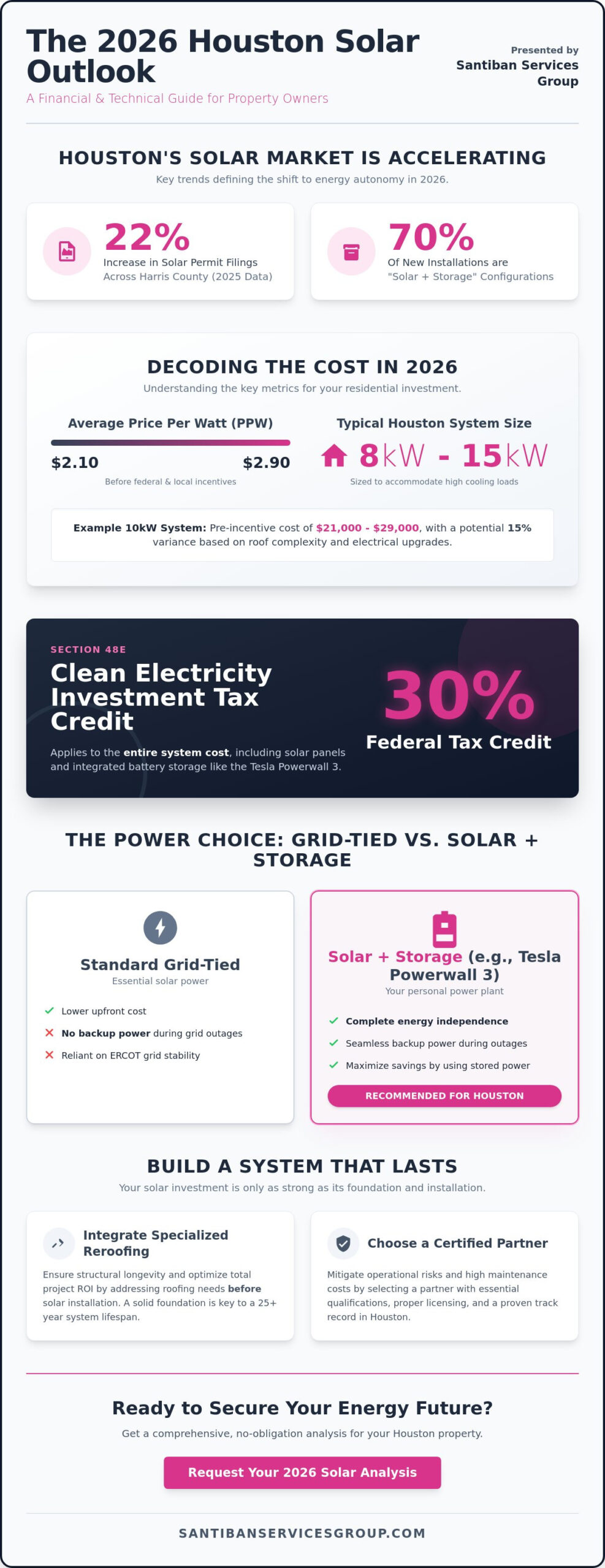
The Houston-The Woodlands-Sugar Land metro area has emerged as a primary hub for renewable energy integration. Recent data from 2025 indicates a 22% increase in solar permit filings across Harris County. This growth reflects a disciplined transition toward energy autonomy as homeowners and businesses seek to mitigate rising utility rates. The industry relies on the “Price per Watt” (PPW) metric to maintain transparency. This standard allows for a direct comparison of system value by dividing the total installation cost by the system’s total wattage. It remains the most reliable indicator of investment efficiency in 2026.
Global supply chain shifts have reached a state of equilibrium. The volatility seen in previous years has been replaced by consistent manufacturing outputs and streamlined logistics. This stability directly impacts the cost of solar panels in Houston TX 2026, allowing for more predictable project budgeting. Within the broader U.S. Solar Power Landscape, Houston stands out for its rapid adoption of “Solar + Storage” configurations. Battery integration is no longer a secondary consideration. It is the default setup for 70% of new installations, providing a necessary layer of protection against localized grid instability.
Average Cost per Watt and System Sizing in Houston
Residential energy demands in Houston typically require systems ranging from 8kW to 15kW. These sizes accommodate the high cooling loads necessary for the Texas climate. Current pricing for these systems fluctuates between $2.10 and $2.90 per watt before any federal or local incentives are applied. Final project costs are influenced by meticulous factors, including Harris County’s specific permitting fees and the prevailing labor rates for certified technicians. A 10kW system might see a total price variance of 15% based on roof complexity and the required electrical upgrades.
Commercial vs. Residential Solar Cost Factors
Commercial solar projects benefit from significant economies of scale. Large-scale industrial facilities often secure lower per-watt pricing due to bulk hardware procurement and streamlined installation workflows. The physical requirements also differ. Residential projects involve pitched roofs requiring specialized flashing and mounting, while commercial installations often utilize ballasted systems on flat roofs. Santiban observes that 40% of commercial projects now include integrated EV charging infrastructure. This expansion of scope requires sophisticated power management systems but delivers superior long-term operational value for corporate fleets and employee facilities.
Maximizing Your Investment: Tax Credits and Houston Incentives
Strategic financial planning is essential for optimizing the return on renewable energy assets. In 2026, federal and state incentives remain the most effective tools for reducing the net cost of solar panels in Houston TX 2026. These mechanisms transform a standard home improvement project into a sophisticated capital investment that yields predictable long-term dividends. By leveraging established tax codes, homeowners can significantly lower their initial capital outlay while securing a resilient energy future.
Navigating the Transition to Section 48E
The transition from the traditional Section 25D credit to the technology-neutral Section 48E framework represents a calculated shift in federal energy policy. Section 48E serves as the primary federal mechanism for solar cost reduction in 2026. This updated code provides a 30% tax credit for systems that achieve zero greenhouse gas emissions during electricity generation. Houston homeowners qualify for this credit by ensuring their installation is completed within the tax year and that they own the equipment rather than leasing it. The 30% credit applies to the entire system cost, including high-capacity storage units like the Tesla Powerwall 3. Accurate financial modeling often utilizes the U.S. Department of Energy’s cost benchmarks to validate that installation quotes align with national standards for efficiency and pricing. This federal support ensures that the integration of advanced battery technology remains economically viable for residential applications.
Local Houston Rebates and Utility Programs
Houston’s deregulated energy market requires a meticulous approach to selecting a Retail Electric Provider (REP). Each provider offers distinct buyback programs that determine how much credit you receive for excess energy sent back to the grid. While CenterPoint Energy maintains the physical infrastructure, the financial benefits are dictated by your specific REP contract. You must evaluate the performance of “Free Nights and Weekends” plans versus traditional Solar Buyback plans. Free nights plans often prioritize those with significant evening storage capacity, while buyback plans favor high-output arrays. Understanding these variables is critical when calculating the total cost of solar panels in Houston TX 2026. Texas state law provides a significant advantage through property tax exemptions. Under Texas Tax Code Section 11.315, 100% of the value added by a solar installation is exempt from property tax appraisals. This ensures your home value increases without an accompanying increase in annual tax liabilities. For those seeking a comprehensive facility management solution, understanding these local nuances is the first step toward energy independence.
- Federal ITC: A 30% reduction in total project costs via the Section 48E credit.
- Property Tax Exemption: 100% exclusion of solar value from Harris County tax appraisals.
- REP Buyback: Variable credits based on energy export rates and specific plan structures.
- Storage Integration: Full credit eligibility for batteries like the Tesla Powerwall 3.
The Impact of Reroofing and Engineering on Total Project Cost
Installing a high-efficiency solar array on a roof with less than 10 years of remaining life is the most frequent financial error homeowners make. This oversight significantly inflates the total cost of solar panels in Houston TX 2026. If the underlying roof fails mid-cycle, you’ll face the substantial expense of dismantling and reinstalling the entire system. This redundant labor typically adds between $3,000 and $5,000 to your total expenditure. A strategic investment requires a single-source approach where the roof and solar system function as a unified, resilient asset.
Professional facility management principles dictate that technical readiness must precede installation. By addressing roofing and solar as a combined project, you streamline logistical challenges and ensure the structural integrity of your property. Santiban Services Group prioritizes this integrated methodology to provide clients with a silent engine of reliability that operates without interruption.
- Bundling services reduces mobilization fees and streamlines project management.
- Integrated warranties prevent liability gaps between roofing and solar contractors.
- Structural reinforcement ensures the property maintains its value and safety standards during extreme weather.
Solar Reroofing: Protecting Your 25-Year Investment
Synchronizing your roof replacement with solar installation maximizes the 30% federal tax credit’s impact on your total project budget. This coordination ensures that both the substrate and the energy system share a 25-year lifecycle. Many property owners now opt for Tesla and solar roof solutions in Houston to achieve superior durability. These integrated designs eliminate traditional mounting penetrations, which reduces the risk of water intrusion during the 45-plus inches of rain Houston receives annually.
The Value of PE-Stamped Engineering in Harris County
Technical compliance in Harris County is a foundational requirement for any solar project. City and county permits mandate a professional engineer’s stamp to verify that the existing roof structure can support the weight of the hardware and withstand the uplift of 130 mph hurricane winds. Our PE stamped engineering guide outlines why this meticulous design is a non-negotiable cost for safety and legal adherence. Professional engineering prevents catastrophic structural failures during extreme weather events and reduces city inspection delays by up to 40%. It’s the disciplined process that ensures your system remains a stable, long-term contributor to your facility’s energy independence.
Comparing Solar Configurations: Grid-Tied vs. Tesla Powerwall 3
While the base cost of solar panels in Houston TX 2026 remains a primary concern for property owners, the specific configuration determines the long-term utility of the installation. A basic grid-tied system operates as a financial instrument designed for bill mitigation. It’s efficient during sunny days but remains vulnerable to the frequent grid instabilities affecting Southeast Texas. In contrast, a resilient hybrid system featuring the Tesla Powerwall 3 transforms a standard solar array into a comprehensive infrastructure asset.
Analyzing the “Cost of Inaction” is essential for a realistic ROI. During a multi-day grid failure, such as those experienced during recent tropical events, the financial impact often exceeds the price of battery hardware. Lost refrigerated inventory, emergency lodging, and property damage from high indoor humidity can quickly total $2,500 to $5,000 per event. Shifting the ROI calculation from simple payback to “resilience value” allows owners to account for these avoided losses while maintaining operational continuity.
Tesla Powerwall 3 Integration Costs
Integrating a Powerwall 3 into a Houston solar project typically requires a budget between $12,000 and $16,000 per unit before applying the 30% Federal Investment Tax Credit. This configuration yields significant labor savings because the Powerwall 3 features a superior integrated solar inverter. This design eliminates the requirement for secondary hardware installations, which simplifies the electrical architecture and reduces onsite labor hours. Our Tesla Powerwall 3 installation guide details the meticulous technical standards required for these seamless integrations.
Estimating 25-Year Savings and Payback Period
Strategic investments in solar technology typically achieve a break-even point within 7 to 11 years in the 2026 Houston market. This timeline remains favorable due to several key factors:
- Utility Rate Inflation: Projections indicate CenterPoint customers will face 4% to 6% annual rate increases to fund grid modernization.
- Property Appreciation: Industry data confirms that solar installations increase Houston residential resale values by an average of 4.1%.
- System Longevity: Modern Tier-1 panels maintain high performance for over 25 years, ensuring decades of carbon-free energy.
When calculating the total cost of solar panels in Houston TX 2026, owners should view the system as a hedge against energy inflation. Over a 25-year lifecycle, the accumulated savings frequently triple the initial capital expenditure, providing a stable and predictable energy cost structure.
Contact Santiban Services Group to request a tailored resilience assessment for your property.
Choosing a Certified Houston Solar Partner for 2026
Selecting an installation partner in 2026 requires a strategic shift in perspective. The market often presents low-bid quotes that prioritize immediate savings over long-term structural integrity. These “cheap” solar solutions frequently result in higher maintenance costs over the 25-year lifespan of the system. Hiring a Tesla-certified installer is a critical requirement for homeowners who want to integrate advanced energy storage like the Powerwall 3. This certification ensures the electrical architecture supports high-demand backup loads without system failure during grid outages.
The total cost of solar panels in Houston TX 2026 depends heavily on the quality of the initial engineering. Industrial-grade execution prevents the common issues of roof leaks or inverter malfunctions that plague budget installations. A professional partner provides a PE-stamped site assessment; this is a formal document verified by a Professional Engineer. It differs from generic online estimates because it accounts for specific wind load requirements and electrical panel capacities unique to your Houston property. This level of precision protects your investment from unforeseen technical hurdles during the permitting phase.
The Santiban Difference: Engineering-First Solar
Santiban Services Group brings over 24 years of experience in Texas industrial and energy sectors to every residential project. We operate as a “silent engine” for our clients. This means our dedicated teams manage the logistical complexities of permitting and procurement so your project remains on schedule and on budget. Our technicians specialize in the integration of Tesla Powerwall 3 and EcoFlow backup solutions. We apply the same meticulous standards to home energy systems that we use for large-scale industrial facilities. This disciplined approach ensures that your investment in the cost of solar panels in Houston TX 2026 yields consistent performance for decades.
Initiating Your Houston Solar Project
A successful transition to solar energy begins with accurate data. Before your first consultation, you should gather 12 months of utility records. This history allows our energy experts to size your system based on actual consumption patterns rather than seasonal averages. Our process moves beyond simple sales pitches to provide a comprehensive technical evaluation. You can expect a transparent review of your roof’s structural health and electrical readiness. To begin this methodical process, Contact Santiban Services Group for a professional solar evaluation. Our team provides the stability and expertise required to secure your energy future through superior engineering and reliable execution.
Securing Your Energy Future Through Strategic Infrastructure
Investing in a sustainable energy strategy requires a disciplined approach to both technology and engineering. The 2026 landscape underscores the 30% Federal Investment Tax Credit as a critical tool for maximizing financial returns. Property owners must also account for the structural impact of reroofing and the technical superiority of systems like the Tesla Powerwall 3. Navigating the cost of solar panels in Houston TX 2026 requires a partner who understands these complex variables and delivers a seamless integration into your existing facility.
Santiban Services Group leverages over 24 years of Texas industrial experience to ensure your project meets the highest professional standards. Every installation includes a PE-stamped engineering design to guarantee structural safety and compliance. As a Tesla-certified installer, we provide the authoritative expertise needed to manage every operational detail with quiet confidence. You’ll benefit from a single-source solution that prioritizes long-term reliability and meticulous execution.
Request a Meticulous Solar & Storage Quote from Santiban Services Group
Your path toward energy independence is a significant milestone, and we’re ready to help you achieve excellence in every detail.
Frequently Asked Questions
How much do solar panels cost in Houston, TX for a typical 2,500 sq ft home in 2026?
A typical 2,500 square foot home in Houston requires an 8kW to 10kW system, which averages between $24,000 and $35,000 before federal incentives. These figures reflect market data from the Solar Energy Industries Association for residential installations in the Texas market. Your final cost of solar panels in Houston TX 2026 depends on specific energy consumption patterns and equipment selection. Our team provides a meticulous assessment to ensure your system meets these precise technical requirements.
Does the 30% federal tax credit still apply to solar in 2026?
The 30% federal tax credit remains fully available in 2026 under the provisions of the Inflation Reduction Act of 2022. This credit applies to the total cost of solar equipment, labor, and energy storage systems installed during the tax year. Homeowners can claim this 30% deduction on their federal income taxes until the rate begins to decrease in 2033. This established incentive provides a reliable foundation for your long-term energy strategy and capital investment.
Is it worth getting a Tesla Powerwall 3 with my solar panels in Houston?
Integrating a Tesla Powerwall 3 provides essential energy security for Houston residents facing frequent grid instability from seasonal storms. This unit offers 13.5 kWh of storage capacity and a continuous power output of 11.5 kW, which sustains critical appliances during outages. While it increases the initial expenditure, the seamless transition to backup power ensures operational continuity for your home. Our integrated approach evaluates your specific load requirements to determine if this storage solution fits your goals.
How long does it take for solar panels to pay for themselves in Texas?
Solar panels in Texas typically achieve a full return on investment within 8 to 12 years based on current utility rates and federal incentives. This timeline varies based on your local utility provider’s net metering policies and your total household electricity consumption. By reducing monthly utility expenses, the system functions as a stable financial asset that protects against future energy price hikes. We deliver comprehensive projections to help you understand the exact fiscal trajectory of your installation.
Do I need to replace my roof before installing solar panels?
You should replace your roof before installation if the existing structure has less than 10 years of remaining service life. Solar arrays are engineered to function for 25 to 30 years, so matching the roof’s lifespan prevents the need for costly removal and reinstallation later. Our technicians conduct a thorough inspection of your roof’s integrity during the initial site assessment. This proactive measure ensures a superior, long-term fit for your integrated energy system.
Are there any Houston-specific solar rebates available in 2026?
Houston residents can access specific financial benefits such as the CenterPoint Energy Houston Electric Solar Rebate Program and state property tax exemptions. The Texas tax code Section 11.27 ensures that the added value of a solar installation doesn’t increase your annual property taxes. These programs offer a tailored way to reduce the total cost of solar panels in Houston TX 2026. We track these meticulous details to maximize the financial efficiency of your project.
How do solar panels hold up during a Houston hurricane?
Solar panels are engineered to withstand wind speeds up to 140 miles per hour, meeting the rigorous building codes required in the Houston Gulf Coast region. Most Tier 1 modules carry a UL 1703 or UL 61730 certification, ensuring they resist impact from hail and high-velocity debris. Our installation teams utilize heavy-duty racking systems that provide a secure, stable connection to your home’s structure. This disciplined focus on safety ensures your system remains operational after severe weather events.
What is the difference between Section 25D and Section 48E tax credits?
Section 25D serves individual homeowners through the Residential Clean Energy Credit, while Section 48E provides the Clean Electricity Investment Credit for commercial and utility-scale projects. Section 25D offers a straightforward 30% credit for residential systems installed through 2032. Section 48E is a technology-neutral credit that replaces the traditional Investment Tax Credit for projects placed in service after December 31, 2024. Both credits represent a sophisticated federal commitment to long-term renewable energy infrastructure and corporate sustainability.