
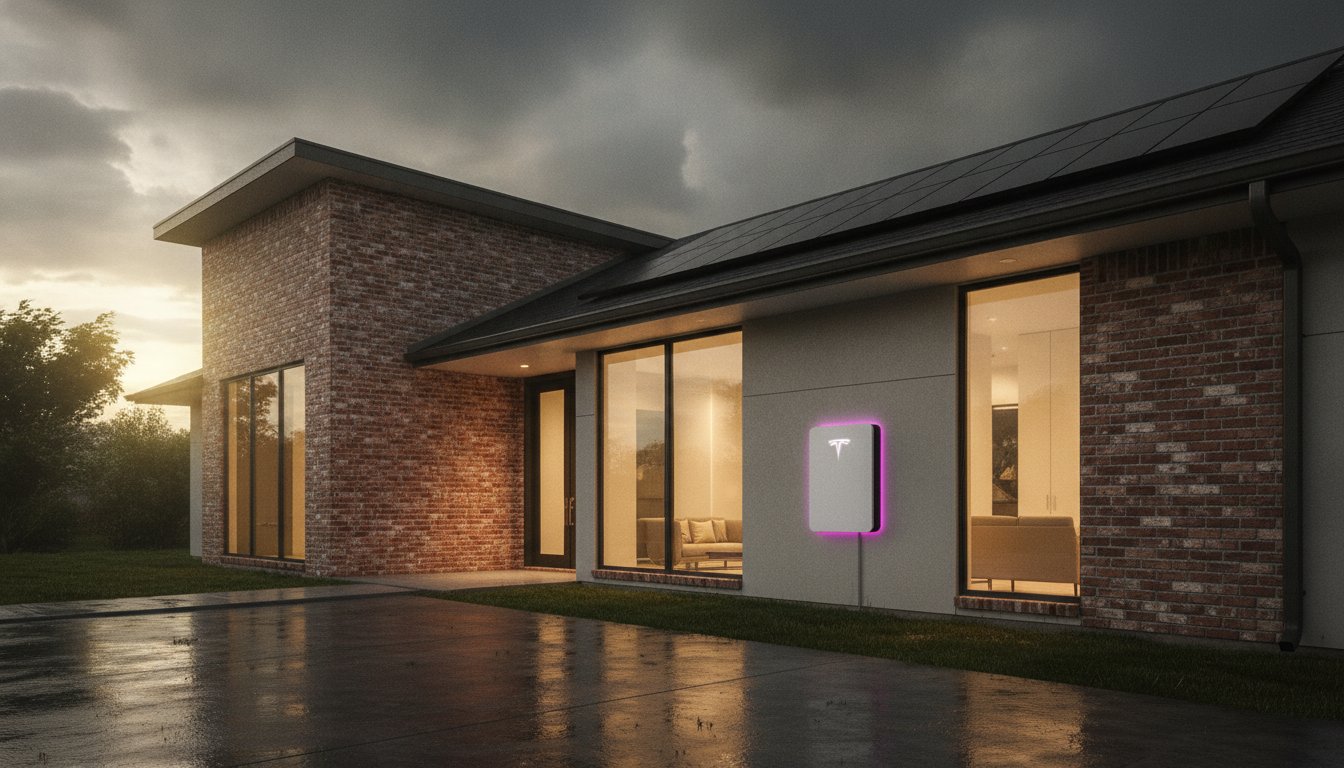
In 2026, a home energy system is no longer a secondary consideration; it’s a critical piece of infrastructure designed to ensure your family’s safety during Houston’s increasingly frequent grid failures. When evaluating EcoFlow vs Tesla Powerwall for home backup, you’re likely balancing the need for technical precision against the frustration of confusing jargon like kW versus kWh. You’ve seen the instability of the Texas grid firsthand, and you need a system that won’t fail when a hurricane or freeze puts your property to the test.
We understand that choosing between the Tesla Powerwall 3 and the EcoFlow Ocean Pro involves more than just comparing battery sizes. It’s about ensuring your central AC can handle high-surge loads during a multi-day outage without compromising your home’s electrical integrity. This guide provides a professional comparison of these leading systems to help you select a reliable, long-term solution. We’ll examine how current 2026 regulations, such as the expiration of the federal tax credit and local CenterPoint incentives, impact your investment. By the end of this analysis, you’ll have the clarity needed to secure a professionally installed backup that maintains your home’s operational continuity.
Key Takeaways
- Analyze the operational impact of battery chemistry and peak surge capacity on your ability to maintain central air conditioning during extended grid outages.
- Compare the technical specifications of EcoFlow vs Tesla Powerwall for home backup to determine which architecture best aligns with your property’s specific energy demands.
- Discover the necessity of PE-stamped engineering and specialized installation techniques to protect your infrastructure against Houston’s unique environmental stressors.
- Understand the strategic importance of solar reroofing to synchronize the lifespan of your roof with your long-term energy storage system.
- Establish a clear decision-making framework based on modularity, ecosystem integration, and professional reliability standards for 2026.
The State of Home Backup in 2026: Tesla and EcoFlow Defined
The transition from temporary portable units to permanent, hardwired infrastructure marks a significant shift in how Houston homeowners approach energy security. In 2026, the comparison of EcoFlow vs Tesla Powerwall for home backup is no longer about camping gear versus home appliances. It’s a choice between two distinct engineering philosophies designed to sustain a household during multi-day grid failures. True resilience now requires sophisticated smart switching and high-voltage integration rather than simple energy storage. A battery alone isn’t a solution; it’s the core of a managed system that must respond instantly when the utility grid fails.
Tesla Powerwall 3: The Integrated Standard
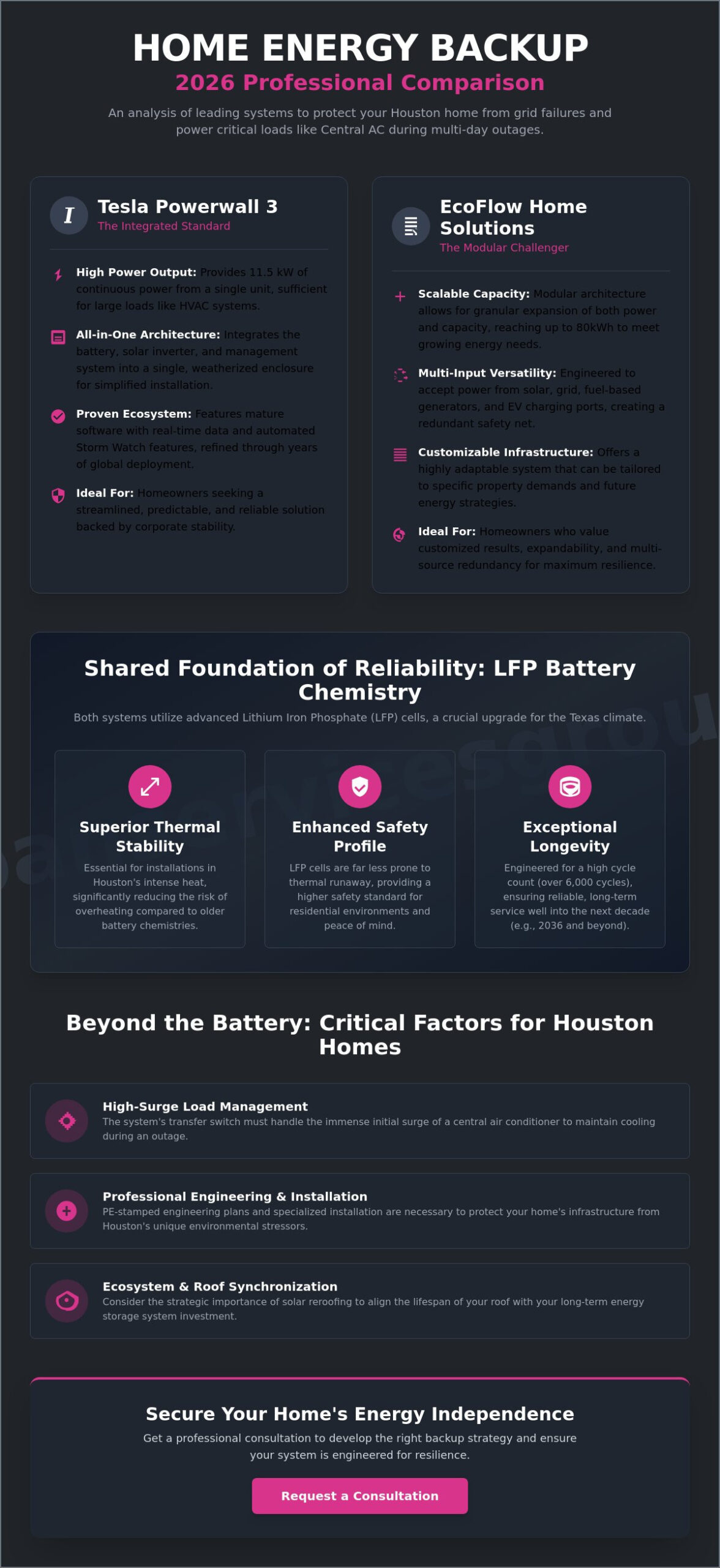
The Tesla Powerwall 3 represents the current benchmark for integrated residential energy systems. It functions as a unified power plant, housing a high-efficiency solar inverter and battery management system within a single, weatherized enclosure. This all-in-one approach minimizes installation complexity and reduces the physical footprint on your property. With a continuous power output of 11.5 kW, a single unit provides the necessary amperage to maintain heavy loads, such as large HVAC systems and well pumps, without requiring multiple stacked components. The mature software ecosystem offers a predictable user experience, providing real-time data and automated storm watch features that have been refined through years of global deployment. This system projects an image of corporate stability and proven performance.
EcoFlow Home Solutions: The Modular Challenger
EcoFlow has successfully transitioned from its origins in portable power to become a formidable challenger in the permanent home backup sector. The Delta Pro Ultra and Ocean Pro series offer a modular architecture that allows for granular scaling of both capacity and power output. Unlike fixed-capacity systems, these units can be expanded as your energy requirements grow, reaching capacities of up to 80kWh. A primary differentiator for EcoFlow is its multi-input versatility. These systems are engineered to accept power from solar arrays, the utility grid, traditional fuel-based generators, and even electric vehicle charging ports. This flexibility provides a redundant safety net, ensuring your home remains powered even during prolonged periods of low solar production. This approach appeals to those who value customized results and adaptable infrastructure.
Reliability in 2026 is defined by the seamless transition between energy sources. A large battery is ineffective if the transfer switch cannot handle the initial surge of a central air conditioner. Choosing between EcoFlow vs Tesla Powerwall for home backup requires an understanding of how these systems integrate with your existing electrical panel. Professional engineering ensures that the chosen system doesn’t just store energy, but manages it with the precision required to maintain your home’s operational continuity during a crisis. Every operational detail must be under expert control to ensure the system functions when it’s needed most.
Technical Specs & Performance: Power, Capacity, and Chemistry
The technical architecture of your backup system determines its operational lifespan and its ability to sustain critical infrastructure during a blackout. When analyzing EcoFlow vs Tesla Powerwall for home backup, the primary differentiator is no longer just capacity. It’s the precision of the power delivery and the resilience of the internal chemistry. Modern systems have converged on advanced battery technologies to meet the rigorous demands of the Texas climate, ensuring that every operational detail remains under control during a crisis.
LFP Chemistry: Why Longevity Matters in 2026
Both the Tesla Powerwall 3 and the EcoFlow Ocean Pro utilize Lithium Iron Phosphate (LFP) chemistry. This represents a significant advancement over the traditional Nickel Manganese Cobalt (NMC) cells used in earlier residential batteries. LFP batteries offer superior thermal stability, which is a vital requirement for installations subjected to intense Houston heatwaves. These cells are significantly less prone to thermal runaway, providing a higher safety profile for residential environments. LFP technology supports a high cycle count, often exceeding 6,000 cycles before reaching significant capacity loss. By the year 2036, a professionally maintained LFP system will likely still provide reliable service, whereas older NMC chemistries would have faced substantial degradation. This durability ensures your investment remains a stable asset for over a decade of consistent performance.
Surge Capacity and Whole-Home Loads
Starting a 5-ton central air conditioning unit requires a massive, instantaneous burst of energy known as Locked Rotor Amps (LRA). If your battery system cannot exceed this specific amperage threshold, your AC will fail to start. This renders the backup system insufficient for true climate control during a summer outage. The Tesla Powerwall 3 is engineered with a 185A motor start capability, allowing a single unit to handle most residential HVAC demands. In contrast, EcoFlow utilizes a stackable architecture where power output increases as more units are added to the system. This modularity allows for a customized power profile that scales to meet the specific LRA requirements of your home’s unique hardware. Understanding these requirements is essential when designing a system for home battery backup that covers whole-home loads rather than just essential circuits.
Round-trip efficiency is another critical metric, representing the percentage of energy that remains available for use after the conversion process. High-performance systems typically achieve efficiencies between 89% and 91%. This means for every 10 kWh stored, approximately 9 kWh are usable. Efficiency losses are inevitable; however, they must be minimized through precise engineering and high-quality components. When selecting a system, homeowners must weigh these performance metrics against the long-term reliability of a 10-year warranty. This ensures the provider stands behind the hardware’s capacity retention and operational uptime through 2036 and beyond.
Built for the Gulf Coast: Weather Resilience and Engineering
The Gulf Coast environment presents a set of rigorous challenges that standard residential battery specifications often fail to address. Sustained humidity, corrosive salt air, and extreme thermal loads during Houston summers can accelerate component degradation and compromise system efficiency. When evaluating EcoFlow vs Tesla Powerwall for home backup, the hardware’s ability to survive these environmental stressors is a primary metric of reliability. A battery unit that is not properly engineered for these conditions risks premature failure or reduced discharge capacity when the grid is most vulnerable. Professional engineering ensures that your backup system remains an invisible, competent force regardless of external climate conditions.
Thermal Management in the Texas Heat
Battery performance is directly influenced by ambient temperature. Sustained 100°F+ days in Houston require active management to prevent thermal throttling. Tesla’s Powerwall 3 utilizes a closed-loop liquid cooling system, which maintains optimal internal temperatures more effectively than air-cooled alternatives. This liquid-based approach ensures consistent discharge rates and protects the long-term health of the LFP cells during peak summer usage. EcoFlow systems employ a modular air-cooled design. While this reduces mechanical complexity, it necessitates strategic placement in shaded or climate-controlled areas to maintain peak efficiency. Professional installers prioritize placement in north-facing or ventilated locations to mitigate the impact of solar heat gain on the system’s electronics and ensure the longevity of the work.
Engineering Compliance and Permitting
In Houston, local Authorities Having Jurisdiction (AHJs) enforce strict compliance standards for energy storage installations. This regulatory environment requires PE-stamped engineering for solar systems to ensure that every structural and electrical detail meets municipal code. Without these professional seals, projects are frequently red-tagged, leading to significant delays and failed inspections. Working with a certified Tesla Powerwall installer guarantees that your system is designed with these local requirements in mind. This level of professional oversight prevents common permitting errors and ensures the system is legally and operationally sound from day one, providing the quiet confidence that comes with expert control.
Structural integrity is another critical factor when mounting heavy battery stacks on residential walls. A single Powerwall 3 or a high-capacity EcoFlow stack carries significant weight that requires reinforced mounting solutions. Santiban utilizes specialized engineering designs to distribute these loads safely, preventing structural damage to the home’s framing. Flood mitigation is also a priority for Houston residents. We implement elevated mounting strategies or indoor installations to protect sensitive electronics from rising water during storm events. These precise execution standards transform a standard battery installation into a resilient piece of infrastructure capable of withstanding the Gulf Coast’s most severe conditions.
Ecosystem Integration: Solar Reroofing and Smart Apps
The success of a residential energy strategy depends on the seamless integration of hardware, software, and the physical structure of the property. When comparing EcoFlow vs Tesla Powerwall for home backup, homeowners must look beyond the battery enclosure to the broader ecosystem. A battery system is only as reliable as the roof that supports the solar array and the software that manages the power flow. Achieving maximum resilience in 2026 requires a unified approach where every component is synchronized for long-term performance.
The Importance of Solar Reroofing
The architectural integrity of your home serves as the foundation for any energy storage project. Installing a sophisticated 2026 battery system on a 15-year-old roof creates a significant operational liability. Most solar panels and battery systems are engineered for a 25-year lifespan. If the underlying roof fails mid-cycle, the cost to decommission, remove, and reinstall the solar hardware can negate the financial benefits of the system. Santiban coordinates solar reroofing alongside battery installation to ensure the roof and the energy system share the same lifecycle. This proactive coordination also allows homeowners to maximize available financial incentives by bundling structural upgrades with clean energy property. A professionally managed reroof ensures that the mounting points for solar arrays are structurally sound and watertight, protecting your investment from the heavy rains common to the Gulf Coast.
Smart Management: Storm Watch vs. AI Optimization
Digital management platforms provide the necessary control to navigate Houston’s volatile energy market. Tesla’s proprietary application is recognized for its functional clarity and the highly effective Storm Watch feature. This utility automatically detects incoming severe weather and prioritizes charging the battery to 100 percent from the grid before an outage occurs. This automated response provides quiet confidence during hurricane season. In contrast, EcoFlow utilizes an AI-driven management system that excels in complex, multi-source environments. The EcoFlow interface allows for the integration of third-party generators, providing a customized backup strategy for those who require redundant power sources. Both systems enable daily energy arbitrage, allowing you to discharge stored energy during peak-rate periods to lower monthly utility bills. For a unified aesthetic that merges structural resilience with energy production, many clients choose Tesla and Solar Roof solutions to maintain architectural standards while achieving energy independence.
Selecting the right ecosystem is a strategic decision that affects your property’s value and operational readiness. Whether you prioritize the integrated simplicity of the Tesla ecosystem or the modular flexibility of EcoFlow, the installation must be executed with precision. Consult with our engineering team for a comprehensive solar reroofing and battery integration assessment. Our specialized personnel ensure that your home’s infrastructure is prepared to support these advanced technologies for decades to come.
Professional Verdict: Choosing Your Backup Strategy
Selecting the optimal architecture for residential energy resilience requires a strategic evaluation of your household’s specific operational demands. The decision between EcoFlow vs Tesla Powerwall for home backup ultimately depends on whether you value a unified, integrated ecosystem or a modular, multi-source configuration. Both systems provide the high standards of performance necessary for the Houston climate; however, their deployment strategies cater to different long-term objectives. A successful installation ensures that every operational detail remains under expert control during the next grid instability event.
The Tesla Powerwall 3 Recommendation
The Tesla Powerwall 3 is the preferred solution for homeowners who prioritize a streamlined, high-output system with a proven record of reliability. This hardware is ideal for those seeking a set it and forget it experience, where the software manages energy transitions with minimal user intervention. If your property is already equipped with Tesla hardware, such as an electric vehicle or a solar roof, the Powerwall 3 provides a unified aesthetic and functional synergy. Beyond hardware integration, homeowners in the Texas deregulated market can leverage Tesla Electric to maximize their return on investment through automated grid participation. This system functions as a silent engine, maintaining your home’s power with disciplined precision.
The EcoFlow Recommendation
EcoFlow is the superior choice for homeowners who require maximum flexibility and the ability to scale their infrastructure incrementally. This modular architecture allows you to start with a baseline capacity and expand the system as your energy needs or budget evolve. It is particularly effective for properties that already utilize gas or propane standby generators, as the EcoFlow system is engineered to integrate these external power sources into a single managed backup strategy. This versatility makes it an excellent candidate for hybrid or semi-off-grid applications where redundant energy inputs are a priority. EcoFlow’s ability to transition from portable origins to permanent home infrastructure provides a customized result for complex organizational challenges.
The Santiban Standard dictates that the quality of the installer is as critical as the hardware itself. A battery is only a component; a professionally engineered system is a solution. Our approach prioritizes precision in execution, ensuring that every PE-stamped design meets the rigorous safety and structural requirements of the Gulf Coast. Before signing a contract for your energy storage system, verify that your provider addresses this final checklist:
- Engineering Verification: Does the design include a PE-stamped structural and electrical plan?
- Surge Capacity: Has the system been sized to exceed the Locked Rotor Amps (LRA) of your central AC?
- Roof Synchronization: Has a professional assessment confirmed that your roof will outlast the 25-year lifespan of the solar hardware?
- Permitting Compliance: Does the installer handle all municipal AHJ inspections and red-tag mitigation?
Choosing your backup strategy is a commitment to long-term property resilience. By selecting a system that aligns with your technical requirements and ensuring it is installed by specialized personnel, you secure a dependable and stable power source for the next decade of Texas weather events.
Securing Your Energy Independence for 2026 and Beyond
The final choice between EcoFlow vs Tesla Powerwall for home backup involves a precise evaluation of your property’s electrical load and structural readiness. Resilience in the Gulf Coast climate requires more than just high-capacity storage. It demands advanced LFP chemistry to withstand extreme heat and specialized engineering to ensure your central AC remains operational during extended outages. Whether you prioritize the integrated simplicity of the Tesla ecosystem or the modular versatility of EcoFlow, your system’s long-term performance relies on the precision of its installation and the integrity of your home’s infrastructure.
Santiban Services Group provides the technical expertise necessary to transition your home to a grid-independent future. Our team brings 24+ years of industrial electrical experience to every project, ensuring every operational detail is under expert control. We include PE-stamped engineering designs to guarantee municipal compliance and structural safety. As certified Tesla Powerwall 3 installers, we maintain the high standards required for sophisticated residential backup solutions. Request a Professional Backup Assessment from Santiban Services Group to establish a dependable energy strategy for your household. You can face the next storm season with the quiet confidence that your home is fully prepared.
Frequently Asked Questions
Is Tesla Powerwall 3 better than EcoFlow for whole-home backup?
The determination of which system is superior depends entirely on your property’s specific electrical architecture and integration requirements. Tesla offers a highly integrated, all-in-one solution with a mature software ecosystem and high continuous power output. EcoFlow provides a modular approach that allows for incremental capacity expansion and the ability to integrate third-party power sources like standby generators. A professional engineering assessment is required to decide which system best aligns with your home’s operational goals.
Can I install an EcoFlow or Tesla battery myself in Houston?
No, permanent residential battery installations in Houston must be performed by licensed electrical contractors to ensure safety and code compliance. Local Authorities Having Jurisdiction (AHJs) require professional permits and PE-stamped engineering designs for these systems. Attempting a self-installation on permanent infrastructure risks significant safety hazards, municipal red-tagging, and the potential denial of insurance claims during a storm event.
How many Tesla Powerwalls do I need to run a 5-ton AC unit?
A single Tesla Powerwall 3 is often capable of starting a 5-ton central air conditioning unit due to its 185A motor start capability. This specific amperage handles the initial surge, known as Locked Rotor Amps, required by large HVAC compressors. While one unit can start the AC, multiple units are typically recommended to sustain that cooling load over an extended multi-day outage without depleting the stored energy too quickly.
Does EcoFlow qualify for the 30% Federal Solar Tax Credit (ITC)?
As of June 2026, the 30% federal tax credit for residential clean energy property has expired for systems placed in service after December 31, 2025. When evaluating EcoFlow vs Tesla Powerwall for home backup, homeowners should instead utilize the 100% Texas property tax exemption for solar and battery storage. Local utility incentives, such as the CenterPoint Standard Offer Program, also provide financial credits that are applied through your certified installer.
What happens if my battery backup fails during a hurricane?
Professional installations incorporate redundant bypass switches that allow you to manually revert to grid power or a secondary generator if the battery system experiences a fault. Our engineering designs prioritize flood-mitigated mounting and advanced thermal management to prevent failures during extreme weather. If a system failure occurs, the integrated monitoring software will alert our specialized personnel to begin diagnostic procedures and restore your home’s operational continuity.
How long will a single 13.5kWh battery last during a total power outage?
The duration of a single 13.5kWh battery depends on the managed load of the household. If the system is restricted to critical loads such as refrigeration, LED lighting, and communications, it can typically sustain a home for 24 to 48 hours. Using high-draw appliances like a central air conditioner or electric oven will reduce this timeframe to a few hours, which makes solar replenishment or additional battery modules necessary for long-term resilience.
Do I need to replace my roof before installing a home battery system?
Replacing an aging roof is a strategic prerequisite if the existing structure is more than 10 to 15 years old. Because home battery systems and solar arrays are engineered for a 25-year operational lifecycle, the roof must be capable of supporting the hardware for that entire duration. Synchronizing a solar reroof with your battery installation ensures a stable structural foundation and prevents the excessive costs associated with removing and reinstalling equipment for future roof repairs.
What is the difference between a portable power station and a whole-home backup system?
A portable power station is a temporary, plug-and-play device intended for light loads, while a whole-home system is a permanent piece of industrial-grade infrastructure. Whole-home systems are hardwired into your electrical panel and utilize sophisticated transfer switches to provide automated power during an outage. These permanent systems, including the options for EcoFlow vs Tesla Powerwall for home backup, provide the high-voltage output required to sustain major appliances and HVAC systems that portable units cannot handle.