
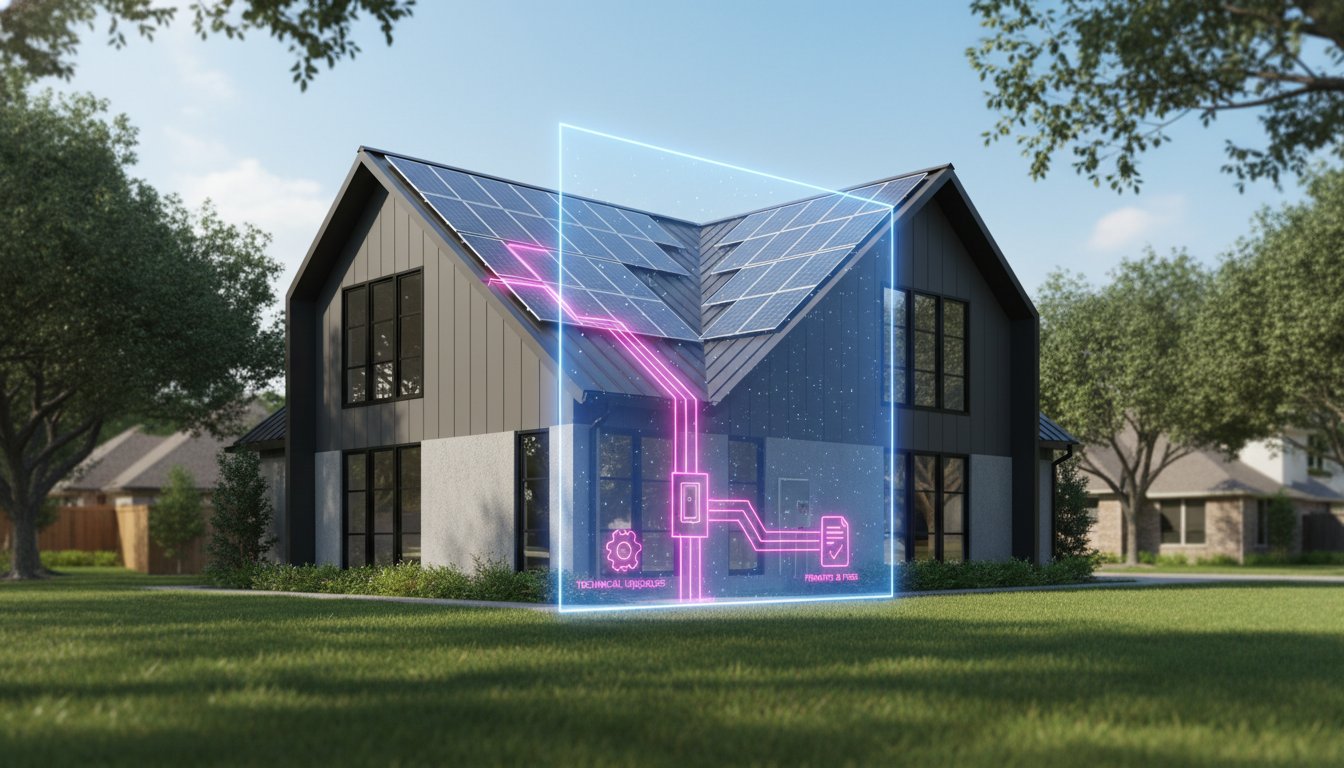
While “free solar” ads flood your digital feeds, nearly 30% of a financed solar budget can vanish into undisclosed dealer fees before a single technician arrives at your property. You aren’t alone if you feel a sense of hesitation when reviewing a quote that seems too good to be true. Finding hidden costs of solar installation requires a disciplined look at the technical and regulatory landscape of 2026, especially as the industry shifts following the expiration of the federal tax credit for owned systems. It’s natural to prioritize reliability over marketing hype when the stability of your home’s energy is at stake.
We understand that you value transparency and professional precision in your home’s infrastructure. This guide provides the authoritative framework you need to identify the “gotchas” that often inflate budgets, such as essential electrical service upgrades or the specific $127.56 City of Houston permit fee. You’ll gain a line-item understanding of potential expenses and a clear strategy to compare quotes with total confidence. We will examine everything from the new Texas registration mandates for retailers to the engineering requirements for Houston weather resilience, ensuring your transition to solar is managed with expert control.
Key Takeaways
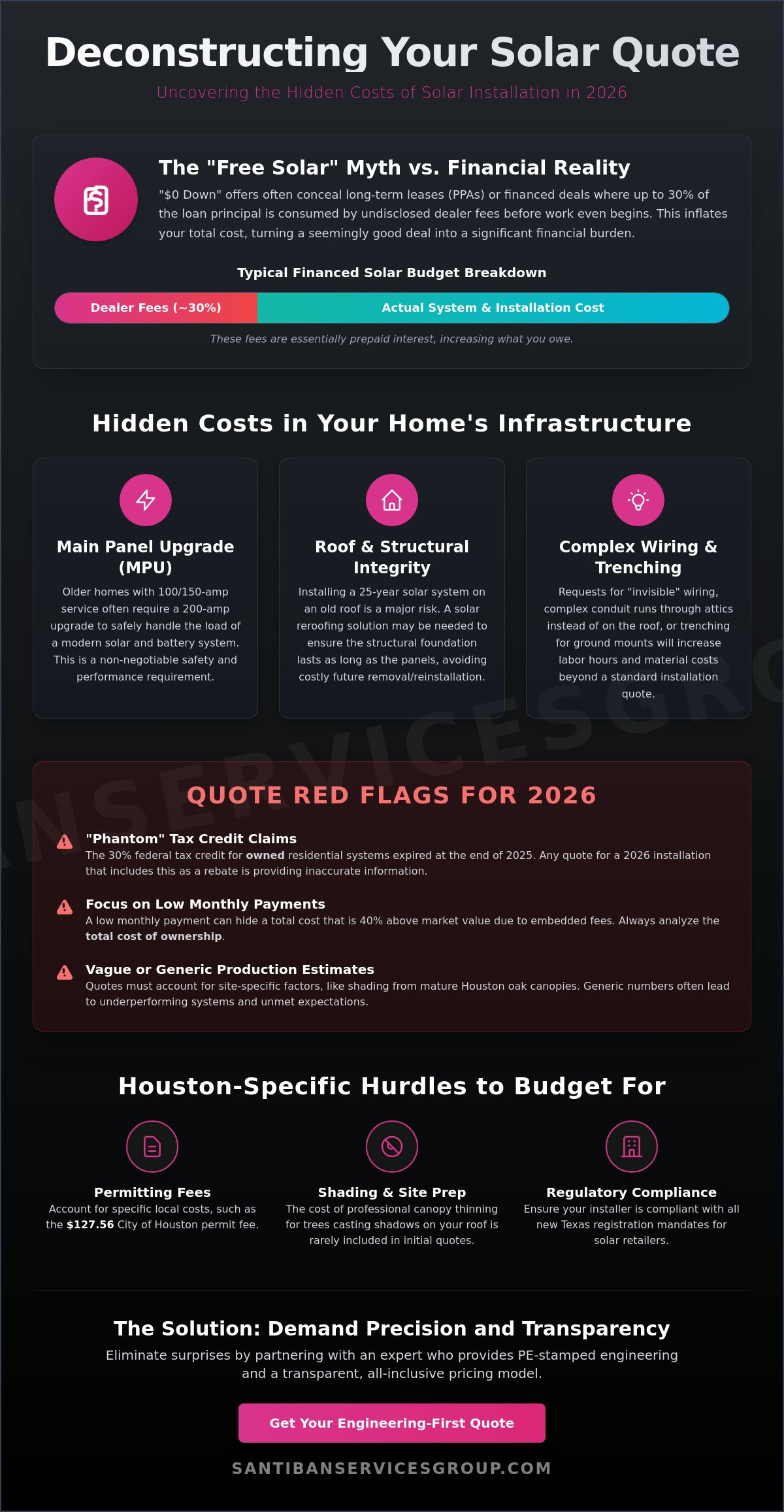
- Distinguish between aggressive “$0 down” marketing and the reality of solar dealer fees that can significantly inflate financed principal amounts.
- Identify critical technical requirements, such as the necessity for a 200-amp electrical panel upgrade or a comprehensive solar reroofing solution, to ensure long-term system integrity.
- Master the process of finding hidden costs of solar installation by accounting for Houston-specific permitting fees and the potential need for professional canopy thinning.
- Analyze the 2026 regulatory environment to understand how the expiration of the federal tax credit for owned systems impacts your total financial return.
- Leverage a disciplined framework for evaluating quotes that prioritizes PE-stamped engineering and transparent, all-inclusive pricing models.
The “Free Solar” Myth and the Reality of Upfront Costs
Marketing campaigns across Texas frequently utilize the “No-Cost Solar” hook to capture homeowner attention. These advertisements suggest that the government or utility providers will pay for your transition to renewable energy. This is a fundamental misrepresentation of the financial structures involved. In reality, these programs are typically long-term solar leases or Power Purchase Agreements (PPAs). While these models require no upfront capital, they often result in higher long-term expenditures compared to direct ownership. When finding hidden costs of solar installation, you must look past the initial sales pitch to the underlying contract terms. Choosing an established partner with a track record spanning over 20 years is essential for ensuring that warranty claims are honored decades from now.
Total Cost of Ownership vs. Monthly Payment
Focusing solely on a low monthly payment is a common pitfall when finding hidden costs of solar installation. Sales representatives often present a monthly obligation that is lower than your current utility bill, yet the total price tag may be 40% above market value due to embedded dealer fees. These fees are essentially prepaid interest that inflates the principal loan amount. Additionally, third-party ownership models often involve a solar lien on the property. This can complicate future home sales or refinancing efforts. For many homeowners, utilizing cash reserves or a traditional Home Equity Line of Credit (HELOC) provides a more transparent path to understanding the total cost of energy and maximizing system value.
The Red Flags of Predatory Solar Estimates
Precision in engineering is the only way to avoid mid-project budget increases. Predatory estimates often rely on generic production numbers that ignore specific Houston shading factors, such as mature oak canopies. Another significant red flag is a quote that fails to mention necessary electrical infrastructure upgrades. If your home has a 100-amp service, a 200-amp upgrade is almost certainly required for a modern solar and battery backup system. You should also be wary of “phantom” tax credit calculations. Since the federal tax credit for owned residential systems expired at the end of 2025, any salesperson claiming you’ll receive a 30% refund check for an owned system in 2026 is providing inaccurate information. Identifying these discrepancies early protects your capital and ensures your installation is built on a foundation of technical accuracy.
Technical Infrastructure: The Hidden Costs of Your Home’s Readiness
Finding hidden costs of solar installation often begins behind the dead front of your main electrical service panel. Most aging Houston residences were constructed with 100-amp or 150-amp services, which are frequently insufficient for the additional load of a modern solar array and battery storage system. When your system’s output exceeds the busbar’s rated capacity, a Main Panel Upgrade (MPU) becomes a technical necessity rather than an optional enhancement. This infrastructure readiness directly impacts your solar panel return on investment by ensuring the system operates safely and without interruption. Neglecting these upgrades during the estimation phase leads to significant change orders once the physical installation commences.
Structural integrity is equally critical. Installing heavy glass panels on an aging roof is an engineering risk that many budget-focused installers overlook. A solar reroofing solution ensures that the underlying structure is capable of supporting the system for its 25-year lifespan. For homeowners seeking a unified approach, Tesla and Solar Roof solutions in Houston provide a streamlined alternative that replaces traditional shingles with energy-generating tiles. This proactive strategy eliminates the future cost of removing and reinstalling panels when the roof eventually fails. Beyond structural concerns, aesthetic preferences for “invisible” wiring or complex conduit runs through attics instead of across rooflines will increase labor hours and material costs.
Main Panel Upgrades (MPU) and Sub-Panels
Integrating high-performance hardware requires a sophisticated electrical foundation. Engaging a certified Tesla Powerwall 3 installer ensures that your existing panel is correctly interfaced with the battery’s integrated inverter. If your panel is located in a position that no longer meets modern National Electrical Code (NEC) requirements, such as inside a closet or near a gas line, relocation may be mandatory. These labor-intensive tasks are essential for passing municipal inspections and securing your interconnection agreement.
The Necessity of PE-Stamped Engineering Design
Precision in the planning phase prevents structural failure during Houston’s severe weather events. Most Texas jurisdictions now require PE stamped engineering for solar systems to verify that the wind-load calculations and mounting points are sound. While some installers use “cookie-cutter” permit applications to save time, professional design documents tailored to your specific roof pitch and rafter spacing provide superior safety. Investing in a comprehensive engineering assessment at the outset ensures that your project remains compliant and avoids costly mid-project modifications.
Financial “Gotchas”: Dealer Fees and Tax Credit Nuances
Precision in financial planning is as vital as technical accuracy. Finding hidden costs of solar installation often involves identifying “dealer fees” that lenders embed within financing packages. These fees are essentially prepaid interest charges that allow solar companies to offer artificially low interest rates, such as 1.99% or 3.99%. While the monthly payment appears attractive, the total loan principal is often inflated by 15% to 30% to cover the lender’s costs. This practice can add thousands of dollars to the total contract price without providing any additional hardware or performance value. These maneuvers are a significant portion of non-hardware solar costs that many homeowners overlook during the initial consultation phase.
Ongoing operational expenses also require consideration. Houston homeowners must account for adjustments in property insurance premiums. Adding a solar array increases the replacement value of the structure, which typically results in a moderate increase in annual insurance costs. You’ll also find that while solar systems are durable, they aren’t maintenance-free. Professional cleaning to remove Houston’s environmental debris and potential subscription fees for advanced monitoring software are recurring costs that impact the system’s 25-year economic profile. Addressing these factors early ensures your investment remains grounded in fiscal reality rather than marketing projections.
The Truth About Solar Financing Fees
Determining the actual cost of a financed system requires a direct comparison between the “cash price” and the “financed price.” If an installer provides a lower total price for a cash purchase, the difference represents the dealer fee. Achieving transparency regarding Tesla solar cost and financing structures is essential for calculating an accurate return on investment. Homeowners should evaluate whether a higher-interest loan with zero dealer fees or a traditional bank loan offers a lower total cost of ownership over the life of the system.
Federal Solar Tax Credit Pitfalls
Misunderstandings regarding the Federal Investment Tax Credit (ITC) can lead to significant financial shortfalls. The ITC is a non-refundable credit that reduces your federal tax liability; it’s not a guaranteed refund check. If your tax liability is lower than the credit amount, you won’t receive the full benefit in a single year. Sales representatives frequently suggest “rolling” the anticipated credit into the loan to maintain a low monthly payment. If you’re unable to claim the full credit, your loan payment will likely increase significantly after the initial 18-month period. Always consult a CPA to verify your tax position before committing to a financing plan based on tax incentives.
Local Houston Hurdles: Permitting, Shading, and Utilities
Finding hidden costs of solar installation requires a disciplined evaluation of the local regulatory and environmental landscape. Homeowners must account for the $127.56 City of Houston electrical permit fee, which is a mandatory baseline for legal compliance. While CenterPoint Energy acts as the transmission and distribution utility, the administrative process for securing an interconnection agreement often spans two to four weeks. This phase requires precise technical documentation to ensure your system meets utility standards for grid safety. You must also coordinate with a Retail Electric Provider (REP) to establish a solar buyback plan, as CenterPoint doesn’t manage energy credits or sell electricity directly.
Homeowners’ Associations (HOAs) in established Houston neighborhoods frequently introduce another layer of administrative expense. These entities often demand professional structural reports or specific aesthetic modifications to panel layouts to maintain neighborhood standards. Such requirements can necessitate additional engineering hours or specialized mounting hardware. Beyond aesthetics, the technical necessity for storm-readiness is paramount in the Gulf Coast region. Systems must be engineered to withstand high-velocity wind zones. Utilizing reinforced racking systems and PE-stamped designs ensures the installation remains secure during hurricane season, preventing catastrophic structural failure and costly repairs. To navigate these local complexities with professional precision, it’s essential to partner with an established Houston solar installation expert who understands the specific utility and environmental landscape.
Utility Interconnection and Net Metering
The administrative cost of filing for Permission to Operate (PTO) is frequently buried within general labor categories, yet it requires significant expertise to manage correctly. You should verify if your specific REP requires a bi-directional meter installation to track exported energy accurately. Understanding the distinction between gross billing and true net metering is vital for projecting your long-term savings. Some providers offer less favorable credit rates, which can significantly alter your financial timeline and system valuation.
Site Preparation: Trees and Shading
Environmental factors present a recurring financial consideration. Data indicates that a mere 10% increase in shading can reduce your system’s return on investment by 30% over its functional lifespan. Professional canopy thinning or tree removal is often a prerequisite for achieving optimal solar exposure in Houston’s wooded suburbs. This should be viewed as a recurring operational expense. In shaded lots, the technical choice between microinverters and string inverters is critical. Microinverters allow each panel to operate independently, effectively mitigating the production loss caused by partial shading from mature foliage.
The Santiban Solution: Eliminating Surprises Through Precision
Our approach to residential energy is rooted in over 24 years of industrial electrical construction expertise. Finding hidden costs of solar installation is frequently a consequence of installers lacking the technical depth required for sophisticated electrical integration. We provide an “All-In” quote that anticipates every variable from the initial assessment. This comprehensive pricing model includes mandatory PE-stamped engineering design and all municipal permitting fees, ensuring the investment remains predictable. Precision is our standard. By applying industrial-grade standards to residential projects, we eliminate the mid-project change orders and technical surprises that often affect less disciplined providers.
Executing a successful installation involves more than placing panels on a roof; it requires a deep understanding of electrical load management. Integrating high-performance hardware like the Tesla Powerwall 3 demands precise engineering to ensure your home backup system functions as a unified whole. Our specialized teams manage this integration with quiet confidence, prioritizing safety and system longevity. We also provide solar reroofing services to address aging structures before the array is mounted. This strategic approach prevents the redundant labor costs of removing panels for roof repairs later, securing your financial precision for the next quarter-century. We focus on long-term stability over short-term savings.
Our PE-Stamped Engineering Advantage
Professional in-house design significantly reduces the probability of permit rejection in strict Texas jurisdictions. Our engineering team verifies that every component, particularly heavy battery storage units like the Powerwall 3, complies with local structural and electrical codes. We conduct thorough assessments of your rafters and busbar capacities to ensure the infrastructure can support the added load during Houston’s extreme weather events. PE-stamped engineering is the gold standard for project safety and regulatory compliance in 2026.
Professionalism Over Sales Hype
We prioritize industrial-grade reliability over the aggressive sales tactics and “free solar” myths common in the industry. Our persona is that of a silent engine; we are a competent force that keeps your home’s operations running smoothly in the background. Partnering with a Tesla-certified installer ensures your whole-home resilience is engineered by trained professionals who value traditional professional standards. We focus on consistent performance and technical accuracy, offering a level of service that meets the requirements of the most discerning homeowners. Request a transparent, engineered solar quote from Santiban Services Group today.
Securing Your Energy Future with Financial Precision
Finding hidden costs of solar installation requires a disciplined approach that looks beyond the initial quote to the underlying engineering and financial structures. You’ve identified how undisclosed dealer fees, essential electrical panel upgrades, and local Houston permitting requirements can alter your investment profile. True energy independence isn’t found in “$0 down” marketing; it’s built on a foundation of technical accuracy and transparent planning. By prioritizing precision during the assessment phase, you protect your capital and ensure your system is engineered for the specific demands of the Gulf Coast climate.
Our team leverages 24+ years of industrial electrical expertise to ensure your residential project meets the highest standards of safety and performance. As a Tesla-certified installation partner, we integrate advanced technology with in-house PE-stamped engineering design to eliminate the risk of structural failure or regulatory rejection. We invite you to Request an Engineered Solar Consultation with Santiban Services Group to secure a line-item understanding of your project. You can move forward with the confidence that your home’s infrastructure is managed by an established partner committed to consistent, long-term performance. We look forward to helping you achieve a resilient and predictable energy future.
Frequently Asked Questions
Are there hidden fees in solar financing?
Undisclosed “dealer fees” are a common reality in solar financing packages. These charges are added to the loan principal to facilitate artificially low interest rates. Finding hidden costs of solar installation requires a disciplined comparison between the cash price and the financed total. This transparency ensures you understand exactly how much capital is allocated to hardware versus lending costs.
Do I need a new roof before installing solar panels?
Structural readiness is essential for a 25-year installation lifespan. If your roof has less than 10 years of functional life remaining, a solar reroofing solution is a strategic necessity. Replacing the roof prior to installation prevents the redundant labor costs associated with removing and reinstalling the array for future repairs. Professional assessments verify that your structure can support the weight of modern glass panels and mounting hardware.
What is a solar dealer fee and how much does it cost?
A dealer fee is an origination charge paid by the installer to the lender to “buy down” the interest rate. These fees typically range from 15% to over 30% of the system’s cash price. While they result in a lower monthly payment, they significantly inflate the total loan principal. You should request a line-item disclosure to evaluate the true economic impact of these financing maneuvers.
Does the Texas solar tax credit cover battery storage like the Tesla Powerwall?
Texas does not offer a state-level solar tax credit; instead, it provides a 100% property tax exemption on the value added by solar and battery systems. Regarding federal incentives, the 30% residential tax credit for owned systems expired on December 31, 2025. Homeowners in 2026 may still access credits through lease or PPA models where the provider owns the hardware. Consult a CPA to verify your specific eligibility.
How much do solar permits and engineering stamps cost in Houston?
The City of Houston mandates an electrical permit for all solar installations, which carries a verified fee of $127.56. Beyond municipal permits, most Texas jurisdictions require professional PE-stamped engineering design to confirm structural safety. Costs for these specialized documents vary based on project complexity. These fees ensure your system is engineered to withstand local wind-load requirements and high-velocity weather events.
Will adding solar panels increase my home insurance premiums in Texas?
Adding a solar array typically increases your home’s replacement value, which often results in a moderate premium adjustment. You must notify your insurance provider to ensure the panels and battery storage units, such as the Tesla Powerwall 3, are included in your dwelling coverage. Failure to update your policy could leave this significant infrastructure investment unprotected in the event of a total loss.
What happens if my solar installer goes out of business?
Hardware warranties are generally held by the manufacturer, but your labor and workmanship warranties may become void if the installer ceases operations. This risk highlights the necessity of choosing an established partner with corporate stability. The Residential Solar Retailer Regulatory Act (SB 1036) provides new consumer protections in Texas, but your primary safeguard is the professional track record of the entity managing your project.
Is tree removal necessary for solar installation?
Tree removal or professional canopy thinning is necessary if mature foliage obstructs the solar window significantly. Finding hidden costs of solar installation involves accounting for these site preparation expenses during the planning phase. Data indicates that even a 10% increase in shading can reduce system production by 30% over time. Achieving optimal irradiance is critical for maximizing the return on your energy investment.