
A standard manufacturer warranty is a financial safety net, but it isn’t a guarantee of operational performance under the relentless Texas sun. Many property owners rightfully worry about how long do solar panels last in Texas climate when faced with extreme UV exposure and the thermal stress of triple-digit summers. While most hardware is rated for decades, the difference between a system that fails at year fifteen and one that thrives at year thirty often comes down to the precision of the initial structural engineering.
We understand that a solar transition is a significant capital investment that requires long-term stability. This 2026 longevity guide provides a technical analysis of how professional engineering ensures your equipment maintains high efficiency for its entire 25 to 30-year lifespan. You’ll gain a clear understanding of the impact of Texas heat on hardware, the critical role of roof integrity, and the specific maintenance roadmap necessary to protect your energy yields. We’ll also examine how industrial-grade installation standards prevent the common points of failure that often plague systems in harsh environments, ensuring your infrastructure remains a silent, productive engine for your home or business.
Key Takeaways
- Identify the technical standards that allow Tier 1 panels to remain productive for 25 to 30 years in high-UV environments.
- Recognize why solar reroofing is essential to prevent costly system removals and protect your underlying structural assets.
- Analyze the specific engineering measures required to safeguard electrical connections against Houston’s humidity and coastal salt air.
- Determine how long do solar panels last in Texas climate when supported by professional maintenance and precision engineering.
- Explore the advantages of applying industrial electrical construction standards to residential solar projects for enhanced durability.
Solar Panel Lifespan in Texas: The 25 to 30-Year Reality
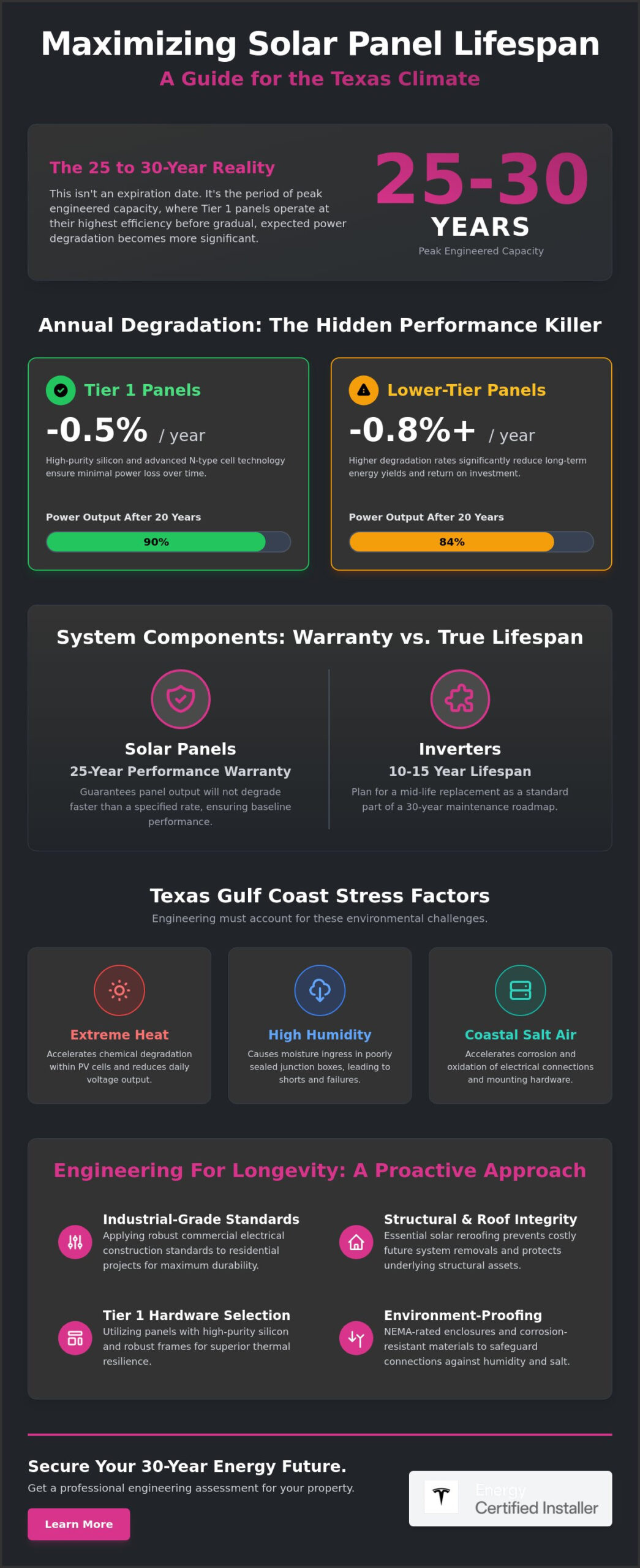
Understanding how long do solar panels last in Texas climate requires moving beyond simple marketing claims and examining the technical specifications of Tier 1 monocrystalline silicon. For a high-end strategic investment, the industry standard for operational longevity is currently 25 to 30 years. This timeframe doesn’t represent a hard expiration date where equipment ceases to function. Instead, it defines the period during which the system operates within its peak engineered capacity. Tier 1 panels are characterized by their high-purity silicon and robust frame construction, which are essential for maintaining structural integrity during the extreme temperature fluctuations common in the Houston and Austin corridors.
Most modern systems are designed to withstand the volatile thermal cycles of the Southern United States. While total equipment failure is rare in professionally engineered installations, gradual power degradation is an inevitable physical reality. The Solar Panel Lifespan is often dictated by the “useful life” of the cells, meaning the point at which the energy output no longer meets the specific operational requirements of the property. Even after 30 years, many panels continue to produce power at 70% to 80% of their original capacity, providing ongoing value long after the initial payback period has concluded.
Understanding Annual Degradation Rates
Modern silicon panels typically experience an average annual degradation rate of 0.5%. By 2026, advancements in N-type cell technology and enhanced encapsulation materials have significantly improved resilience against UV-induced degradation. High-efficiency modules maintain a much higher percentage of their original nameplate capacity compared to budget-grade alternatives. While a lower-tier panel might lose 0.8% or more each year, a precision-engineered system ensures that 85% to 90% of original power production remains even after two decades of exposure to the intense Texas sun. This stability is a hallmark of disciplined manufacturing and superior material selection.
The Distinction Between Warranty and Lifespan
It’s vital to distinguish between a manufacturer’s equipment warranty and a linear performance guarantee. Most Tier 1 providers offer a 25-year performance warranty, which serves as the baseline for any serious Texas solar investment. This guarantee ensures the panels won’t degrade faster than a specified rate. However, the system’s total lifecycle involves more than just the glass modules. Inverters, the components that convert DC power to usable AC, typically have a lifecycle of 10 to 15 years. Planning for a mid-life inverter replacement is a standard part of a 30-year maintenance roadmap. This methodical approach to component management ensures that the silent engine of your energy production remains reliable. By aligning high-quality hardware with a disciplined maintenance schedule, owners can extend the functional utility of their system well beyond the initial warranty period.
Houston-Specific Stress Factors: Heat, Humidity, and Hurricanes
The Gulf Coast environment presents a unique set of variables that directly influence how long do solar panels last in Texas climate. While high temperatures are the most visible factor, the synergy between ambient humidity and salt-laden air creates a corrosive environment that can degrade standard electrical infrastructure if not properly mitigated. Professional engineering identifies these variables during the design phase to ensure the system remains a stable, long-term asset for the property owner.
High ambient heat causes an immediate reduction in voltage, which impacts the daily energy harvest. However, the more significant risk to longevity is the acceleration of chemical degradation within the photovoltaic cells. By Optimizing PV Performance through precise mounting configurations and high-grade materials, engineers can moderate operating temperatures and protect the hardware’s 30-year design life. This proactive approach ensures that the system doesn’t just survive the heat but maintains its efficiency over decades.
In Houston and surrounding coastal regions, humidity frequently leads to moisture ingress in lower-tier junction boxes. Salt air further complicates this by accelerating the oxidation of exposed copper or aluminum components. Reliability-focused installers prioritize NEMA-rated enclosures and corrosion-resistant alloys to ensure that electrical continuity remains consistent over the entire lifecycle of the project. This level of technical detail is essential when determining how long do solar panels last in Texas climate, as poor component selection can lead to failure long before the panels themselves reach their end of life.
Thermal Cycling and Material Fatigue
Daily temperature fluctuations in Texas cause solar module components to expand and contract at different rates. This mechanical stress can eventually lead to micro-cracks in the silicon wafers or failure in the solder joints. Maintaining a specific air gap between the roof surface and the panels is essential, as this space facilitates passive cooling and reduces the severity of these cycles. Thermal cycling represents the primary environmental stressor for solar infrastructure in the Texas region.
Wind Loads and Structural Compliance
Structural resilience is a non-negotiable requirement for any infrastructure project located within hurricane-prone regions. Standard residential mounting often fails to account for the extreme uplift forces generated by 140+ mph wind gusts. Utilizing PE stamped engineering for solar systems provides the mathematical certainty that every attachment point is secured to the building’s primary structural members. This rigorous approach to professional design prevents catastrophic uplift and ensures the system survives the most severe weather events. Many corporate partners choose to integrate industrial electrical construction standards into their solar projects to guarantee this level of structural stability and safety.
Engineering for Longevity: Why Reroofing and Design Matter
The operational durability of a solar array is fundamentally tethered to the structural integrity of the roof beneath it. While much of the discussion regarding how long do solar panels last in Texas climate focuses on the glass and silicon, the mounting surface is the actual foundation of the investment. Installing a sophisticated energy system on a roof that has already reached its 15-year midpoint is a critical financial oversight. If the underlying shingles fail before the panels reach their 30-year design life, the property owner faces the significant expense of decommissioning, storing, and reinstalling the entire array to facilitate a roof replacement. This avoidable disruption often offsets the initial ROI gained from the solar transition.
A professional approach requires a unified strategy where the roof and the solar system are treated as a single, integrated asset. Specialized solar reroofing services eliminate the risk of split liability between different contractors. By coordinating these phases, engineers can ensure that flashing and mounting hardware are seamlessly integrated into the roofing assembly. This precision is vital for mitigating the risk of water intrusion over three decades of exposure to Houston’s heavy rainfall and humidity. A system is only as reliable as its weakest seal, and industrial-grade installation standards prioritize leak prevention as a core metric of success.
The Solar Reroofing Advantage
Coordinating roofing and solar installation under a single engineering plan simplifies warranty management and ensures long-term accountability. Using high-durability underlayment specifically rated for the increased thermal loads found beneath solar arrays provides an additional layer of protection against material fatigue. For property owners seeking the highest level of architectural integration, Tesla and Solar Roof solutions provide a unified structure that replaces traditional shingles with energy-generating tiles. This approach eliminates the need for separate mounting hardware and offers superior resistance to the environmental stressors found in the Texas region.
The Role of PE-Stamped Engineering
Licensed structural engineers provide the necessary verification that a building’s frame can support the additional dead load of a solar array over a 30-year period. This process involves a detailed analysis of rafter spacing, load-bearing walls, and existing structural health. PE-stamped engineering is a requirement for meeting 2026 Houston building codes and ensures that the system is compliant with local safety standards. Beyond structural safety, these professional documents streamline the permitting and inspection process, providing a clear technical record that facilitates future property appraisals and insurance renewals. This disciplined focus on engineering ensures that your energy infrastructure remains a stable, silent engine for your property.
Maximizing ROI: Performance Maintenance in 2026
Maintaining peak efficiency is a critical component of a disciplined 30-year operational strategy. While the hardware is designed for endurance, environmental factors in the Houston metropolitan area can impact daily yields if left unmanaged. Specifically, the accumulation of organic matter, such as heavy seasonal pollen and industrial dust, creates a physical barrier that reduces photon absorption. Regular, professional cleaning ensures that the system maintains its 0.5% annual degradation target rather than suffering from accelerated performance drops. This methodical approach to maintenance is a primary determinant of how long do solar panels last in Texas climate while remaining financially viable.
Beyond physical cleaning, the technical health of the system relies on consistent data analysis. Minor electrical faults or micro-cracks in the silicon wafers can remain undetected for months, leading to a “hidden” loss of ROI. By utilizing advanced diagnostics, property managers can identify these anomalies before they escalate into hardware failures. This transition from reactive repairs to a proactive maintenance model is essential for protecting the infrastructure’s long-term value. For those seeking the highest standards of reliability, integrating industrial electrical construction principles into residential maintenance ensures every connection remains secure and efficient.
System Monitoring and Fault Detection
Modern 2026 systems utilize sophisticated app-based monitoring to provide real-time visibility into energy production. These platforms identify string-level failures or individual module underperformance with precision. By catching a faulty bypass diode or a damaged conductor early, owners prevent the systemic stress that leads to premature equipment failure. Continuous monitoring prevents long-term ROI loss by ensuring that minor faults don’t compromise the entire array’s output. This technical oversight is a core pillar of a silent, high-performing energy engine.
Battery Longevity: Powerwall 3 vs. The Environment
The integration of energy storage adds another layer of complexity to the question of how long do solar panels last in Texas climate. Lithium-ion batteries are sensitive to the extreme thermal loads found in Southern Texas. However, the Tesla Powerwall 3 features an advanced liquid thermal management system designed to protect the battery chemistry from degradation during heatwaves. Optimal placement is equally important. Installing units in a shaded, well-ventilated area can significantly extend the functional life of the cells. Consulting a certified Tesla Powerwall installer in Houston ensures that your storage infrastructure is configured for maximum resilience against the local environment. This professional oversight guarantees that your backup capacity remains reliable for its intended lifecycle.
The Santiban Approach: Industrial-Grade Residential Solar
Santiban Services Group operates as a disciplined, silent engine behind complex energy transitions. We apply the same rigorous standards found in industrial electrical construction to every residential project, ensuring that your infrastructure functions with absolute precision. Our approach shifts the focus from basic labor to high-end strategic partnership. By prioritizing corporate stability and technical thoroughness, we provide a level of reliability that standard installers cannot match. This professional oversight is the definitive answer to how long do solar panels last in Texas climate, as it ensures every component is optimized for the local environment.
With over 24 years of experience in industrial electrical sectors, our team understands the demands of high-capacity systems. We treat a residential solar reroofing project with the same methodical attention to detail as a large-scale utility installation. This expertise allows us to anticipate environmental stressors before they impact your ROI. We don’t merely install hardware; we design resilient energy solutions that maintain consistent performance through decades of thermal cycling and seasonal volatility. Our commitment to safety and precision execution remains the foundation of every relationship we build.
Certified Expertise and Specialized Personnel
Reliability in energy storage requires specialized training and a deep understanding of modern battery chemistry. As Tesla-certified installers for Powerwall 3 and Powerwall+, our personnel ensure that your home battery backup is integrated into your electrical system with industrial-grade accuracy. This background in complex wiring and load management results in a safer, more durable installation that resists the premature wear common in less disciplined setups. Every project we undertake is supported by PE-stamped engineering design, providing a documented guarantee of technical compliance and structural safety that meets the highest professional standards.
Securing Your Houston Property for 2026 and Beyond
The technical reality of how long do solar panels last in Texas climate is that longevity is a direct result of professional engineering and proactive maintenance. A system is a long-term asset that requires an established partner to ensure its continued viability. By combining industrial-scale expertise with a focus on customized results, we protect your investment against the unique challenges of the Gulf Coast. We invite you to schedule a professional site assessment to determine the optimal configuration for your specific roof and energy requirements. For business owners looking to expand their infrastructure further, we also provide comprehensive commercial EV charger installation services designed to support the next generation of corporate mobility. Let us provide the steady, methodical execution your property deserves.
Securing Long-Term Energy Resilience Through Technical Precision
Achieving an operational lifespan of 30 years requires more than just high-quality hardware; it necessitates a disciplined approach to structural and electrical engineering. You’ve seen that while environmental stressors like thermal cycling and high humidity are persistent, they’re manageable through precise design and coordinated reroofing. The technical reality of how long do solar panels last in Texas climate is ultimately determined by the foundation upon which the system is built and the technical rigor of the initial installation. Implementing a proactive maintenance roadmap further ensures that your energy yield remains consistent as the system matures.
Santiban Services Group leverages over 24 years of industrial electrical experience to deliver residential energy solutions that function with corporate stability. As a Tesla Certified Installer, we prioritize safety and long-term performance in every configuration. We provide licensed PE engineering design to guarantee that your property meets all local compliance standards while maximizing durability. We invite you to Request a PE-Stamped Engineering Design for Your Houston Solar Project to ensure your infrastructure remains a reliable, silent engine for decades to come. Protecting your investment begins with authoritative execution and a commitment to high standards.
Frequently Asked Questions
Do solar panels degrade faster in the extreme Texas heat?
Solar panels experience a slight reduction in immediate efficiency during peak summer temperatures, but they don’t necessarily degrade faster if they’re Tier 1 monocrystalline modules. High-quality hardware is engineered to maintain a standard 0.5% annual degradation rate even in the Southern United States. Proper mounting and ventilation are essential to managing thermal loads and protecting the long-term integrity of the silicon cells. This technical precision is vital when considering how long do solar panels last in Texas climate over a 30-year period.
Will my solar panels survive a Category 4 hurricane in Houston?
Solar systems secured with PE-stamped engineering are designed to withstand the uplift forces of 140+ mph wind gusts. While no structure is entirely immune to extreme weather, industrial-grade racking and precise attachment to the building’s primary structural members significantly increase resilience. This professional design ensures your infrastructure remains stable during severe coastal storms and hurricane events. We prioritize these high standards to protect both your energy production and your underlying property.
How often do I need to clean my solar panels in Texas?
We recommend a professional cleaning at least once or twice per year to remove accumulated pollen, dust, and industrial particulates. In regions like Houston, organic buildup can create a physical barrier that reduces photon absorption and lowers your overall energy harvest. Maintaining a clean surface is a simple but effective way to ensure your system reaches its 30-year performance targets. Regular maintenance prevents minor debris from causing long-term ROI loss.
What happens to my solar panels after 25 years?
Your solar panels will continue to generate electricity after 25 years, though at a slightly lower efficiency than when they were new. Most Tier 1 panels are guaranteed to produce at least 85% of their original nameplate capacity at the quarter-century mark. Many systems remain in operation for 30 years or longer, providing a useful life that extends well beyond the initial warranty period. This longevity is a key factor in determining how long do solar panels last in Texas climate for property owners seeking long-term stability.
Is it necessary to replace my roof before installing solar panels?
It’s highly advisable to replace your roof if it’s nearing the end of its functional life or is more than 15 years old. Installing a 30-year energy system on a compromised roof leads to expensive decommission and reinstallation costs later. Our specialized solar reroofing service integrates the roof and the array into a single, high-durability asset. This approach protects your property from leaks and ensures the foundation of your energy system is as reliable as the panels themselves.
Do hail storms damage solar panels in the Lone Star State?
Modern Tier 1 solar panels are engineered with tempered glass designed to withstand significant impacts, including hail up to one inch in diameter traveling at terminal velocity. While catastrophic storms can cause damage, standard Texas hail rarely compromises the integrity of the modules. We utilize hardware that meets rigorous international testing standards to ensure your system remains a durable, silent engine. Professional installation ensures that the frames and mounting hardware are also protected from mechanical stress.
How long does a Tesla Powerwall 3 last compared to the panels?
A Tesla Powerwall 3 typically carries a 10-year warranty, though its functional lifespan can extend further with proper thermal management. While solar panels are 30-year assets, lithium-ion storage systems generally require replacement or refurbishment every 10 to 15 years. This component lifecycle is a standard part of a long-term energy roadmap. It ensures your backup capacity remains reliable as battery technology continues to evolve in the coming decade.
Are there specific Texas incentives for installing long-lasting solar systems?
Texas offers a 100% property tax exemption on the appraised value added by your solar energy system, meaning your taxes won’t increase due to the installation. While the 30-year federal tax credit for homeowner-owned systems expired at the end of 2025, various local utilities still offer significant rebates. For example, Austin Energy provides a flat rebate of $2,500, and AEP Texas offers rebates ranging from $1,500 to $3,000 depending on system size. These incentives support the deployment of high-durability infrastructure across the state.