

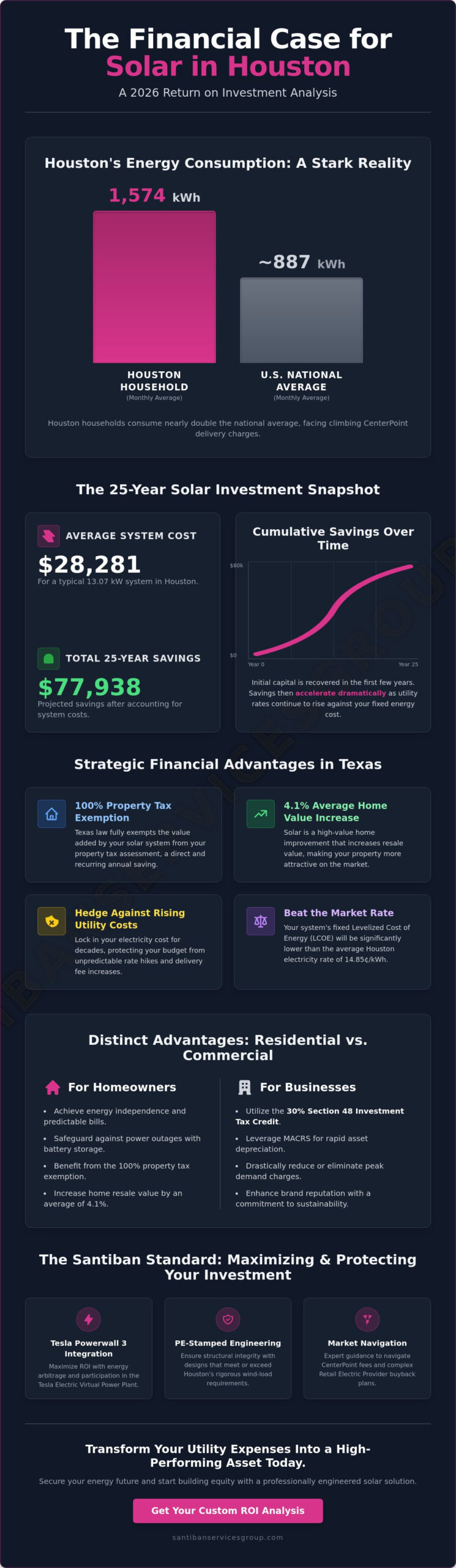
The average Houston household consumes 1,574 kWh of electricity every month, nearly double the national average. As CenterPoint delivery charges climb and the 2025 expiration of the federal residential tax credit shifts the financial landscape, homeowners are urgently asking exactly how much do solar panels save on electricity in Houston today. While the average installation cost for a 13.07 kW system is $28,281, data from EnergySage indicates homeowners can save approximately $77,938 over 25 years. It’s a significant figure that requires a sophisticated understanding of local utility structures to realize.
You likely share the frustration of decoding complex Retail Electric Provider buyback plans while worrying about grid reliability during hurricane season. Santiban Services Group recognizes that true energy independence is built on professional-grade engineering and disciplined execution. This 2026 ROI analysis delivers a precise financial roadmap, covering everything from property tax exemptions to the strategic integration of Tesla Powerwall 3 storage. We will examine how tailored energy solutions and smart arbitrage can transform your utility expenses into a predictable, high-performing asset.
Key Takeaways
- Evaluate the financial performance of your solar investment by comparing current Harris County electricity rates against the Levelized Cost of Energy (LCOE).
- Determine exactly how much do solar panels save on electricity in Houston by assessing technical variables such as roof pitch, orientation, and annual solar irradiance.
- Navigate the Houston deregulated energy market with a clear understanding of the distinction between CenterPoint delivery fees and Retail Electric Provider buyback structures.
- Maximize your ROI through advanced energy arbitrage and participation in the Tesla Electric Virtual Power Plant using the integrated capabilities of the Tesla Powerwall 3.
- Safeguard your investment’s structural integrity by utilizing PE-stamped engineering designs that ensure full compliance with Houston’s rigorous wind-load requirements.
The Economics of Solar Energy in Houston: 2026 Market Overview
Understanding ROI in a deregulated environment requires looking beyond simple bill offsets. In Houston, Return on Investment (ROI) represents the net financial gain realized after accounting for system costs, maintenance, and the fluctuating rates of Retail Electric Providers (REPs). As of May 2026, the average electricity rate in Houston stands at 14.85 cents per kWh. When compared to the Levelized Cost of Energy (LCOE) for a professionally installed solar system, which remains fixed over the system’s lifespan, the long-term financial advantage is clear. Property owners must evaluate how much do solar panels save on electricity in Houston by analyzing the delta between these rising market rates and the fixed cost of self-generation.
Investing in solar serves as a strategic hedge against the consistent upward trend of utility costs. Historically, rates in the ERCOT region have seen annual increases, often exacerbated by rising CenterPoint delivery charges that remain outside the control of REPs. By locking in a fixed cost for power generation today, property owners insulate themselves from these unpredictable market shifts. While the federal residential solar tax credit (Section 25D) expired on December 31, 2025, Solar power in Texas continues to thrive through local incentives and high-efficiency technology that drives down the cost per watt.
Breaking Down the 25-Year Savings Projection
Calculating long-term value involves more than just immediate monthly reductions. Most owners find that the first five years represent the slowest phase of ROI due to the initial capital recovery. However, cumulative savings accelerate as utility rates rise. Data indicates a typical Houston homeowner can expect to save approximately $77,938 over a 25-year period. These projections account for standard system degradation, which typically occurs at a rate of 0.5% annually. Additionally, solar installations provide non-liquid equity. Texas law offers a 100% property tax exemption on the value solar adds to a home, which averages a 4.1% increase in resale value according to industry reports.
Commercial vs. Residential Savings Potential
Business entities in Houston realize distinct advantages through industrial-scale solar deployment. Unlike residential properties in 2026, commercial installations still qualify for the Section 48 Investment Tax Credit, offering a 30% base credit for systems under 1 MW. Commercial owners also benefit from the Modified Accelerated Cost-Recovery System (MACRS), allowing for rapid depreciation of the asset. These financial levers significantly shorten the payback period. Strategic solar deployment also mitigates peak demand charges, which often constitute a substantial portion of industrial utility bills during Houston’s high-heat months. Determining how much do solar panels save on electricity in Houston for a business requires a meticulous analysis of these specific commercial incentives alongside traditional energy production metrics.
Variables That Dictate Your Houston Solar Savings
A variety of localized factors influence the final production numbers of any photovoltaic system. With more than 2,600 hours of annual sunshine, the geographic potential in Southeast Texas remains robust. However, calculating how much do solar panels save on electricity in Houston requires a detailed analysis of roof orientation and pitch. While south-facing surfaces provide the highest yield, modern high-efficiency modules ensure that east and west-facing arrays remain financially viable. Local climate conditions, including high humidity and potential shading from mature trees, also dictate the meticulous placement of each module to maintain peak thermal performance.
Current Texas solar energy statistics indicate that Southeast Texas is a leading region for residential adoption. This growth is driven by the realization that production efficiency is a technical requirement, not a variable. Professional engineering ensures that systems are designed to mitigate the impact of Houston’s unique environmental stressors, such as salt air in coastal areas and high wind-load demands during hurricane season. These factors directly correlate to the long-term reliability of your energy production.
The Financial Synergy of Solar Reroofing
Santiban Services Group recommends solar reroofing for any property with a roof older than ten years. Installing a new system on an aging surface creates a significant future liability. If the underlying roof requires replacement in the next decade, the owner will face “remove and reinstall” fees that often exceed $10,000. By combining these services, we consolidate labor costs and secure the structural integrity of the facility. This integrated approach ensures the roof’s lifespan aligns with the 25-year performance warranty of the solar modules, protecting your capital investment from avoidable maintenance expenses.
System Sizing and Energy Consumption Profiles
Determining how much do solar panels save on electricity in Houston depends heavily on your specific consumption profile. In Harris County, heavy loads from HVAC systems and pool pumps define the sizing requirements. Many owners assume a 100% energy offset is the optimal goal, but the highest ROI often lies in a “sweet spot” that covers 80 to 90 percent of usage. This strategy avoids over-investing in capacity that might be sold back to the grid at lower wholesale rates. We utilize historical usage data to design tailored systems that prioritize financial performance over total production. You can consult with our engineering team to identify the precise system size required for your specific energy needs.
Navigating Texas Solar Buyback Plans and Utility Credits
Houston’s deregulated market creates a distinct operational environment for solar owners. You must distinguish between the Transmission and Distribution Utility (TDU), which is CenterPoint Energy, and your chosen Retail Electric Provider (REP). While CenterPoint maintains the physical infrastructure, your REP manages billing and determines the value of excess energy exported to the grid. Because Texas lacks a statewide net metering mandate, how much do solar panels save on electricity in Houston depends heavily on the specific “net billing” structure of your retail contract. Unlike traditional net metering, net billing often credits exported power at a lower rate than the retail price you pay for imported power.
Smart meters play a critical role in this ecosystem by recording bi-directional energy flow in 15-minute intervals. This granular data allows REPs to offer specialized products, such as “Free Nights” plans. These plans present a strategic opportunity for owners of electric vehicles or high-capacity battery systems. By shifting heavy loads to free periods and using solar generation during peak daytime hours, you can optimize your system’s financial performance. It’s a sophisticated method of energy management that requires professional design to execute effectively.
Selecting the Right Retail Electric Provider (REP)
Choosing an REP requires a meticulous review of the Electricity Facts Label (EFL). Some providers offer 1-to-1 buyback plans that match the retail rate; others credit exports at the real-time wholesale market price. Wholesale rates are often significantly lower, which can erode your projected ROI. Watch for hidden monthly base fees or minimum usage penalties that can offset your solar credits. We recommend auditing your energy production annually. Switching providers to a plan that prioritizes high export credits can maximize your cumulative balance and improve the overall performance of your investment.
The Impact of CenterPoint Delivery Charges
A common misconception is that a 100% solar offset eliminates your entire utility bill. In reality, CenterPoint delivery charges remain non-bypassable expenses. A TDU delivery charge is a fixed, regulated fee that covers grid maintenance and is billed per kWh of electricity delivered from the grid to your home. Even if your total solar production matches your total consumption, you’ll still incur these charges for any power pulled from the grid during the night or cloudy periods. To minimize these expenses, we emphasize strategic self-consumption. By using your solar energy as it’s produced rather than exporting it, you bypass the grid entirely and avoid the associated delivery fees. This approach is a primary factor in determining how much do solar panels save on electricity in Houston for the modern property owner.
Maximizing ROI with Tesla Powerwall 3 and Smart Storage
Integrating energy storage transforms a standard solar installation into a dynamic financial asset. While many homeowners view batteries solely as a contingency for grid failures, the Tesla Powerwall 3 functions as a strategic tool for energy arbitrage. By leveraging “Time-of-Use” load shifting, the system stores solar energy produced during the morning and discharges it during peak evening hours when REP rates are highest. This capability is central to determining how much do solar panels save on electricity in Houston, as it allows owners to avoid purchasing power during ERCOT price spikes that can reach $5/kWh. Using stored energy during these volatile windows protects your budget from extreme market fluctuations.
Participation in the Tesla Electric Virtual Power Plant (VPP) further enhances this return. Through this program, your battery system provides automated grid support to the Houston region during periods of high demand. In exchange, owners receive “Grid Support” credits that directly offset utility costs. This revenue model ensures the battery actively pays for itself while stabilizing the local grid. It’s a level of financial sophistication that traditional standby generators cannot replicate, turning a backup device into a consistent revenue generator.
The Powerwall 3 Integrated Inverter Advantage
The Tesla Powerwall 3 features an integrated solar inverter that streamlines the entire hardware stack. This design significantly reduces DC-to-AC conversion losses, resulting in superior system efficiency compared to modular configurations. Because the inverter is built directly into the unit, installation complexity and associated labor costs are minimized. Santiban Services Group is a certified Tesla Powerwall installer, ensuring every component is meticulously configured for peak performance. This integrated approach provides a seamless transition from generation to storage, maximizing the energy available for your facility’s specific requirements.
Energy Independence as a Financial Asset
Reliability carries a tangible dollar value in Houston. Calculating the true ROI of a system requires accounting for the cost of grid outages, including food preservation and the continuity of HVAC systems during extreme heat. Over a 10-year period, the total cost of ownership for a Powerwall 3 is often lower than a traditional gas-powered standby generator when you factor in fuel costs, maintenance, and the lack of daily utility savings. Additionally, the system is designed with future-ready capabilities for bidirectional charging, positioning your home to utilize Vehicle-to-Home (V2H) technology as it becomes available. You can request a custom ROI analysis to see how smart storage impacts your specific energy profile and long-term savings goals.
The Santiban Standard: Protecting Your Investment via Engineering
Santiban Services Group approaches energy infrastructure with a level of discipline typically reserved for industrial facilities. We believe that a solar system is only as valuable as its long-term reliability. While many providers focus on the upfront price, calculating how much do solar panels save on electricity in Houston must include the avoidance of deferred maintenance costs and structural repairs. Our methodology centers on PE-stamped engineering, which ensures that every component is sized and secured according to rigorous professional standards.
This meticulous design process streamlines permitting with the City of Houston and Harris County. By submitting comprehensive, engineer-verified plans, we eliminate the delays and revisions common with less organized installers. We apply an industrial-scale mindset to every project. This means we don’t cut corners on wiring gauges or conduit placement. Every detail is documented and checked against our internal safety protocols to ensure residential installations benefit from the same corporate-grade precision used in our large-scale electrical construction projects.
Structural Compliance and Wind Load Resilience
Houston’s geographic location requires specific attention to wind zone requirements. During hurricane season, residential solar arrays are subjected to extreme uplift forces. We utilize meticulous racking and mounting selections designed to withstand these Southeast Texas weather extremes. This level of structural verification is often a prerequisite for maintaining home insurance eligibility. If a system is installed without professional engineering oversight, it could jeopardize your coverage during a major storm event. We prioritize the physical integrity of your roof, using advanced sealing techniques to prevent leaks and structural degradation over the system’s 25-year lifespan.
Meticulous Electrical Design for Long-Term Safety
Safety is a non-negotiable pillar of our service model. Poorly designed electrical systems can lead to “thermal runaway” or electrical fires, particularly in Houston’s high-heat environment. Our teams leverage over 24 years of industrial electrical experience to design circuits that manage heat and load effectively. When finalizing your ROI analysis, remember that the cheapest quote often leads to the most expensive repairs. A system that fails after five years offers no savings. By choosing a partner that values excellence in every detail, you ensure that your investment continues to perform as expected for decades, providing a definitive answer to how much do solar panels save on electricity in Houston for your specific property.
Securing Your Energy Asset Performance
The financial performance of a solar investment in 2026 depends on sophisticated execution rather than simple hardware installation. Strategic energy management through Tesla Powerwall 3 integration and Virtual Power Plant participation allows you to transform backup systems into revenue-generating assets. Prioritizing structural integrity through PE-stamped engineering ensures your system withstands the rigors of the Gulf Coast climate while maintaining peak production. These disciplined engineering standards are what differentiate a standard installation from a high-performing financial asset.
Santiban Services Group leverages over 24 years of Texas industrial electrical expertise to deliver superior residential solutions. Our Tesla-certified installation team provides meticulous, integrated designs that prioritize long-term reliability. We include PE-stamped engineering as a standard practice to guarantee full compliance with local wind-load requirements. You can Request a Professional Solar ROI Analysis from Santiban Services Group to receive a tailored assessment of your property’s potential. Understanding exactly how much do solar panels save on electricity in Houston requires this level of technical precision. Transitioning to a self-sustaining energy model is a significant capital decision. Partnering with an established expert ensures every detail remains under expert control, providing you with a stable and predictable energy future.
Frequently Asked Questions
How much does a typical 10kW solar system save per month in Houston?
A 10kW solar system in Houston typically saves between $200 and $300 per month depending on your specific Retail Electric Provider (REP) plan and seasonal consumption. Because Houston households use an average of 1,574 kWh monthly, a system of this size offsets a substantial portion of the high cooling costs associated with the local climate. These savings are realized through direct self-consumption and credits earned for excess energy exported to the grid.
Does Texas have net metering for solar owners in 2026?
Texas does not have a statewide net metering mandate in 2026. Instead, homeowners in Houston’s deregulated market must select a Retail Electric Provider that offers a voluntary solar buyback plan. These plans utilize net billing structures where exported energy is typically credited at a different rate than imported energy. It’s essential to analyze the Electricity Facts Label (EFL) to ensure the buyback terms align with your production profile.
What is the average payback period for solar panels in Houston?
The average payback period for solar installations in Houston generally ranges from 9 to 13 years. This timeline is influenced by the expiration of the federal residential tax credit in 2026 and the rising cost of grid electricity. While the initial capital recovery phase is the slowest, the long-term financial performance is robust. Over a 25-year lifespan, a properly engineered system can generate total savings exceeding $77,000 according to industry data.
Can I sell my excess solar power back to the grid in Houston?
Yes, you can sell excess solar power back to the grid by enrolling in a solar buyback program with a Houston REP. These providers utilize smart meter data to track the exact kilowatt-hours you export. Determining how much do solar panels save on electricity in Houston depends on whether your provider offers a 1-to-1 credit or a wholesale market rate. Strategic storage allows you to manage these exports for maximum financial gain.
Are there any Houston-specific solar rebates or incentives available?
Houston residents benefit from a 100% property tax exemption on the value added to a home by a solar installation. This state-level incentive ensures that your property taxes don’t increase even as your home’s market value rises by an average of 4.1%. While direct municipal rebates are limited, the combination of property tax savings and competitive REP buyback plans provides a significant financial foundation for your investment.
How does the Tesla Powerwall 3 increase my solar savings?
The Tesla Powerwall 3 increases savings by enabling energy arbitrage and participation in Virtual Power Plants. By storing energy when rates are low and discharging it during peak demand periods, you avoid high grid prices that can spike during extreme weather. Additionally, the system earns Grid Support credits through programs like Tesla Electric. This functionality clarifies how much do solar panels save on electricity in Houston by adding a secondary revenue stream to your system.
What happens to my solar savings if I have an older roof?
An older roof can significantly diminish your long-term ROI due to the high cost of removing and reinstalling panels during a roof replacement. Santiban Services Group recommends solar reroofing for any surface older than ten years to synchronize the lifespan of the roof with the solar modules. Avoiding these future remove and reinstall fees, which often exceed $10,000, is a critical component of a disciplined financial strategy.
Do solar panels increase my property taxes in Texas?
Solar panels do not increase your property taxes in Texas. State law provides a comprehensive property tax exemption for the appraised value of solar energy devices. While your home’s resale value may increase by approximately 4.1% compared to non-solar homes, the specific value attributed to the solar system is legally excluded from your tax assessment. This protection ensures that your investment remains a tax-neutral asset while reducing monthly liabilities.