
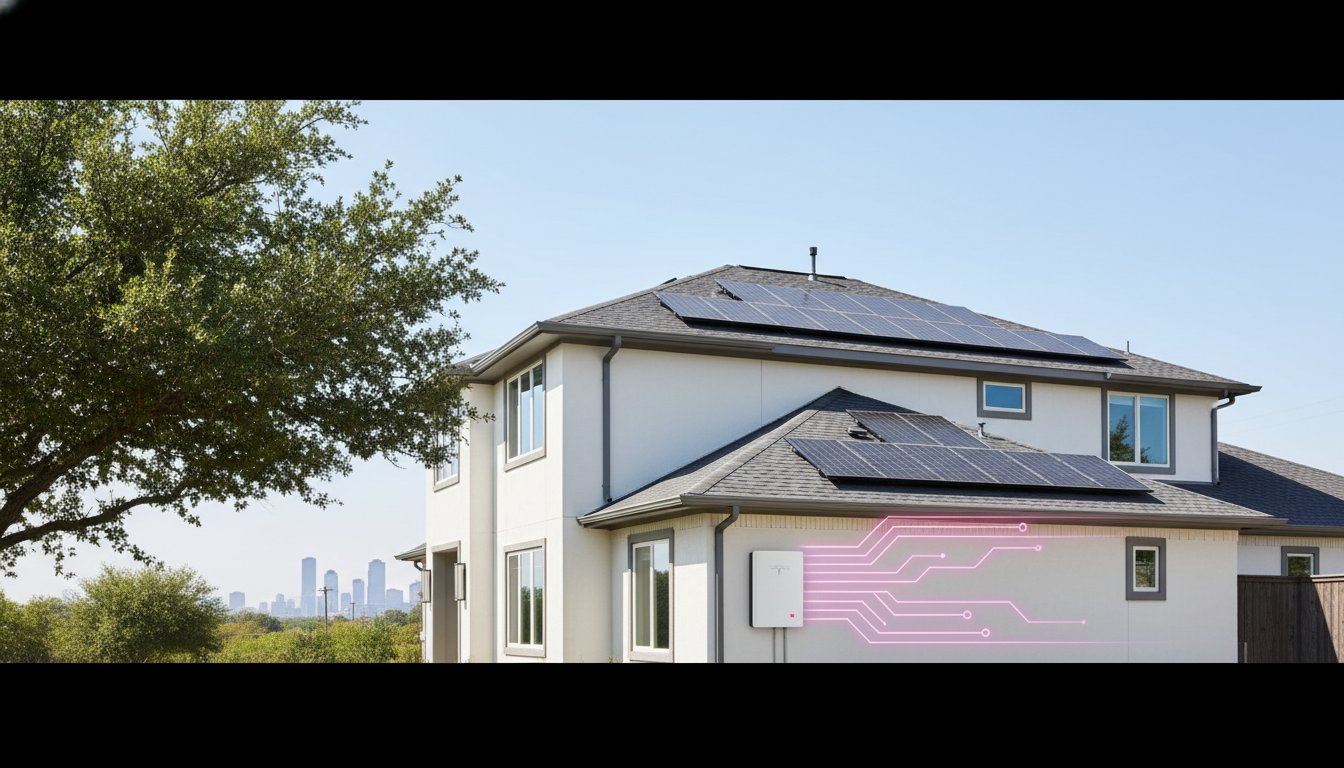
What if the value of your home energy system was measured not just in dollars saved, but in the hours of security provided during a regional blackout? For many homeowners in Southeast Texas, the question of whether is solar worth it in Houston 2026 has moved beyond simple utility bill comparisons. You’ve likely noticed the steady increase in rates within the CenterPoint service area and felt the growing anxiety that accompanies every hurricane season. It’s a concern we share, as the local grid continues to face unprecedented demands and weather-related stress.
This article provides a definitive analysis of the 2026 solar landscape, evaluating how financial returns, technical engineering, and advanced battery storage converge to create a resilient energy strategy. We’ll examine the specific impact of the 100 percent Texas property tax exemption and the critical role of the Tesla Powerwall 3 in maintaining grid independence. By the end of this guide, you’ll understand how to calculate your own “Resilience Premium” and identify the criteria for selecting a partner capable of delivering industrial-grade reliability for your Houston property.
Key Takeaways
- Evaluate the shifting financial landscape to determine how the “Resilience Premium” justifies your investment following the 2026 expiration of the federal tax credit.
- Discover why the Tesla Powerwall 3 serves as the critical hub for maintaining continuous operations and safety during local grid outages.
- Understand the necessity of PE-stamped engineering and professional reroofing in protecting your asset’s structural integrity and long-term performance.
- Access a data-driven analysis to conclude whether is solar worth it in Houston 2026 based on current utility rates and hardware advancements.
- Identify the specific criteria for selecting a professional partner with industrial electrical expertise to manage complex residential solar deployments.
The Economics of Houston Solar: ROI and Incentives in 2026
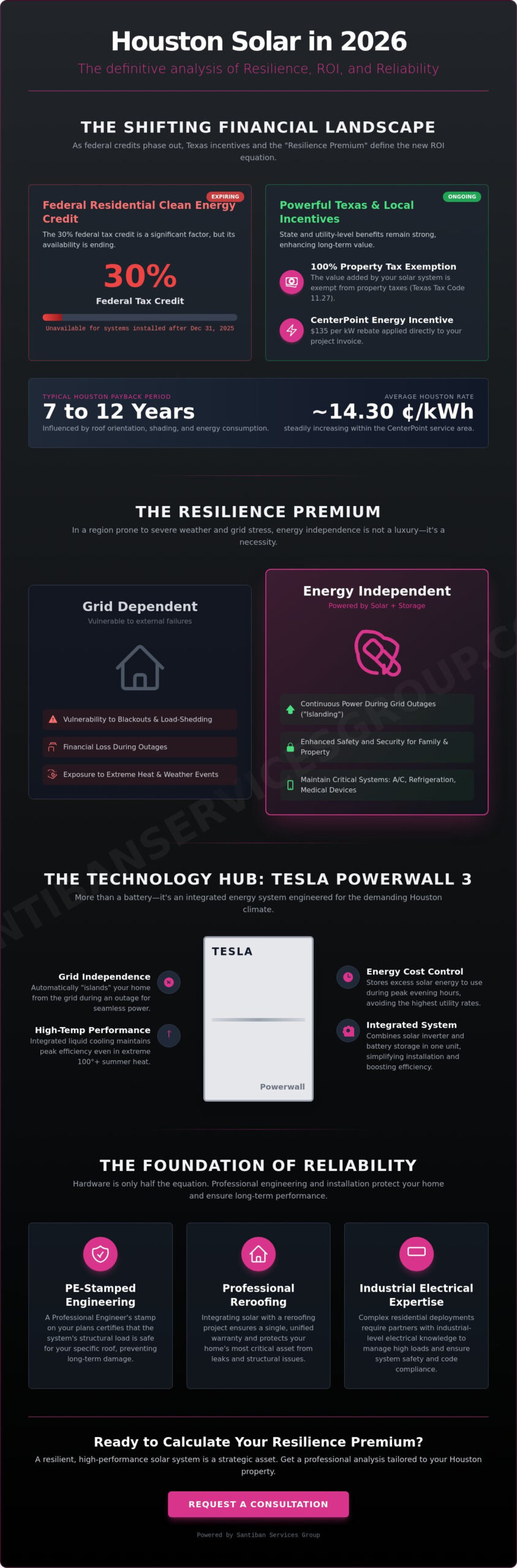
Quantifying the financial viability of a solar asset requires a granular look at the current market variables. When evaluating if is solar worth it in Houston 2026, you must shift focus from federal subsidies to local operational efficiencies. We define the “Resilience Premium” as the unified value of direct energy savings combined with the mitigation of financial loss during grid failures. While Houston’s electricity rates have climbed to approximately 14.30 cents per kWh, the true ROI includes the security of maintaining operations when the regional grid falters. This calculation treats your energy infrastructure as a strategic asset rather than a monthly expense.
Federal and Local Financial Incentives
The landscape for financial incentives has undergone a significant transition. According to the IRS, the 30% federal residential clean energy credit is not available for systems installed after December 31, 2025. This shift places a greater emphasis on local mechanisms. CenterPoint Energy continues to offer a $135 per kW incentive for residential solar installations, which is applied directly to the project invoice. Additionally, Texas Tax Code Section 11.27 provides a 100% property tax exemption on the value added by your solar system. You must file Form 50-123 with the Harris County Appraisal District by April 30 to secure this benefit. Understanding the history and growth of Solar Power in Texas helps contextualize why these state-level protections remain a cornerstone of Houston’s energy market.
Houston’s deregulated market means your financial return also depends on your Retail Electric Provider (REP). Since CenterPoint does not manage net metering, you must select a solar buy-back plan from an REP like Green Mountain Energy. These plans vary. Some offer fixed export credits around 6.3 cents per kWh, while others utilize real-time wholesale market prices. Choosing the correct plan is as vital as the hardware itself.
Calculating Your Break-Even Point
Calculating your break-even point involves analyzing your specific consumption profile. The average Houston home consumes about 1,150 kWh monthly. Current data suggests a payback period of 7 to 12 years. Factors such as roof orientation and shading significantly influence these timelines. A south-facing roof with zero obstructions maximizes production. Conversely, heavy shading from Houston’s mature oak trees can extend the ROI period.
Battery integration via the Tesla Powerwall 3 or EcoFlow systems adds to the initial capital requirement but fundamentally changes the long-term forecast. By storing excess energy for use during peak evening hours, you avoid the highest utility rates. Evaluating whether is solar worth it in Houston 2026 also requires a look at commercial benefits. For business entities, the financial outlook is further enhanced by the Modified Accelerated Cost Recovery System (MACRS). This allows for accelerated depreciation of solar assets, providing substantial tax advantages that are unavailable to residential owners.
Grid Reliability: Why Houston Solar Requires a Resilience Strategy
Reliability serves as the primary driver for energy investments in the Gulf Coast region. The ERCOT grid currently manages record-breaking peak loads; however, the local distribution infrastructure often remains vulnerable to localized failures during severe weather. This persistent instability is why many homeowners ask is solar worth it in Houston 2026 from a survival and safety standpoint. Data from the Texas Energy Profile shows that while renewable capacity is expanding, the transition period creates volatility that impacts Houston residents directly through unpredictable frequency fluctuations and load-shedding events.
Houston’s environmental conditions, specifically the 90% humidity and extreme summer heat, dictate the technical requirements of a resilient system. You need equipment engineered for high-temperature performance to prevent thermal throttling or premature component failure. Systems like the Tesla Powerwall 3 include integrated liquid cooling to maintain efficiency when ambient temperatures exceed 100 degrees. True resilience is achieved through “islanding,” a technical capability that allows your home to disconnect from the main grid automatically during an outage. This turns your property into an independent power station that continues to generate and store energy while the surrounding neighborhood remains dark.
The CenterPoint Energy Context
CenterPoint Energy manages the delivery of power, but they don’t control the generation. When local lines go down due to wind or flooding, utility-scale solutions can’t reach your home regardless of how much power is available elsewhere. By deploying distributed energy resources (DERs) like solar and battery storage, you contribute to a more robust neighborhood ecosystem while ensuring your own operational continuity. These systems allow for local generation that bypasses the most common points of failure in the regional transmission network.
Solar vs. Generators: The 2026 Reliability Verdict
Traditional standby generators were once the standard, yet 2026 standards favor solar plus storage for several reasons. Generators require mechanical maintenance and a steady supply of fuel. During major hurricanes, natural gas pressure can drop, and gasoline stations often lose power or run dry. Solar operates passively and doesn’t rely on external supply chains to function. It provides a silent, emission-free solution that removes the logistical anxiety of fuel management during a crisis. For those prioritizing long-term safety, is solar worth it in Houston 2026 is answered by the peace of mind that comes from total energy autonomy. Engaging a certified Tesla Powerwall installer ensures your backup system is configured for maximum reliability and seamless transition during grid failures.
Technical Integrity: Solar Reroofing and PE-Stamped Engineering
The physical stability of an installation dictates its long-term financial viability. In a region prone to high-velocity hurricane winds, the question of whether is solar worth it in Houston 2026 is inseparable from structural engineering. A system that cannot withstand a Category 4 storm represents a total capital loss. This is why professional PE stamped engineering for solar systems is a mandatory requirement for serious energy projects. These designs ensure that every mounting point and rail can manage the specific uplift forces unique to the Gulf Coast. Professional engineering also streamlines the City of Houston permitting process. It provides the municipal inspectors with the technical assurance that the system meets all local building codes and safety standards.
The Solar Reroofing Advantage
A solar installation is a 25 year commitment. You should never install panels on a roof with less than 10 years of remaining life. Removing and reinstalling a system to address roof leaks creates unnecessary labor costs and risks hardware damage. We prioritize a unified approach by integrating Tesla and solar roof solutions that treat the roof and the energy system as a single, durable asset. This strategy ensures warranty alignment. By coordinating the roof and solar warranties, you protect your investment against the complexities of multi-party liability. This foundation of structural integrity is what makes the 2026 ROI transition technically sound and practically reliable.
Engineering for Compliance and Safety
A comprehensive PE-stamped design is more than a formality. It includes detailed structural analysis, precise electrical schematics, and accurate site plans. These documents are essential for preventing costly delays during utility interconnection with CenterPoint. Professional engineering also addresses the safety implications of proper mounting and electrical grounding. In industrial and high-end residential settings, this precision prevents electrical fires and structural fatigue. Our disciplined approach to engineering ensures that every operational detail is under expert control. This focus on technical excellence is a primary factor when evaluating if is solar worth it in Houston 2026 for your specific property. High standards in the design phase translate directly to consistent performance and safety throughout the system’s lifecycle.
- Structural analysis verifies roof load capacity for heavy battery and panel arrays.
- Electrical schematics ensure compatibility with existing industrial electrical construction.
- Site plans optimize panel placement for maximum solar gain and wind resistance.
Maximizing Value with Tesla Powerwall 3 and Energy Storage
In the current energy market, the debate regarding whether is solar worth it in Houston 2026 is incomplete without prioritizing advanced energy storage. Standalone solar panels provide energy during daylight hours, but they offer zero protection against the evening grid failures common in Southeast Texas. The Tesla Powerwall 3 functions as the central hub of a modern energy ecosystem. It manages generation, storage, and consumption with industrial-grade precision. This integrated approach ensures that your investment provides value 24 hours a day, not just when the sun is at its zenith.
Why Powerwall 3 is the 2026 Standard
The Powerwall 3 established itself as the 2026 benchmark due to its integrated hybrid solar inverter and superior power output. Featuring an 11.5 kW continuous power capacity and 13.5 kWh of usable energy, a single unit can support essential heavy appliances that previous generations struggled to manage. This includes high-draw central AC units, which are non-negotiable for safety during Houston’s humid summer months. The unified system architecture reduces conversion losses, leading to higher overall efficiency. Smart energy management through the Tesla application allows you to automate your system to discharge during peak utility pricing periods. This proactive management strategy directly lowers your monthly operational costs and accelerates your break-even point.
VPPs and Grid Participation
Financial returns in 2026 are no longer limited to simple bill offsets. Through Tesla Electric, Houstonians can participate in Virtual Power Plants (VPPs). This grid-interactive model allows you to sell stored energy back to the ERCOT grid when demand is highest and prices are most favorable. This participation transforms your battery from a passive backup device into a revenue-generating asset. By contributing to regional grid stability, you earn credits that significantly improve the long-term financial forecast of the system. It’s a sophisticated method of maximizing the “Resilience Premium” we discussed previously.
For properties with varying power requirements or specific footprint constraints, EcoFlow battery backups provide a modular and scalable alternative. These systems allow for customized energy storage capacities that fit specific residential or light commercial needs. Whether you choose a Tesla or EcoFlow solution, the objective remains the same: achieving total grid independence while maximizing every watt of generated power. Securing these technical advantages requires precise execution and expert oversight. You can schedule a professional consultation with our team to explore a Tesla Powerwall 3 installation tailored to your property’s specific engineering requirements.
Implementation: Choosing the Right Houston Solar Partner
Selecting a qualified partner is the final, most critical variable in determining if is solar worth it in Houston 2026. While national solar firms often prioritize high-volume sales, they frequently lack the granular understanding of Houston’s specific distribution challenges and Harris County’s permitting nuances. A successful deployment requires a partner who treats your energy system as a strategic asset rather than a simple appliance. You should prioritize a tesla powerwall installer with deep local expertise and a proven history of managing complex industrial electrical construction. This background ensures that the integration of solar panels, battery storage, and your home’s existing electrical infrastructure is executed with professional precision.
You must remain vigilant against common industry red flags. High-pressure, door-to-door sales tactics often prioritize commissions over technical accuracy. Similarly, firms that sub-contract their engineering or electrical work create fragmented accountability, which leads to delays during the utility interconnection process. Santiban Services Group bridges the gap between industrial-grade quality and residential service. We maintain absolute expert control over every operational detail, ensuring that your system is designed and installed by the same unified team. This disciplined approach eliminates the risk of technical errors and guarantees that your installation meets the high standards required for long-term reliability in the Gulf Coast climate.
The Santiban Difference
Our organization applies over 24 years of industry experience to every energy project. We function as a comprehensive, single-source provider, managing everything from solar reroofing to PE-stamped engineering design. This unified model provides significant advantages. It ensures that your roof warranty remains intact and that your electrical system is fully optimized for the 2026 energy market. Our commitment to technical compliance means we handle all coordination with CenterPoint and local building departments, providing you with a seamless path to energy independence. We project an image of corporate stability, reassuring you that we’ll be available to maintain and support your system for its entire 25 year lifecycle.
Next Steps for Your Houston Property
Preparing your property for a transition to energy autonomy is a methodical process. You can begin by gathering 12 months of utility bills to help us analyze your specific consumption patterns. During a professional site assessment, we conduct a thorough roof inspection and evaluate your current electrical panel capacity. This data allows us to determine if is solar worth it in Houston 2026 for your specific financial goals. The timeline from initial engineering design to receiving your utility Permission to Operate (PTO) typically involves several weeks of coordinated activity, all managed by our specialized personnel. You can request a customized quote that accounts for current utility rates, local incentives, and the latest hardware specifications to ensure your investment is positioned for maximum ROI and resilience.
- Gather 12 months of electricity usage data for accurate system sizing.
- Schedule a comprehensive structural and electrical site assessment.
- Review customized engineering plans and projected break-even analysis.
- Execute the installation with a partner committed to industrial-grade standards.
Securing Your Energy Future in Houston
The evolution of the 2026 energy market requires a sophisticated approach to property infrastructure. While financial incentives have changed, the fundamental necessity for reliable, independent power remains constant. Determining if is solar worth it in Houston 2026 involves weighing the rising costs of utility dependence against the security of a professionally engineered system. By prioritizing structural integrity and high-capacity storage, you protect your property from the volatility of the regional grid.
Santiban Services Group offers the technical expertise required to navigate this complex environment. We leverage over 24 years of industrial electrical experience and in-house PE-stamped engineering design to ensure every installation meets rigorous safety standards. Our status as Tesla-certified installers allows us to deploy the latest storage technology with absolute precision. We’re committed to delivering customized results that align with your specific operational requirements and long-term goals.
Request a Professional Solar & Storage Consultation from Santiban Services Group to establish a stable foundation for your energy needs. We’re ready to help you secure your property’s future.
Frequently Asked Questions
Is solar still worth it in Houston without the full 30% tax credit in 2026?
Solar remains a viable investment due to rising electricity rates and the high value of grid independence. While the 30% federal tax credit expired at the end of 2025, homeowners still benefit from the $135 per kW CenterPoint incentive and a 100% state property tax exemption. When evaluating if is solar worth it in Houston 2026, you must consider the “Resilience Premium,” which accounts for the avoided costs and safety provided by having power during extended grid outages.
Can solar panels survive a Category 4 hurricane in Houston?
Solar systems can withstand hurricane-force winds when they are installed using PE-stamped engineering designs. These designs ensure that the mounting hardware and structural attachments are rated for the high-velocity hurricane zones found along the Gulf Coast. Professional installation focuses on precise rail placement and secure grounding to prevent uplift or structural failure during extreme weather events.
How much does a Tesla Powerwall 3 installation cost in Houston for 2026?
The cost of a Tesla Powerwall 3 installation depends on the specific electrical requirements of your home and the complexity of the backup configuration. Every property has unique needs regarding load management and industrial electrical construction. You should contact a professional partner for a customized quote that evaluates your specific site conditions and engineering needs instead of relying on generic estimates.
Do I really need to replace my roof before getting solar panels?
You should replace your roof if it has less than 10 years of service life remaining. Installing a solar array on an aging roof is inefficient because you’ll eventually pay for the removal and reinstallation of the panels when the roof fails. A solar reroofing strategy ensures that the foundation of your energy system is as durable as the technology itself, protecting your long-term ROI.
What is a PE-stamped engineering design, and why does the City of Houston require it?
A PE-stamped engineering design is a technical blueprint certified by a licensed Professional Engineer to ensure structural and electrical safety. The City of Houston requires these documents to verify that your solar system meets local building codes and can withstand regional wind loads. This professional oversight prevents mechanical failures and streamlines the permitting process with municipal authorities and utilities.
How long is the typical solar payback period for a Houston home in 2026?
The typical payback period for a Houston solar investment currently ranges from 7 to 12 years. This timeline has extended slightly since the expiration of the federal tax credit but is mitigated by Houston’s average electricity rate of 14.30 cents per kWh. Your specific break-even point will depend on your monthly consumption, roof orientation, and the solar buyback plan you select from your retail electric provider.
Can I power my central AC with solar and a Tesla Powerwall during an outage?
Yes, the Tesla Powerwall 3 is designed with an 11.5 kW power output capable of starting and running most central air conditioning units. This high-capacity output is essential for maintaining a habitable environment during Houston’s humid summer months when the grid is most vulnerable. Proper engineering ensures your battery backup is configured to prioritize these heavy loads during an islanding event.
Does solar increase my property taxes in Harris County?
Solar installations do not increase your property taxes in Harris County or anywhere in Texas. Under Texas Tax Code Section 11.27, you are entitled to a 100% property tax exemption on the value added to your home by a solar system. To receive this benefit, you must file Form 50-123 with the Harris County Appraisal District by the April 30 deadline.