
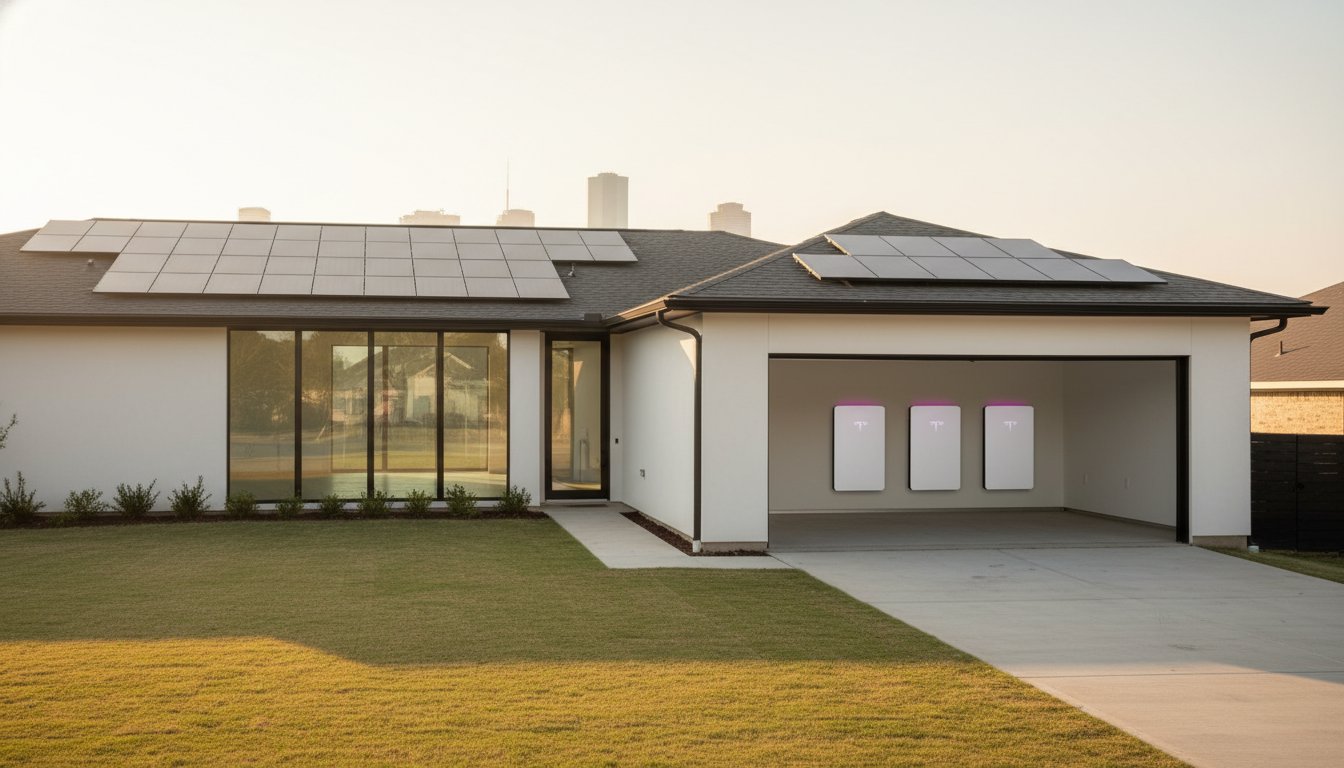
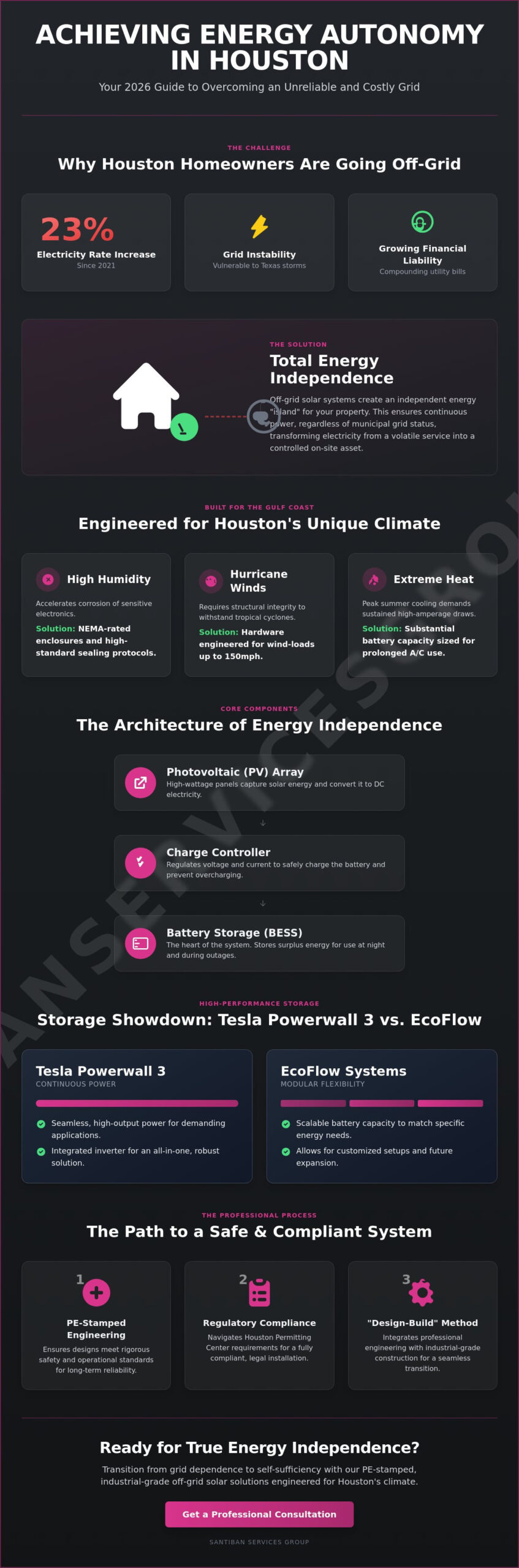
With Houston electricity rates climbing 23% since 2021, the traditional reliance on the municipal grid is no longer a simple convenience; it’s a growing financial and operational liability. You’ve likely experienced the frustration of grid instability during Texas storms and the compounding stress of rising utility bills. It’s a common concern that achieving true independence requires navigating a maze of complex permitting and technical hurdles. This 2026 guide clarifies that path, showing you how to achieve total energy autonomy through professional engineering and the deployment of off-grid solar systems Houston homeowners utilize for storm-resilient performance.
We’ll detail the precise steps to transition from grid dependence to self-sufficiency by leveraging advanced battery storage and industrial-grade design. You’ll discover how a PE-stamped engineering approach ensures long-term reliability even when the local infrastructure fails. This article provides a comprehensive overview of the latest hardware, such as the Tesla Powerwall 3 and EcoFlow systems, while outlining the essential regulatory requirements for a seamless, compliant installation in the Houston area.
Key Takeaways
- Establish total energy autonomy by decoupling from the ERCOT utility grid through the deployment of professional off-grid solar systems Houston homeowners utilize for long-term stability.
- Secure regulatory compliance and operational safety by prioritizing PE-stamped engineering designs that meet the rigorous standards of the Houston Permitting Center.
- Evaluate high-performance storage architectures, including the continuous power capabilities of the Tesla Powerwall 3 and the modular flexibility of EcoFlow battery backup solutions.
- Maximize system efficiency through the precise selection of high-wattage PV arrays and charge controllers engineered to manage energy flow in Southeast Texas climates.
- Streamline the transition to independence by utilizing a “Design-Build” methodology that integrates professional engineering with industrial-grade electrical construction.
Understanding Off-Grid Solar Systems in Houston’s Energy Landscape
Off-grid solar systems represent a fundamental shift from centralized utility dependence to localized, autonomous energy production. Within the context of the ERCOT grid, which has faced significant operational scrutiny following extreme weather events, true independence requires a self-sustaining ecosystem. Unlike standard grid-tied systems that automatically shut down during utility outages to protect line workers, or hybrid systems that maintain a constant tether to the provider, off-grid solar systems Houston residents utilize are engineered for total isolation. This independence ensures that your facility or residence remains powered regardless of the state of the municipal infrastructure.
The technical gold standard for this level of autonomy is known as “islanding.” This capability allows a property to function as an independent energy island, generating, storing, and consuming power without any external input. For many homeowners, Understanding Off-Grid Living starts with this requirement for hurricane resilience. It transforms electricity from a volatile service provided by a third party into a controlled, tangible asset managed on-site. This transition requires disciplined engineering to ensure that energy production consistently meets or exceeds demand.
The Legal and Regulatory Reality of Going Off-Grid in Texas
Houston municipal codes and building standards prioritize safety and structural integrity. While Texas law generally favors energy independence, total physical disconnection from CenterPoint Energy is often restricted by local ordinances regarding habitable structures. Most professional installations focus on “off-grid capable” engineering. This strategy provides the technical capacity to operate indefinitely without the grid while maintaining a dormant connection to satisfy residential permitting requirements. This dual approach ensures full compliance with the Houston Permitting Center while delivering the operational autonomy you require during periods of grid volatility.
Why Houston Requires a Specialized Off-Grid Approach
The Gulf Coast environment presents specific challenges that standard solar configurations often fail to address. High humidity levels in Southeast Texas can accelerate the corrosion of sensitive electrical components. To mitigate this risk, systems must utilize NEMA-rated enclosures and high-standard sealing protocols to ensure longevity. Structural integrity is another critical factor; solar racking and mounting hardware must be engineered to meet wind-load requirements of up to 150mph to withstand tropical cyclones. Finally, Houston’s peak summer cooling loads demand substantial battery storage capacity. A system isn’t truly off-grid unless it’s sized to handle the sustained high-amperage draws of air conditioning units during a prolonged heatwave without grid support.
The Architecture of Energy Independence: Core System Components
Designing off-grid solar systems Houston requires a meticulous selection of high-performance components engineered to withstand the specific environmental rigors of Southeast Texas. The foundation of this architecture is the photovoltaic (PV) array. Because urban Houston properties often have limited roof space, we prioritize high-wattage panels that maximize energy density per square foot. These panels capture solar radiation and convert it into direct current (DC) electricity, which serves as the primary fuel for your autonomous energy ecosystem.
Managing the flow of this energy is the charge controller. This device regulates the voltage and current from the solar panels to prevent overcharging the battery bank. It ensures that the Battery Energy Storage System (BESS), which acts as the heart of the setup, remains in optimal condition. According to the Homeowner’s Guide to Going Solar, selecting the right storage capacity is critical for maintaining power during non-daylight hours. The BESS stores surplus energy generated during the day for use at night, providing the reliability required for true energy independence.
Solar Reroofing: The Foundation of Off-Grid Reliability
A solar installation is a 25-year commitment. It’s illogical to mount advanced hardware on a roof that may require replacement in five years. We emphasize the necessity of solar reroofing as a preliminary step to ensure total system integrity. Santiban Services Group provides specialized reroofing services designed to prevent future leaks and structural failure. This integrated approach creates a synergy between the new roof surface and optimized panel mounting. You can learn more about these resilient strategies in our Tesla and solar roof solutions guide.
Inverters and Power Management
The inverter serves as the “brain” of the system, converting stored DC power into alternating current (AC). In an off-grid context, we evaluate string inverters versus microinverters based on site-specific shading and scalability. A critical feature for Houston residents is “black start” capability. This allows the system to restart using solar power even after a total battery drain. Additionally, inverters must provide surge capacity to handle high-amperage startup loads for HVAC units. If you’re ready to explore these technical specifications, Santiban Services Group provides specialized solar panel installation and engineering services.
Comparing Storage Solutions: Tesla Powerwall 3 vs. EcoFlow
Selecting the appropriate storage medium is the most critical decision when engineering off-grid solar systems Houston residents depend on for uninterrupted power. Modern energy independence relies on Lithium Iron Phosphate (LFP) chemistry, which has largely superseded older lead-acid and nickel-manganese-cobalt (NMC) technologies. LFP batteries provide superior thermal stability and a significantly longer cycle life. These characteristics are essential for the high-temperature environment of Southeast Texas, where battery systems must perform consistently under heavy cooling loads. By stacking multiple units, homeowners can achieve a whole-home power profile that supports industrial-grade reliability during extended grid failures.
The Tesla Powerwall 3 and EcoFlow systems represent the vanguard of this technology, though they serve different operational strategies. The Powerwall 3 is a unified solution featuring an integrated solar inverter and a continuous power output of 11.5 kW. This represents a 130% increase in power delivery over the previous generation, allowing a single unit to support more significant loads. Conversely, EcoFlow battery backup solutions offer a modular architecture. This flexibility allows for incremental capacity increases, making it an ideal choice for specialized residential needs where portability or phased expansion is a priority.
Why Tesla Powerwall 3 is the Industry Standard for 2026
The Tesla Powerwall 3 has established itself as the premier choice for off-grid applications due to its streamlined installation and robust software ecosystem. Its “Storm Watch” feature automatically prioritizes energy storage when severe weather is detected, ensuring maximum reserves before a potential outage. Architecturally, the Powerwall 3 is designed to manage high-inrush currents, which are the momentary power spikes required to start large HVAC compressors or well pumps. As a certified Tesla Powerwall installer in Houston, Santiban Services Group ensures these systems are integrated with the precision required for long-term resilience.
EcoFlow Solutions for Specialized Off-Grid Scenarios
While Tesla offers a centralized approach, EcoFlow systems excel in scenarios requiring modularity and user-centric control. These systems allow homeowners to start with a smaller storage footprint and expand as their energy requirements grow. The EcoFlow software interface provides granular data on energy consumption, allowing users to manage their off-grid reserves with high precision. This modularity is particularly effective for properties with varied structures or for residents who prefer a system that can be easily serviced or relocated. The plug-and-play nature of these units reduces the complexity of system expansion, providing a customized path to energy autonomy.
Engineering and Permitting: The Necessity of PE-Stamped Design
PE-stamped engineering serves as a legal and technical validation by a licensed Professional Engineer, certifying that a system’s design adheres to rigorous safety and performance standards. In the Houston area, the municipal permitting office requires these stamps for both structural and electrical plans before any significant installation begins. This requirement is not merely a bureaucratic hurdle. It is a critical safety measure. For off-grid solar systems Houston residents rely on, professional engineering prevents system failure during the catastrophic weather events common to the Gulf Coast. Santiban Services Group maintains in-house engineering capabilities to provide a streamlined project flow, ensuring that design and execution remain under a single point of professional accountability.
A failed permit application or a poorly engineered system can lead to significant financial loss and property damage. By integrating engineering into the initial design phase, we identify potential structural or electrical conflicts before they manifest in the field. This proactive approach ensures that every component, from the racking hardware to the battery enclosures, is sized and positioned for maximum reliability. If you require professional validation for your project, Santiban Services Group provides the PE-stamped engineering design necessary for a successful, code-compliant installation.
Structural Engineering for Hurricane-Force Winds
Houston is situated in a high-wind region where solar arrays must withstand extreme conditions. Our engineering process includes the precise calculation of uplift forces on solar arrays during 140+ mph winds. These calculations are essential for developing PE-stamped racking designs that satisfy both municipal codes and insurance requirements. Proper structural engineering protects the home’s integrity by ensuring that wind loads are distributed safely across the roof’s load-bearing members. This prevents the panels from detaching or causing structural failure during a tropical cyclone.
Electrical Design and Technical Compliance
Off-grid energy storage involves complex electrical paths that require detailed one-line diagrams. These diagrams illustrate exactly how power flows from the PV array through the charge controllers and into the battery bank. Engineering ensures that every circuit complies with the National Electrical Code (NEC) and local Houston amendments. This technical oversight is vital for sizing conductors and overcurrent protection devices correctly, which prevents fire hazards and equipment degradation. You can find more detail on these requirements in our 2026 compliance guide for Houston energy projects. Comprehensive electrical design guarantees that your autonomous system operates safely under peak summer loads.
Implementing Your Off-Grid Strategy with Santiban Services Group
Santiban Services Group brings over 24 years of expertise in industrial electrical construction to the residential and commercial solar sectors. This extensive history provides a foundation of corporate stability and technical proficiency that is rare in the renewable energy industry. We operate using a “Design-Build” methodology, which integrates PE-stamped engineering and field installation into a single, unified workflow. This approach eliminates the communication gaps that often occur between third-party designers and field technicians, ensuring that the final off-grid solar systems Houston clients receive are executed with absolute precision. Our commitment to quality is reinforced by a focus on long-term performance. We provide comprehensive monitoring and maintenance services post-installation to ensure every component of the energy ecosystem continues to function at peak efficiency.
Our organization values the trust established through consistent performance and disciplined execution. By maintaining control over every operational detail, we reassure our clients that their transition to energy autonomy is managed by an established partner. We prioritize professional standards over market trends, focusing on the rigorous engineering required to maintain power during the most challenging Texas weather conditions. This dedication to reliability defines our role as a strategic partner for those seeking total energy independence.
The Santiban Installation Process
The Santiban installation process is defined by a methodical series of operational milestones. It begins with a comprehensive site assessment to evaluate structural load-bearing capacity and electrical infrastructure readiness. Following this, our in-house engineers develop a customized PE-stamped design tailored to the specific energy profile of the facility. The physical installation is performed by specialized personnel trained in industrial-grade electrical standards. We view our work as a “silent engine,” a competent force that operates seamlessly in the background to maintain your energy independence without requiring constant intervention. Final commissioning involves rigorous testing of the battery storage and inverter systems to guarantee they handle peak loads as designed.
Commercial and Industrial Off-Grid Applications
For Houston businesses and industrial facilities, scaling off-grid solar requires a higher degree of technical sophistication and adherence to safety protocols. We engineer systems capable of supporting large-scale operations and integrating commercial EV charging infrastructure into the off-grid ecosystem. This allows organizations to insulate their logistics and operations from grid volatility while meeting corporate sustainability targets. Our team is prepared to handle the complex organizational challenges associated with industrial-scale storage and high-amperage distribution. We invite procurement departments and facility managers to request a professional consultation to discuss the specific engineering requirements and long-term reliability of their facility’s energy infrastructure.
Securing Your Energy Future through Engineering Precision
Achieving total energy autonomy in Southeast Texas is a complex engineering objective that requires meticulous planning and professional execution. This guide has detailed the necessity of PE-stamped structural designs to withstand hurricane-force winds and the critical role of advanced battery storage in managing peak cooling loads. Successful deployment of off-grid solar systems Houston homeowners rely on depends on integrating high-standard components with a code-compliant electrical architecture.
Santiban Services Group leverages over 24 years of industrial electrical construction experience to deliver customized energy solutions. Our status as a Tesla Certified Installer combined with our in-house engineering team ensures that every operational detail remains under expert control. We prioritize long-term performance and safety through a unified design-build approach. Request a PE-Stamped Off-Grid Consultation from Santiban Services Group to secure your facility’s energy independence. It’s a strategic investment that ensures your property remains operational regardless of grid conditions.
Frequently Asked Questions
Is it legal to disconnect from the grid in Houston, Texas?
Yes, it’s legal to operate an off-grid system, but municipal habitability codes often require a utility connection for a Certificate of Occupancy in residential areas. Most high-end installations in the region are technically “off-grid capable.” This allows the property to operate in total isolation during grid failures while maintaining a dormant connection to satisfy local building ordinances and permitting requirements.
How many solar panels and batteries do I need to go fully off-grid?
The average residential system in Houston is approximately 12.49 kW, but true energy independence often requires a larger array and multiple storage units. Your specific requirements depend on your daily kilowatt-hour consumption and the peak amperage draw of your facility. A professional engineering assessment is necessary to size the system to handle sustained cooling loads during the peak of summer.
What is the difference between a backup battery and a true off-grid system?
A backup battery provides temporary power during utility outages, while off-grid solar systems Houston homeowners use for autonomy are engineered for indefinite operation. True off-grid systems require “islanding” technology and significantly larger battery banks to manage the entire energy cycle independently. Backup systems are typically smaller and rely on the grid to eventually recharge the storage units.
Can an off-grid solar system run my central AC during a Houston summer?
Yes, a correctly engineered system can support central air conditioning if it has sufficient surge capacity and storage. Central AC units require a high-inrush current to start the compressor; therefore, you must use inverters like the Tesla Powerwall 3 that handle these spikes. The battery bank must also be large enough to sustain the continuous draw throughout humid nights when production is zero.
Why do I need a PE-stamped engineering design for my solar project?
A PE-stamped design is a legal requirement in Houston for commercial projects and residential systems exceeding 10kW. This stamp certifies that a licensed Professional Engineer has verified the structural integrity of the mounting and the safety of the electrical schematics. It provides the necessary validation for the Houston Permitting Center and ensures the system can withstand wind loads of up to 150mph.
How does the Tesla Powerwall 3 perform in off-grid scenarios compared to generators?
The Tesla Powerwall 3 offers a silent, self-sustaining alternative to traditional combustion generators by integrating directly with solar production. Unlike generators that require fuel storage and mechanical maintenance, the Powerwall 3 recharges daily from the sun and provides instantaneous power transfer. It eliminates the risks of fuel degradation and mechanical failure that often occur during prolonged weather events.
What maintenance is required for a professional off-grid solar system?
Professional off-grid systems require minimal maintenance because they lack the moving parts found in traditional generators. We recommend an annual electrical inspection and periodic cleaning of the solar panels to ensure maximum efficiency. Monitoring the system’s software interface allows you to track battery health and production levels, ensuring the “silent engine” of your property continues to function flawlessly.
Does insurance cover off-grid solar systems in high-wind zones like Houston?
Most insurance providers cover solar installations as permanent property improvements if they meet local building codes and structural standards. Providing a PE-stamped engineering design is often essential to satisfy underwriters regarding the system’s resilience against hurricane-force winds. You should always notify your carrier after installation to ensure the system’s value is fully integrated into your property coverage.