
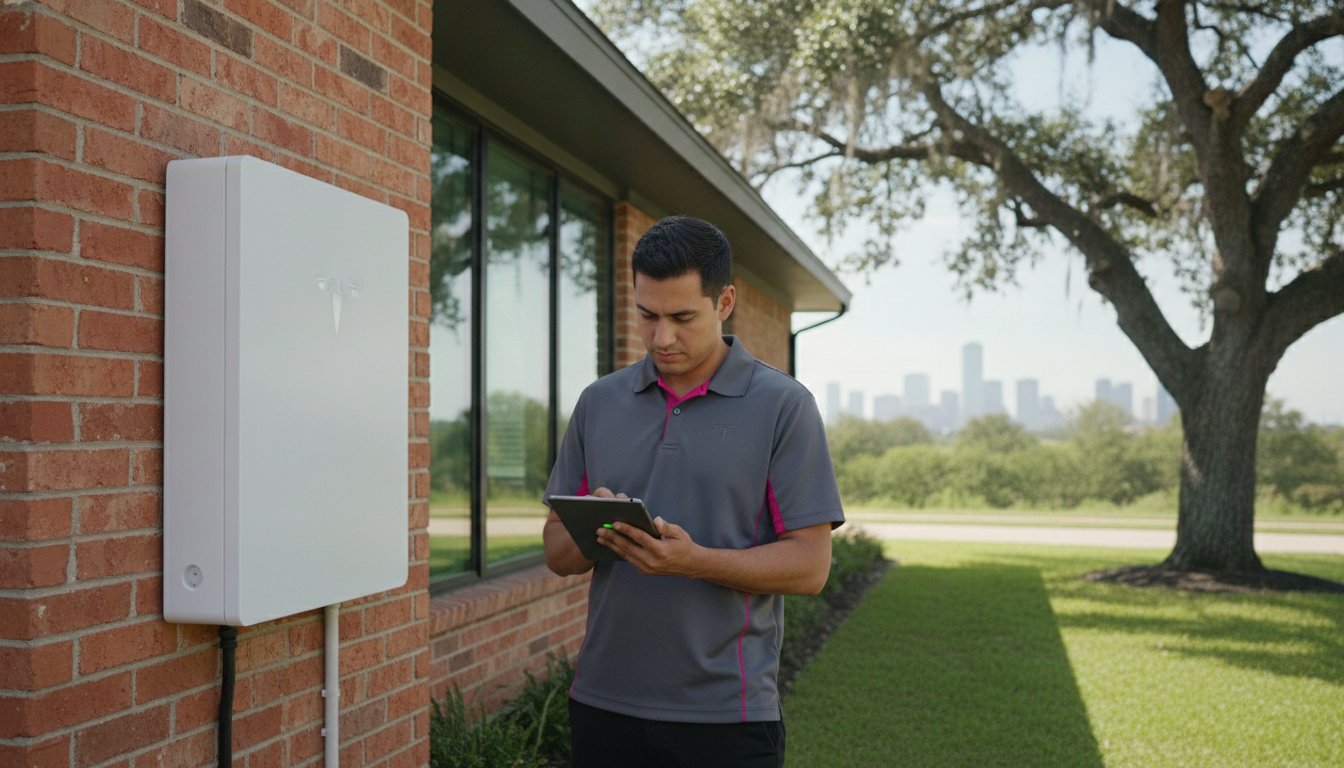
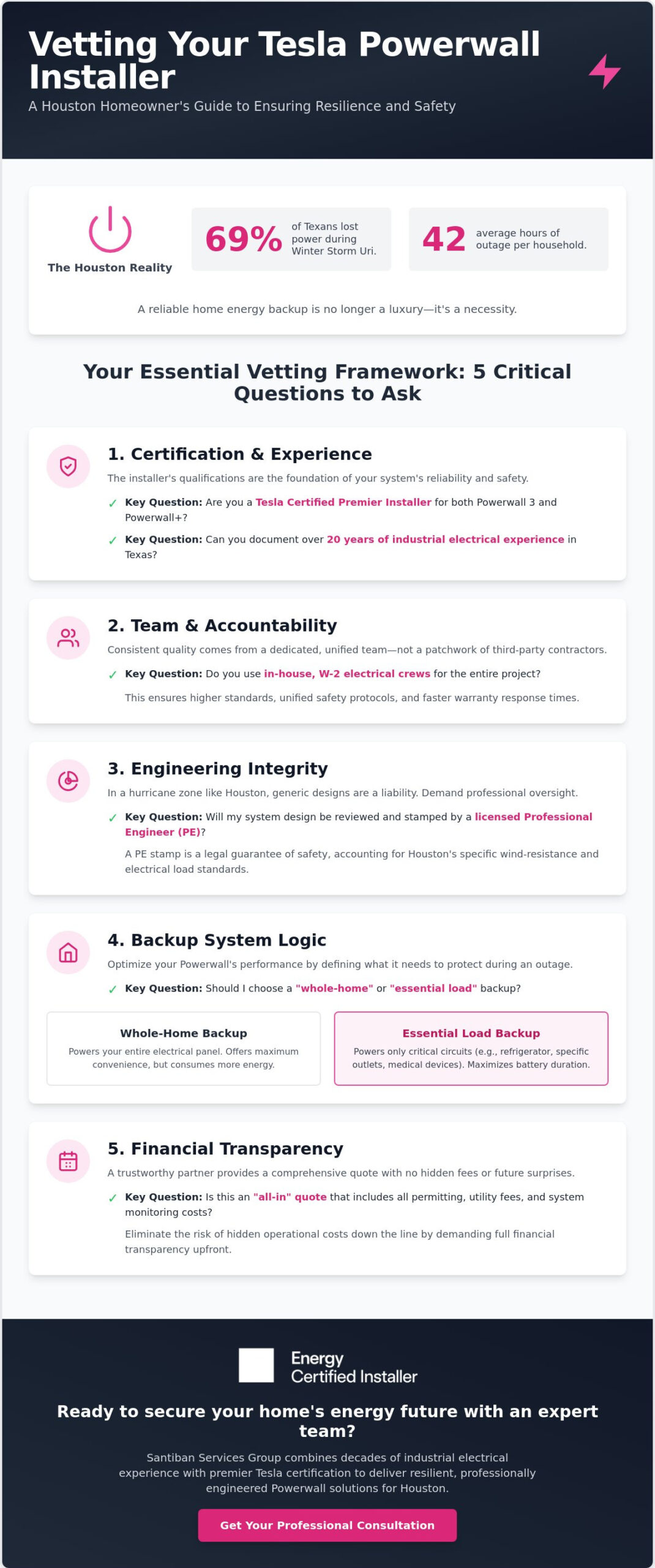
During Winter Storm Uri, 69% of Texans lost power for an average of 42 hours, a data point that continues to drive the urgent demand for reliable home energy storage in our region. You recognize that a backup system is no longer a luxury but a critical component of Houston homeownership. However, the complexity of modern energy integration means the difference between a resilient home and a system failure often comes down to the caliber of your contractor. Knowing the right technical questions to ask about Tesla Powerwall installation is the only way to separate disciplined engineering firms from high-volume sales operations.
We understand your priority is the safety and long-term stability of your electrical infrastructure. This guide provides a comprehensive vetting framework for 2026, focusing on the rigorous standards required for Houston’s unique climate and regulatory environment. You’ll learn how to evaluate an installer’s approach to PE-stamped engineering, wind-load calculations, and the specific permitting hurdles required by the City of Houston. We will examine the critical engineering benchmarks that ensure your Tesla Powerwall 3 operates with absolute precision when the local grid fails.
Key Takeaways
- Verify the installer’s status as a Tesla Certified Premier partner and confirm the use of in-house, W-2 electrical crews to ensure consistent execution quality and accountability.
- Prioritize structural safety by requiring PE-stamped engineering designs that account for Houston’s specific electrical loads and wind-resistance standards.
- Identify the essential technical questions to ask about Tesla Powerwall installation regarding roof structural integrity and the potential need for integrated solar reroofing services.
- Distinguish between “whole-home” and “essential load” backup logic to ensure the Powerwall 3 is optimized for your specific energy demands during a grid outage.
- Demand financial transparency with “all-in” quotes that encompass permitting, utility fees, and long-term system monitoring to eliminate hidden operational costs.
Vetting the Installer: Questions on Certification and Local Stability
The selection of an energy storage partner is a decision that impacts your home’s safety for decades. You must prioritize technical proficiency over marketing claims. One of the most vital questions to ask about Tesla Powerwall installation concerns the provider’s certification level. Specifically, verify if they are a Tesla Certified Premier Installer for both the Powerwall 3 and Powerwall +. Premier status is not merely a label; it is a designation reserved for partners who demonstrate consistent excellence in installation volume and technical accuracy. This status ensures the installer has direct access to Tesla’s engineering support and the latest hardware updates.
Longevity in the Texas market serves as the ultimate proof of reliability. Ask potential providers if they can document over 20 years of industrial electrical experience. A firm with deep roots in industrial construction brings a level of precision to residential backup systems that retail-focused solar companies often lack. This background ensures the Tesla Powerwall is integrated into your electrical panel with the same rigor applied to commercial infrastructure projects. It represents a commitment to corporate stability that protects your investment through every hurricane season.
The Accountability of In-House Teams
Quality control remains the primary risk when installers rely on third-party subcontractors. Subcontracting often leads to communication gaps and inconsistent workmanship. We recommend confirming that the company utilizes in-house, W-2 electrical crews for every phase of the project. These teams operate under a unified safety protocol and are held to a higher standard of internal accountability. In-house crews also provide faster warranty response times during the critical Houston storm seasons. When a system alert occurs, you deserve a direct line to the technicians who performed the initial commissioning rather than a revolving door of outsourced labor. Ask how the specific crew on your project is trained for Tesla-specific commissioning to ensure they are prepared for the nuances of your unique site.
Local Houston Grid and Permitting Expertise
A system that is physically installed but cannot legally turn on provides no value. Your installer must have a proven track record of successful interconnections with CenterPoint Energy. Ask for specific examples of systems they have cleared through the Houston permitting process. Understanding the nuances of ERCOT regulations and local utility requirements is essential for a seamless transition to the grid. A local physical office is another non-negotiable requirement. It represents a commitment to long-term service and ensures the company is available for maintenance long after the initial incentives are processed. Verification of their knowledge regarding current Texas-specific solar and storage incentives will further confirm their status as a specialized strategic partner.
Engineering Integrity: Questions About PE-Stamped Designs
Engineering integrity is the foundation of a resilient home backup system. When evaluating questions to ask about Tesla Powerwall installation, you must move beyond equipment specifications and scrutinize the underlying engineering plan. A critical inquiry is whether a licensed Professional Engineer (PE) will review and stamp the system design for your specific property. In a high-risk hurricane zone like Houston, generic templates are insufficient. A custom engineering plan ensures that every electrical connection and structural mount meets the highest safety standards. This level of oversight is what separates a professional installation from a high-risk gamble.
A PE stamp represents a legal guarantee of technical accuracy and safety provided by a licensed professional. Utilizing PE stamped engineering for solar systems is essential for navigating the City of Houston’s stringent permitting requirements. Without this certification, homeowners risk permit rejections, structural failures during extreme weather, or potential fire hazards. A NABCEP certified professional understands that engineering is not a formality; it’s a safeguard against the “solar cowboy” approach that ignores local wind-load variables. These professionals ensure that the electrical diagrams are customized for your specific panel rather than adapted from a one-size-fits-all template.
The Role of a PE-Stamped Engineering Design
Your engineering plan must include specific wind-load calculations for the mounting site. Houston’s building codes are rigorous regarding wind-resistant connections. If an installer cannot provide site-specific electrical diagrams, they are likely using shortcuts that compromise system longevity. Precision in these calculations ensures the Powerwall 3 can handle your home’s specific backup needs without overloading the system or the grid. This rigorous approach protects your home’s structural integrity while streamlining the approval process with local utility providers.
Electrical Infrastructure and Panel Readiness
The integration of a Powerwall 3 often requires updates to your existing infrastructure. You should ask if your current electrical panel can support a high charging load, which is typical for advanced storage configurations. High-performance systems require more than just basic wiring; they demand industrial-grade electrical construction. This level of precision prevents long-term efficiency loss and mitigates heat issues that can lead to electrical fires. If your project involves complex integration, you may need a partner capable of PE-stamped engineering design to ensure every operational detail is under expert control.
The Structural Foundation: Questions on Roof Health and Reroofing
A solar-plus-storage system is only as reliable as the surface upon which it’s mounted. One of the critical technical questions to ask about Tesla Powerwall installation involves the current state of your roofing infrastructure. You should verify if the installer performs a comprehensive, professional roof assessment before proposing a design. This step is non-negotiable for ensuring that the mounting site can withstand Houston’s high-velocity wind events. It’s also helpful to consult a consumer guide from the Pacific Northwest National Laboratory to understand how structural integrity influences the long-term financial viability of home energy storage.
If your roof is nearing its end-of-life, you must ask if the provider offers integrated solar reroofing services. Installing 25-year solar panels on a roof with only ten years of service life remaining is a significant financial oversight. It often leads to the costly requirement of removing and reinstalling the entire array when the roof fails prematurely. A unified Tesla and solar roof approach ensures that the structural components and the energy system are engineered to function as a single, cohesive unit. Structural health is the foundation of energy storage ROI.
Evaluating Your Roof Before the Powerwall
A thorough evaluation prevents the logistical challenges of future repairs. You must clarify who is responsible for the roof warranty after the solar penetrations are made. Ask potential installers for their specific process regarding the removal and reinstallation of panels if repairs are needed later. A professional partner should provide a clear protocol for these maintenance events, ensuring that your long-term operations remain uninterrupted. Precision in these early assessments protects your home’s structural integrity.
Warranty and Leak Protection
In the context of Houston’s heavy rain conditions, a robust “penetration warranty” is essential. Ask for the specific length of this warranty and exactly what it covers. High-end installers use specialized flashing and industrial-grade mounting hardware to prevent water intrusion at every attachment point. The advantage of having one company handle both the reroof and the Tesla Powerwall 3 installation is the elimination of liability gaps between separate trades. This unified accountability ensures that your home remains protected from both grid instability and environmental elements.
Technical Execution: Questions Specific to Powerwall 3 and Backup Logic
The transition to the Powerwall 3 represents a significant advancement in energy storage technology. One of the most important questions to ask about Tesla Powerwall installation is how the technician plans to optimize the integrated hybrid solar inverter for your specific array. Unlike earlier models, the Powerwall 3 simplifies the electrical architecture by combining the battery and inverter into a single unit. This integration achieves a 97.5% round-trip efficiency, but it requires precise commissioning to ensure the 11.5 kW of continuous power output is distributed effectively across your home’s circuits. This level of technical detail is what separates industrial-grade execution from basic labor services.
You must also determine if the proposed system will provide “whole-home” backup or only support “essential loads” during a grid outage. Whole-home backup requires a sophisticated understanding of your peak electrical demand, particularly regarding high-draw appliances like HVAC systems. A professional installer should explain how the system handles “islanding,” the process that disconnects your home from the Houston grid to maintain power during local outages. This capability is what allows your solar panels to continue generating energy even when the utility lines are down, a feature that standard solar-only systems cannot provide. Ensuring your system is configured for seamless islanding is critical for maintaining operations during extended recovery periods.
Maximizing the Powerwall 3 Architecture
A professional Tesla Powerwall 3 installation differs fundamentally from previous hardware generations. You should ask your contractor about specific battery placement and cooling requirements to ensure long-term performance. Fire safety compliance is another critical area; in Houston, battery storage systems with an aggregate capacity of 20 kWh or more require a formal fire marshal review according to NFPA 855 standards. The integrated inverter not only improves efficiency but also reduces the physical footprint of the installation, provided the engineering design accounts for proper thermal management and safety clearances.
Grid Resilience and Storm Readiness
System responsiveness during major Houston storms is a primary concern for homeowners. The Powerwall 3 is designed to detect grid instability and transition to backup power automatically. You should verify if the system is future-proofed to integrate with emerging technologies, such as bidirectional EV charging. As your energy needs grow, perhaps by adding a second electric vehicle, the system should be easily expandable. Ensuring your infrastructure is ready for these advancements is a hallmark of a high-end strategic partner. If you require a system designed for maximum grid resilience, schedule a technical consultation with our electrical construction team to discuss a customized solution.
The Contract and Long-Term Support: Questions on Accountability
The final stage of securing your energy future involves formalizing the partnership through a transparent and comprehensive contract. One of the primary questions to ask about Tesla Powerwall installation is whether the provided quote is truly “all-in.” A professional proposal must explicitly include all necessary components: hardware procurement, specialized labor, PE-stamped engineering, and all applicable utility fees. Vague line items or “estimated” permitting costs are significant red flags that often indicate a lack of operational control. Precision in the initial quote reflects the installer’s ability to manage complex organizational challenges without passing unexpected costs to the client.
A disciplined partner provides clear documentation regarding performance guarantees and long-term stability. You must verify the specific process for handling hardware failures or underproduction. It’s also essential to understand the continuity of your warranty and support if the installation company is sold or ceases operations. High-end strategic partners prioritize long-term relationships and consistent performance, ensuring that your investment remains a stable asset for your home. This level of corporate accountability is what distinguishes an established electrical firm from a transient sales organization.
The “No-Surprise” Quote
A professional quote serves as a roadmap for the entire project. It should break down costs for hardware, labor, and the rigorous engineering required for Houston’s regulatory environment. Understanding how Tesla Electric in Houston integration affects your long-term ROI is another vital consideration. This program can significantly enhance the financial viability of your system by allowing you to participate in grid services. However, this integration requires precise electrical configuration and a contract that clearly outlines your role in the ERCOT market. Detailed quotes prevent the sudden shifts in tone or erratic messaging that often accompany poorly planned projects.
Monitoring and Post-Installation Support
Monitoring is the silent engine that keeps your system running smoothly in the background. You should ask about your access to real-time data through the Tesla app and clarify who is responsible for acting on service alerts. A reliable provider handles service tickets with a methodical approach and maintains a predictable response time within the Houston area. This ongoing commitment to safety and performance ensures that every operational detail remains under expert control long after the initial installation is complete. If you are ready to secure your home with a system designed for maximum resilience, contact Santiban Services Group for an engineered, storm-ready Powerwall consultation.
Securing Your Energy Independence with Precision
A resilient home backup system is the result of disciplined engineering and rigorous vetting. By identifying the critical technical questions to ask about Tesla Powerwall installation, you ensure your Houston property is protected by industrial-grade standards rather than retail-level shortcuts. Prioritizing PE-stamped designs and in-house electrical expertise mitigates the risks of system failure during extreme weather events. This focused approach guarantees that your energy infrastructure remains a stable and high-performing asset for decades.
Santiban Services Group brings over 24 years of industrial electrical experience to every residential project in the Houston market. As a Tesla Certified Premier Installer, we provide in-house PE-stamped engineering design to ensure your system meets the highest safety and regulatory benchmarks. Our commitment to precision execution provides the long-term stability your home deserves. Schedule a Professional Powerwall & Engineering Consultation with Santiban today to begin your transition to a more secure energy future. You can move forward with the confidence that every detail is under expert control.
Frequently Asked Questions
Do I really need a Professional Engineer (PE) for a residential Powerwall project in Texas?
Yes, the City of Houston requires a Texas-licensed Professional Engineer to stamp both the structural and electrical plans for every solar and battery permit application. This legal requirement ensures that your system design adheres to local wind-load regulations and National Electrical Code standards. Working with a firm that provides in-house PE-stamped engineering design streamlines the approval process with CenterPoint Energy and guarantees the technical accuracy of your home’s energy infrastructure.
What happens if my solar company goes out of business after the installation?
If your installer ceases operations, your equipment warranties from Tesla remain valid, but you typically lose your labor warranty and local technical support. This risk highlights the importance of choosing a partner with a long history of industrial electrical construction and corporate stability in the Texas market. Vetting the provider’s long-term viability is one of the most critical questions to ask about Tesla Powerwall installation to ensure your system receives professional service for decades.
Is it better to hire a local Houston installer or a large national company?
Local Houston installers generally provide superior knowledge of specific municipal codes and faster response times for post-installation service alerts. While national organizations have significant scale, they often rely on third-party subcontractors who may lack deep familiarity with the Houston grid’s unique requirements. A local partner with a physical presence in the region offers a level of accountability and specialized training that sales-driven national firms cannot consistently replicate.
How do I know if my electrical panel is strong enough for a Tesla Powerwall 3?
A professional site assessment is the only way to determine if your existing panel can support the 11.5 kW continuous power output of the Powerwall 3. Older 100-amp panels frequently require an upgrade to 200-amp service to accommodate the increased electrical load and potential future additions like commercial-grade EV charging infrastructure. This technical evaluation is a standard component of the engineering design phase for any high-end energy storage project.
Should I replace my roof at the same time I install the Powerwall and solar?
You should replace your roof if it has less than ten years of service life remaining to avoid the logistical costs of removing and reinstalling the solar array later. Coordinating a solar reroofing project allows for the seamless integration of mounting hardware and flashing with new materials, which maximizes leak protection. This unified approach ensures the structural integrity of your home and protects your long-term return on investment during Houston’s intense rain seasons.
Can a Tesla Powerwall 3 work with my existing solar panels from another company?
Yes, the Powerwall 3 is designed with a hybrid inverter that can be configured to work alongside your existing solar panels through AC-coupling. A qualified technician will evaluate your legacy inverter and wiring to ensure the new battery communicates effectively with your current hardware. This flexibility allows homeowners to modernize their energy systems and increase grid resilience without the necessity of replacing their entire existing solar array.
What is the difference between a solar sales company and a solar engineering company?
A solar sales company operates primarily as a marketing entity that often outsources the actual installation to third-party subcontractors. In contrast, a solar engineering company manages the entire project lifecycle using in-house, W-2 electrical crews and licensed Professional Engineers. This distinction is vital for those who value precision and want to ensure their questions to ask about Tesla Powerwall installation are answered by the experts performing the work.
Will my Powerwall 3 work during a hurricane or major Houston flood?
The Powerwall 3 is engineered for high resilience during hurricanes, featuring a rugged, water-resistant enclosure that maintains operations when the grid fails. However, the unit must be installed above the local floodplain elevation to prevent damage from rising waters during a major Houston flood. Proper site engineering and secure wind-load mounting are essential details that ensure your backup power remains functional and safe during the region’s most severe weather events.