
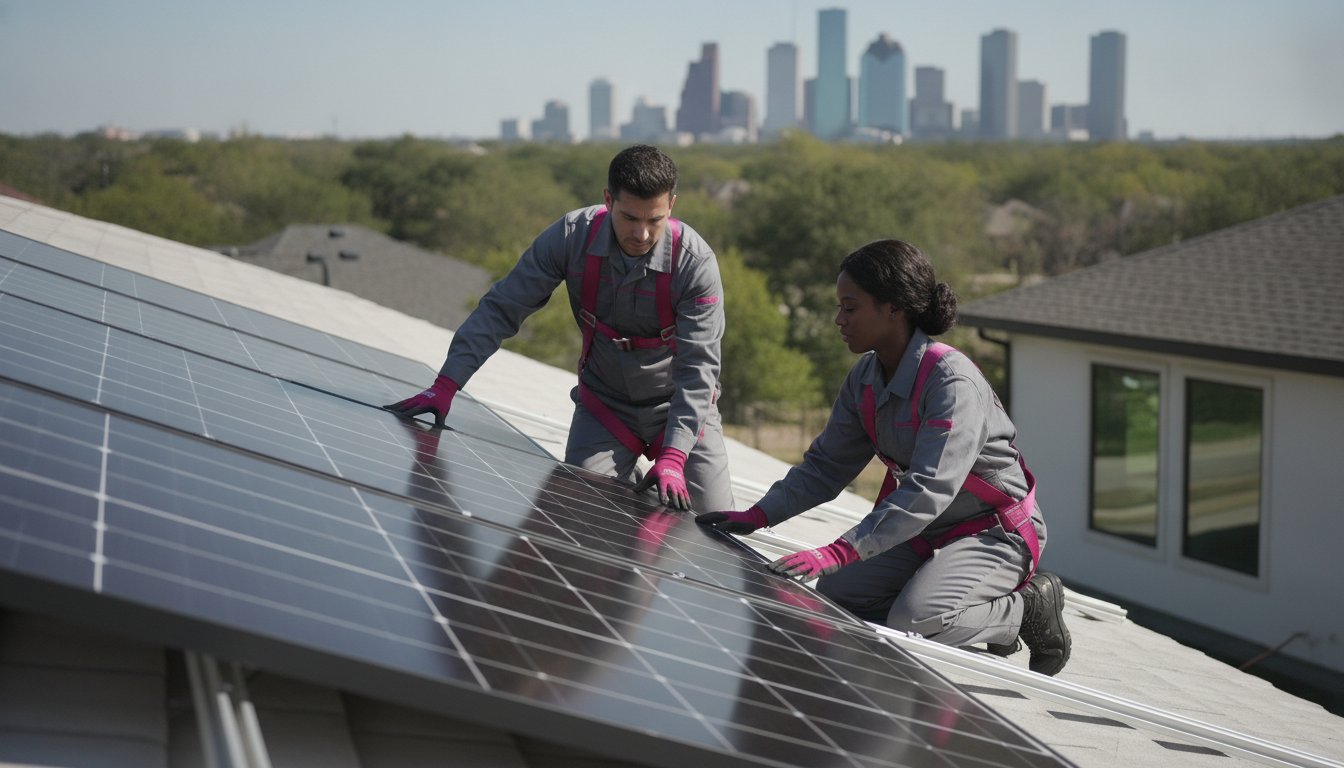
A solar array is not a temporary fixture; it is a sophisticated structural component integrated into your property’s specialized engineering. You likely invested in renewable technology for long-term energy security, so the prospect of dismantling that system for a roof repair is understandably stressful. The process of solar panel removal and reinstallation Houston homeowners face in 2026 requires more than just manual labor. It demands precise technical execution to protect your investment and maintain your manufacturer’s warranty.
We understand that anxiety over potential panel damage or post-installation roof leaks can be overwhelming. This professional guide provides the technical requirements for safely redeploying your solar assets while maintaining total structural integrity. You’ll learn how to navigate the current Houston permitting landscape, which typically requires a two to four week lead time, and how to adhere to the updated NEC 2026 standards. We preview the essential steps for a seamless transition from your old roof to a new one, ensuring your system returns to full production with zero damage and complete compliance with local structural codes.
Key Takeaways
- Understand why high-voltage PV components require specialized electrical expertise rather than standard roofing labor to prevent system failure.
- Learn the systematic detachment and re-deployment protocols that safeguard your production baseline and equipment health.
- Navigate the specific technical requirements for solar panel removal and reinstallation Houston authorities mandate, including necessary PE-stamped engineering for city approval.
- Discover how integrated solar reroofing strategies synchronize specialized crews to minimize downtime and ensure structural integrity.
- Identify the essential documentation and safety protocols required to maintain manufacturer warranties and secure insurance claim approvals.
Professional Solar Panel Removal and Reinstallation in Houston
Executing a successful solar panel removal and reinstallation Houston project requires a disciplined approach to industrial electrical standards. While the physical removal of modules may seem straightforward, the underlying complexity of high-voltage DC systems demands professional oversight. Standard roofing crews possess excellent skills for structural waterproofing, but they often lack the specialized training required to manage energized photovoltaic strings. Entrusting your energy assets to non-specialists risks catastrophic system failure and physical injury. It’s a high-stakes engineering task that should never be treated as basic labor.
The environmental variables unique to the Gulf Coast add another layer of difficulty. Houston’s persistent humidity and extreme thermal cycles accelerate the oxidation of mounting hardware and electrical enclosures. Professional technicians evaluate these components during the detachment phase to ensure that re-deployment doesn’t compromise the new roof’s integrity. By adhering to rigorous Solar Panel Technology standards, we preserve the operational lifespan of your array. This methodical care protects your long-term investment from the degradation often seen in poorly managed projects. Every bolt and rail must be inspected for structural stability before it returns to your roof.
Common Scenarios Requiring Solar Detachment
Most detachment requests in the Houston area stem from structural necessity. Frequent storm activity, including high-velocity winds and significant hail events, often necessitates roof deck inspections or shingle replacements. Property owners also require removal during comprehensive facility upgrades, such as the installation of new industrial HVAC units or the expansion of commercial skylights. In each case, the solar array must be decommissioned and stored securely to prevent secondary damage during the construction phase. Planning for these events ahead of time ensures that energy downtime is kept to a minimum.
The Risks of Improper Panel Handling
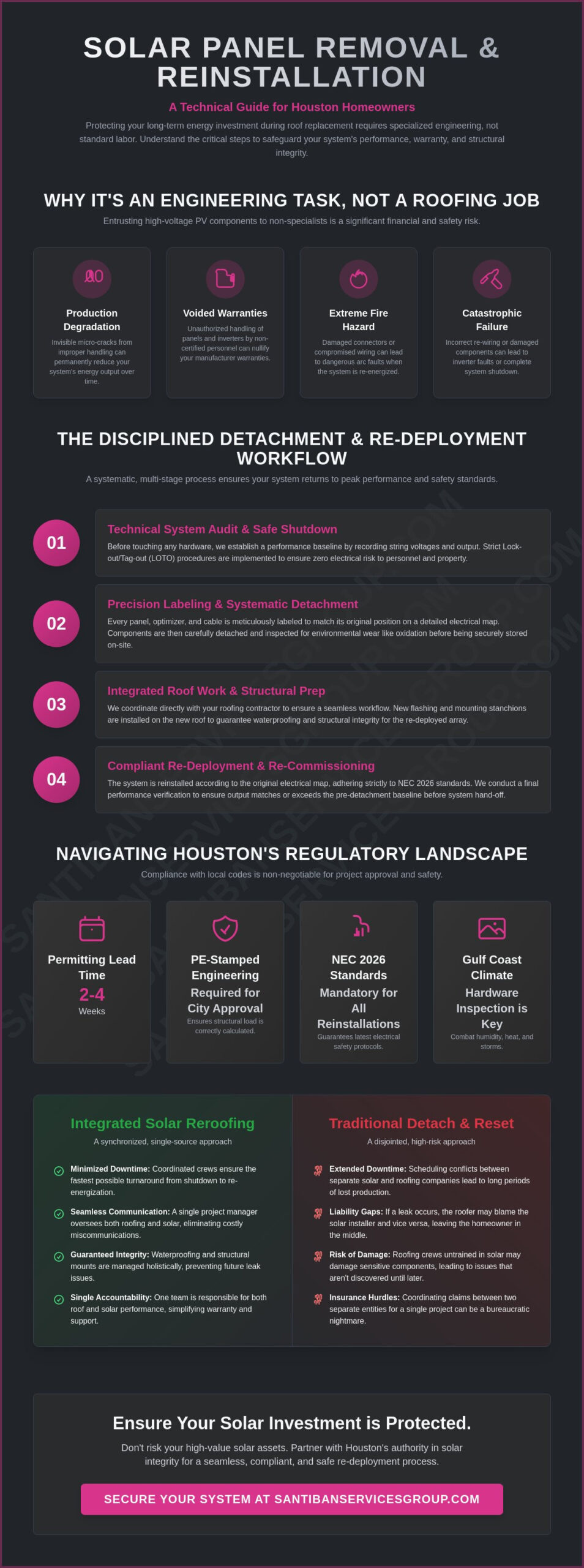
Improper handling during the transition period creates invisible liabilities. Micro-cracks in the silicon cells often occur when modules are stacked incorrectly or subjected to uneven pressure. These defects aren’t visible to the naked eye but significantly degrade energy production over time. Additionally, unauthorized handling can void manufacturer warranties on Tier 1 panels and inverters, leaving you unprotected against future equipment failure. The most severe risk involves fire hazards. Damaged MC4 connectors or compromised wire insulation can lead to arc faults once the system is re-energized. Professional reinstallation ensures that every connection meets the 2026 National Electrical Code (NEC) safety requirements.
The Detachment and Re-deployment Process
The transition from an existing roof to a new structural surface requires a disciplined engineering workflow. Precision in the detachment phase is the only way to guarantee that the system returns to its peak efficiency after the roofing project concludes. Every component, from the high-voltage modules to the intricate communication cables, must be handled with the same care applied during the original installation. A systematic approach ensures that the solar panel removal and reinstallation Houston residents expect is executed without compromising the long-term viability of the technology.
Step 1: Technical System Audit and Shutdown
Before any hardware is moved, technicians establish a performance baseline. This involves recording string voltages and verifying current AC/DC output against historical production data. We identify damaged hardware or thermal anomalies before the removal begins to ensure clear accountability for the system’s health. Safety remains the highest priority, which is why we implement strict Lock-out/Tag-out (LOTO) procedures for all industrial and residential sites. This protocol prevents accidental energization, protecting both the electrical infrastructure and the personnel on the roof. By adhering to established Solar Installation Standards, we provide a documented performance benchmark for the post-installation phase.
Precision labeling follows the shutdown. Each module, optimizer, and micro-inverter is tagged to correspond with its original position on the racking. This ensures the electrical map remains consistent during re-deployment, which is essential for maintaining the accuracy of your monitoring software. We don’t just dismantle the array; we map it for an exact reconstruction.
Step 2: Safe Detachment and Secure Storage
The physical removal process utilizes specialized tools designed to eliminate mechanical stress on the frames and glass. Improper detachment can cause hairline fractures that lead to hotspots and eventual module failure. Once removed, panels are stored in vibration-free, climate-controlled environments to prevent environmental degradation. We also protect the delicate mounting rails and flashing during this period, ensuring that every piece of hardware is ready for a seamless re-deployment on the new roof deck.
After the new roof is installed, we execute the re-deployment phase with meticulous attention to the original electrical layout. Our team conducts a final post-installation commissioning to validate that your system meets all regulatory requirements and delivers the expected energy output. If you are currently planning a roofing project, coordinating with certified solar electrical specialists early in the process will minimize downtime and preserve your system’s longevity. This professional validation is the final step in securing your energy independence for the next decade of production.
Integrated Solar Reroofing vs. Traditional Detach-and-Reset
Traditional solar panel removal and reinstallation Houston projects often suffer from fragmented communication between separate contractors. When a roofing company and a solar installer operate independently, the property owner frequently faces conflicting timelines and technical discrepancies. A unified engineering strategy eliminates these friction points by aligning the structural requirements of the roof deck with the electrical demands of the PV system from the start. This synchronized approach ensures that the transition from old shingles to a new structural surface is handled with industrial precision.
The Unified “Solar Reroof” Strategy
Adopting tesla and solar roof solutions provides a superior level of weatherproofing compared to disjointed, multi-contractor services. This integrated methodology ensures that every mounting penetration is sealed according to rigorous roofing standards while simultaneously meeting all electrical safety codes. It effectively removes the risk of “finger-pointing” between crews; a single firm remains accountable for both the roof’s waterproof seal and the array’s energy performance. For properties utilizing advanced storage, coordinating with a Tesla Powerwall 3 installation during the reroofing phase allows for cleaner conduit runs and optimized electrical panel placement, resulting in a more resilient and aesthetically unified system.
Cost-Efficiency of Integrated Services
Consolidating these specialized services into a single firm significantly reduces overall project timelines and redundant mobilization fees. Instead of two separate crews scheduling around each other’s availability, a synchronized team manages the entire workflow. This efficiency is particularly valuable for commercial projects where administrative overhead and energy downtime can impact the bottom line. Following official guidance on solar permitting is much simpler when the engineering design accounts for both the new roofing material and the structural load of the panels simultaneously.
Integrated services also offer a unique opportunity to optimize the array layout during the reinstallation phase. As technology evolves, the way we position modules can be adjusted to maximize ROI based on current shading patterns or new building obstructions. We don’t just put the panels back where they were; we evaluate the site to ensure your redeployed system performs with peak efficiency on its new structural foundation. This holistic view of energy and structure ensures that your investment remains protected for the next several decades of production.
Navigating Permits, PE-Stamps, and Insurance Claims
Houston’s regulatory environment for renewable energy is rigorous and requires disciplined adherence to municipal codes. Many property owners assume that because a system was previously permitted, the re-deployment process is exempt from further oversight. This is an incorrect assumption. The Houston Permitting Center requires new structural permits for the reinstallation phase to verify that the replacement roof deck meets current wind load and weight-bearing standards. Professional solar panel removal and reinstallation Houston services ensure that these administrative hurdles are cleared before the first tool touches the roof, preventing costly stop-work orders or grid disconnection.
Securing these permits in 2026 involves more than just submitting a basic application. Authorities now require updated electrical diagrams that reflect the latest NEC 2026 safety standards. This includes specific calculations for rapid shutdown systems and updated grounding requirements. Failing to secure the proper documentation can lead to significant delays in utility interconnection with providers like CenterPoint Energy, which typically takes an additional two to four weeks after the physical work is complete.
The Critical Role of PE-Stamped Engineering
In Houston, systems exceeding 10kW typically require professional engineering validation to proceed with city approval. Utilizing PE stamped engineering for solar systems is the only way to verify that your new roof structure can safely support the dead load of the existing array. These engineers provide the structural calculations necessary to prove that the mounting points won’t compromise the building’s integrity under extreme weather conditions. For commercial facilities, this stamped documentation is a non-negotiable prerequisite for maintaining insurance coverage and securing grid re-connection after a major reroofing project.
Maximizing Insurance Coverage for Solar Removal
Insurance adjusters often view “detach and reset” as a secondary expense, but it’s a critical component of a comprehensive storm restoration claim. To document hail damage for an insurance supplement, provide high-resolution, timestamped photographs of fractured glass and dented frames alongside a production report showing localized energy drops. We work directly with adjusters to ensure that the technical costs of decommissioning and redeploying your system are fully accounted for in the claim. An itemized technical quote, detailing the specialized labor and engineering fees, is essential for securing approval for these high-value electrical services. Secure your project’s compliance by partnering with our industrial electrical specialists for a comprehensive technical assessment.
Santiban Services Group: Houston’s Authority in Solar Integrity
Santiban Services Group operates as a stable, authoritative partner for clients requiring sophisticated energy solutions. With over 24 years of experience in industrial electrical construction and solar technology, we bring a level of technical rigor that standard residential contractors often lack. We position ourselves as a silent engine for our clients, providing the competent and organized force necessary to keep complex operations running smoothly. Managing a solar panel removal and reinstallation Houston project requires an engineering-first mindset that prioritizes the structural and electrical integrity of your property above all else.
Our approach is rooted in reliability and corporate stability. We understand that a solar array represents a significant capital investment, and its redeployment must be handled with disciplined precision. By utilizing in-house PE-stamped engineering design, we eliminate the operational gaps that occur when third-party firms are involved. This unified structure allows us to maintain absolute control over every detail, from the initial system audit to the final utility interconnection. We value long-term relationships and consistent performance, ensuring that your system returns to full production with zero damage and full warranty preservation.
Why Houston Property Owners Choose Santiban
Houston’s unique climate and evolving building codes demand a specialized level of expertise. Our personnel are not just laborers; they are highly trained specialists with deep experience in the Gulf Coast’s specific environmental challenges. We provide direct access to Tesla-certified technicians for Tesla Powerwall 3 and Powerwall + installations, as well as EcoFlow Battery Backup systems. This technical depth allows us to solve complex organizational challenges that arise during large-scale reroofing projects. Our industrial-grade electrical capabilities ensure that every project meets the highest standards of safety and structural precision, regardless of the system’s scale or complexity.
Request Your Strategic Project Consultation
A successful reroofing project begins with a methodical technical audit. We guide our clients through a seamless transition from the initial decommissioning of their solar assets to the final commissioning on a new structural foundation. Whether you are managing a residential property or a large-scale industrial facility, our team provides the predictable and factual support required for a successful outcome. We focus on a recurring promise of execution precision, ensuring that your transition to a new roof is handled with professional sobriety and technical excellence. Contact Santiban for expert solar reroofing in Houston to begin your project with a comprehensive technical assessment.
Securing Your Energy Infrastructure for the Next Decade
Managing the lifecycle of a photovoltaic system requires a commitment to technical precision and structural integrity. Successful solar panel removal and reinstallation Houston projects depend on a disciplined approach to both electrical safety and municipal compliance. It’s this commitment to technical safeguards that ensures your energy assets continue to perform at their peak production baseline long after the roofing project is complete. By prioritizing professional oversight, you eliminate the risks of micro-cracks, voided warranties, and structural failure.
Santiban Services Group provides the industrial expertise necessary to manage these complex operational transitions. Our team leverages 24+ years of industrial electrical experience to deliver customized results for every client. With in-house PE-stamped engineering and Tesla-certified installers, we provide a unified solution that bridges the gap between roofing and renewable energy. Secure your solar investment with Santiban’s professional detachment and reinstallation services. Your transition to a more resilient energy future starts with a foundation of professional engineering.
Frequently Asked Questions
Do I need a permit to reinstall my solar panels in Houston?
Yes, the Houston Permitting Center requires a new structural permit to reinstall panels after a roof replacement. This process ensures the new roof deck meets current wind load and weight-bearing standards. For systems over 10kW, a PE-stamped engineering design is mandatory for city approval. Securing these permits before work begins prevents legal complications and ensures your system remains compliant with 2026 municipal codes.
Will removing my solar panels void the manufacturer warranty?
Removing solar panels can void manufacturer warranties if the work isn’t performed by certified technicians. Most Tier 1 manufacturers require documented handling by licensed electrical professionals to maintain coverage on modules and inverters. Professional solar panel removal and reinstallation Houston services protect your investment by adhering to strict manufacturer-approved protocols. This documentation is essential if you need to file an equipment claim in the future.
How long does the solar removal and reinstallation process take?
The physical removal and reinstallation typically takes one to three days, but the administrative process is longer. Permitting in Houston usually requires two to four weeks for approval. After reinstallation, utility interconnection with CenterPoint Energy can take an additional two to four weeks. Coordinating these phases early helps minimize the downtime of your energy production and ensures a predictable project schedule.
Can my roofing company remove the solar panels for me?
Standard roofing crews should not handle high-voltage PV components. While they are experts in waterproofing, they lack the specialized training for safe DC/AC disconnection and system commissioning. Entrusting solar assets to non-specialists risks electrical fires, micro-cracks in the cells, and physical injury. Professional electrical contractors ensure that every connection meets the latest safety standards while protecting the integrity of your new roof.
What happens to my solar production while the panels are removed?
Solar energy production ceases entirely while the panels are detached from the roof. Your property will rely solely on the utility grid or battery backup systems like a Tesla Powerwall 3 during this period. We prioritize efficient scheduling to ensure the system is offline for the shortest time possible. Once reinstalled and commissioned, the system returns to its baseline performance levels and resumes its normal energy output.
Is it better to replace my solar panels when I replace my roof?
If your panels are over 15 years old, it’s often more cost-effective to replace them rather than pay for reinstallation. Newer modules offer significantly higher efficiency and better integration with modern battery storage. However, if your system is relatively new and performing well, re-deployment is the standard choice. A technical audit helps determine which path maximizes your long-term return on investment based on current energy needs.
Does insurance cover the cost of solar panel removal and reinstallation?
Insurance policies typically cover the cost of solar panel removal and reinstallation if the roof replacement is triggered by a covered event like hail or storm damage. You must provide an itemized technical quote to your adjuster to ensure these specialized labor costs are included in the settlement. Documenting the system’s health before removal is a critical step for securing claim approval and maximizing your coverage for the project.
How are solar panels stored safely during a roof replacement?
Panels must be stored in secure, vibration-free environments to prevent environmental degradation and physical damage. Stacking modules incorrectly can lead to micro-cracks that aren’t visible but reduce energy output over time. We utilize specialized crates and climate-controlled storage solutions to safeguard your assets while the roofing project is underway. This methodical care ensures the hardware remains in peak condition for its eventual re-deployment on your new roof.