
Between 2020 and 2024, Texas electricity prices surged by 28%, leaving Houston homeowners vulnerable to both escalating monthly bills and the persistent threat of CenterPoint grid outages. You likely recognize that energy independence is no longer a luxury but a strategic necessity for maintaining a stable, functioning household. Understanding the Tesla Powerwall 3 cost Houston residents face in 2026 is the first step toward securing that stability, especially since the 30% federal tax credit expired on December 31, 2025. While the incentive landscape has shifted, the requirement for reliable backup power remains a critical priority for property management and residential safety.
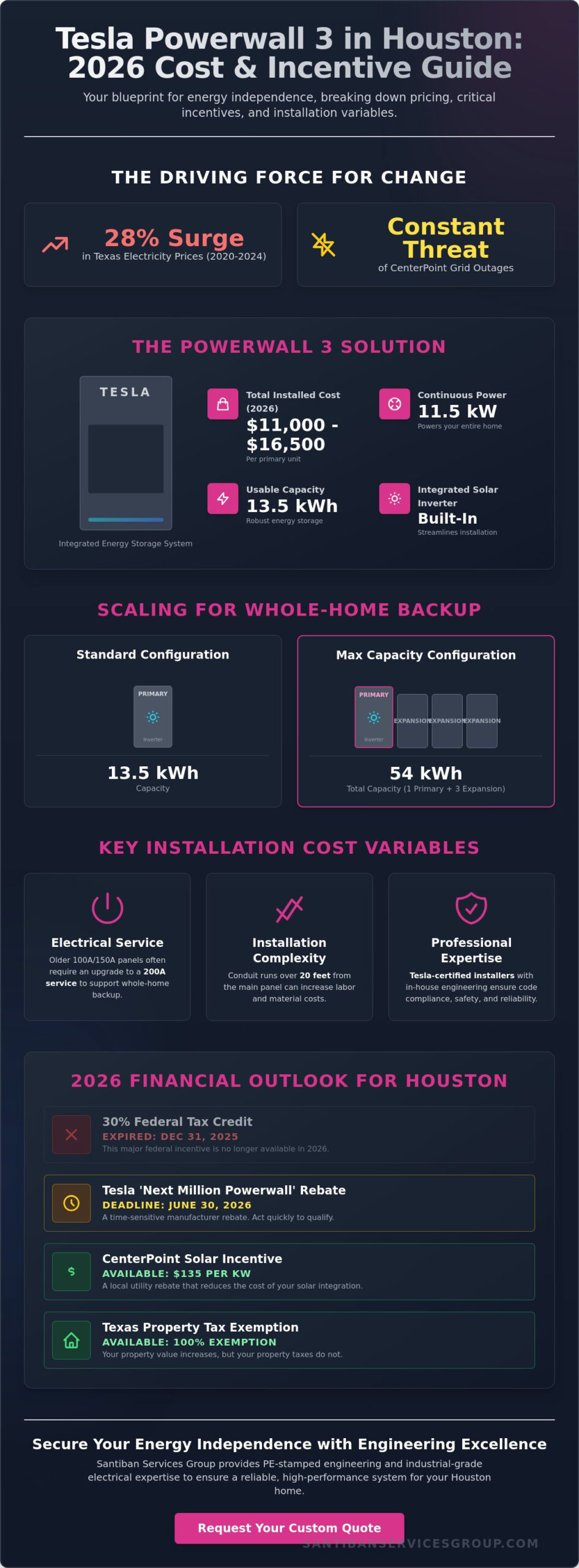
This guide provides a meticulous breakdown of current pricing, which typically ranges from $11,000 to $16,500 per unit. We’ll explore how to leverage the Tesla Next Million Powerwall rebate before the June 30, 2026 deadline and maximize the CenterPoint solar incentive of $135 per kW. You’ll gain a comprehensive understanding of installation variables, Texas property tax exemptions, and the engineering precision required for a seamless, code-compliant backup system. We’ll show you how to transform unpredictable utility expenses into a controlled, high-performance infrastructure investment through tailored energy solutions.
Key Takeaways
- Understand the 2026 pricing model for hardware and expansion units to accurately estimate the total Tesla Powerwall 3 cost Houston residents should budget for their energy infrastructure.
- Identify critical infrastructure requirements for Houston homes, such as 200A service entry upgrades and the necessity of PE-stamped engineering for municipal permit approval.
- Analyze the financial impact of current local incentives, including the CenterPoint solar rebate and the 100% Texas property tax exemption for renewable energy systems.
- Quantify the long-term ROI of battery storage by evaluating peak shaving strategies and the mitigation of secondary costs associated with frequent grid outages.
- Discover how industrial-grade electrical expertise and in-house engineering design streamline the installation process while ensuring superior system reliability and safety.
Tesla Powerwall 3 Pricing in Houston: 2026 Market Overview
The 2026 energy market in Southeast Texas demands a shift from reactive repairs to proactive infrastructure investments. A primary concern for property owners is the Tesla Powerwall 3 cost Houston installers quote for a standard residential configuration. As of May 2026, the estimated installed cost for a single unit typically ranges from $11,000 to $16,500. This pricing reflects a sophisticated hardware package that includes a high-capacity 11.5 kW integrated solar inverter. This feature distinguishes the Powerwall 3 from the previous Powerwall 2 and Powerwall + generations, which often required separate inverter hardware. By consolidating these components into a single chassis, Tesla reduced the physical footprint and simplified the electrical architecture for Houston homes.
You can review detailed Tesla Powerwall specifications to understand how these technical advancements compare to earlier lithium-ion storage solutions. The Powerwall 3 offers a usable capacity of 13.5 kWh, providing a robust foundation for energy independence. Unlike previous models, the integrated design allows for a more efficient DC-coupled installation, which minimizes energy loss during the conversion process. This efficiency is a critical factor for Houston residents aiming to maximize their solar self-consumption in a market without statewide net metering. Professional engineering ensures that these hardware components work in harmony with your existing electrical system.
Hardware vs. Total System Cost
While the base unit represents the core of the investment, the total invoice involves several essential components. The Gateway 3 serves as the system’s intelligence, managing the transition between grid power and battery backup during CenterPoint outages. In 2026, global supply chain stability has largely normalized hardware rates, yet the unit price rarely reflects the final project cost. Understanding the comprehensive Tesla Powerwall 3 cost Houston residents face involves analyzing both hardware and labor variables. Communication hardware, mounting equipment, and the Gateway itself are mandatory for a code-compliant installation. These elements ensure the system functions as a unified energy hub capable of managing complex loads during extreme weather events.
Expansion Units: Scaling for Whole-Home Backup
For Houston estates with higher peak loads or larger square footage, the Powerwall 3 introduces a cost-effective scaling model through expansion units. These units lack the integrated inverter found in the primary unit, which significantly reduces the cost-per-kWh for multi-battery configurations. You can stack up to four expansion units behind a single primary Powerwall 3, creating a massive energy reservoir tailored to your specific requirements. A second full unit is typically only necessary if your home’s peak power demand exceeds the 11.5 kW output of a single inverter. For most residential applications, the expansion unit strategy provides a superior balance of capacity and financial efficiency while maintaining a streamlined installation process.
Variables Influencing Installation Costs in Southeast Texas
While hardware expenses are relatively standardized, the actual Tesla Powerwall 3 cost Houston homeowners encounter is largely dictated by the existing electrical infrastructure of the property. Older residences in established neighborhoods often feature 100A or 150A main service panels. These systems are insufficient for the 11.5 kW output of the Powerwall 3; they typically require a comprehensive 200A service entry upgrade to support whole-home backup. This technical necessity ensures the home can safely handle the simultaneous load of air conditioning units and high-capacity battery charging. Beyond panel capacity, the physical distance between your main breaker and the battery mounting location influences labor and material costs. Installations exceeding 20 feet of conduit run require additional specialized wiring and labor hours to maintain voltage stability.
Labor specialization represents another critical variable. While general electricians may offer lower base rates, they often lack the proprietary diagnostic tools and specific training required for Tesla’s ecosystem. Choosing a team with the correct certifications prevents technical errors that could void equipment warranties or lead to system inefficiencies. It is also essential to recognize that the 30% Federal Residential Clean Energy Credit officially expired for new installations on December 31, 2025. Consequently, 2026 project budgets must prioritize local rebates and the 100% Texas property tax exemption to maximize the financial performance of the system.
Infrastructure and Main Lug Upgrades
The choice between “essential-loads” and “whole-home” backup significantly impacts the final invoice. Essential-loads wiring involves a critical circuits subpanel, which is less labor-intensive but limits your power availability during a storm. Conversely, whole-home backup requires a meticulous integration with the main lug. For detached garages, trenching costs can vary based on soil conditions and the length of the run. Securing structural integrity during this process is paramount. Utilizing PE stamped engineering for solar systems ensures that your mounting location and electrical pathways meet stringent local wind-load and safety requirements.
Permitting and Administrative Fees in Houston
Administrative logistics represent a significant portion of the project timeline and budget. City of Houston and Harris County permitting fees for 2026 are calculated based on the total project valuation, and these “soft costs” include the preparation of technical documentation and engineering designs. Working with certified Tesla Powerwall installers eliminates the technical errors that often lead to permit rejections and costly delays. These professionals manage the entire submission process, ensuring your system is code-compliant from the initial filing. If you are planning a complex installation, reviewing our industrial-grade engineering services can help you identify potential infrastructure hurdles before construction begins.
2026 Financial Outlook: Incentives, Rebates, and Tax Credits
The financial landscape for residential energy storage underwent a significant transformation on January 1, 2026. While many property owners still anticipate the 30% credit, the Federal Home Energy Tax Credits for new battery installations officially expired at the end of 2025. This shift requires a more analytical approach to calculating the total Tesla Powerwall 3 cost Houston residents must manage. The focus has transitioned from federal tax relief to localized grants and state-level resiliency funds. Texas now prioritizes the Backup Power Package initiative, which supports the deployment of distributed energy resources to stabilize the ERCOT grid during peak demand periods.
Harris County residents benefit significantly from the 100% property tax exemption provided under Texas law. This statute ensures that the appraised value added to your home by a solar-plus-storage system is entirely exempt from property taxes. For a high-end installation, this represents a substantial long-term saving that offsets the initial capital expenditure. Additionally, the CenterPoint Energy solar incentive provides approximately $135 per kilowatt of installed solar capacity. Because this is an installer-facilitated rebate, our team applies these savings directly to your project cost, ensuring a more efficient allocation of your capital. This meticulous approach to financial planning ensures that every available dollar is leveraged to improve your system’s ROI.
Utility-Scale Virtual Power Plants (VPP)
One of the most effective ways to mitigate the long-term tesla electric costs is through Virtual Power Plant participation. By enrolling in the Tesla Electric retail plan, Houstonians can receive compensation for sharing their stored energy with the grid during critical periods. These grid support services provide a predictable revenue stream within the ERCOT market, often yielding several hundred dollars in annual earnings depending on discharge frequency. This integrated approach transforms your battery from a passive backup device into an active financial asset that supports regional grid stability while reducing your net electricity expenditure.
Local Rebate Programs and Financing
Manufacturer-direct incentives remain a vital component of the 2026 pricing strategy. The Tesla “Next Million Powerwall” rebate offers $500 per Powerwall 3 unit, capped at $1,000 for a dual-battery system. To qualify for this Virtual Visa Reward Card, you must complete your order by June 30, 2026, and finalize installation by December 31, 2026. Many clients choose to maximize their site mobilization by reviewing the ev charger installation cost when bundling services. Combining these infrastructure upgrades into a single project timeline reduces redundant labor fees and streamlines the permitting process for a more cost-effective total investment.
Calculating ROI: Grid Resilience vs. Outage Costs
The total Tesla Powerwall 3 cost Houston homeowners invest today is balanced against the escalating “Cost of Darkness” experienced during Southeast Texas hurricane seasons. Financial performance extends beyond simple utility savings; it encompasses the mitigation of secondary expenses such as emergency hotel stays and significant food spoilage. For a household managing a standard refrigerator and deep freezer, a single multi-day outage can result in over $500 in lost perishables alone. When you factor in the average $250 nightly rate for local hospitality during regional emergencies, the value of a seamless backup system becomes mathematically clear. This infrastructure provides a predictable environment where your family’s routine remains undisturbed by CenterPoint grid instability.
Longevity is a cornerstone of this investment. Tesla provides a 10-year warranty that guarantees the system will retain at least 70% of its capacity over a decade of operation. This protection ensures that your capital remains productive well into the 2030s. Unlike traditional mechanical systems, the Powerwall 3 requires zero scheduled maintenance and operates without the ongoing fuel costs associated with combustion engines. It’s a “set and forget” solution that delivers consistent performance through every seasonal peak. To ensure your system is optimized for maximum longevity, you can schedule a technical consultation with our engineering team.
Peak Shaving and Energy Arbitrage
In March 2026, electricity rates for CenterPoint customers in Houston averaged $0.14 per kWh. However, many Retail Electric Providers (REPs) utilize Time-of-Use (TOU) structures that penalize afternoon consumption. The Powerwall 3 uses “Peak Shaving” to discharge stored energy during these expensive windows, effectively shielding you from the highest rates. For a typical 2,500 sq ft Houston home, this strategy can reduce monthly energy expenditures by 15% to 25%. Additionally, the system’s integrated “Storm Watch” mode automatically monitors ERCOT alerts. If a grid emergency is detected, the battery prioritizes a full charge to ensure you have maximum backup capacity before the first raindrop falls.
Property Value and Market Differentiation
2026 real estate trends indicate that energy-independent homes in Texas command a significant market premium. Buyers increasingly prioritize properties with established resilience infrastructure over those with standard utility connections. Integrating tesla and solar roof combinations maximizes property appraisal by offering a unified, aesthetically superior energy solution. When compared to noisy, maintenance-heavy gas generators, a silent battery backup system represents a sophisticated upgrade that appeals to high-end buyers. It transforms a standard residence into a high-performance asset that stands out in a competitive Houston housing market.
The Santiban Advantage: Engineering Excellence in Houston
The successful deployment of energy infrastructure depends entirely on the precision of the initial engineering design. While many providers approach battery storage as a simple appliance installation, Santiban Services Group treats every project as a critical electrical construction mission. Our industrial-grade expertise ensures that your home’s electrical architecture is not just functional, but resilient enough to withstand the specific environmental challenges of Southeast Texas. By maintaining in-house PE-stamped engineering capabilities, we eliminate the common technical errors and permitting delays that often inflate the total Tesla Powerwall 3 cost Houston property owners face when working with less specialized contractors. This proactive approach to project management ensures your system meets the highest standards of safety and regulatory compliance.
Single-source accountability is the foundation of our corporate stability. We manage every phase of the project, from initial solar reroofing to the final commissioning of the battery system. This integrated approach ensures that no detail is overlooked and that every component performs according to its exact design specifications. Our clients value this disciplined methodology, as it provides a predictable project timeline and a superior level of safety for their families and properties. We operate as a silent engine in the background, ensuring your home’s energy system runs smoothly while you focus on your daily life. This commitment to reliability is what distinguishes a Santiban installation from a standard residential service.
Meticulous Technical Standards
Our technical process begins with a comprehensive evaluation of your home’s load profile. We analyze peak demand periods and seasonal energy fluctuations to determine the optimal configuration for your Powerwall 3. This rigorous standard of care is rooted in our extensive experience with commercial ev charger installation and industrial electrical construction. We apply the same meticulous attention to detail to residential backup systems that we do to large-scale facility management projects. This focus on “excellence in every detail” ensures your system is fully optimized during the commissioning phase, providing reliable power when the CenterPoint grid fails.
Tailored Energy Solutions
Every Houston property has unique energy requirements that demand a customized approach. Whether we are integrating a Powerwall 3 with an existing solar array or designing a new, high-performance solar-plus-storage system, our solutions are always tailored to the specific needs of the client. We prioritize long-term reliability and consistent performance, delivering factual data and professional results instead of marketing hype. Our dedicated teams handle complex logistical challenges with quiet confidence and professional clarity. To secure your home’s energy future with a professional-grade installation, Schedule a professional consultation with Santiban Services Group today for a comprehensive site evaluation.
Achieving Energy Resilience Through Professional Infrastructure
Houston’s energy landscape in 2026 requires a transition from reactive measures to disciplined, engineering-first solutions. While the expiration of the federal clean energy credit on December 31, 2025, shifted the financial outlook, the combination of CenterPoint incentives and Texas property tax exemptions maintains a strong ROI. Navigating the Tesla Powerwall 3 cost Houston residents encounter involves more than just hardware; it’s about finding a partner who understands the industrial-grade electrical requirements of Southeast Texas. Our meticulous approach ensures your investment is protected by superior technical standards and long-term reliability.
Santiban Services Group brings 24+ years of industrial electrical experience and in-house PE-stamped engineering design to every residential project. Our Tesla-certified installers ensure your system is meticulously integrated for seamless performance during the next grid emergency. Secure Your Houston Home with a Tesla Powerwall 3 Quote from Santiban and transform your property into a high-performance, energy-independent asset. We’re the silent engine that keeps your household running smoothly through every storm. Your journey toward predictable energy costs and superior safety starts with a commitment to excellence in every detail.
Frequently Asked Questions
How much does a Tesla Powerwall 3 cost in Houston with installation?
The total Tesla Powerwall 3 cost Houston residents should budget for typically ranges from $11,000 to $16,500 per unit. This comprehensive figure includes the primary hardware, the Gateway 3 intelligence hub, and professional labor. Final pricing depends on your property’s electrical complexity and whether you’re integrating the battery with a new solar array. Meticulous site evaluations are necessary to provide a fixed-price proposal tailored to your specific infrastructure.
Is the 30% Federal Solar Tax Credit still available for Powerwall 3 in 2026?
No, the 30% Residential Clean Energy Credit is no longer available for systems installed after December 31, 2025. Homeowners must now rely on localized incentives, such as the 100% Texas property tax exemption and manufacturer-direct rebates. These state-level benefits help maintain the financial viability of energy storage projects in the post-tax credit market. We prioritize identifying every available local grant to optimize your project’s ROI.
Can a single Powerwall 3 run my Houston home’s AC unit?
A single Powerwall 3 provides 11.5 kW of peak power, which is sufficient to start and run most high-efficiency central air conditioning units in Houston. However, the 13.5 kWh usable capacity determines how long that AC can operate during an outage. For whole-home backup during extended summer grid failures, we often recommend a multi-unit configuration. This ensures your HVAC system doesn’t deplete the energy reservoir prematurely during critical periods.
What is the difference between Powerwall 3 and Powerwall 2 in terms of cost?
The primary cost difference lies in the Powerwall 3’s integrated solar inverter, which eliminates the need for separate hardware required by the Powerwall 2. While the base unit price for the newer model reflects this advanced technology, the total system invoice is often more efficient due to reduced component counts. This consolidated architecture simplifies the installation process and minimizes potential points of failure within your home’s energy hub.
Does Houston offer any local rebates for battery backup systems?
Houston residents served by CenterPoint Energy can access a solar incentive of approximately $135 per kW of installed capacity. Additionally, Tesla is currently offering a “Next Million Powerwall” rebate of $500 per unit for orders placed by June 30, 2026. These programs, combined with the 100% property tax exemption for added home value, provide a robust financial framework for 2026 installations within Harris County.
How long is the wait time for Powerwall 3 installation in Harris County?
The typical timeline for a Powerwall 3 installation in Harris County ranges from four to eight weeks from the date of contract signing. This period includes the time required for PE-stamped engineering design and municipal permit approval through the City of Houston. Our dedicated teams manage these administrative logistics to prevent delays and ensure a seamless transition to energy independence before the peak hurricane season.
Do I need a solar panel system to install a Tesla Powerwall 3?
You don’t need a solar panel system to install a Powerwall 3, as it functions effectively as a standalone grid-tied backup solution. It will charge from the grid when rates are low and discharge during outages or peak demand periods to reduce costs. However, the system’s integrated inverter is specifically optimized for solar-plus-storage configurations. Pairing the two technologies delivers the highest level of long-term energy resilience and grid independence.
What happens to the Powerwall cost if I need a main panel upgrade?
Requiring a main panel upgrade will increase the total Tesla Powerwall 3 cost Houston installers quote, as it involves significant infrastructure work. Many older Houston homes require a transition to a 200A service entry to safely manage the 11.5 kW power output of the Powerwall 3. This upgrade is a critical safety requirement that ensures your home’s electrical system remains code-compliant and capable of supporting modern energy demands.