
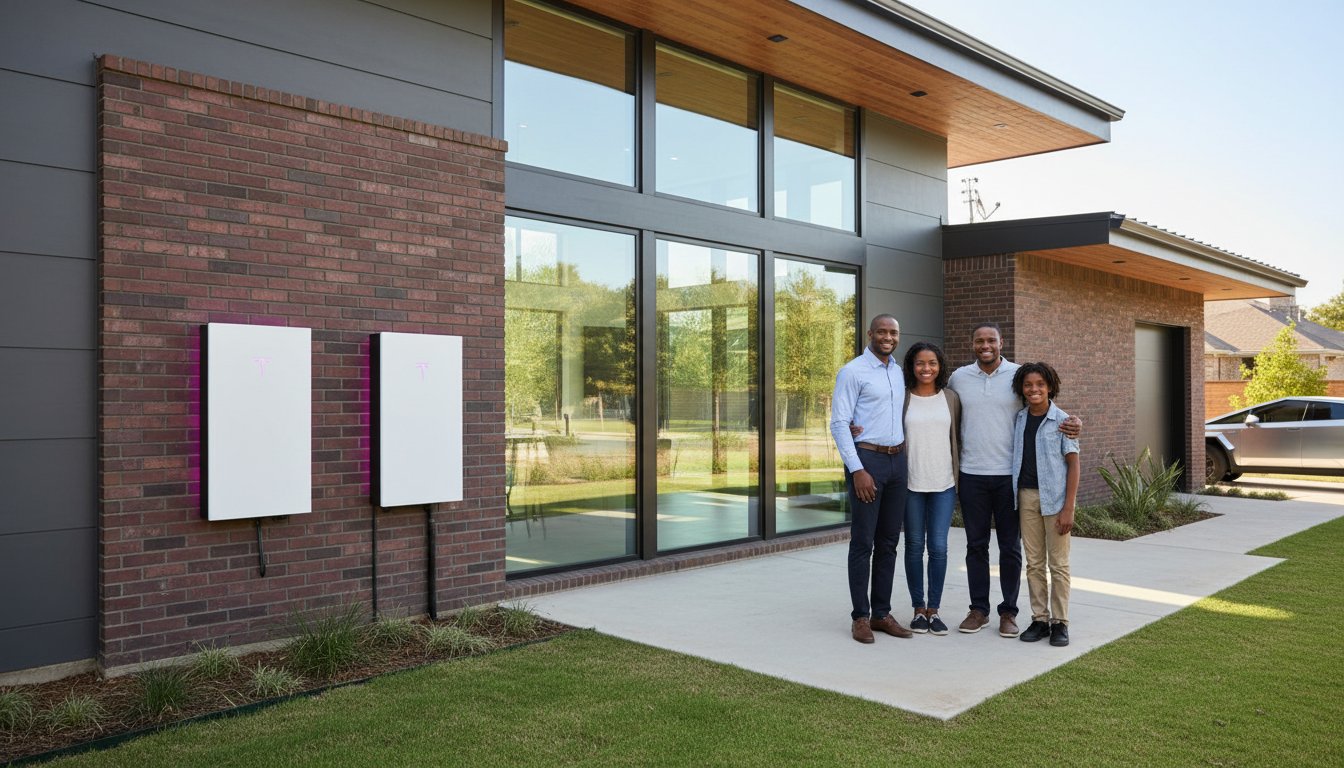
In 2024, the Greater Houston area recorded a 23% increase in grid-related service interruptions compared to the previous year. You recognize that maintaining a standard connection to the Texas grid is no longer a sufficient strategy for protecting your home’s operational continuity or your family’s comfort. This guide provides the technical precision and regulatory clarity required to implement a tesla solar power battery system that delivers absolute energy autonomy.
We’ll outline the specific engineering advantages of the Powerwall 3, clarify the critical hardware distinctions from its predecessors, and detail the meticulous PE-stamped documentation necessary for Houston’s unique permitting landscape. Our objective is to replace confusion with a structured, professional path toward resilience. You’ll gain a comprehensive understanding of how to secure a tailored energy solution that ensures your property remains powered during the next major weather event or infrastructure failure. Every detail of this guide is designed to provide the reliability and stability your household requires.
Key Takeaways
- Analyze the evolving ERCOT landscape and how integrated storage provides a definitive solution to Houston’s energy volatility through 2026.
- Explore the technical specifications of the Powerwall 3, including its 11.5 kW continuous power output and advanced MPPT configurations for optimized solar harvesting.
- Contrast the operational advantages of a tesla solar power battery with traditional gas generators to achieve silent, fuel-independent home resilience.
- Master the complex regulatory requirements of Harris County, focusing on the necessity of PE-stamped engineering for structural compliance and safety.
- Establish a framework for evaluating certified installers to protect your long-term investment through meticulous execution and comprehensive warranty adherence.
Tesla Solar Power Battery Systems: Solving Houston’s Energy Crisis
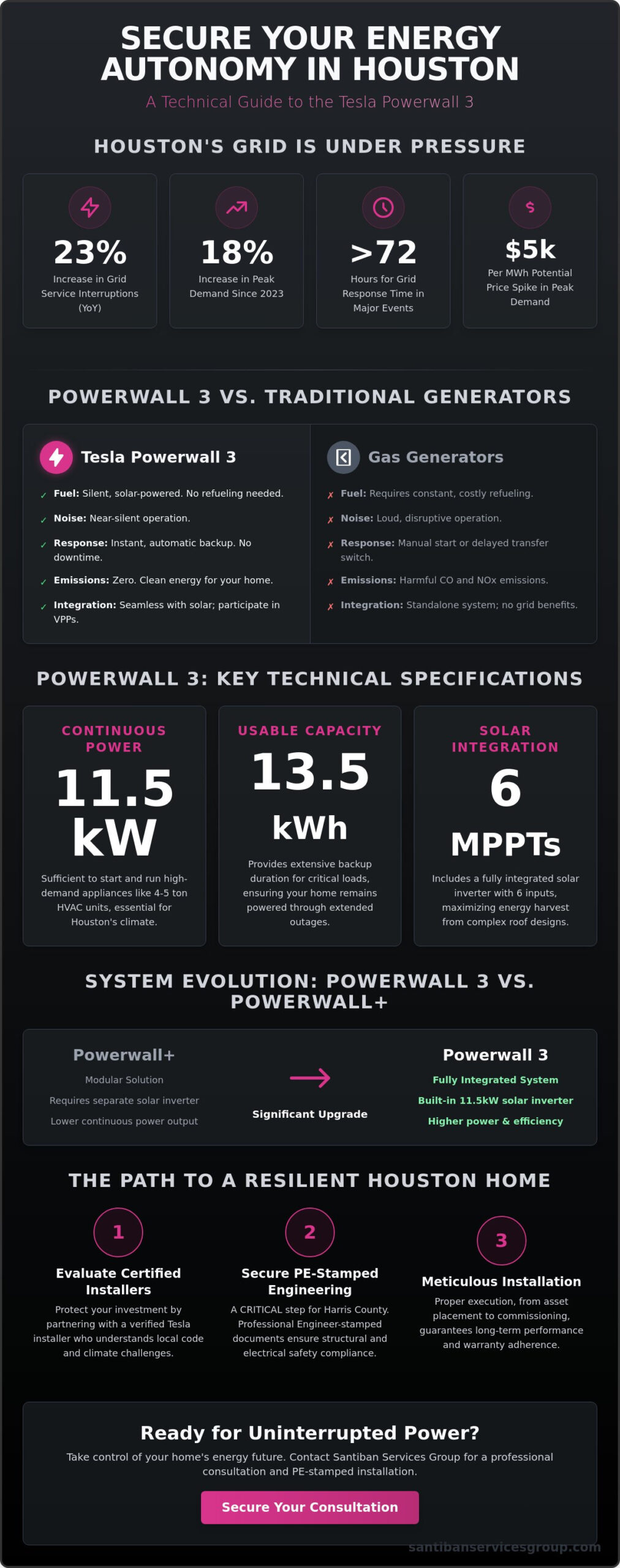
The ERCOT grid in 2026 remains under substantial pressure. Population growth in the Greater Houston area has increased peak demand by over 18% since 2023, leaving the centralized infrastructure vulnerable during thermal extremes. For the disciplined homeowner, a tesla solar power battery is no longer a luxury addition. It is a fundamental requirement for maintaining operational continuity. These systems provide a sophisticated buffer against a grid that frequently struggles with frequency regulation and load shedding during Houston’s intense summer months.
Reliability depends on more than just hardware; it requires a tailored approach to installation. Houston’s environmental conditions, characterized by 90% average morning humidity and seasonal hurricane threats, dictate meticulous placement of energy assets. We prioritize elevated, climate-controlled installations to protect the sensitive power electronics. The modern tesla solar power battery setup has evolved from a passive backup reserve into an active participant in the energy market. Through the Tesla Electric program, homeowners now transition from mere consumers to strategic partners in a decentralized virtual power plant.
Why Houston Homeowners are Prioritizing Energy Storage
Recent data from the 2024 derecho and subsequent hurricane landfalls confirmed that traditional grid response times often exceed 72 hours for residential neighborhoods. This delay creates significant risk for Houston families. By implementing Tesla electric in Houston, property owners secure a strategic ROI that offsets the volatile pricing found in the deregulated Texas market. During peak-demand events, wholesale electricity prices in the Houston zone can spike to $5,000 per megawatt-hour. Integrated storage allows you to avoid these costs by deploying stored energy when the grid is most expensive. This methodical approach to energy management ensures that your facility remains powered while your neighbors face rising costs and potential blackouts.
Powerwall 3 vs. Powerwall +: What is the Difference?
Choosing the correct hardware is essential for long-term performance. The Powerwall 3 features a fully integrated solar inverter, which simplifies the system architecture and improves round-trip efficiency. It offers a continuous power output of 11.5 kW, a significant upgrade over previous generations. This capacity is vital for Houston’s high-tonnage HVAC systems. Most 4-ton or 5-ton air conditioning units require substantial “locked rotor amps” to start; the Powerwall 3 handles these surges with superior precision.
When reviewing Tesla Powerwall technical specifications, the distinction in solar integration becomes clear. While the Powerwall + was a modular solution designed for retrofitting existing arrays, the Powerwall 3 is a comprehensive, single-source unit. It supports up to six solar inputs, allowing for complex roof designs common in Houston’s master-planned communities. This level of integration ensures a seamless transition between solar generation, battery storage, and home consumption without the latency issues found in fragmented, multi-brand systems.
Technical Specifications: Powerwall 3 Capacity and Performance
The Powerwall 3 represents a significant evolution in the tesla solar power battery ecosystem. It provides 13.5 kWh of usable energy capacity and a robust 11.5 kW of continuous power output. This output level allows a single unit to support major appliances, including three-ton air conditioning units, which are essential for Houston residences during peak demand periods. According to recent Texas energy consumption data, the state’s residential sector maintains some of the highest cooling loads in the country. The Powerwall 3 addresses this with 6 Maximum Power Point Trackers (MPPTs). These solar inputs allow for meticulous configuration on complex, multi-angled rooflines common in Houston’s master-planned communities. This flexibility ensures maximum energy harvest even when shading or architectural constraints limit direct sunlight on certain roof facets.
For large estates requiring comprehensive backup, the system scales seamlessly. Up to four units can be integrated into a single Gateway, providing 54 kWh of storage. This modularity ensures that Santiban’s technical teams can deliver a tailored energy solution that meets specific load requirements. The hardware operates efficiently in temperatures ranging from –4°F to 122°F. It maintains high performance during intense Texas heat waves through an active liquid thermal management system that regulates cell temperature with precision.
The Integrated Solar Inverter Advantage
The Powerwall 3 architecture features a fully integrated solar inverter. This design eliminates the need for external hardware mounted on the home’s exterior, resulting in a cleaner aesthetic. By utilizing DC-to-DC coupling, the system achieves higher round-trip efficiency compared to older AC-coupled models. Homeowners benefit from a streamlined installation with fewer points of failure. The unified system allows for proactive monitoring and simplified maintenance protocols. It represents a single-source solution for both energy storage and solar conversion, reinforcing the tesla solar power battery as a leader in integrated home energy technology.
LFP Battery Chemistry and Longevity
Tesla transitioned to Lithium Iron Phosphate (LFP) chemistry for its 2026 storage solutions. LFP is recognized for superior thermal stability and safety compared to traditional nickel-based chemistries. This is a critical factor for installations in high-temperature environments like Southeast Texas. LFP cells offer an extended lifecycle, typically maintaining 80% capacity after 10 years of daily cycling. The standard warranty guarantees performance, ensuring long-term reliability for Houston property owners who prioritize corporate-grade stability in their home infrastructure. This chemistry choice reflects a commitment to safety and meticulous engineering standards.
Tesla Powerwall 3 vs. Traditional Generators in Houston
Selecting the right backup solution requires a comparison between mechanical combustion and solid-state technology. Traditional standby generators produce noise levels often exceeding 70 decibels, which creates a constant disturbance in residential neighborhoods. The tesla solar power battery operates in near-total silence, providing a sophisticated power solution that complies with the strictest local noise ordinances. This silent operation is a hallmark of the quiet confidence Santiban Services Group brings to every installation.
Fuel logistics represent a critical failure point for Houston property owners. Standby generators rely on natural gas lines or on-site propane tanks. During major weather events like the 2021 winter storm, pressure drops in natural gas lines and delivery delays for propane left many systems inoperable. A solar-integrated battery eliminates this dependency by utilizing an inexhaustible, local energy source. It transforms your property into a self-reliant utility hub that doesn’t rely on external supply chains during a crisis.
Maintenance requirements further separate these two technologies. Mechanical generators require meticulous annual servicing, including oil changes, spark plug replacements, and battery health checks. The Powerwall 3 simplifies facility management through automated software updates. These over-the-air enhancements ensure the system’s logic remains current without the need for manual intervention or mechanical repairs.
- Instantaneous Transfer: Tesla’s internal switchgear detects grid failure and transitions to battery power in a fraction of a second. This prevents computer reboots and keeps security systems online.
- Zero Emissions: Unlike gas-powered units, batteries produce no carbon monoxide, allowing for safer placement near living spaces.
- Space Efficiency: The sleek, wall-mounted design of the Powerwall 3 preserves valuable ground space compared to the large footprint of a permanent generator.
Resilience During Extended Grid Outages
The primary advantage of a tesla solar power battery is its ability to recharge during a prolonged blackout. While a generator eventually runs out of fuel, solar panels replenish the battery capacity every morning. This creates a continuous cycle of power that can last indefinitely if managed correctly. Homeowners must prioritize critical loads to maximize this resilience. While the system easily manages lighting and medical equipment, high-draw assets like electric vehicle chargers or large pool pumps require a certified Tesla Powerwall installer in Houston to design a custom load-management strategy.
Total Cost of Ownership (TCO) Over 10 Years
The financial profile of a battery system is defined by higher upfront costs offset by zero operational expenses. Generators involve lower initial capital but incur cumulative costs through fuel consumption and professional maintenance contracts. Over a 10-year horizon, the integrated battery often proves more economical, especially when factoring in the lack of mechanical wear. The federal government provides substantial support for this transition to clean energy. The Residential Clean Energy Credit provides a 30% federal tax credit for solar battery systems installed through the 2026 tax year.
Houston Permitting and the Necessity of PE-Stamped Engineering
Houston’s regulatory landscape requires a disciplined approach to technical documentation. Harris County and the City of Houston Building Code Enforcement mandate professional engineering (PE) stamps for all high-capacity energy storage projects. This requirement ensures that every tesla solar power battery installation adheres to stringent safety protocols. Structural load-bearing analysis is a critical component of this process. A Tesla Powerwall 3 weighs 287 lbs; therefore, wall-mounted units require a verified structural assessment to confirm the mounting surface can sustain the weight over time. Floor-mounted configurations must comply with local flood-elevation requirements and specific anchoring standards. Beyond the physical structure, engineers must produce detailed electrical line diagrams. These documents demonstrate compliance with the 2023 National Electrical Code (NEC). Santiban delivers these comprehensive PE-stamped designs, providing the corporate stability and technical precision required for high-end residential projects.
Streamlining the Solar Permit Process in Texas
Administrative errors frequently derail renewable energy projects. In 2024, data indicated that 15% of Houston solar permit applications were rejected due to insufficient technical detail or non-compliant diagrams. Utilizing PE stamped engineering for solar systems mitigates these risks by providing a superior level of technical accuracy. This meticulous preparation accelerates the utility interconnection process with CenterPoint Energy. A complete and professional application package reduces the back-and-forth with utility engineers, leading to faster system activation and grid independence. Our dedicated teams ensure that every calculation is precise, facilitating a seamless transition from design to operation.
Solar Reroofing: Protecting Your Investment
Installing advanced energy systems on a compromised roof leads to avoidable expenses. If a roof is older than 12 years, homeowners should evaluate replacement options before mounting a tesla solar power battery array. The labor cost to remove and reinstall equipment for a roof repair often exceeds $3,000. Exploring Tesla and solar roof solutions offers a seamless, integrated approach to home protection. This method aligns roofing and solar warranties, ensuring that a single partner remains accountable for the system’s performance and the home’s structural integrity. It’s a proactive strategy for long-term resilience in the Texas Gulf Coast region. Santiban provides the tailored solutions necessary to integrate these complex systems without compromising aesthetic or functional standards.
Secure your energy future with a partner that values excellence in every detail. Consult with Santiban Services Group to begin your engineered solar solution.
Choosing a Certified Tesla Powerwall Installer in Houston
Selecting a contractor for a tesla solar power battery system requires a focus on technical certification and industrial-grade precision. Tesla mandates that only certified installers perform the setup to maintain the validity of their 10-year equipment warranty. This certification ensures that every component, from the Gateway to the battery modules, meets the manufacturer’s strict safety and performance specifications. A non-certified installation risks the integrity of the hardware and can lead to the denial of future warranty claims.
The Santiban Services Group applies industrial-scale expertise to residential energy projects. Our background in large-scale electrical infrastructure provides a level of technical depth that standard residential contractors rarely match. We provide PE-stamped designs for every project. This means a licensed Professional Engineer reviews and approves the structural and electrical plans, ensuring the system withstands Houston’s specific environmental challenges. Our transition from industrial construction to residential energy storage means your home receives the same meticulous attention to detail required for high-stakes commercial facilities.
What to Look for in a Houston Solar Contractor
Verification is the first step in protecting your investment. Homeowners should verify that any contractor holds a valid Texas Electrical Contractor License through the Texas Department of Licensing and Regulation. It’s also vital to confirm their familiarity with local utility requirements. In Houston, navigating the specific interconnection standards for CenterPoint Energy or Entergy is a complex process. We manage these administrative hurdles directly, ensuring your system complies with the latest 2026 grid regulations. Reliable contractors should provide specific data regarding storm performance from previous hurricane seasons, demonstrating how their systems functioned during extended outages.
The Santiban Services Group Commitment
Our history is built on high-capacity industrial electrical work and commercial EV infrastructure. We bring this “excellence in every detail” mantra to every tesla solar power battery installation. We don’t offer generic packages. We provide tailored energy resilience proposals based on your specific consumption patterns. Our dedicated teams prioritize safety and long-term reliability over rapid turnaround times. We operate as a single-source solution, managing everything from the initial load-profile analysis to final system commissioning.
- Site Assessment: We evaluate your property’s physical readiness for battery integration.
- Load-Profile Analysis: Our team reviews 12 months of utility data to size your system accurately.
- PE-Stamped Engineering: Every design undergoes professional engineering review for maximum safety.
- Utility Coordination: We handle all permitting and interconnection paperwork with Houston utilities.
The path to grid independence begins with a comprehensive technical evaluation. Contact The Santiban Services Group today to schedule a site assessment and receive a professional energy resilience proposal for your Houston home.
Architecting Your Energy Independence for 2026
Houston’s power landscape requires a shift toward resilient, independent infrastructure. The tesla solar power battery system offers a robust solution with its 11.5 kW continuous power capacity, ensuring your home remains operational during grid failures like those documented during the 2021 Texas freeze. Integrating this technology provides a sophisticated energy management platform tailored for the specific demands of the Gulf Coast climate. As Tesla-Certified Installers, our team simplifies the complex permitting process by providing PE-stamped engineering for every project. This meticulous approach ensures your installation meets the highest safety standards and local regulatory requirements without delay.
With over 24 years of industrial electrical experience, Santiban Services Group manages every detail of your transition to renewable energy. We provide the technical precision required for seamless grid integration and superior long-term performance. It’s time to transition from a vulnerable consumer to a self-sufficient energy producer. Our dedicated professionals ensure that your backup system isn’t just an addition, but a core component of your home’s operational stability.
Secure Your Houston Home with a Certified Tesla Powerwall 3 Installation
Your path to a more reliable and sustainable home starts with a foundation of engineering excellence.
Frequently Asked Questions
How long will a Tesla Powerwall 3 power my Houston home during a hurricane?
A single Tesla Powerwall 3 typically sustains essential Houston residential loads for 24 to 48 hours during a hurricane. This duration depends on your specific energy consumption; however, a standard 13.5 kWh unit supports critical appliances like refrigerators and LED lighting systems. When integrated with a solar array, the system recharges daily, providing a continuous power cycle that extends independence indefinitely until the grid stabilizes.
Does the Tesla Powerwall 3 work with existing solar panels from other brands?
The Tesla Powerwall 3 integrates seamlessly with existing solar installations from third-party manufacturers. Its internal 11.5 kW solar inverter allows for direct connection to most photovoltaic arrays, whether they use string inverters or microinverters. This compatibility ensures homeowners can upgrade their energy storage without replacing their current solar infrastructure, provided the existing hardware meets 2026 National Electrical Code requirements.
What is the current cost of a Tesla Powerwall 3 installation in Houston for 2026?
Market data from the first quarter of 2026 indicates that a Tesla Powerwall 3 installation in the Houston area ranges between $13,000 and $16,000 before federal incentives. This figure includes the battery unit, Gateway 3, and labor costs associated with a standard electrical integration. Final pricing fluctuates based on site-specific requirements such as main lug transitions or sub-panel upgrades needed to support the tesla solar power battery system.
Do I need a PE-stamped engineering design for a residential solar battery in Texas?
The City of Houston and surrounding jurisdictions require a PE-stamped engineering design for all residential battery storage installations. Structural engineers must certify that the mounting surface supports the 287-pound unit, while electrical engineers verify compliance with the 2023 National Electrical Code. Santiban Services Group ensures every project meets these rigorous municipal standards to secure necessary permits and guarantee long-term operational safety.
Can a Tesla Powerwall 3 charge my electric vehicle during a grid outage?
You can charge an electric vehicle during a grid outage using the Powerwall 3, but it requires careful energy management. The Tesla app allows users to set a backup reserve, ensuring the vehicle doesn’t deplete the battery below 20% or 30% of its capacity. High-amperage charging can drain a single unit in less than 2 hours, so many owners prioritize home essentials over vehicle range during extended blackouts.
Is the Tesla Powerwall 3 eligible for the 30% Federal Solar Tax Credit?
The Tesla Powerwall 3 qualifies for the 30% Residential Clean Energy Credit under the Inflation Reduction Act of 2022. This federal incentive applies to both the hardware and the installation labor costs through at least 2032. Homeowners should consult tax professionals to claim this credit on IRS Form 5695, which significantly reduces the net investment for a tesla solar power battery installation.
What happens if my solar battery fails during a storm?
If a system failure occurs during a storm, the Tesla Gateway automatically isolates your home from the grid to prevent electrical hazards. The Powerwall 3 features a 10-year warranty that guarantees at least 70% capacity retention over a decade of use. Our dedicated technical teams provide rapid response diagnostics to identify whether the issue stems from a hardware fault or a software communication error caused by local network disruptions.
How does the Powerwall 3 handle Houston’s extreme humidity and heat?
The Powerwall 3 utilizes an advanced liquid thermal management system designed to operate efficiently in temperatures reaching 122 degrees Fahrenheit. This active cooling technology is essential for Houston’s climate, as it prevents the lithium iron phosphate cells from degrading during high-humidity summer months. The unit’s IP67 rating ensures the internal components remain protected against moisture and dust, maintaining superior performance in the Gulf Coast environment.