

A professional engineering (PE) stamp is the ultimate guarantor of structural integrity and regulatory compliance for any modern solar installation. While the transition to renewable energy offers significant long-term value, the technical barrier of entry remains high due to a fragmented regulatory environment. Understanding the specific Texas solar panel permit requirements is essential for any property owner who wants to avoid the costly delays associated with system rejection by utility providers like CenterPoint or Oncor.
We recognize that the discrepancy between state licensing mandates and local municipal codes often creates friction during the planning phase. This guide provides a definitive roadmap for a compliant 2026 installation by detailing the multi-layered framework of TDLR registrations and municipal filings. We’ll analyze the mandatory criteria for selecting a licensed installer, the precise timeline for permitting, and why PE-stamped engineering serves as the foundation for a safe, high-performance energy system.
Key Article Insights
- Identify the mandatory licensing requirements established by the Texas Department of Licensing and Regulation to ensure your contractor possesses a valid Texas Electrical Contractor License.
- Comprehend the essential role of PE-stamped engineering in certifying that your roof structure and electrical design meet rigorous safety benchmarks.
- Streamline your project by understanding the specific Texas solar panel permit requirements that prevent system rejection from major utility providers.
- Don’t skip the precise steps to verify installer credentials through the TDLR database to protect your investment from unauthorized labor.
- Discover how an integrated approach with in-house PE-stamped engineering design provides the reliability needed for complex renewable energy deployments.
The Texas Solar Regulatory Framework: TDLR and NEC Compliance
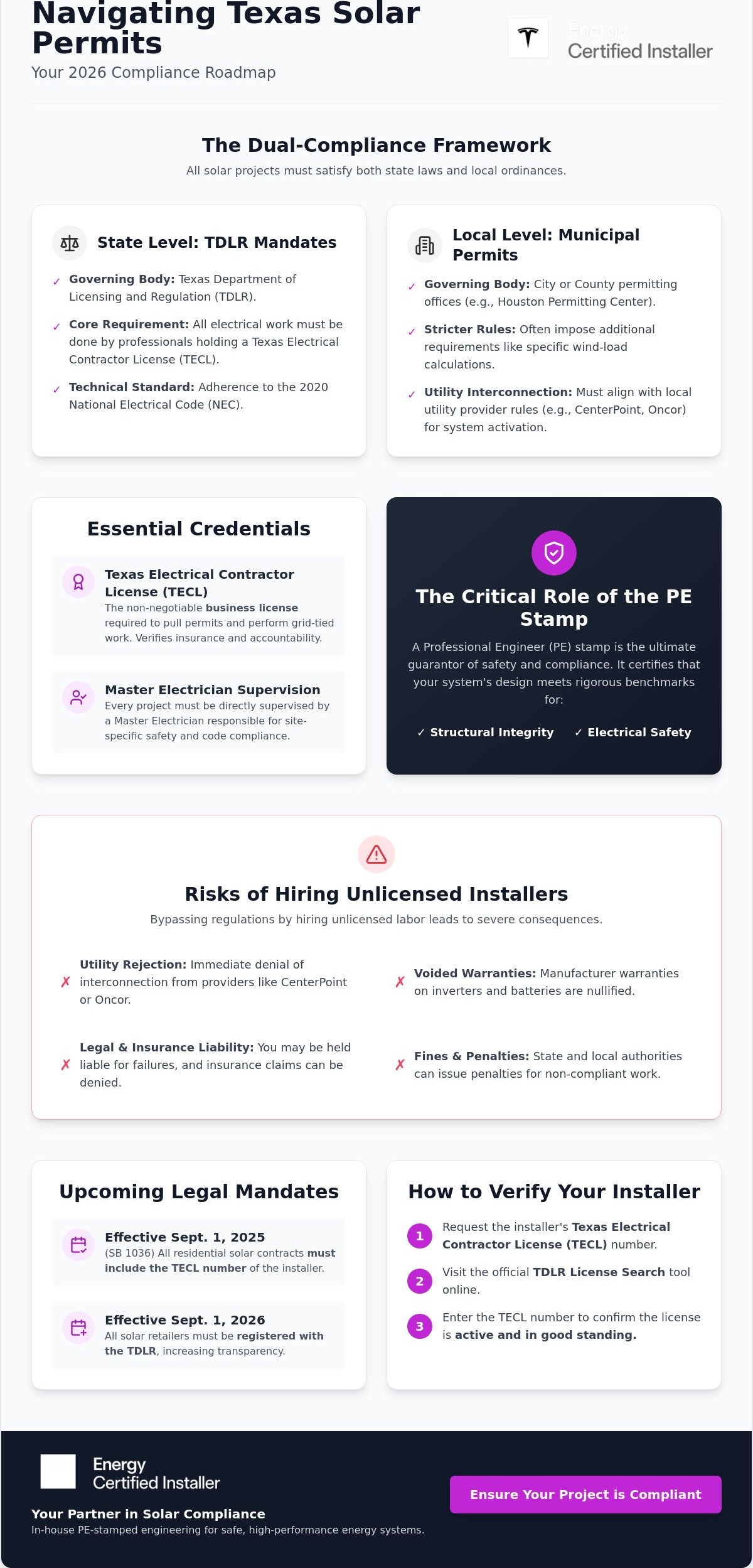
The Texas Department of Licensing and Regulation (TDLR) serves as the primary governing body for all solar contractors within the state. This agency ensures that every individual performing electrical terminations on a solar photovoltaic (PV) array possesses the necessary technical training and liability insurance. Texas law is explicit: any work involving the connection of a solar system to the electrical grid must be performed by a licensed professional. As of September 1, 2026, all solar retailers must also be registered with the TDLR, a new mandate designed to increase transparency and consumer protection across the industry.
Adherence to the 2020 National Electrical Code (NEC) remains the technical baseline for all municipal inspections. While Solar power in Texas is projected to add over 39,000 MW of capacity by 2031, this growth is managed through a dual-layered regulatory system. Contractors must maintain a Texas Electrical Contractor License (TECL) at the state level while simultaneously securing municipal building permits from local authorities like the Houston Permitting Center. Understanding these Texas solar panel permit requirements is the first step toward a compliant and safe energy installation that meets the standards of both the state and your local utility provider.
The Legal Definition of a Solar Installer in Texas
General contractors and “handyman” services are legally prohibited from performing electrical work on solar arrays. Only a firm holding an active TECL can pull the necessary electrical permits. Every project requires the direct supervision of a Master Electrician, who is responsible for verifying site-specific electrical safety and code compliance. Property owners who bypass these regulations by hiring unlicensed installers face severe consequences. These include:
- Immediate rejection of interconnection by utility providers like CenterPoint Energy.
- The voiding of manufacturer warranties on inverters and battery storage units.
- Potential legal liability and insurance claim denials if an electrical failure occurs.
- Fines and penalties for failing to meet Texas solar panel permit requirements.
State Law vs. Local Ordinances: The Dual-Compliance Requirement
The Texas Electrical Safety and Licensing Act sets the mandatory safety floor for the entire state. However, local jurisdictions frequently impose stricter structural and administrative requirements. For instance, the City of Houston and Harris County may require specific wind-load calculations that exceed state minimums. Effective September 1, 2025, SB 1036 further mandates that all residential solar contracts include the specific license number of the electrical contractor performing the installation. Installers must also navigate the interconnection rules of local utilities. Meeting these standards ensures that your system is eligible for utility buyback programs and long-term grid stability. Failure to align municipal permits with utility standards often results in a system that is physically installed but legally unable to activate.
Essential Licenses for Texas Solar Contractors and Technicians
Professional solar contracting requires more than technical knowledge. It demands a rigorous adherence to state-mandated licensing. While many property owners focus solely on the hardware, the legal authorization to perform the work is what determines project viability. In Texas, the distinction between a business license and an individual technician’s credential is a critical factor in project success. Understanding these layers ensures that your installation complies with all Texas solar panel permit requirements and remains eligible for utility interconnection.
The TECL: The Foundation of Professional Solar Contracting
The Texas Electrical Contractor License (TECL) is the non-negotiable business credential for any firm offering solar services. This license is the only legal mechanism that allows a company to pull electrical permits and perform grid-tied work. Property owners can verify a contractor’s status through the TDLR License Search tool to ensure the firm is in good standing. A valid TECL provides several layers of protection:
- Verification of statutory general liability and workers’ compensation insurance.
- Preservation of manufacturer warranties for high-value components like inverters and panels.
- Accountability to state safety standards and the National Electrical Code.
- The legal authority to submit documentation for Texas solar panel permit requirements.
Individual Electrician Ratios and Supervision
The specific qualifications of the crew on your roof are just as important as the company’s business license. Texas law establishes strict ratios for licensed journeymen to apprentices on every job site to maintain safety. A Residential Wireman license allows a technician to perform electrical work on one- and two-family dwellings, but a Journeyman Electrician possesses a broader scope of technical proficiency. Our team prioritizes Master Electrician oversight for all projects to ensure every termination meets industrial-grade standards. This disciplined approach to staffing minimizes the risk of system failure and inspection rejection.
Beyond mandatory state licenses, elite installers pursue voluntary certifications that represent the technical gold standard. Credentials from the North American Board of Certified Energy Practitioners (NABCEP) indicate a deep mastery of solar-specific engineering. Furthermore, specialized technology requires specific manufacturer training. Working with certified Tesla Powerwall installers in Houston ensures that your energy storage system is integrated with the precision required for long-term grid resilience. These advanced certifications, when paired with a valid TECL, provide the stability and expertise necessary for a seamless transition to solar power. If you’re ready to begin your project, consulting with an authoritative electrical partner can help you navigate these technical prerequisites with confidence.
The Critical Role of PE-Stamped Engineering and Permitting
A Professional Engineer (PE) stamp represents the highest level of technical validation in the renewable energy sector. It is a legal certification that confirms a solar design is both structurally sound and electrically viable. For property owners, this document is the primary bridge between a conceptual design and a final, city-approved installation. Utilizing PE stamped engineering for solar systems ensures that every technical specification adheres to the rigorous Texas solar panel permit requirements set by municipal authorities.
Structural Integrity and Wind Load Compliance
Houston-specific requirements for wind load resilience are particularly stringent given the region’s susceptibility to high-velocity weather events. A structural PE stamp validates that your roof can support the dead load of the panels and the wind uplift forces generated during a hurricane. This engineering review is essential for older structures or complex industrial electrical construction where the existing rafters may require reinforcement. Beyond immediate safety, a stamped design serves as a permanent legal guarantee for insurance providers and prospective home buyers, documenting that the installation was executed with professional precision.
Electrical Engineering for Advanced Storage Systems
The integration of advanced energy storage, such as the Tesla Powerwall 3 or EcoFlow battery backups, introduces a new layer of electrical complexity. These systems often require line-side taps and backup gateways that must be meticulously documented in single-line diagrams to pass city inspections. An electrical PE stamp validates that the system will not overload the home’s existing infrastructure. This level of engineering prevents the common pitfalls of system rejection by utility companies who require precise technical data before granting permission to operate.
Professional engineering also serves a strategic administrative purpose. Cities like Houston utilize the iPermits system and SolarAPP+ to process applications; however, these systems prioritize submissions that include complete, stamped engineering packets. By providing comprehensive documentation upfront, installers can significantly accelerate the permitting timeline. This proactive approach eliminates the back-and-forth revisions that often delay projects by weeks or months, ensuring your system moves from design to activation with predictable efficiency. This disciplined focus on technical accuracy is what distinguishes a high-end strategic partner from a standard labor service.
How to Verify a Solar Installer’s Credentials in Texas
Selecting a contractor requires a methodical approach to verification that goes beyond reviewing marketing materials. Because the state does not have a unified permit standard, the burden of due diligence falls on the property owner to ensure their chosen firm can meet specific Texas solar panel permit requirements. A disciplined verification process protects your capital and ensures the long-term viability of your energy infrastructure. Follow these five steps to validate any solar installer before signing a contract.
- Step 1: Request the company’s Texas Electrical Contractor License (TECL) number. Use the TDLR License Search tool to confirm the license is active and that the firm carries the required insurance.
- Step 2: Identify the Master Electrician of record. Every TECL holder must have a Master Electrician who assumes ultimate responsibility for the technical integrity of all projects.
- Step 3: Demand proof of specialized certifications. If your project includes high-performance storage, verify the firm is an authorized Tesla Certified Installer.
- Step 4: Audit the written proposal for transparency. Ensure the document explicitly includes the costs for professional PE-stamped engineering and all municipal permit fees.
- Step 5: Evaluate local project history. Review past industrial electrical projects or residential installations within the Houston area to gauge the firm’s familiarity with regional standards.
Red Flags in a Solar Bid
The presence of certain “red flags” often indicates an installer is attempting to bypass legal mandates. One of the most dangerous tactics is asking a homeowner to pull “owner-builder” permits. This maneuver shifts all legal and safety liability from the contractor to you. It’s often a sign the installer lacks a valid TECL. Additionally, be wary of vague language regarding labor. You should know exactly who is performing the electrical terminations. Finally, a lack of transparency regarding which engineering firm provides the PE stamps suggests a disorganized workflow that could lead to system rejection during the final inspection.
The Value of Local Houston Expertise
Installers who maintain a consistent presence in Harris County possess a distinct advantage in navigating the local bureaucracy. They understand the nuances of the Houston Permitting Center’s iPermits system, which leads to shorter revision cycles and faster approvals. This local knowledge is especially critical when integrating advanced platforms like Tesla Electric in Houston. Firms with established relationships with CenterPoint Energy can navigate the interconnection process with precision, preventing the multi-month delays that often plague inexperienced contractors. If you require a partner that prioritizes regulatory precision and technical mastery, contact Santiban Services Group to review your project specifications.
Santiban Services Group: Your Partner in Solar Compliance
Santiban Services Group brings over 24 years of experience in industrial electrical construction and renewable energy deployment to every project. Our operational philosophy centers on precision; we ensure that every installation meets the most stringent Texas solar panel permit requirements. We provide a comprehensive service model that integrates in-house PE-stamped engineering design for every solar project. This internal capability allows us to maintain total control over technical accuracy and regulatory compliance from the initial site audit to final utility interconnection.
We specialize in the deployment of advanced energy storage systems, including Tesla Powerwall 3, Tesla Powerwall +, and EcoFlow battery backup solutions. Our team maintains a relentless focus on safety standards that exceed the baseline mandates set by the TDLR and the National Electrical Code. By treating every residential project with the same rigor as an industrial build, we ensure your system is a stable, long-term asset. We don’t just install hardware; we engineer resilient energy solutions.
Industrial-Grade Standards for Residential Solar
Our extensive background in complex electrical infrastructure directly benefits every home solar installation. We apply industrial-grade methodologies to ensure your system remains resilient against the environmental challenges of the Gulf Coast. Investing in Tesla and solar roof solutions provides a strategic boost to long-term property value and energy independence. We reject the shortcut culture prevalent in the industry. Instead, we prioritize thorough permitting, meticulous engineering, and transparent communication with utility providers to ensure a seamless activation.
Secure Your Energy Future with Santiban
The complexity of Texas solar panel permit requirements demands a partner who values corporate stability and technical precision. Working with a fully licensed, insured, and certified Texas partner provides the peace of mind necessary for such a significant investment. Every project we undertake is managed by specialized personnel who understand the nuances of local municipal codes and utility standards. This disciplined approach eliminates the uncertainty often associated with renewable energy transitions.
We invite you to request a professional evaluation of your property. This assessment includes a full compliance and engineering review conducted by our expert team. It’s the most reliable way to ensure your design is optimized for performance and legal standing. Contact us today to begin the process of building a resilient, compliant, and high-performance solar energy system for your home or business.
Securing Your Energy Infrastructure for 2026 and Beyond
Transitioning to renewable energy is a strategic investment that requires meticulous planning and adherence to evolving standards. We’ve established that meeting Texas solar panel permit requirements is not merely a bureaucratic hurdle; it’s a fundamental safety protocol that ensures long-term system performance. By prioritizing valid TECL credentials and professional engineering validation, property owners protect their structural integrity and guarantee seamless interconnection with local utility providers like CenterPoint Energy.
Success in the 2026 regulatory landscape depends on choosing a partner that values precision over speed. Our organization leverages over 24 years of industrial electrical experience and in-house PE-stamped engineering to deliver results that meet the highest technical benchmarks. As a Tesla Certified Installer, we possess the specialized expertise required to integrate advanced storage solutions with total reliability. Consult with our Houston-based Tesla-certified solar experts today to review your project specifications. We look forward to helping you build a resilient, compliant energy future that stands the test of time.
Frequently Asked Questions
Do solar installers in Texas need an electrical license?
Yes, any entity performing solar PV work in the state must possess a valid Texas Electrical Contractor License (TECL). This business-level credential ensures the firm is registered with the TDLR and maintains the necessary liability insurance. Individual technicians on the job site must also hold specific licenses, such as Journeyman or Residential Wireman, to ensure all electrical terminations meet safety standards.
Can I install my own solar panels in Texas?
Self-installation is generally restricted in urban jurisdictions like Houston and Dallas for grid-tied systems. While some unincorporated rural areas have fewer regulations, municipal codes usually mandate that a licensed electrical contractor pull the permits. Attempting a DIY installation for a grid-tied system often leads to rejection by the utility provider, as they require professional certification before granting permission to operate.
What is a PE stamp and why is it required for solar in Texas?
A PE stamp is a legal certification from a licensed Professional Engineer verifying that your system design is structurally and electrically sound. In Texas, these stamps are often required to prove that a roof can withstand specific wind loads and that the electrical line diagrams won’t compromise the home’s infrastructure. This validation is a core component of the Texas solar panel permit requirements enforced by local building departments.
How do I check if a solar company is licensed in Texas?
You can verify a contractor’s status by using the TDLR License Search database. By entering the company’s name or their specific TECL number, you can confirm their license is active and check for any past enforcement actions. This step is essential for property owners to ensure they’re working with a legitimate and insured entity that’s authorized to pull municipal permits.
Does Texas require NABCEP certification?
Texas law doesn’t mandate NABCEP certification for solar installers, though it remains the industry’s gold standard for technical proficiency. While the TECL is the legal requirement for operation, NABCEP credentials demonstrate that a contractor has voluntarily met rigorous national standards for solar design and installation. Choosing a firm with these certifications often results in a more precise and efficient deployment of renewable energy assets.
Are there specific requirements for installing a Tesla Powerwall in Texas?
Installing a Tesla Powerwall requires the contractor to be a Tesla Certified Installer and hold a valid TECL. Additionally, the permitting process for battery storage often requires detailed PE-stamped electrical plans that specify how the gateway and backup circuits will integrate with the existing panel. These requirements ensure the storage system functions safely during grid outages and meets all local fire and electrical codes.
How long does the solar permitting process take in Houston?
The permitting process in Houston typically spans four to eight weeks from the initial submission to final approval. This timeline accounts for the engineering review at the Houston Permitting Center and the interconnection application with CenterPoint Energy. Factors such as the complexity of the PE-stamped designs and the current volume of applications within the municipal system can influence the total duration of the approval cycle.
What happens if I install solar without a permit in Texas?
Installing a system without adhering to Texas solar panel permit requirements can result in significant legal and financial penalties. Municipal authorities may impose heavy fines or issue a stop work order, potentially forcing the removal of the unpermitted equipment. Furthermore, utility companies will refuse to grant an interconnection agreement, meaning your system can’t legally be turned on or connected to the grid.