
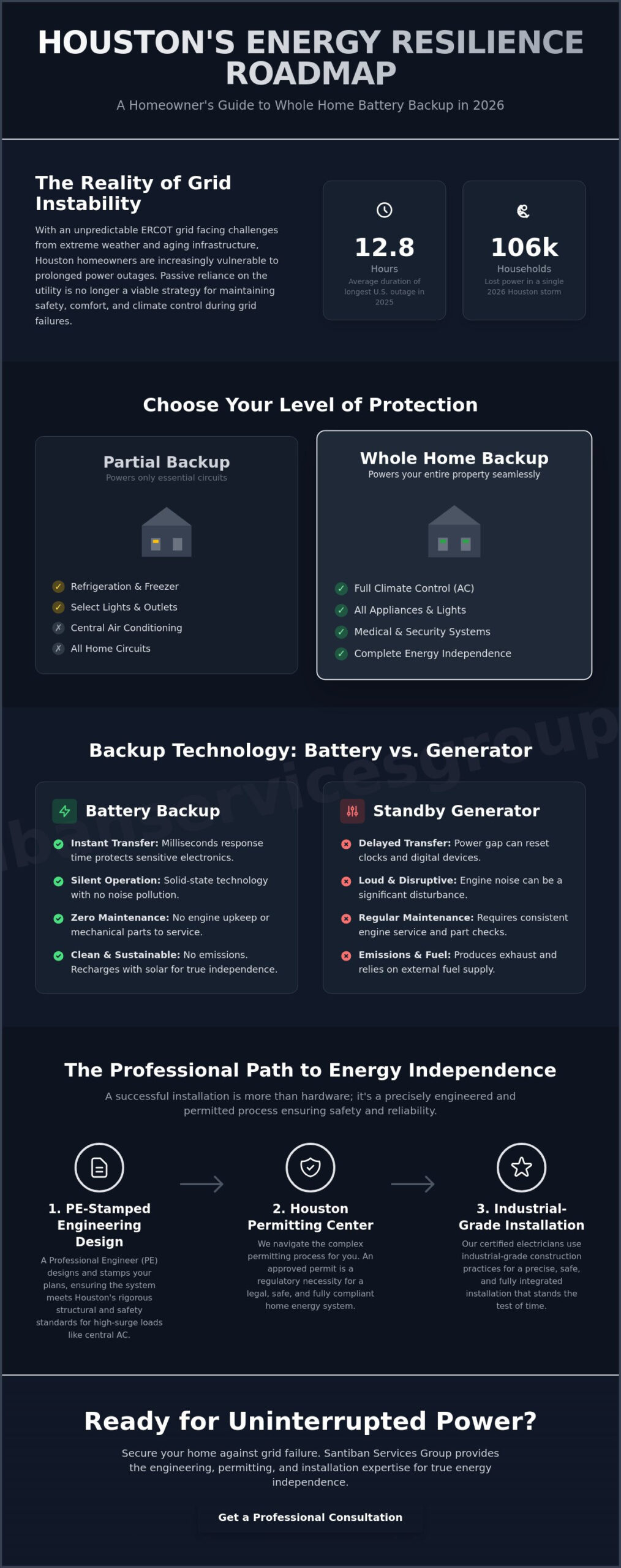
In 2025, the average duration of the longest power outage in the United States climbed to 12.8 hours, representing a significant increase from previous years. For residents navigating the unpredictable ERCOT grid, installing a robust whole home battery backup system Houston homeowners trust is now a fundamental requirement for maintaining a safe and functional household. You’ve likely experienced the frustration of watching the lights flicker during a Gulf storm, knowing that losing air conditioning in our intense humidity isn’t just uncomfortable; it’s a risk to your property and well-being.
We understand that the transition to energy independence involves more than just purchasing hardware. It requires navigating the Houston Permitting Center’s standards and ensuring your system meets specific engineering requirements for safety, especially now that federal tax incentives for standalone storage have expired. This 2026 resilience guide provides a professional roadmap for integrating advanced solutions like the Tesla Powerwall 3 or EcoFlow DELTA Pro Ultra into your home. You’ll discover how a PE-stamped, engineered design ensures a seamless transition during outages while positioning your property for long-term operational stability.
Key Takeaways
- Evaluate the critical differences between partial backup and a comprehensive whole home battery backup system Houston to maintain continuous climate control during grid failures.
- Compare the technical specifications of the Tesla Powerwall 3 and EcoFlow Delta Pro Ultra to identify which architecture aligns with your specific energy consumption patterns.
- Master the calculations for peak demand versus continuous load to ensure your backup solution successfully manages high-surge appliances like central AC units.
- Understand the regulatory necessity of PE-stamped engineering design for navigating the Houston Permitting Center’s rigorous safety and structural standards.
- Learn how industrial-grade electrical construction practices provide the precision required for a safe, fully integrated energy storage installation.
Why Houston Homeowners are Prioritizing Whole Home Battery Backup Systems
Houston’s energy landscape changed significantly following the volatility of the mid-2020s. The ERCOT grid continues to face challenges from both extreme temperature fluctuations and aging infrastructure. Residents no longer view a whole home battery backup system Houston as an optional luxury. Instead, it’s a foundational utility required to maintain residential safety and climate control. Unlike temporary fixes, these engineered systems provide a permanent solution for energy resilience in Southeast Texas.
The Reality of Grid Instability in Southeast Texas
Recent data underscores the necessity of local power autonomy. In early May 2026, a severe storm system caused approximately 106,000 Houston-area households and businesses to lose power. While CenterPoint Energy remains responsible for grid interconnection, the physical reliability of the distribution network is frequently compromised by environmental stressors. Passive reliance on the utility provider is no longer a viable strategy for families who must maintain refrigeration and air conditioning during extended outages. Modern home energy storage systems serve as a critical defense, providing a disciplined approach to domestic energy management that operates independently of external failures.
A true whole-home solution differs fundamentally from portable units or partial backups. It’s a sophisticated, industrial-grade installation designed to handle the entire electrical load of a property. This integration ensures that every circuit remains active, from medical equipment to home security systems. It eliminates the anxiety of choosing which appliances to keep running when the grid goes dark.
Battery Backup vs. Traditional Standby Generators
Traditional combustion generators rely on mechanical parts and consistent fuel supplies. They require regular engine maintenance, produce significant noise, and emit exhaust that complicates placement in residential areas. In contrast, battery backup systems utilize solid-state technology. They operate silently and require virtually zero mechanical upkeep. The response time is another critical differentiator. Battery systems provide an instantaneous power transfer that occurs in milliseconds. This precision prevents digital devices from resetting and ensures that sensitive electronics remain protected from the sudden voltage drops common during grid switching.
The long-term value of battery storage has also shifted. While the federal tax credit for standalone systems expired at the end of 2025, the operational ROI remains strong when integrated with solar panel installation. This combination allows for perpetual recharging without relying on external fuel supply chains. Homeowners can effectively manage peak energy costs by discharging stored power when utility rates are highest, creating a predictable and stable energy environment regardless of external market conditions.
Evaluating Tesla Powerwall 3 vs. EcoFlow for Houston’s Climate
Selecting a whole home battery backup system Houston requires a technical evaluation of how hardware responds to extreme thermal stress. Houston’s summer temperatures frequently exceed 95 degrees with high humidity, which can degrade battery efficiency if the system lacks superior thermoregulation. Both Tesla and EcoFlow offer high-performance solutions, yet they serve different operational philosophies. The decision depends on your specific load requirements and whether you prioritize integrated simplicity or modular scalability.
The Tesla Powerwall 3 is engineered as a unified, high-output solution. It features an integrated 11.5 kW solar inverter, which simplifies the electrical architecture by eliminating the need for separate components. This streamlined design reduces potential failure points and optimizes energy conversion. For homeowners seeking a comprehensive Guide to Home Batteries, the Powerwall 3 represents the peak of integrated residential energy storage, providing a clean aesthetic and industrial-grade reliability.
Tesla Powerwall 3: The Industrial-Grade Choice
Tesla’s latest iteration provides 13.5 kWh of storage capacity with a focus on high-demand performance. It utilizes Nickel Manganese Cobalt (NMC) chemistry, supported by an advanced liquid cooling system specifically designed to maintain optimal operating temperatures in the harsh Texas climate. Precision in installation is paramount for maintaining the 10-year warranty and ensuring peak performance. Engaging a certified tesla powerwall installer ensures the system is configured according to manufacturer specifications and local engineering codes.
EcoFlow Solutions for Flexible Backup
The EcoFlow DELTA Pro Ultra offers a modular approach to energy resilience. Its base unit provides 6 kWh of storage, but the architecture allows expansion up to 90 kWh. This system provides 7.2 kW of continuous power output per unit, which can be stacked to increase total capacity. Using Lithium Iron Phosphate (LiFePO4) chemistry, the EcoFlow system is recognized for its high cycle life and thermal stability. It integrates seamlessly with existing solar arrays, making it a versatile choice for diverse home sizes.
Managing these systems during a grid event requires reliable software. Both platforms provide sophisticated mobile applications that allow homeowners to monitor real-time consumption, set backup reserves, and prioritize critical loads. This visibility is essential when the ERCOT grid is under strain, as it enables proactive energy management from your smartphone. For those requiring a customized strategy, our team provides PE-stamped engineering design to ensure your hardware choice aligns with your home’s unique peak demand.
Defining ‘Whole Home’ Backup: Managing Houston AC Loads
Achieving true energy independence requires a precise understanding of your property’s electrical profile. In Southeast Texas, a whole home battery backup system Houston must do more than keep the lights on; it must manage high-surge appliances that define our standard of living. Central air conditioning units, pool pumps, and electric ovens represent significant “Peak Demand” challenges. Without professional engineering, a standard battery installation might fail the moment a 4-ton AC compressor attempts to engage during a grid outage.
Engineered systems distinguish between continuous load and surge capacity. Continuous load is the total wattage required to keep your home running over several hours. Peak demand, or surge, is the massive, momentary spike of electricity needed to start a motor. For many Houston homes, the startup current of an older AC unit can exceed the instantaneous output of a single battery. We solve this through industrial-grade load management and the strategic application of soft-starters, which can reduce the initial amperage draw of an AC unit by up to 70%.
The AC Factor: Can a Battery Run Your 4-Ton Unit?
The technical feasibility of running large cooling systems depends on the Locked Rotor Amps (LRA) rating of your equipment. A standard 4-ton unit might require a surge that exceeds the capacity of basic residential storage. However, tesla electric configurations are specifically designed to handle these high-demand scenarios by stacking multiple units or utilizing the Powerwall 3’s 11.5 kW continuous output. This allows for a “Comfort Mode” configuration where the AC remains fully operational, or a “Survival Mode” where smart load shedding prioritizes refrigeration and medical equipment during multi-day outages.
Solar Integration for Multi-Day Resilience
Battery storage alone is a finite resource. For resilience that lasts beyond 24 hours, integrating energy storage with tesla and solar roof solutions creates a self-sustaining power loop. This setup allows your batteries to recharge during the day while simultaneously powering your home. In Houston, we calculate recharge times based on local solar irradiance patterns to ensure your system recovers enough energy by sunset to maintain cooling throughout the night. This disciplined approach to energy cycles ensures that your home remains a sanctuary, regardless of the ERCOT grid’s status or the duration of a storm’s aftermath.
The Importance of PE-Stamped Engineering and Houston Permitting
Professional engineering serves as the foundation for every resilient energy project. A whole home battery backup system Houston installation requires more than just electrical wiring; it demands structural and electrical validation from a licensed Professional Engineer (PE). This process ensures that the system design adheres to the rigorous safety standards established by the City of Houston and Harris County. By prioritizing an engineered approach, homeowners mitigate the risks of electrical hazards, code violations, and potential equipment failure during critical grid events.
A PE-stamped design provides a comprehensive roadmap for your home’s energy infrastructure. It confirms that the intended configuration can safely manage the specific electrical loads of your property while maintaining compliance with the National Electrical Code (NEC). This level of precision is what separates industrial-grade installations from standard residential labor. It offers a sense of quiet confidence that every operational detail has been calculated for long-term stability and safety.
Permitting Excellence in Harris County
Navigating the Houston Permitting Center requires technical expertise and meticulous documentation. While the city participates in the SolarAPP+ program for instant permit approval on standard systems, larger or more complex installations often require a manual review process. Utilizing PE stamped engineering for solar systems is a non-negotiable standard for our operations. This disciplined approach prevents the “Solar Cowboy” trap, where unpermitted installations lead to grid interconnection denials or insurance complications. Proper permitting is the only way to ensure your system is recognized as a legal and safe addition to your home’s utility profile.
Structural and Electrical Compliance
Structural integrity is paramount when installing heavy energy storage hardware. A single Tesla Powerwall 3 or EcoFlow unit represents significant weight that must be securely anchored to your home’s structure. Engineering reviews confirm that your walls can support these loads and that roof-mounted solar components can withstand the wind loads common in hurricane-prone zones. Additionally, we evaluate your existing electrical panel to ensure it can safely handle bidirectional energy flow. Every project concludes with a detailed “As-Built” document, providing you with a permanent record of your system’s engineered specifications. To begin your transition to a professionally designed energy solution, contact us for an industrial electrical construction consultation.
Engineering Your Energy Independence with Santiban Services Group
Santiban Services Group leverages over 24 years of industrial-grade electrical and energy expertise to protect Houston residences. We’ve established a reputation for reliability by treating residential projects with the same disciplined rigor required for large-scale industrial electrical construction. Our team provides a unified approach to energy resilience, integrating solar panel installation, solar reroofing, and advanced storage solutions into a single, high-performance ecosystem. When you invest in a whole home battery backup system Houston through our firm, you aren’t just buying equipment; you’re securing an engineered solution designed for the specific demands of the Gulf Coast climate.
Our methodology is defined by a commitment to precision. We manage every phase of the project lifecycle, from the initial PE-stamped engineering design to the final certified installation. This comprehensive oversight ensures that your system functions as a silent engine in the background of your daily life, maintaining operational stability without requiring constant homeowner intervention. Because we live and work in the community we protect, we understand the local grid dynamics better than national retail installers. We prioritize long-term relationships over short-term transactions, ensuring your system remains a dependable asset for years to come.
Why Industrial Expertise Matters for Your Home
Applying commercial-grade safety standards to residential battery projects is a core tenet of our operations. We utilize specialized personnel who are trained in the complexities of high-voltage systems and bidirectional energy flow. This focus on technical proficiency minimizes the risk of electrical faults and ensures that your hardware—whether it’s a Tesla Powerwall 3 or an EcoFlow DELTA Pro Ultra—operates at its maximum rated efficiency. Our commitment to high standards means we don’t cut corners on structural mounting, thermal management, or code compliance. You receive a professional-grade installation that meets the same safety benchmarks as a corporate data center or industrial facility.
Next Steps: Securing Your Houston Home
The transition to true energy independence begins with a factual assessment of your property’s needs. We provide customized load analyses to determine the exact storage capacity required to maintain your standard of living during a prolonged grid failure. For homeowners planning for future needs, we also evaluate the ev charger installation cost when integrated with your home battery system. This holistic planning prevents expensive retrofits and ensures your electrical panel is prepared for the next generation of home energy technology. Don’t leave your family’s comfort to the unpredictability of the ERCOT grid. Schedule your professional energy consultation today to begin engineering your home’s resilience.
Securing Your Energy Future in Houston
Houston’s energy landscape requires a disciplined, engineered approach to ensure your home remains operational during grid failures. This guide has analyzed how selecting the correct whole home battery backup system Houston ensures your high-surge AC units and critical appliances remain functional under stress. Professional engineering and meticulous permitting are the only methods to guarantee long-term safety and full compliance with local standards.
Santiban Services Group brings over 24 years of electrical expertise and industrial-grade standards to every residential installation. As a Tesla Certified Installer, we prioritize precision; every project is backed by a PE-stamped engineering design that secures your property against the unpredictability of the ERCOT grid. It’s time to transition from passive reliance to active resilience.
Request Your PE-Stamped Whole Home Backup Design from Santiban Services Group
Achieving true energy independence is a strategic investment in your family’s safety and comfort. We look forward to engineering a solution that provides your home with lasting stability.
Frequently Asked Questions
How long will a whole home battery backup system run my Houston home?
The duration of your backup power depends on your total energy consumption and the number of storage units installed. A single battery with 13.5 kWh of capacity typically supports essential loads for 12 to 24 hours. By stacking multiple units, homeowners can achieve multi-day autonomy. This resilience is significantly extended when integrated with solar panels, allowing the system to recharge daily while the grid remains offline.
Can a Tesla Powerwall 3 run my central air conditioning during a summer outage?
A Tesla Powerwall 3 can operate a central air conditioning unit, provided the system is engineered to handle the initial startup surge. With 11.5 kW of continuous power output, the Powerwall 3 is capable of running most modern high-efficiency cooling systems. Older or larger units may require the installation of a soft-starter to reduce the Locked Rotor Amps, ensuring the compressor engages without tripping the battery’s safety protocols.
Do I need solar panels to install a home battery backup in Houston?
Solar panels aren’t required for a battery installation, but they are highly recommended for true independence. A standalone battery charges from the grid and provides a finite amount of power during an outage. Without a solar array, the system cannot replenish its energy once it’s depleted. Integrating solar creates a self-sustaining loop that provides continuous power throughout extended grid failures common in Southeast Texas.
What is the difference between partial home and whole home backup?
Partial backup only powers a dedicated sub-panel for critical loads, while a whole home battery backup system Houston installation energizes the entire main electrical panel. Partial solutions focus on lighting and refrigeration. In contrast, a whole-home approach utilizes industrial-grade engineering to manage high-demand appliances, including your HVAC system and electric water heaters, maintaining your home’s full functionality during a crisis.
Are there federal tax credits available for home battery systems in 2026?
Federal tax credits for standalone home battery storage are no longer available as of January 1, 2026. The Section 25D Residential Clean Energy Credit expired on December 31, 2025. Homeowners should now focus on local utility programs or property value increases to justify the investment. While CenterPoint Energy currently lacks direct battery rebates, the operational security of the system remains the primary driver for Houston residents.
How does the installation of a battery backup affect my home’s resale value in Texas?
Battery backup systems typically enhance a property’s marketability and resale value in the Texas real estate market. Given that CenterPoint Energy experienced the highest number of outages in the U.S. during late 2025, energy resilience has become a high-priority feature for buyers. An engineered, fully permitted system provides a documented advantage that distinguishes your home from properties reliant solely on an unstable grid.
What happens to my battery system during a hurricane or severe flood?
Battery systems are housed in weather-resistant enclosures designed to withstand severe storms, but they must be installed according to specific elevation requirements to prevent water damage. Our engineering process includes a site-specific assessment to ensure hardware is mounted securely and positioned above historical flood levels. This protects your investment from the structural stresses of hurricane-force winds and localized flooding.
Why does my Houston home need a PE-stamped engineering design for a battery?
A PE-stamped engineering design is necessary to verify the structural and electrical safety of your installation. The Houston Permitting Center requires professional validation for complex energy projects to ensure they meet the National Electrical Code. This stamped documentation confirms that your home’s existing infrastructure can safely support the weight and electrical throughput of the battery, preventing hazardous failures and code violations.