
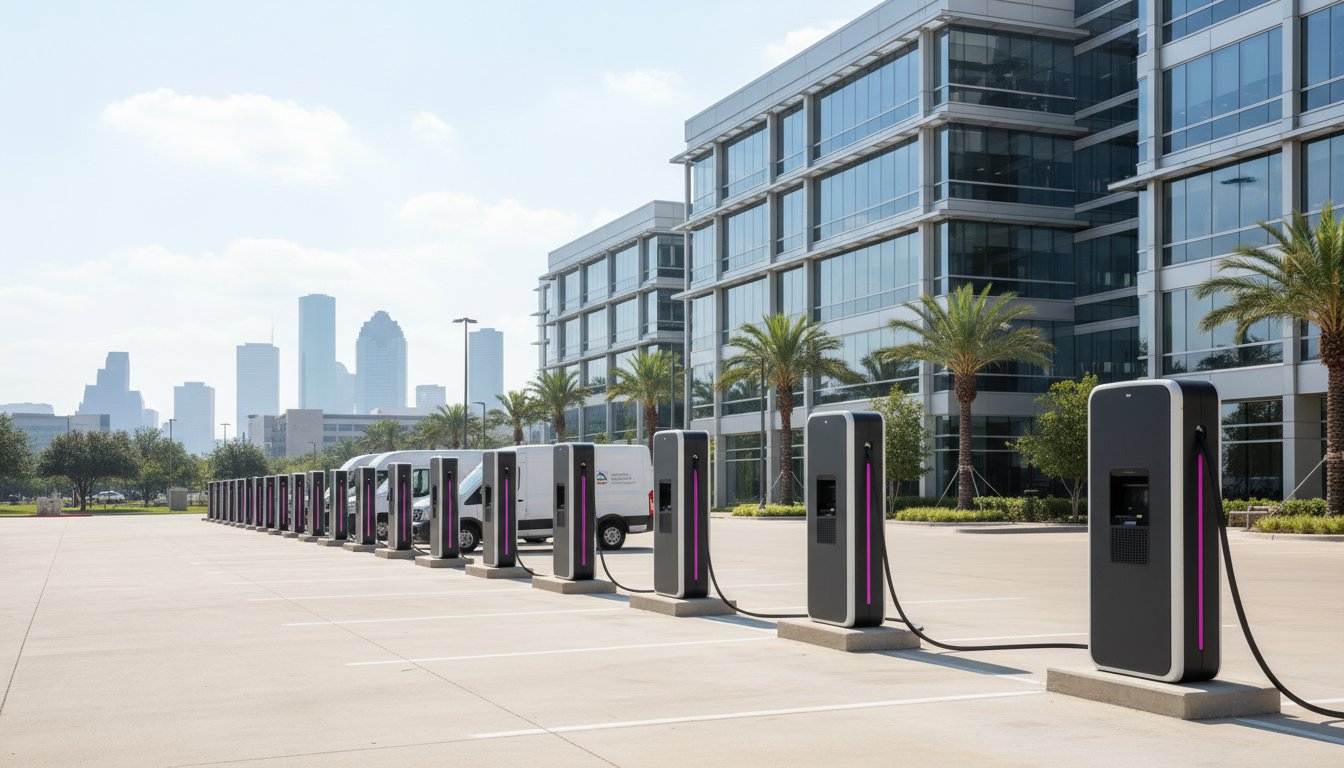
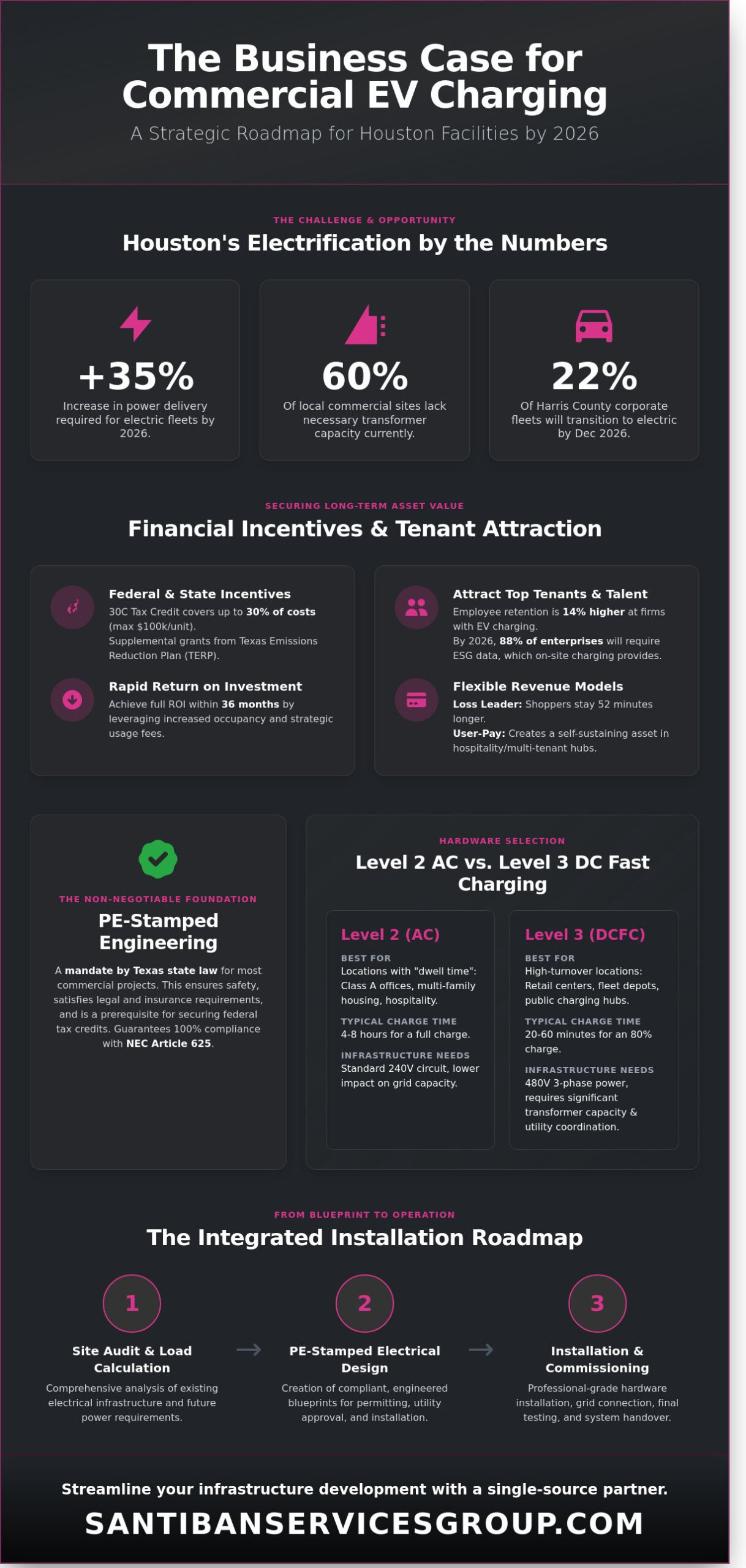
By 2026, Houston’s industrial corridors will require a 35% increase in power delivery to support the transition to electric fleets, yet 60% of local commercial sites currently lack the necessary transformer capacity. You recognize that deploying commercial ev charging is a high-stakes capital investment. A single permitting error or grid miscalculation can stall operations for months. We agree that the traditional fragmented approach to electrical upgrades often fails to meet the rigorous demands of modern fleet management. The Santiban Services Group provides the authoritative guidance required to manage these technical challenges with precision.
This guide delivers a comprehensive roadmap for navigating CenterPoint Energy load requirements, selecting industrial-grade hardware, and ensuring 100% compliance with Texas electrical codes. You’ll learn how to secure your infrastructure against future demand. We’ll examine the meticulous engineering specifications and localized permitting strategies that transform complex infrastructure into a seamless, future-proof asset. Our focus remains on delivering an integrated solution that safeguards your long-term operational stability and meets the highest standards of corporate excellence.
Key Takeaways
- Identify how commercial ev charging serves as a vital strategic asset for Class A office spaces and corporate fleets amid Houston’s projected 2026 adoption rates.
- Navigate the critical necessity of PE-stamped engineering to ensure full compliance with Texas state laws for large-scale industrial energy projects.
- Compare Level 2 and Level 3 hardware options based on their performance and resilience against the specific humidity and thermal challenges of the Houston Gulf Coast.
- Execute a meticulous installation roadmap that transitions seamlessly from initial site audits and tailored electrical design to final commissioning.
- Streamline your infrastructure development by leveraging a single-source partner capable of delivering comprehensive, professional-grade electrical solutions.
The Business Case for Commercial EV Charging in Houston (2026)
As Houston approaches the 2026 fiscal year, the transition toward electrified transportation has shifted from a speculative trend to a core operational requirement. Projections indicate that 22% of corporate fleets in Harris County will transition to electric power by December 2026. This evolution demands a robust infrastructure that supports both high-volume commuting and fleet logistics. Property owners who integrate a reliable electric vehicle charging station network into their facilities aren’t just following a trend; they’re securing long-term asset value through proactive facility management. Santiban Services Group views these installations as a “silent engine” of property value. It’s a competent force that maintains a building’s relevance without disrupting its daily cadence or aesthetic integrity.
This transition to electric vehicles also necessitates a review of corporate fleet insurance policies to ensure adequate coverage for new assets and potential liabilities. For businesses looking to understand the nuances of modern vehicle coverage, you can visit SI Insurance for strategic insights.
The federal government continues to incentivize this transition through the 30C Alternative Fuel Infrastructure Tax Credit. This provision allows businesses to claim up to 30% of installation costs, capped at $100,000 per unit for properties located in eligible census tracts. Locally, the Texas Emissions Reduction Plan (TERP) offers supplemental grants that further reduce the initial capital expenditure. These financial mechanisms significantly lower the barrier for commercial ev charging deployment. They allow property managers to achieve a full return on investment within 36 months by leveraging increased occupancy rates and strategic usage fees.
Attracting Tenants and Talent
Class A office spaces in the Houston Energy Corridor now recognize EV accessibility as a mandatory lease provision rather than a luxury. By mid-2026, 88% of local enterprises will require detailed ESG (Environmental, Social, and Governance) data for their annual stakeholders’ reports. Providing onsite charging simplifies this reporting process for tenants by offering measurable carbon offset data. Recent surveys show that employee retention rates are 14% higher at firms offering Level 2 charging compared to those without. It’s a silent differentiator that signals a commitment to modern, sustainable operations and the well-being of a professional workforce.
Revenue Generation vs. Amenity Models
Selecting the right financial structure determines the long-term viability of the installation. Retail centers often adopt a “Loss Leader” strategy, offering complimentary charging to attract high-net-worth customers who prioritize convenience. Data suggests that shoppers spend an average of 52 minutes longer in stores when their vehicle is connected to a commercial ev charging point. Conversely, hospitality and multi-tenant hubs often utilize user-pay models to offset utility demand charges. Santiban provides tailored solutions that balance these user fees with ongoing operational costs. This ensures the system remains a self-sustaining asset that enhances the property’s financial performance without increasing the administrative burden on ownership.
Engineering and Compliance: The PE-Stamped Requirement
Professional Engineering (PE) stamped plans represent the gold standard for commercial ev charging installations in 2026. In Texas, the Board of Professional Engineers and Land Surveyors mandates a licensed engineer’s seal on electrical plans for most commercial facilities. This verification ensures that the proposed infrastructure can safely handle the sustained high amperage loads required by Level 2 and DC Fast Chargers. Santiban’s engineering-first methodology eliminates guesswork; it provides facility managers with a meticulous blueprint that satisfies both legal mandates and insurance liability standards. Following the latest National Electrical Code (NEC) Article 625 guidelines, our team validates that every circuit, breaker, and conductor meets 100% of the safety requirements for industrial energy projects.
Securing these approvals is a prerequisite for capturing financial incentives. Businesses often leverage Federal tax credits for EV charging to offset up to 30% of installation costs. Without a PE-stamped design, these applications may face rejection or significant delays. Our disciplined approach provides the technical documentation necessary to secure these funds while maintaining a superior level of operational stability. It’s a proactive strategy that protects your investment from the outset.
Navigating Houston Permitting and Codes
The City of Houston Building Code involves rigorous reviews at the permitting office. A PE-stamped design functions as a catalyst, accelerating the approval timeline by providing pre-validated technical data that city inspectors trust. This level of precision isn’t exclusive to EVSE; the same rigorous standards apply when we provide PE-stamped engineering for solar systems to our industrial clients. We manage the entire administrative cycle, ensuring that your facility remains compliant with local Houston ordinances from day one.
Grid Capacity and CenterPoint Coordination
Installing a multi-port charging hub requires a comprehensive evaluation of transformer capacity. We coordinate directly with CenterPoint Energy to manage utility interconnection requests, ensuring the local grid can support the increased demand. Our engineers utilize smart load management to mitigate demand charges, which can account for 50% of a monthly utility bill if left unmanaged. This tailored strategy protects your bottom line while ensuring a seamless power supply. To ensure your facility’s infrastructure is prepared for these demands, consider a comprehensive site assessment from our expert team.
Choosing the Right Commercial EV Charger Hardware
Hardware selection determines the long-term ROI of commercial ev charging infrastructure. Reliability in the Houston Gulf Coast region requires equipment rated for NEMA 4X standards to resist 90% humidity and saline air. We prioritize systems using the Open Charge Point Protocol (OCPP). This standard ensures your business can switch software providers without replacing physical stations. Integrating these units with the Tesla Powerwall 3 allows for strategic peak-shaving. This reduces demand charges by discharging stored energy during high-use periods. Businesses can also offset up to 30% of hardware and installation costs, capped at $100,000 per location, through the Federal Alternative Fuel Vehicle Refueling Property Credit. Our approach focuses on meticulous hardware vetting to guarantee operational continuity in extreme Texas temperatures.
Level 2 Charging for Workplace and Multi-Family
Level 2 chargers operating between 48-amp and 80-amp represent the standard for long-dwell locations. These units typically provide 30 to 50 miles of range per hour of charging. The Tesla Universal Wall Connector offers unique versatility by supporting both NACS and J1772 connectors in a single unit. Ford Pro and Leviton units provide robust alternatives for specific fleet needs. Utilizing dual-port pedestal configurations allows property managers to service two parking stalls with a single electrical pull. This layout maximizes space efficiency and reduces trenching costs by approximately 40% in multi-family developments. It’s a strategic way to scale commercial ev charging capacity without doubling the footprint of the infrastructure. For property owners considering residential charging solutions alongside commercial installations, understanding the level 2 charger installation process for Houston homeowners can provide valuable insights into the technical requirements and permitting considerations that apply across both residential and commercial projects.
Level 3 DC Fast Charging for Fleets and Retail
High-turnaround environments like retail centers or logistics hubs require Level 3 DC Fast Charging (DCFC). These 50kW to 350kW systems require 480V three-phase power and specialized industrial electrical construction. A 2024 implementation for a Houston delivery fleet demonstrated that 50kW DCFC units could return a van to 80% charge in under 60 minutes. This rapid turnaround is essential for maintaining strict delivery schedules. Santiban’s technical teams manage the complex utility upgrades required for these high-voltage systems. We ensure your facility’s electrical backbone supports the massive current draws without compromising existing operations. This single-source approach eliminates the friction between equipment procurement and utility coordination.
- NEMA 4X Enclosures: Essential for resisting Houston’s corrosive coastal air.
- OCPP Compliance: Protects your investment from software obsolescence.
- Dual-Port Pedestals: Reduces installation costs per port by nearly 30%.
- 480V Three-Phase: Required for all Level 3 DCFC installations.
The Installation Roadmap: From Site Audit to Commissioning
Successful commercial ev charging deployments begin with a meticulous site audit. This process identifies critical electrical bottlenecks. Engineers evaluate existing transformer capacity and panel board limits to prevent future failures. Following the audit, our team develops tailored electrical designs. These plans include PE-stamped documentation that complies with City of Houston building codes and 2023 NEC requirements. This professional oversight ensures the infrastructure supports high-demand loads without compromising safety.
According to 2024 regional infrastructure reports, 68% of Houston commercial properties require panel upgrades to support Level 2 charging at scale. Our dedicated teams execute industrial construction with precision. We handle everything from deep-earth trenching to secure pedestal mounting. Final testing involves rigorous commissioning. We also provide comprehensive staff training for software management systems. This ensures your team can operate the network with total confidence from day one.
Site Preparation and Trenching
Strategic layout planning ensures ADA-compliant charging stalls. This includes specific signage and 96-inch wide access aisles required by the Texas Accessibility Standards. We minimize business disruption by scheduling heavy electrical construction during off-peak hours. Houston’s environment demands resilience. We use NEMA 4X rated enclosures and elevated mounting to protect equipment in flood-prone zones. These measures ensure 99.9% uptime during Gulf Coast storm seasons.
Software Integration and Management
Cloud-based management systems provide granular control over user access and billing. Property managers monitor energy consumption and implement real-time load balancing to avoid peak demand surcharges. This software allows for seamless integration of bidirectional EV chargers. These systems enable future grid-to-building power capabilities. Our technical experts configure these platforms to ensure secure data transmission and automated reporting. It’s an essential step for long-term operational efficiency.
Santiban Services Group: Your Houston EV Infrastructure Partner
Transitioning to commercial ev charging requires more than simple hardware installation. It demands a sophisticated understanding of Houston’s industrial power grid. Since 2000, Santiban Services Group has functioned as a single-source provider for complex electrical and construction projects. We manage every phase of the project lifecycle. This integrated approach eliminates the communication gaps that occur when property managers juggle multiple subcontractors. Our teams oversee everything from initial utility load studies to the final commissioning of high-voltage systems.
The Santiban commitment is rooted in excellence in every meticulous detail. Twenty-four years of refining our processes in the Houston energy corridor have taught us that reliability remains the primary metric of success. We don’t just install chargers; we build long-term infrastructure. By acting as your strategic partner, we provide a seamless transition to electric mobility. Our dedicated teams handle the heavy lifting, from engineering to long-term maintenance, so you can focus on your core business operations. We operate as a silent engine, a competent and invisible force that keeps your facility running smoothly in the background.
Certified Industrial Expertise
Santiban’s background isn’t limited to basic electrical work. We’ve spent over two decades executing large-scale electrical construction and specialized solar reroofing projects across Southeast Texas. This foundation allows us to apply Tesla-certified installation standards to the most demanding commercial environments. We maintain a 0.0 Total Recordable Incident Rate (TRIR) on many of our industrial job sites. Our technicians follow meticulous safety protocols that exceed OSHA requirements. Every installation we perform is built to be resilient, compliant, and ready for the high-demand cycles of 2026. Our expertise includes:
- High-Voltage Power Distribution: Upgrading existing switchgear to handle increased loads.
- Industrial Solar Integration: Combining EV infrastructure with renewable energy sources for maximum efficiency.
- Meticulous Site Safety: Implementing rigorous protocols that protect your staff and our crew during construction.
Request Your Commercial Site Audit
Successful commercial ev charging deployment begins with a data-driven facility evaluation. We don’t provide generic estimates based on guesswork. Instead, our engineers conduct a professional site audit to analyze your existing electrical capacity and peak demand periods. Providing customized ROI projections that account for local utility rebates and projected energy usage patterns is a standard part of our process. This transparency ensures your investment aligns with your long-term operational goals. You’ll receive a detailed roadmap that outlines equipment selection, permit timelines, and preventive maintenance schedules.
Ready to modernize your property with a partner you can trust? Contact Santiban for a tailored commercial EV charging quote today. Our team is prepared to deliver the superior, integrated solutions your Houston facility deserves.
Securing Your 2026 Houston EV Infrastructure
Transitioning to commercial ev charging requires more than just hardware; it demands a meticulous engineering approach to satisfy Houston’s 2026 compliance standards. Successful implementation hinges on PE-stamped design documents and an integrated roadmap that accounts for specific site capacity. Businesses that prioritize these technical benchmarks today avoid costly retrofits tomorrow. Santiban Services Group leverages 24+ years of Houston industrial experience to deliver these results. Our status as a Tesla-Certified Energy Pro ensures your facility benefits from superior hardware integration. We utilize an in-house PE-stamped engineering design team to manage every detail from the initial site audit through final commissioning. This comprehensive strategy transforms a complex logistical challenge into a seamless operational asset for your property. We’ve built our reputation on corporate stability and technical excellence. We’re ready to help you navigate the evolving energy landscape with precision and reliability. Your facility’s future starts with a solid foundation.
Take the first step toward a resilient facility. Request a Professional Site Audit for Your Houston Business and ensure your infrastructure is built to last.
Frequently Asked Questions
Is a PE-stamped engineering design required for EV chargers in Houston?
Yes, the City of Houston mandates a PE-stamped engineering design for all commercial EV installations to ensure compliance with the 2023 National Electrical Code. Our licensed engineers provide meticulous drawings that satisfy Houston Public Works requirements. This step prevents costly revisions during the 2026 inspection phase. We handle the entire submittal process to ensure your project meets municipal standards without delay.
What is the average cost to install a commercial EV charging station in Texas?
The average cost for commercial ev charging in Texas ranges from $3,500 for a basic Level 2 port to $140,000 for high-speed Level 3 infrastructure. These figures include hardware, trenching, and labor. Site-specific variables, such as a 50-foot run versus a 200-foot run, impact the final budget. Santiban provides transparent, line-item estimates to ensure financial predictability for your facility.
How long does the permitting process take for commercial EVSE in Houston?
Permitting for commercial EVSE in Houston typically requires 5 to 9 weeks through the Houston Public Works Electronic Plan Review system. The timeline depends on the project’s complexity and current municipal backlog. Our team monitors every application daily to expedite approvals. We’ve optimized our workflow to navigate the 2026 regulatory environment, ensuring your installation stays on schedule according to your business needs.
Can I integrate commercial EV chargers with my existing solar panel system?
You can seamlessly integrate commercial ev charging stations with existing solar arrays using smart energy management systems. This configuration reduces peak demand charges by 20% to 35% depending on your storage capacity. We deploy integrated inverters that prioritize renewable energy during daylight hours. It’s a superior strategy for businesses aiming to lower long-term operational costs while maximizing their 2026 sustainability metrics.
To ensure the quality and longevity of such an integrated system, sourcing reliable components is paramount. While local expertise is key for installation, the core photovoltaic technology often comes from specialized international suppliers. For example, firms like EEHD Erneuerbare Energien Handel und Distribution GmbH are experienced partners in the trade and distribution of renewable energy components.
What is the difference between Level 2 and Level 3 commercial chargers?
Level 2 chargers utilize 240V AC power to deliver 19kW, while Level 3 DC Fast Chargers provide up to 350kW for rapid replenishment. A Level 2 unit typically requires 5 to 8 hours for a full charge. In contrast, Level 3 stations can reach 80% capacity in 22 minutes. We help you select the tailored solution that aligns with your dwell time requirements and vehicle turnover rates. For property owners considering residential charging solutions alongside commercial installations, our comprehensive guide to Level 2 charger installation near me in Houston provides detailed insights into the technical requirements and permitting considerations that apply across both residential and commercial projects.
Are there specific Texas incentives for business EV charging in 2026?
Texas businesses can access the 30C Federal Tax Credit, which covers 30% of project costs up to $100,000 through December 2026. Additionally, the Texas Commission on Environmental Quality offers grants that often offset 60% of equipment expenses. Local utility programs from providers like CenterPoint Energy offer supplemental rebates. These financial levers make 2026 an ideal year for significant infrastructure investment at your facility.
Do I need to upgrade my commercial electrical panel for EV charging?
You’ll need an electrical panel upgrade if your current system lacks the 40-amp to 100-amp spare capacity required for each individual charger. Most older Houston warehouses operate on 200A service, which is often insufficient for multiple Level 2 units. We perform comprehensive load calculations to determine if a 480V transformer or a panel expansion is necessary. Our goal is to ensure 100% safety and reliability. For residential properties considering EV charging infrastructure, many homeowners find that installing a NEMA 14-50 outlet for EV charging provides the optimal balance of charging speed and electrical system compatibility. While commercial installations require more complex infrastructure, understanding EV charger installation costs in Houston can help property owners budget appropriately for both residential and commercial projects. For employees and tenants who also need charging solutions at home, working with a qualified professional ev installer near me in Houston ensures their residential setup meets the same rigorous 2026 building codes and CenterPoint Energy regulations that govern commercial installations.
How does Santiban handle maintenance for commercial charging stations?
Santiban manages maintenance through a dedicated service program that includes quarterly physical inspections and 24/7 remote monitoring. We maintain a 98.5% uptime SLA for all our commercial clients. If a fault occurs, our technicians arrive on-site within 24 hours to resolve the issue. This proactive approach ensures your charging infrastructure remains a dependable asset for your employees and your customers throughout the year.