
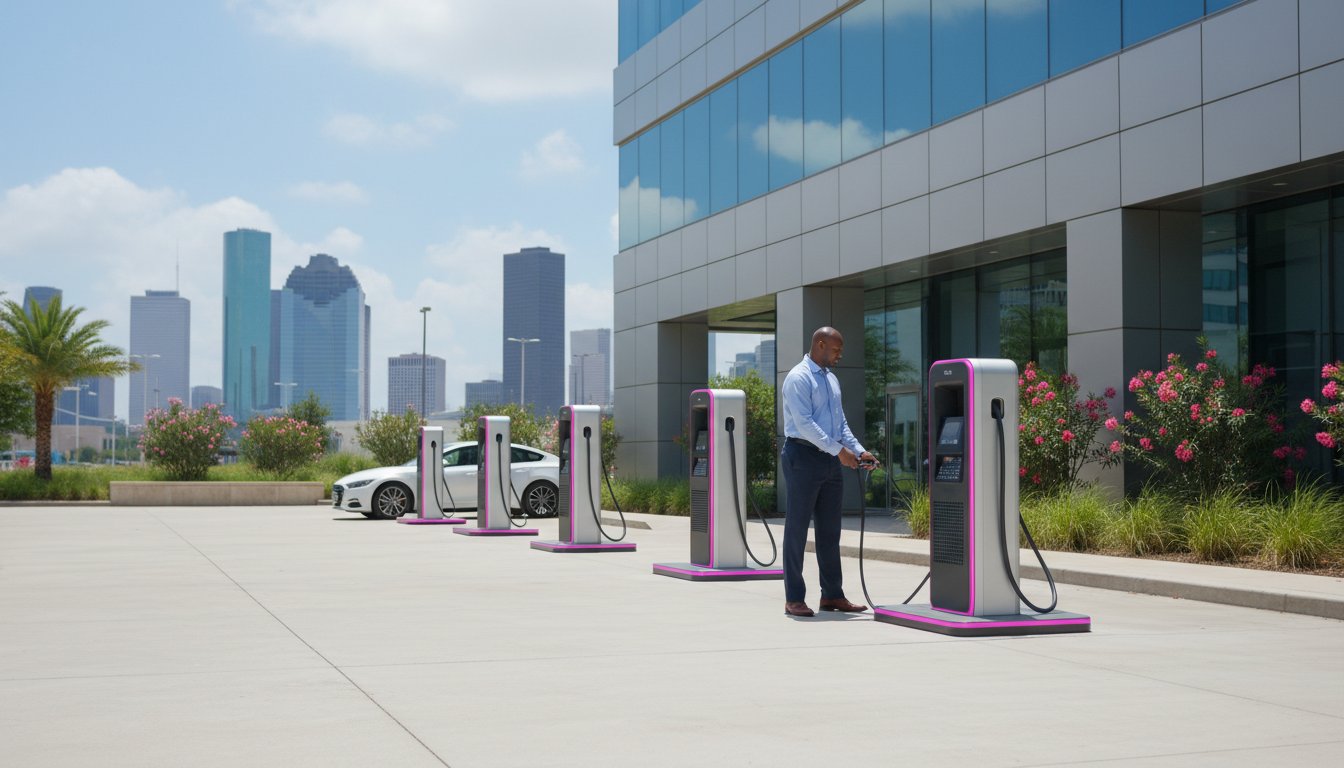
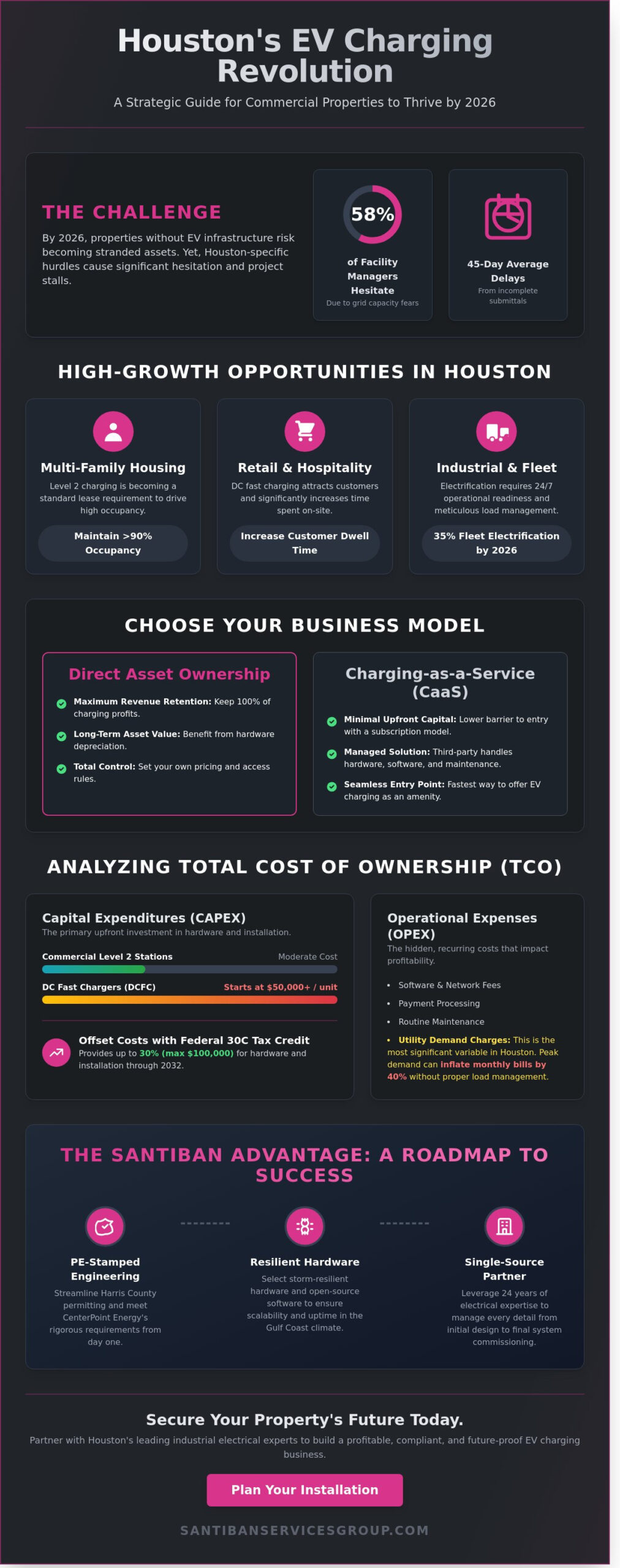
By 2026, a Houston commercial property lacking integrated power infrastructure will be viewed as a stranded asset rather than a competitive enterprise. You’ve likely realized that the shift toward electric mobility is no longer a peripheral concern but a core operational requirement. However, the reality of navigating Harris County’s complex permitting environment often leads to project stagnation. Recent 2024 infrastructure reports indicate that 58% of local facility managers hesitate to launch an ev charging business because they fear localized grid capacity limitations or the 45-day delays typical of incomplete electrical submittals.
You deserve a deployment strategy that prioritizes corporate stability and technical precision. This guide delivers a comprehensive framework for establishing profitable, scalable, and compliant EV infrastructure tailored to your specific site requirements. We’ll analyze the critical role of PE-stamped engineering in ensuring long-term safety, compare the ROI of hardware ownership against third-party hosting models, and outline how a meticulous industrial partner secures your investment against future volatility.
Key Takeaways
- Identify high-growth Houston sectors, such as industrial logistics and multi-family housing, to position your infrastructure as an essential commercial asset.
- Calculate the total cost of ownership for commercial hardware while accounting for hidden operational expenses like utility demand charges and software subscriptions.
- Select storm-resilient hardware and open-source software protocols to ensure your ev charging business remains scalable and operational in the Gulf Coast climate.
- Secure PE-stamped engineering designs to streamline Harris County permitting and meet CenterPoint Energy’s rigorous commercial service requirements.
- Leverage a single-source solution that integrates 24 years of electrical expertise to manage every detail from initial design to final system commissioning.
Defining Your EV Charging Business Model in the Houston Market
By 2026, the Houston commercial landscape has undergone a definitive shift. An ev charging business is no longer a peripheral amenity; it’s a core utility for any competitive property. Market data from 2025 indicates that nearly 24% of new vehicle registrations in Harris County are electric, which has forced a transition from elective installations to essential commercial infrastructure. Santiban Services Group provides the strategic oversight required to manage these complex assets, ensuring that Houston enterprises maintain operational control while meeting this surging demand.
High-demand sectors in the Greater Houston area are clearly defined. Multi-family housing developers now integrate Level 2 charging as a standard lease requirement to maintain occupancy rates above 90%. Retail hubs along the I-10 and I-45 corridors utilize high-speed DC fast charging to drive foot traffic and increase customer dwell time. Industrial logistics firms are also pivoting, with 35% of local fleets scheduled for partial electrification by the end of 2026. Santiban acts as a disciplined partner in these transitions, offering tailored solutions that align with specific site constraints and power availability.
Enterprises must evaluate the merits of direct asset ownership versus a charging-as-a-service (CaaS) model. Asset ownership allows for maximum revenue retention and long-term depreciation benefits. Conversely, CaaS provides a seamless entry point with minimal upfront capital, as a third-party provider manages the hardware and maintenance. Selecting the appropriate EV charging station technology is a critical first step in this decision process, as it dictates the long-term scalability of the installation.
Revenue-Generating Public Charging
Monetizing an ev charging business in retail and hospitality environments requires a sophisticated approach to dwell time. By 2026, successful operators in Harris County have implemented dynamic pricing strategies that adjust rates based on peak grid demand and local electricity costs. This ensures profitability during high-use periods while encouraging off-peak charging. Property owners can leverage the federal 30C tax credit, which provides up to $100,000 for hardware and installation in eligible census tracts, to significantly offset the initial capital expenditure. Santiban’s meticulous planning ensures these financial incentives are fully utilized to maximize the return on investment.
Workplace and Fleet Infrastructure
Subsidized workplace charging has emerged as a superior tool for employee retention in Houston’s competitive corporate sector. Providing reliable charging at the office allows employees to manage their daily commutes without range anxiety. For logistics companies, fleet electrification requires a relentless focus on 24/7 operational readiness. Meticulous scheduling and load management are vital to ensure vehicles are charged and ready for deployment without straining the building’s electrical capacity. Furthermore, integrating real-time charging statistics into corporate ESG and sustainability reporting provides transparent data for stakeholders, proving a company’s commitment to disciplined environmental stewardship.
Analyzing ROI: Revenue Drivers and Operational Costs
Calculating the Total Cost of Ownership (TCO) for an ev charging business requires a meticulous assessment of both capital expenditures and long-term operational liabilities. For commercial-grade Level 2 stations, hardware and installation typically represent the primary upfront investment. DC Fast Chargers (DCFC) demand a more substantial commitment, often exceeding $50,000 per unit due to complex grid synchronization and high-capacity transformer requirements. To offset these initial figures, Houston facility managers should leverage the Federal Alternative Fuel Infrastructure Tax Credit, which provides a credit of up to 30% for hardware and installation costs through 2032.
Operational stability depends on identifying hidden costs early. Software subscriptions for network management, payment processing fees, and routine physical maintenance are mandatory line items. In Houston, utility demand charges represent the most significant variable. CenterPoint Energy’s commercial rates include peak demand penalties that can inflate monthly bills by 40% if multiple vehicles charge simultaneously. Profitability hinges on a comprehensive strategy that balances these utility costs against revenue from direct charging fees and carbon credit sales under emerging low-carbon fuel standards.
Direct vs. Indirect Monetization
Structuring user fees requires a choice between per-kWh, per-minute, or flat-rate models. Per-kWh pricing is the most transparent, ensuring customers pay exactly for the energy consumed. However, many retailers use charging as a strategic loss leader. Data indicates that EV drivers spend an average of 35% more time in-store than traditional vehicle owners, directly increasing secondary retail spending. For 2026, Houston multi-family property upgrades are projected to see a 5% to 8% increase in rental premiums. This indirect ROI stems from attracting high-value tenants who prioritize integrated charging as a core amenity. A tailored facility management plan ensures these systems remain operational and profitable.
Mitigating Demand Charges with Battery Storage
Mitigating high utility costs is achievable through integrated energy storage. Utilizing systems like the Tesla Powerwall 3 allows an ev charging business to shave peak demand by discharging stored energy when grid prices are highest. This prevents the “spike” in usage that triggers expensive demand charges from local providers. When paired with commercial solar reroofing, the infrastructure becomes a self-sustaining asset.
Integrating on-site energy management creates long-term cost stability. It shields the property from volatile energy markets and provides a reliable backup during grid instability. Our dedicated teams focus on the seamless integration of these technologies, ensuring that your infrastructure functions as a disciplined, invisible engine for growth. This proactive approach transforms a simple utility service into a high-end strategic asset.
The Technical Foundation: Hardware, Software, and Industrial Infrastructure
Establishing a resilient ev charging business in Houston requires an infrastructure capable of withstanding extreme environmental stressors. Our city experiences an average of 103 days above 90 degrees Fahrenheit annually. This intense heat, coupled with humidity levels that frequently exceed 90%, accelerates the degradation of sensitive electronic components. Selecting hardware with NEMA 4X ratings is non-negotiable. These enclosures provide superior protection against corrosion and windblown dust, which is especially critical for installations near the industrial corridors of the Houston Ship Channel.
Reliability stems from the distinction between residential-style setups and industrial-grade electrical construction. A professional deployment involves heavy-gauge conduit, dedicated transformers, and integrated surge protection designed for high-frequency commercial use. Operators must prioritize the Open Charge Point Protocol (OCPP) 2.0.1. This standard prevents vendor lock-in, allowing you to swap hardware or software providers without replacing the entire physical network. It’s the only way to ensure your investment remains viable as the market evolves toward 2030. For a comprehensive overview of the logistical and regulatory steps involved, our commercial ev charger installation guide for Houston businesses outlines the full process from site assessment to final commissioning.
Commercial-Grade Hardware Standards
Level 2 chargers serve as the reliable workhorse for locations where vehicles remain parked for 6 to 10 hours, such as corporate campuses or multifamily residential complexes. For high-turnover retail environments and fleet depots, DC Fast Charging (DCFC) is the required standard. These high-output units often require liquid-cooled cables to maintain charging speeds when ambient temperatures climb. Santiban Services Group advocates for hardware that meets these rigorous industrial benchmarks to guarantee consistent performance for your ev charging business. Property owners seeking a detailed deployment framework should review our guide on commercial electric car charger installation in Houston, which addresses CenterPoint Energy grid constraints and municipal permitting pathways specific to Harris County.
Network Management and Load Balancing
Effective network management prevents facility-wide outages through meticulous load shedding. By integrating charging data with an existing Building Management System (BMS), operators can throttle power delivery during peak periods. This is vital because demand charges can account for 50% of a commercial utility bill. Modern software must also support ISO 15118 standards to enable “Plug and Charge” functionality. This creates a seamless user experience by automating authentication and billing through the vehicle’s unique ID. Our approach focuses on these integrated, tailored solutions to ensure your facility’s electrical backbone remains stable under heavy utilization.
- Hardware Resilience: NEMA 4X rated enclosures to combat Houston’s coastal salt and humidity.
- Future-Proofing: Strict adherence to OCPP 2.0.1 for software interoperability.
- Grid Stability: Implementation of smart load management to avoid expensive peak demand surcharges.
- User Experience: Seamless payment integration via dedicated driver applications and RFID compatibility.
The technical foundation is the silent engine of your operation. It requires a disciplined focus on excellence in every detail, from the initial conduit run to the final software handshake. Choosing industrial-grade components over cheaper alternatives ensures your network remains a dependable asset for years to come.
The Houston Roadmap: Engineering, Permitting, and Compliance
Establishing a successful ev charging business in Houston requires more than physical hardware; it demands a rigorous adherence to the municipal and electrical codes that define the Harris County landscape. Developers must coordinate with various Authorities Having Jurisdiction (AHJs) to ensure every station meets the high safety standards expected in a major metropolitan hub. This process begins with meticulous site planning and extends through the final inspection phase. Our approach prioritizes technical precision to ensure your infrastructure remains a reliable asset for years to come.
Why PE-Stamped Engineering is Non-Negotiable
Professional engineering (PE) stamped designs aren’t just a recommendation in Houston. They’re a mandatory requirement for fast-tracking permits through the City of Houston and Harris County building departments. These stamped documents verify that your electrical infrastructure can handle the massive load of Level 3 DC fast chargers without compromising the property’s existing systems. This level of professional verification reduces liability for property owners and ensures structural integrity for heavy-duty deployments. Much like the requirements for PE stamped engineering for solar systems, these designs provide the technical foundation for a resilient energy network that withstands the unique environmental demands of the Gulf Coast.
Local Utility Coordination in Houston
CenterPoint Energy manages the majority of service drops and transformer upgrades in the Houston area. In 2026, the application process for new commercial service requires precise load calculations and detailed site maps. Meticulous planning at this stage prevents the need for excessive trenching or expensive asphalt restoration later. Property managers must also account for the National Electric Code (NEC) Article 625, which governs the safety standards for electric vehicle charging systems. Adherence to these standards ensures your ev charging business avoids costly retrofits or safety delays after the initial installation.
Integrated project management streamlines these complex logistics through a methodical process:
- Coordination with CenterPoint for transformer capacity assessments and new service drops.
- Submission of detailed site plans to local AHJs for expedited review and approval.
- Verification of NEC Article 625 safety protocols to protect users and equipment.
- Strategic management of 2026 local rebates to offset initial infrastructure costs.
Santiban Services Group provides the disciplined oversight necessary to navigate these regulatory hurdles. We act as your single-source partner, ensuring every operational detail meets the highest standards of professional excellence. Our dedicated teams manage the engineering and permitting lifecycle so you can focus on scaling your operations.
Partnering for Excellence: The Santiban Advantage
Santiban Services Group brings over 24 years of industrial electrical construction expertise to your ev charging business project. We operate as a comprehensive, single-source solution provider. Our team manages every development phase, including initial engineering, site permitting, and final commissioning. This integrated model ensures that no detail is overlooked during the transition from design to live operation. We don’t just install hardware; we establish a foundation for long-term reliability through dedicated maintenance teams that support your facility’s ongoing performance.
Industrial-Scale Execution
General contractors often lack the technical depth required for high-capacity electrical projects. Specialized electrical firms excel where others fail because we understand the complexities of industrial-grade power distribution. Santiban maintains a rigorous focus on safety and meticulous detail. We follow strict protocols to manage the significant electrical loads required for multi-stall charging hubs. Our technicians are trained to handle the sophisticated logistics of 2026-era energy infrastructure. To ensure you make an informed decision, read our 2026 Business Selection Guide for choosing the right installer. When evaluating your options, our comprehensive checklist for vetting ev charging installation companies in Houston provides a rigorous framework for assessing engineering credentials, permitting expertise, and long-term maintenance capabilities.
Future-Proofing Your Houston Facility
Scalability is a core component of our design philosophy. We build systems that allow for seamless expansion as EV adoption rates in Texas continue to rise. Our engineers integrate solar arrays and energy storage solutions into a unified ecosystem. As certified installers for Tesla and EcoFlow, we provide the storage technology necessary for grid resilience during peak demand periods. This approach protects your ev charging business from rising utility costs. Consult our guide on how to install an EV charger at your Houston business for a breakdown of technical steps. By prioritizing modular designs, we ensure your facility remains a superior strategic asset.
Our commitment to excellence is reflected in our proactive facility management style. We act as a silent engine, working behind the scenes to keep your operations running smoothly. We provide tailored solutions that address the specific logistical challenges of the Houston market. Whether you’re managing a retail parking lot or a massive fleet depot, our disciplined approach ensures consistent performance. We value the trust our clients place in us and strive to maintain it through professional stability and superior service delivery.
Secure Your Position in Houston’s Electrified Infrastructure
Launching a successful ev charging business in 2026 requires a disciplined approach to engineering precision and regulatory compliance. The City of Houston’s Climate Action Plan targets 30% electric vehicle adoption for new car sales by 2030, making immediate infrastructure investment a strategic priority for property owners. Navigating the technical landscape demands a partner who understands the complexities of industrial electrical systems and the rigorous permitting requirements of Harris County. It’s essential to prioritize hardware scalability and meticulous site planning to ensure long-term ROI and operational stability.
Santiban Services Group provides the authoritative expertise required for these high-stakes deployments. With over 24 years of industrial electrical experience, our dedicated teams deliver tailored solutions that bridge the gap between initial design and final inspection. We utilize Tesla-Certified installers and provide full PE-stamped engineering services to guarantee every installation meets the highest professional standards. Our commitment to excellence in every detail ensures your facility operates as a reliable, high-performance asset within the Houston market.
Request a Professional Consultation for Your Houston EV Infrastructure to align your project with industry-leading technical standards. We’re ready to help you build a foundation of reliability and excellence.
Frequently Asked Questions
Is an EV charging business profitable in Houston in 2026?
An ev charging business in Houston is highly profitable in 2026 because the city’s electric vehicle registration rate is growing by 25 percent annually according to Houston-Galveston Area Council projections. Commercial property owners generate revenue through direct usage fees and increased customer dwell time. Our disciplined approach to site selection ensures your infrastructure captures maximum demand in high-traffic corridors like the Energy Corridor and Uptown.
How much does it cost to start a commercial EV charging station?
Initial capital requirements depend on the charging speed and the existing electrical capacity of your facility. The U.S. Department of Energy reports that a single Level 2 charging port typically costs between 2,500 and 7,000 dollars, while DC Fast Charging units often exceed 50,000 dollars per station. Santiban Services Group provides tailored solutions that align these costs with your specific operational goals and long-term infrastructure budget.
Do I need a panel upgrade to install commercial EV chargers at my business?
Most commercial properties require a panel upgrade if the current electrical service lacks the 40 to 100 amp headroom needed for each new charger. We perform a meticulous load calculation to determine if your 200 or 400 amp service can support the additional demand. This proactive assessment ensures a seamless integration that maintains the stability of your building’s primary power systems without risking unplanned outages.
What is the difference between hosting a charger and owning the infrastructure?
Hosting involves a third-party provider who installs and maintains the equipment on your property while they retain the majority of the charging revenue. Owning the infrastructure means your business retains 100 percent of the profits and maintains total control over pricing and branding. This ownership model positions your firm as a strategic partner in Houston’s energy transition, providing a superior level of service to your tenants.
How long does the permitting process take for commercial EV charging in Harris County?
The permitting process in Harris County typically takes four to eight weeks from the date of your initial application submission. This timeframe includes the necessary structural and electrical plan reviews conducted by the City of Houston to ensure code compliance. Our dedicated teams manage this entire administrative process, utilizing organized workflows to prevent delays and ensure your project meets all municipal regulatory standards.
Can I integrate solar panels with my commercial EV charging station?
You can integrate solar arrays with your station to reduce peak demand charges and improve your facility’s sustainability metrics. Systems using bifacial solar modules can increase energy yield by 15 percent compared to standard panels. This integrated approach allows your ev charging business to operate with greater independence from the ERCOT grid, providing a reliable power source even during periods of high price volatility.
What are the federal tax credits available for Houston EV charging businesses?
The Section 30C Alternative Fuel Vehicle Refueling Property Tax Credit provides a federal tax credit of up to 30 percent for commercial installations in eligible census tracts. This credit is capped at 100,000 dollars per location for projects completed before December 31, 2032. It’s essential to verify your specific geographic eligibility with the latest IRS maps to ensure your project qualifies for these significant financial incentives.
Why is PE-stamped engineering required for my commercial EV project?
Professional Engineer (PE) stamped plans are a legal requirement for commercial projects to verify that the electrical and structural designs comply with the National Electrical Code. This certification guarantees that the installation won’t compromise your facility’s integrity or create safety hazards for the public. Santiban Services Group prioritizes these high standards of engineering excellence to deliver a robust and reliable charging environment for every client.